

Cricket
Mastering the Bowling Run-Up: The Alignment Corridor Drill
Learn how to build a straight, efficient bowling run-up that maximises momentum and ensures legal, balanced crease alignment.
What you need
20-30 Marker cones, 1 Set of stumps, 6-10 Cricket balls, Measuring tape
1. Overview
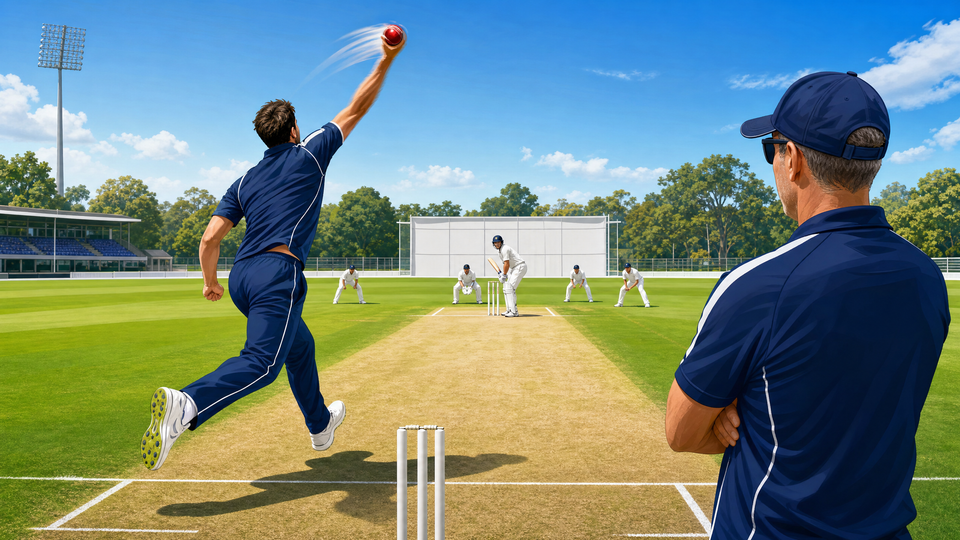
The Bowling Run-Up Alignment Corridor Drill is a foundational exercise designed to help fast and medium-pace bowlers develop a straight, efficient, and repeatable run-up. A drifting or weaving run-up leaks momentum and often results in poor crease alignment, leading to no-balls, wide deliveries, or a loss of pace. By using a visual 'corridor', this drill forces the bowler to run in a straight line, ensuring all their energy is directed straight towards the target.
This drill is highly effective for bowlers who tend to run diagonally across the pitch, bowl too close to the return crease, or struggle with their delivery stride balance. It is best used during the pre-season or early in a net session before moving to full-intensity bowling.
2. Setup
Equipment Needed:
- 20-30 Marker cones (brightly coloured)
- 1 Set of stumps
- 6-10 Cricket balls
- Measuring tape (optional, for precise run-up measurement)
Pitch/Field Setup:
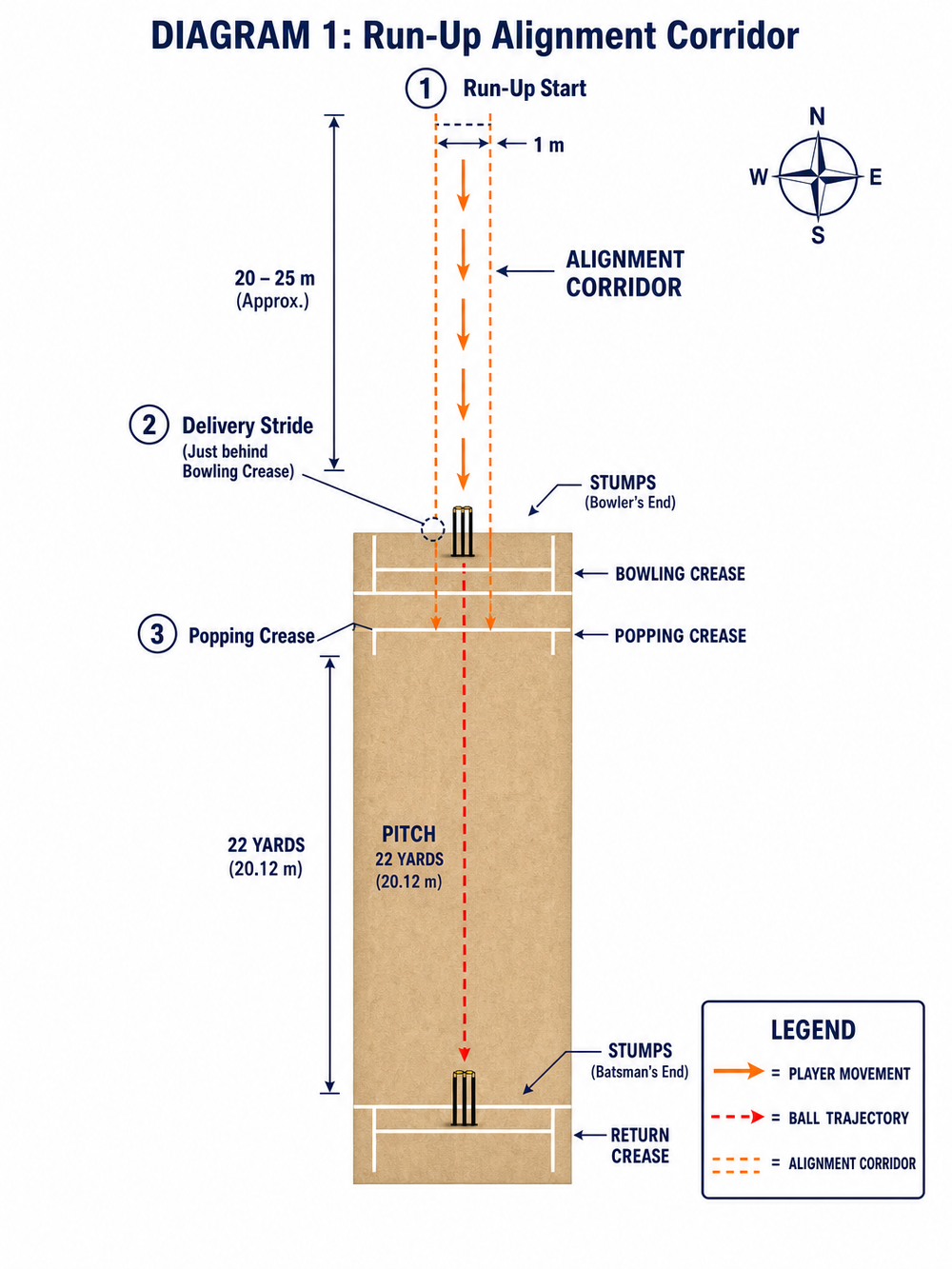
- Set up a single set of stumps at the batsman's end of a 22-yard pitch.
- Identify the bowler's starting mark (usually 15-25 metres back from the bowling crease).
- Create the Alignment Corridor: Place two parallel lines of cones starting from the bowler's mark, running all the way to the bowling crease. The cones should be spaced approximately 1 metre apart, creating a narrow channel.
- Ensure the corridor is perfectly aligned with the target area (e.g., off-stump or middle stump).
3. Step-by-Step Instructions
- The Starting Position: The bowler starts at their mark, standing perfectly still, looking straight down the alignment corridor towards the target stumps.
- The Approach: On the coach's signal, the bowler begins their run-up. The goal is to build momentum gradually while staying strictly within the 1-metre cone corridor.
- The Gather: As the bowler approaches the bowling crease (the end of the cones), they should execute their 'gather' or 'bound' without clipping any cones.
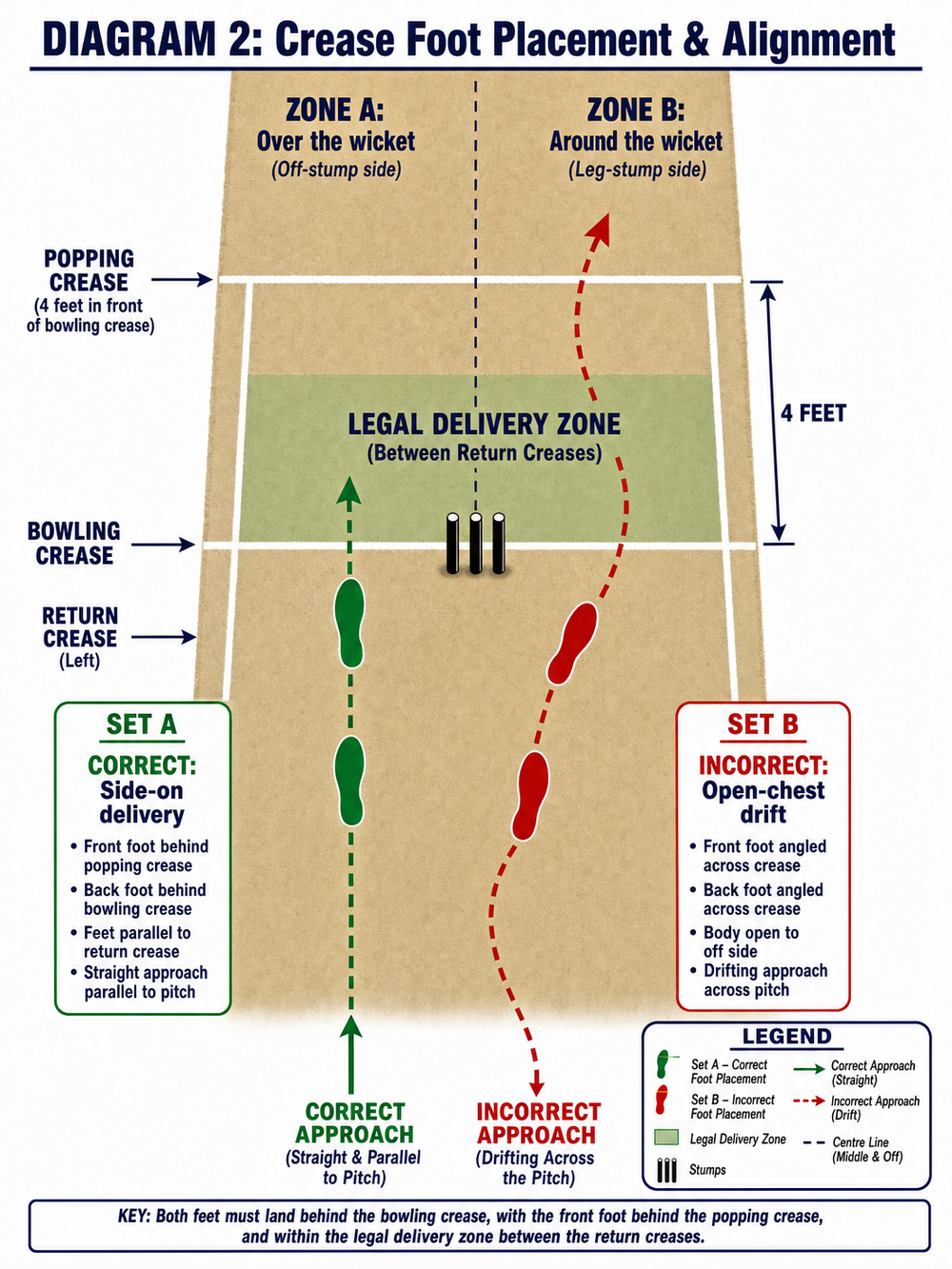
- The Delivery Stride: The bowler lands their back foot and then front foot. The coach must watch to ensure the feet land parallel to the return crease and within the legal delivery zone.
- The Follow-Through: After releasing the ball, the bowler must follow through straight down the pitch, rather than falling away to the off or leg side.
4. Key Coaching Points
- Head Position: The bowler's head must remain still and level throughout the run-up. A bobbing or tilting head will cause the body to drift off the straight line.
- Arm Drive: Encourage strong, linear arm drive during the run-up (like a sprinter). Arms pumping across the body will cause the bowler to weave.
- Gradual Acceleration: The run-up should start smoothly and build to maximum controlled speed just before the delivery stride. Avoid starting too fast.
- Crease Alignment: Watch the back foot landing. It should land parallel to the crease lines, not angled, to allow the hips and shoulders to align correctly for the delivery.
- Follow-Through: A straight run-up should naturally result in a straight follow-through. If the bowler falls away, their momentum was not directed properly.
5. Common Mistakes
- Clipping the Cones: Bowlers drifting left or right will kick the cones. This is immediate visual feedback that their run-up is not straight.
- Looking Down: Bowlers often look down at the cones instead of at the target. Remind them to keep their eyes fixed on the base of the stumps.
- Slowing Down at the Crease: Fear of overstepping or hitting the cones can cause bowlers to decelerate. Encourage them to run through the crease.
- 'Jumping' Out of the Corridor: Some bowlers run straight but jump diagonally during their delivery bound. The bound must also be linear.
6. Variations & Progressions
- Progression 1: Narrowing the Corridor: Once the bowler is comfortable with a 1-metre gap, bring the cones closer together (e.g., 0.8 metres) to demand even greater precision.
- Progression 2: Blindfold Start: Have the bowler close their eyes for the first 3 strides of their run-up (with the coach ensuring safety). This develops kinesthetic awareness and trust in their natural alignment.
- Variation 1: Target Bowling: Add a specific target (e.g., a cone on a good length on off-stump) to ensure the straight run-up translates to accurate bowling.
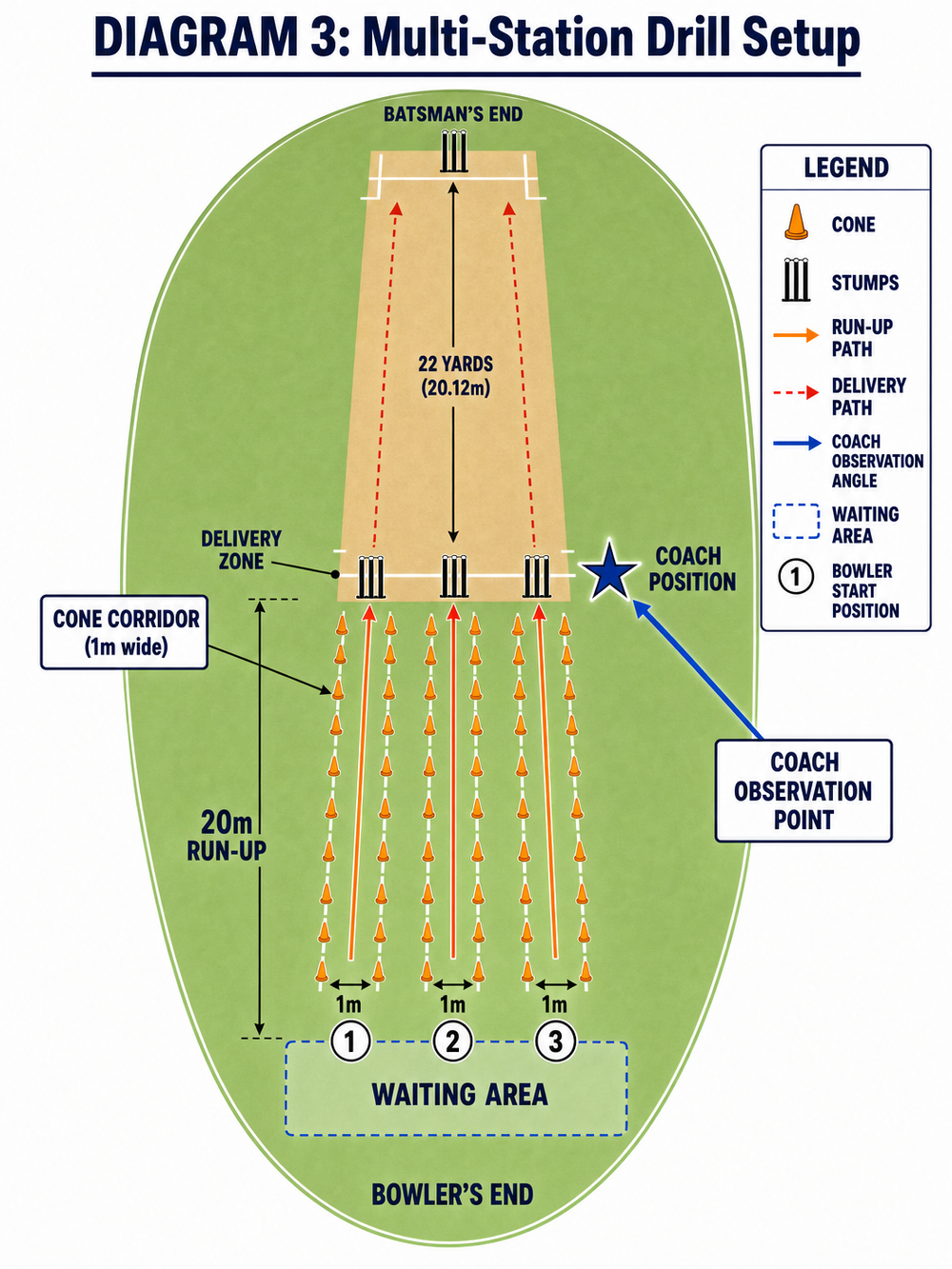
- Variation 2: Multi-Station Drill: Set up 2-3 corridors side-by-side on the outfield (without a pitch) to allow multiple bowlers to practice their run-up mechanics simultaneously without needing a full net.
7. Age Adaptations
- Under 8s – Under 10s: Focus purely on running in a straight line without a ball. Make the corridor wider (1.5 metres) and use it as a fun 'stay on the path' game.
- Under 12s – Under 14s: Introduce the ball. Focus heavily on the head position and straight arm drive. Ensure run-ups are not too long (10–15 paces maximum).
- Under 16s – Open: Full pace, full run-up. Demand strict adherence to the 1-metre corridor and integrate tactical targets (e.g., bowling yorkers from a straight approach).
