

Cricket
Mastering the Calling System: Run Out Prevention & Safe Running
A comprehensive guide to establishing a clear calling system and safe running techniques to eliminate unnecessary run outs in your team.
What you need
2 Cricket bats, 1 Cricket ball, 2 Sets of stumps, Cones, Batting helmets, pads, and gloves
1. Overview
Run outs are often the result of poor communication rather than brilliant fielding. Establishing a clear, unambiguous calling system is one of the most fundamental aspects of building a successful batting partnership. This resource provides coaches with a structured approach to teaching the calling system, identifying danger zones, and instilling safe running techniques to minimise the risk of run outs.
This set play is designed to drill the essential calls ('YES', 'NO', 'WAIT'), clarify who is responsible for calling based on the ball's trajectory, and practice the physical mechanics of backing up and sliding the bat into the crease.
2. Setup

Equipment Needed:
- 2 Cricket bats
- 1 Cricket ball (or incrediball for juniors)
- 2 Sets of stumps
- Cones to mark fielding zones
- Helmets, pads, and gloves for batters (to simulate match conditions)
Pitch & Field Setup:
- Set up a standard 22-yard pitch with marked creases (4 feet from the stumps).
- Place cones to mark the 'Striker Calls' zone (V in front of the wicket) and the 'Non-Striker Calls' zone (behind square).
- Position fielders (or cones) at key danger zones: Point, Cover, Mid-Off, and Mid-On.
3. Step-by-Step Instructions

Step 1: The Calling Zones
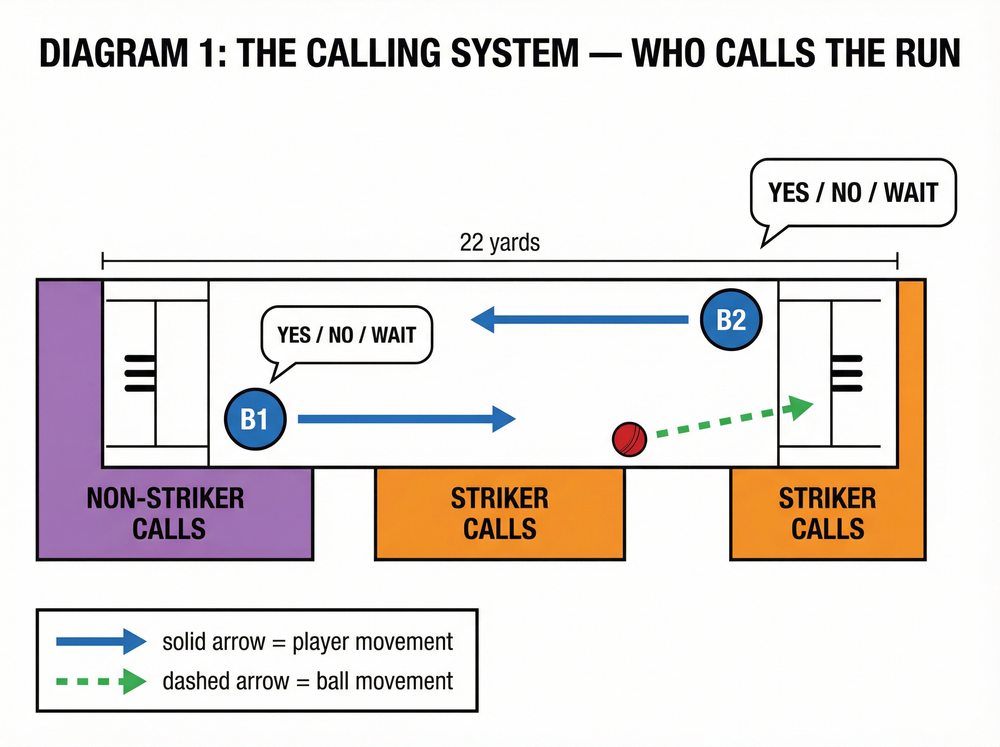
Explain the golden rule of calling: The batter with the best view of the ball makes the call.
- Striker Calls: For any ball hit in front of the wicket (between Point and Square Leg).
- Non-Striker Calls: For any ball hit behind the wicket (behind Point on the off-side, behind Square Leg on the leg-side).
Step 2: The Three Calls
Drill the three distinct, loud calls. There should be no other words used.
- 'YES': Run immediately. Both batters commit.
- 'NO': Stay in your crease or return immediately. Do not run.
- 'WAIT': Pause and assess. The caller will follow up with a 'YES' or 'NO'.
Step 3: Identifying Danger Zones
Educate batters on where the highest risk of a run out exists. Fielders at Point and Cover often have a direct throw at the stumps.
- Balls hit straight to Point or Cover are high-risk. The call is almost always 'NO' unless there is a clear misfield.
- Balls hit to Mid-On or Mid-Off are slightly safer if the fielder is deep, but still require a sharp 'YES' or 'NO'.

Step 4: Backing Up (Non-Striker)
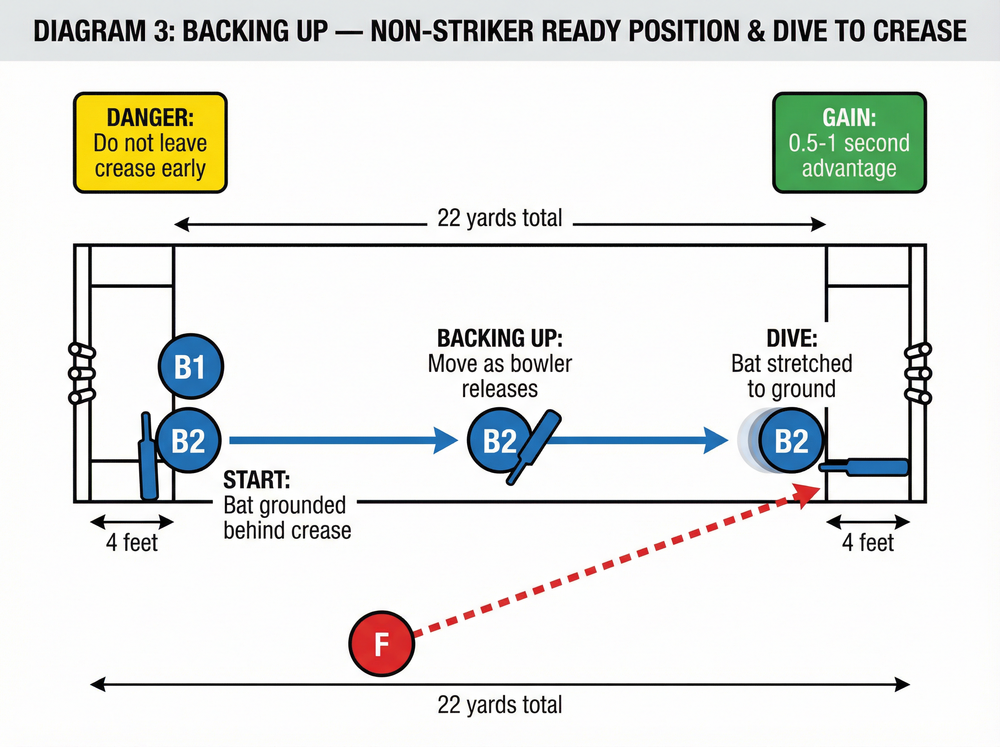
The non-striker must walk in with the bowler to gain momentum and reduce the distance to the other end.
- Start with the bat grounded behind the crease.
- As the bowler releases the ball, take 2-3 steps down the pitch, keeping eyes on the striker.
- If the call is 'NO', turn and ground the bat back in the crease immediately.
Step 5: Grounding the Bat
Teach the correct technique for finishing a run.
- Always slide the bat into the crease; never run past it holding the bat in the air.
- Extend the bat forward with two hands (or one strong hand) to cross the line as quickly as possible.

4. Key Coaching Points
- Volume and Clarity: Calls must be loud and decisive. A quiet call is a dangerous call.
- Trust the Caller: If the non-striker calls 'NO' for a ball behind square, the striker must obey immediately, even if they think there is a run.
- Run the First Run Hard: Always sprint the first run to put pressure on the fielders and create the opportunity for a second run.
- Run on the Edge of the Pitch: Run straight lines down the edge of the pitch to avoid damaging the protected area and to take the shortest route.
- Look at Your Partner: When turning for a second run, always turn facing the ball and look at your partner to gauge their intent.
5. Common Mistakes

- 'Yes-No-Sorry': Changing the call mid-run causes hesitation and leads to run outs. Make a decision and stick to it.
- Ball Watching: The non-striker watches the ball instead of the striker when backing up, missing the call or the start of the run.
- Bat in the Air: Running past the crease without grounding the bat, leaving the batter vulnerable to a direct hit.
- Calling for Your Partner: The striker calling for a ball hit behind square, where they cannot see the fielder's position clearly.
6. Variations & Progressions

- Pressure Calling Drill: Have a coach hit the ball to different zones. The batters must call correctly and run. Introduce fielders to add pressure.
- The 'Blind' Run: The non-striker starts facing away from the pitch and must turn and react solely to the striker's call.
- Two-Run Challenge: Place fielders deep. Batters must judge whether to push for a second run based on the fielder's arm strength and accuracy.
7. Age Adaptations

- Under 8s / Under 10s: Focus purely on loud 'YES' and 'NO' calls. Use cones to clearly define who calls for which zone. Emphasise sliding the bat.
- Under 12s / Under 14s: Introduce the 'WAIT' call. Practice backing up with the bowler's release. Discuss danger zones (Point/Cover).
- Under 16s / Open: Focus on high-intensity running, turning blind, and judging the second run against specific fielders. Simulate match-pressure scenarios.
