

Cricket
Death Bowling Yorker Accuracy Drill: Master the Blockhole Under Pressure
Develop pinpoint yorker accuracy for death overs with this advanced drill designed to help bowlers consistently land the ball in the blockhole under pressure.

What you need
stumps, cricket balls, cones or flat markers, measuring tape
1. Overview
The yorker is the most effective delivery in limited-overs cricket, particularly during the final "death" overs (typically overs 41-50 in a 50-over match or 17-20 in a T20). When executed correctly, it is almost impossible for a batsman to score boundaries from. This drill is designed to develop the pinpoint accuracy required to consistently land the yorker under pressure. It focuses on creating a repeatable action, understanding target areas, and building confidence. This is an advanced drill best suited for experienced bowlers who have a solid, repeatable action and are looking to add a specific, high-impact skill to their arsenal.
2. Setup
Equipment
- A set of stumps
- Multiple cricket balls (older balls are better as they swing less, simulating a real match scenario)
- Cones or flat markers (3 different colors if possible)
- Measuring tape
Pitch & Field Setup
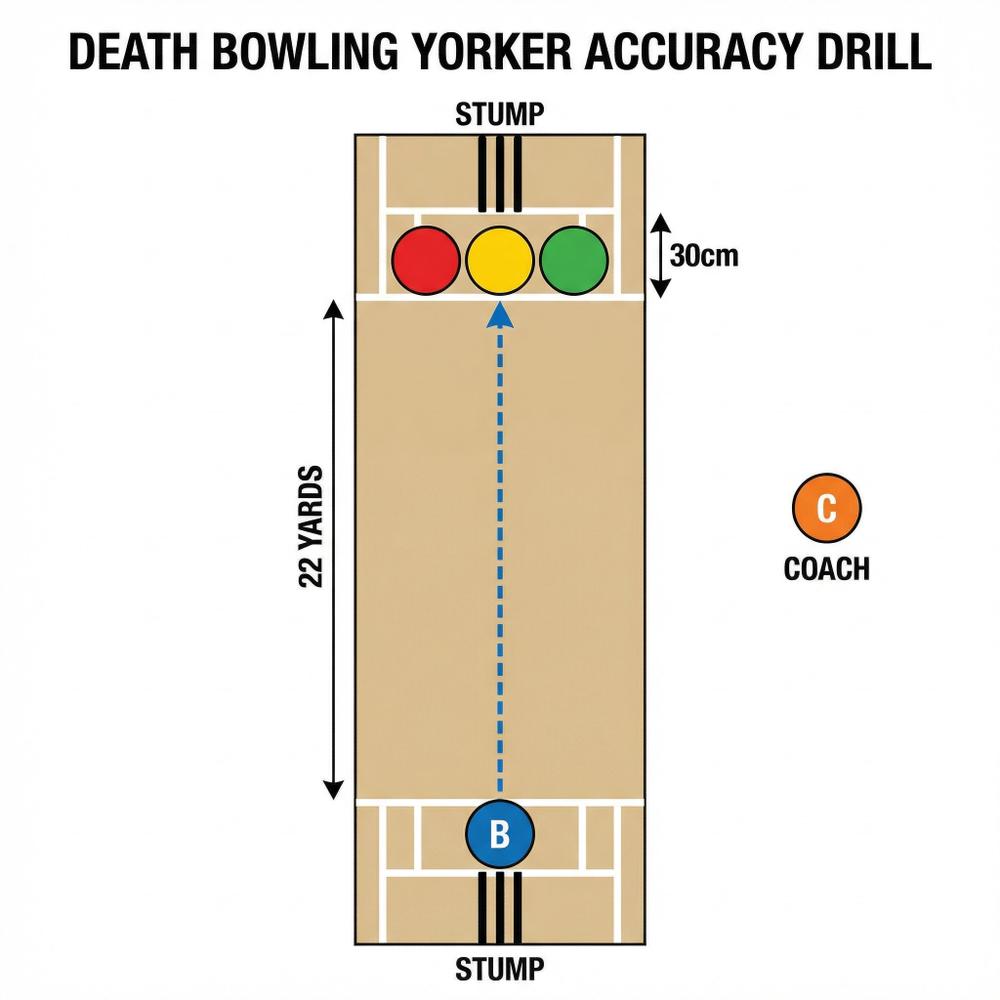
- Use a standard 22-yard cricket pitch.
- Place the stumps at the batsman's end.
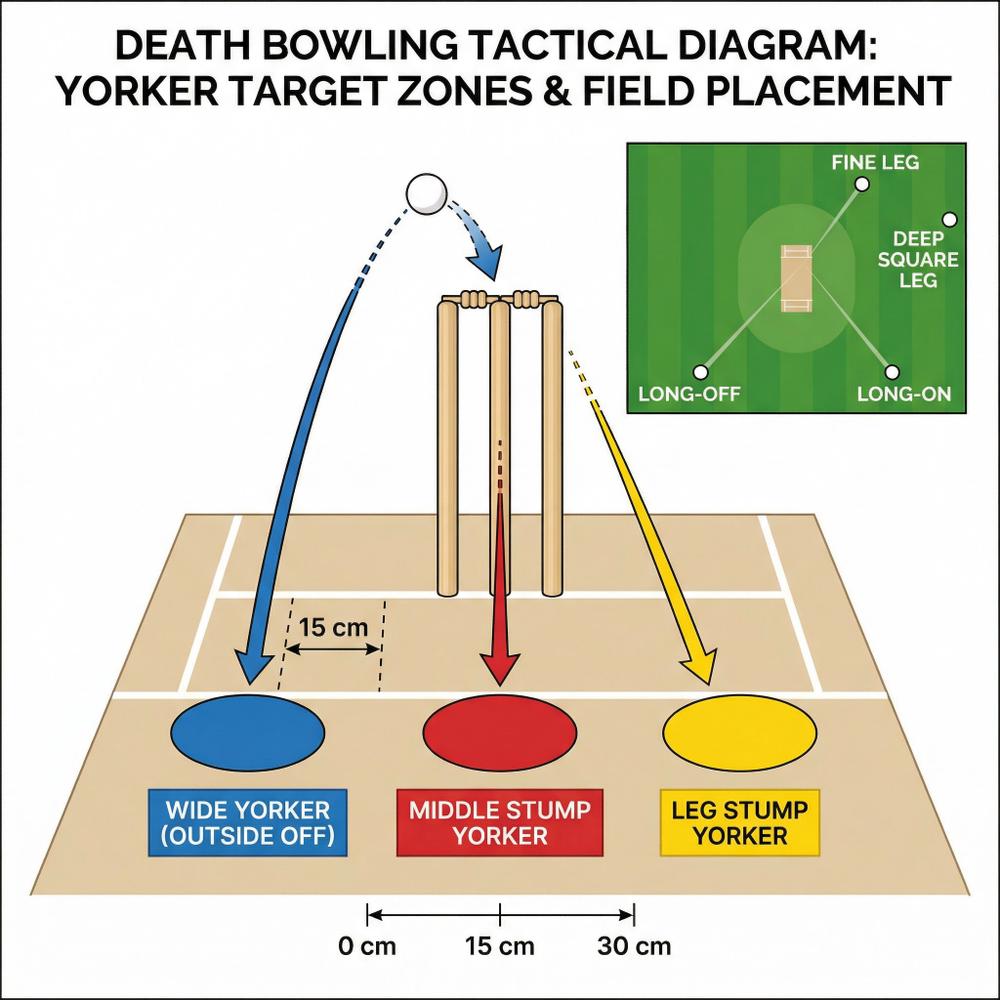
- Using the measuring tape, place three markers at the popping crease to define the target zones for the yorker:
- Off-Stump Yorker: Place a marker just outside the off-stump.
- Middle-Stump Yorker: Place a marker directly in line with the middle stump.
- Leg-Stump Yorker: Place a marker on the leg-stump line.

Player Positions
- Bowler: Starts from their regular run-up.
- Coach/Observer: Stands in a position to get a clear side-on view of the bowler's action and the ball's landing point (e.g., at square leg or point).
3. Step-by-Step Instructions

- The bowler starts at their mark and visualizes the target area they are aiming for (off, middle, or leg stump yorker).
- The coach calls out which target the bowler should aim for.
- The bowler runs in and delivers the ball, aiming to land it on or as close as possible to the designated marker.
- The bowler should aim to bowl a set of 6 balls, with the coach varying the target for each delivery.
- After each set of 6, the bowler and coach review the accuracy and discuss any technical adjustments needed.
- Repeat the drill for a total of 5-6 sets (30-36 balls).
4. Key Coaching Points

- Stable Head Position: The head should be still and upright at the point of delivery. A falling-away head will drag the bowling arm down and affect the release point, leading to inconsistency.
- High Front Arm: A high, strong front arm helps to create momentum and a higher release point, which is crucial for getting the ball to dip late and land in the blockhole.
- Snap the Wrist: A quick wrist snap at the point of release imparts extra pace and dip on the ball. The seam should be pointing towards the target.
- Follow Through: The bowler should follow through straight down the pitch, towards the target. This ensures that all their momentum is going towards the batsman and helps maintain balance.
- Focus on the Target: Encourage the bowler to keep their eyes locked on the target area for as long as possible.
5. Common Mistakes

- Bowling a Full Toss: This happens when the release point is too late. The bowler is trying too hard to get the ball full and ends up over-compensating. Correction: Encourage the bowler to release the ball slightly earlier and focus on a powerful wrist snap.
- Bowling a Half-Volley: This is a result of releasing the ball too early. While not as bad as a full toss, it is an easy scoring opportunity for the batsman. Correction: Remind the bowler to drive their arm through and release the ball later.
- Losing Balance at the Crease: Often caused by the head falling away or the front arm being weak. Correction: Use drills to improve core strength and balance. The bowler can practice their action without a ball to feel the correct body position.
- Telegraphing Intent: Experienced batsmen can pick up on subtle cues from the bowler. Correction: The bowler should aim to keep their action consistent for all deliveries, only making a change at the very last moment.
6. Variations & Progressions

Variations
- Wide Yorker Challenge: Place a marker even wider of the off-stump, simulating a scenario where the batsman is trying to make room to hit through the off-side.
- Double Yorker: The coach calls out two targets in quick succession, and the bowler has to adjust their line and length accordingly for the next two balls.
Progressions
- Add a Batsman: Introduce a batsman with instructions to try and score off the yorkers. This adds a layer of pressure and realism to the drill.
- Simulate a Match Scenario: Set a specific scenario, for example, "6 runs needed to win from the last 2 balls". This tests the bowler's ability to execute under extreme pressure.
7. Age Adaptations

- Under 12/14: For younger players, the focus should be on developing a repeatable action rather than pinpoint accuracy. Use a larger target area and reduce the number of deliveries. The emphasis should be on understanding the concept of a yorker and the body mechanics required.
- Under 16: At this age, bowlers should have a more established action. The drill can be run as described, but with a greater emphasis on consistency and understanding the tactical application of the yorker.
- Open Age/Professional: For elite players, the drill can be made more challenging by narrowing the target zones, increasing the pressure with match simulations, and incorporating video analysis to fine-tune their action.
