

Cricket
Death Overs Bowling Plan: Executing the Yorker and Defensive Field Placements
Master the art of death bowling with this comprehensive guide on executing the perfect yorker, setting defensive fields, and handling high-pressure situations in the final overs.
What you need
Match-quality cricket balls, Target markers or cones, Full protective gear for batsman
1. Overview
The "death overs" (typically the last 4-5 overs of a T20 or the final 10 overs of an ODI) are the most critical phases of a limited-overs cricket match. Batsmen are looking to maximize their scoring rate, taking calculated risks and exploiting every gap in the field. This set play resource focuses on the Yorker Plan—a fundamental strategy designed to restrict scoring, induce errors, and take crucial wickets when the pressure is at its peak.
This plan achieves its goals by combining pinpoint bowling accuracy with a carefully constructed field that protects the boundaries while challenging the batsman to play high-risk shots. It is best used against established batsmen looking to clear the ropes or when defending a tight total.
2. Setup
Equipment Needed
- Match-quality cricket balls (preferably slightly older, as used in the death overs)
- Target markers or cones (for practice sessions)
- Full protective gear for the batsman
Pitch & Field Setup
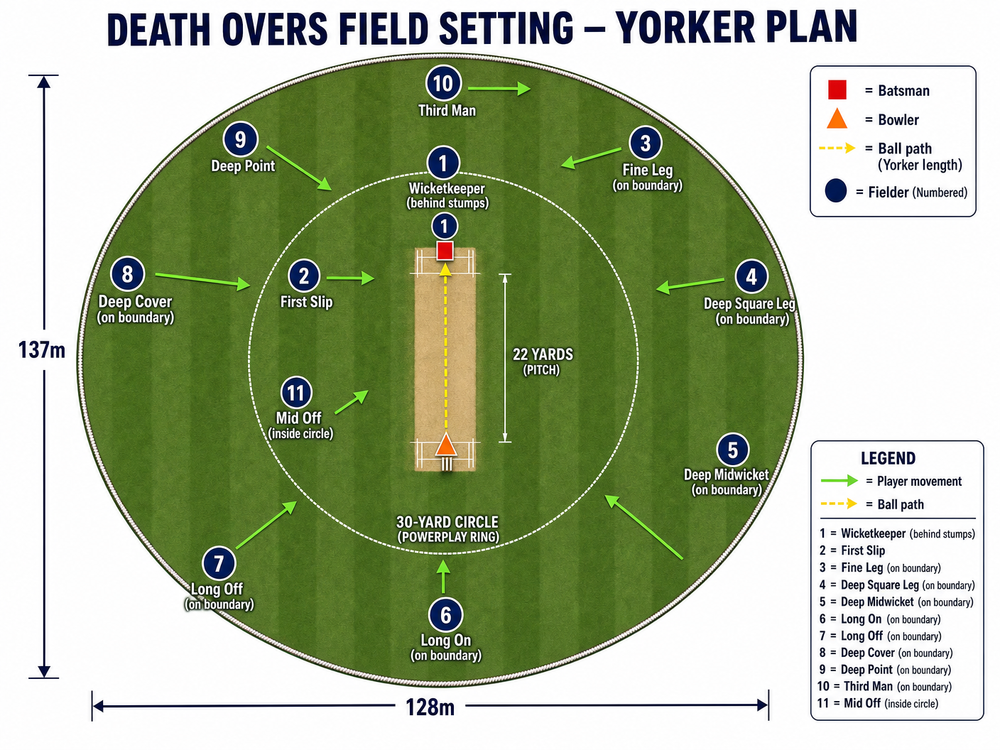
The setup requires a standard 22-yard pitch and a clearly marked 30-yard fielding circle. The field placement is crucial and must be set before the bowler begins their run-up.
Fielding Positions (Yorker Plan):
- Wicketkeeper: Standing back, ready for edges or wide deliveries.
- First Slip: (Optional, often replaced by a boundary rider in extreme death overs, but useful if the ball is reversing).
- Fine Leg: Inside the circle or on the boundary, depending on the bowler's pace and the batsman's tendency to scoop or sweep.
- Deep Square Leg: On the boundary to protect against the pull or slog sweep.
- Deep Midwicket: On the boundary, a prime catching position for the slog.
- Long On: On the boundary, protecting the straight hit.
- Long Off: On the boundary, protecting the straight hit on the off side.
- Deep Cover: On the boundary, guarding against the aggressive drive or slice.
- Deep Point: On the boundary, protecting the square cut or reverse sweep.
- Third Man: Inside the circle (or on the boundary if the pace is high and edges are frequent).
- Mid Off: Inside the circle, ready to cut off the single or catch the mistimed drive.
3. Step-by-Step Instructions
- Assess the Batsman and Conditions: Before committing to the plan, the captain and bowler must assess the batsman's strengths (e.g., strong down the ground, prefers square of the wicket) and the pitch conditions (e.g., pace, bounce, potential for reverse swing).
- Set the Field: The captain sets the defensive field (as outlined above), ensuring the boundary riders are perfectly positioned. Communication is key; fielders must know their exact roles and the bowler's intended target.
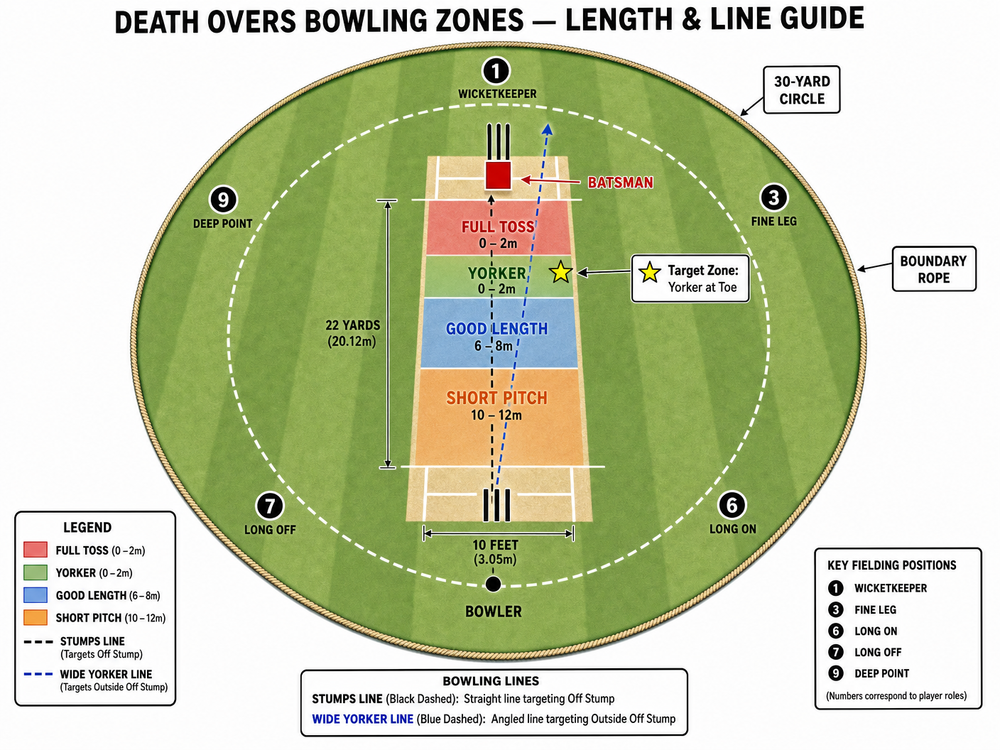
- Identify the Target Zone: The bowler visualizes the target zone—the base of the stumps (the "Yorker" length). The aim is to deliver the ball right at the batsman's toes or the base of the off-stump.
- Execute the Delivery: The bowler runs in with full intensity. The release point is crucial; the ball must be pitched up, not dropped short. The focus is entirely on the base of the stumps.
- Follow-Through and React: After the delivery, the bowler must follow through strongly and be ready to field off their own bowling. The fielders must anticipate the shot and react instantly.
- Review and Adjust: After each delivery, the bowler and captain quickly review the outcome. If the batsman is adjusting (e.g., stepping deep in the crease), the bowler may need to alter their length slightly (e.g., a wide yorker or a slower ball).
4. Key Coaching Points
- Accuracy over Pace: While pace is an asset, a well-directed 130 km/h yorker is far more effective than a 145 km/h full toss or half-volley.
- Clear Mind, Clear Plan: The bowler must commit 100% to the delivery. Hesitation leads to poor execution.
- Practice with Targets: During net sessions, place a shoe or a bright cone at the base of the stumps. Bowlers should practice hitting this target repeatedly until it becomes muscle memory.
- Read the Batsman's Feet: Bowlers should watch the batsman's initial trigger movements. If they back away, follow them; if they come down the pitch, adjust the length accordingly.
- Fielding Discipline: Fielders on the boundary must be alert and positioned correctly. A yard too far in or out can be the difference between a catch and a boundary.
5. Common Mistakes
- Missing the Length (Full Toss or Half-Volley): This is the most costly error. A missed yorker often results in a boundary.
- Predictability: Bowling six consecutive yorkers allows the batsman to set themselves. Mixing it up with a well-disguised slower ball or a sharp bouncer is essential.
- Poor Field Placement: Setting a field that doesn't match the bowling plan (e.g., bowling wide outside off stump with no deep cover or deep point).
- Lack of Commitment: Bowlers trying to "aim" the ball rather than bowling it with their natural action, leading to a loss of pace and accuracy.
6. Variations & Progressions
- The Wide Yorker: Instead of aiming at the stumps, target a line wide outside the off-stump, forcing the batsman to reach for the ball. This requires a strong off-side field (Deep Cover, Deep Point).
- The Slower Yorker: Delivering a yorker with an off-cutter or back-of-the-hand slower ball grip. The deception in pace often causes the batsman to play too early.
- The Bouncer Bluff: After setting the field for a yorker, deliver a sharp bouncer (if permitted) to push the batsman back in their crease, then follow up with the yorker.
7. Age Adaptations
- Under 10 / Under 12: Focus purely on bowling straight and hitting the stumps. The concept of a "yorker" can be introduced as aiming for the batsman's toes, but the primary goal is consistency in length.
- Under 14 / Under 16: Introduce target practice (using cones or shoes). Teach the importance of field placements and how they relate to where the ball is bowled.
- Open / Senior: Full implementation of the tactical plan, including variations (wide yorker, slower balls) and reading the batsman's movements in high-pressure match scenarios.
