

Cricket
Mastering the Death Overs: A Complete Bowling and Fielding Blueprint
Equip your bowlers with a structured, adaptable plan to execute yorkers, disguise variations, and defend totals under extreme pressure in the final overs.
What you need
Stumps, Target mats or flat cones, Match balls (new or semi-new), Fielding markers
1. Overview
Bowling in the death overs (overs 16-20 in a T20, or 41-50 in an ODI) is arguably the toughest skill in modern cricket. Batsmen are set, the field is spread, and the margin for error is non-existent. This set play provides a structured blueprint for bowlers to defend totals by establishing the yorker, effectively using the wide line, and disguising pace variations. It teaches bowlers not just how to bowl the deliveries, but when to bowl them and how to set the field accordingly.
This resource is designed to help coaches run scenario-based training sessions that simulate match pressure, teaching bowlers to read the batsman's movements and adapt their plans dynamically.
2. Setup
Equipment Needed:
- 1 full set of stumps (bowling end) and 1 target stump (batting end)
- Target markers (flat cones or target mats) for the yorker zone
- New or semi-new white balls (to simulate match conditions)
- Fielding markers (cones) to map out boundary riders and inner ring
Pitch & Field Setup:
- Standard 22-yard pitch on an oval ground.
- Mark a 'Yorker Target Zone' (the bottom 1 metre of the pitch at the batting crease) with flat red cones or a target mat.
- Mark a 'Slower Ball Landing Zone' (good length, approx 5-7 metres from the batting crease) with orange cones.
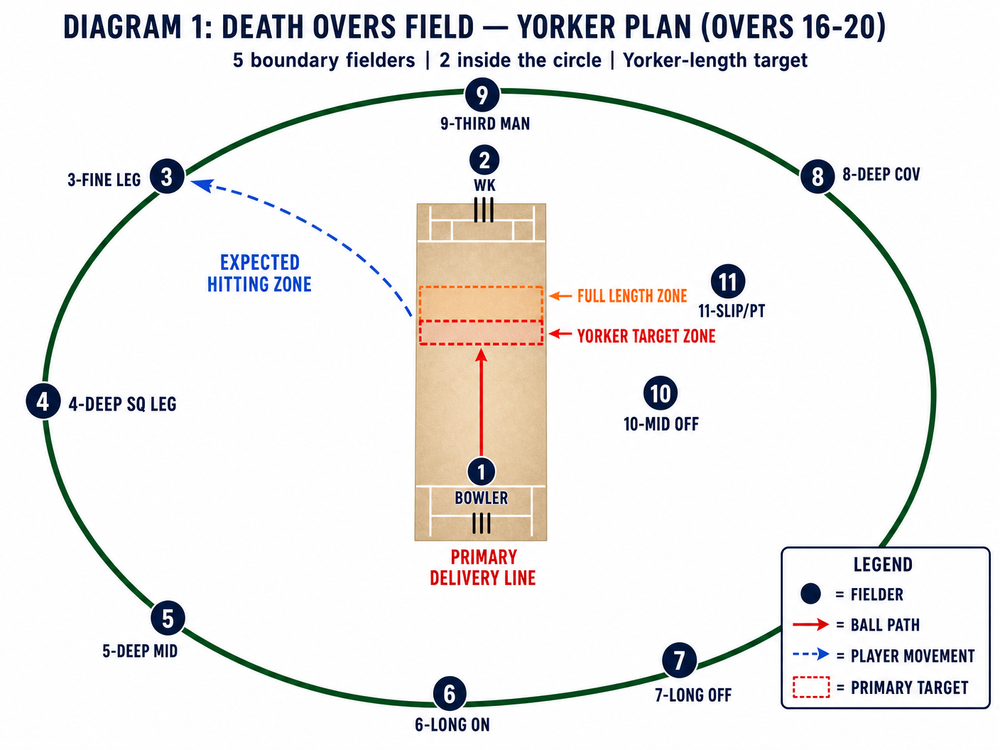
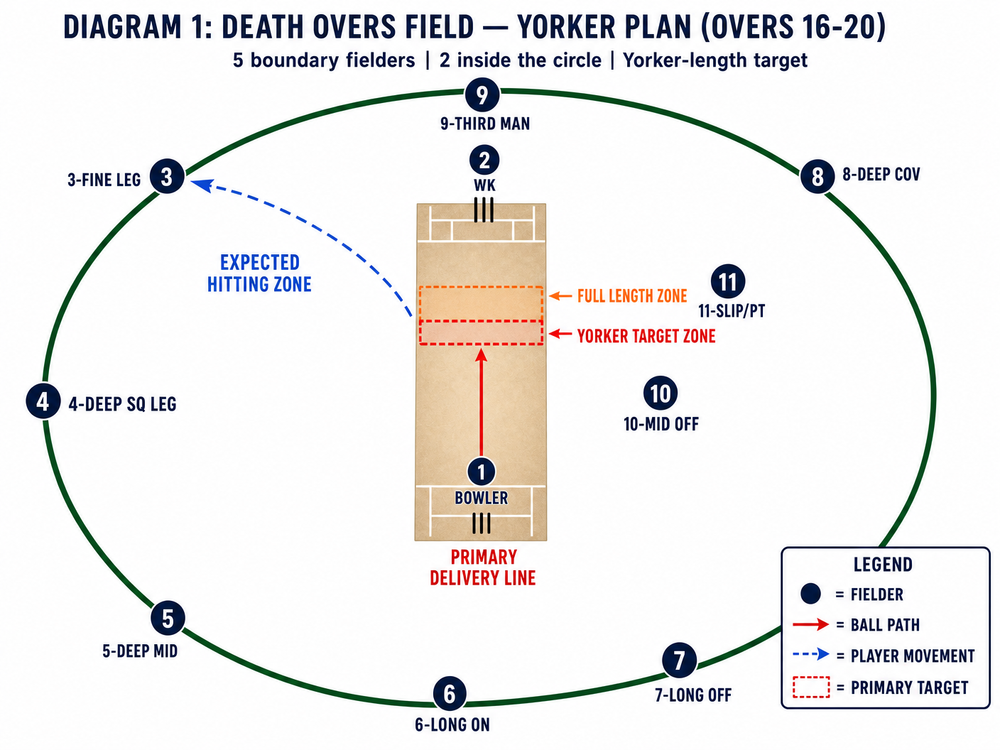
- Set a standard 5-out death field (see Diagram 1): Long On, Long Off, Deep Midwicket, Deep Square Leg, and Third Man/Fine Leg on the boundary. Mid Off and Slip/Point inside the 30-yard circle.
3. Step-by-Step Instructions
Phase 1: Establishing the Primary Plan (The Yorker)
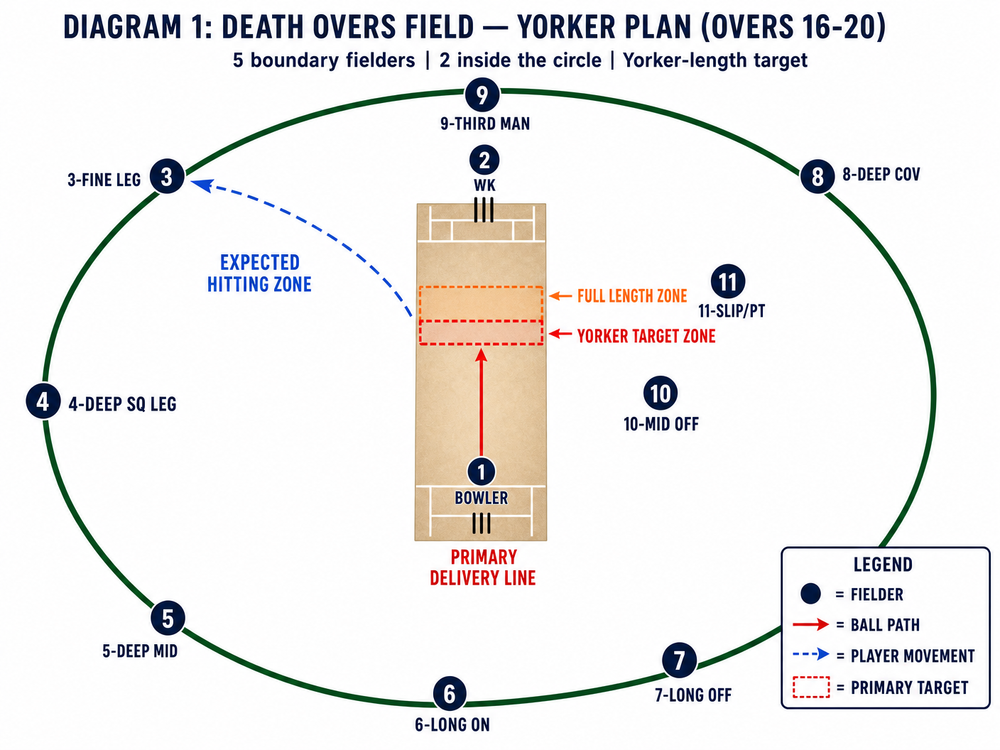
- Set the Field: Ensure the 5 boundary riders are perfectly positioned. The deep fielders must be right on the rope, not 5 metres in.
- Visualise the Target: The bowler must focus intensely on the base of the off-stump or the batsman's toes (the red zone in Diagram 1).
- Execute the Delivery: The bowler runs in with full intensity and attempts to hit the yorker length.
- Assess the Result: If the ball lands in the yorker zone, the batsman will likely only manage a single to the deep fielders. If the bowler misses execution (bowls a full toss or half-volley), they must immediately reset mentally.
Phase 2: The Wide Yorker Variation
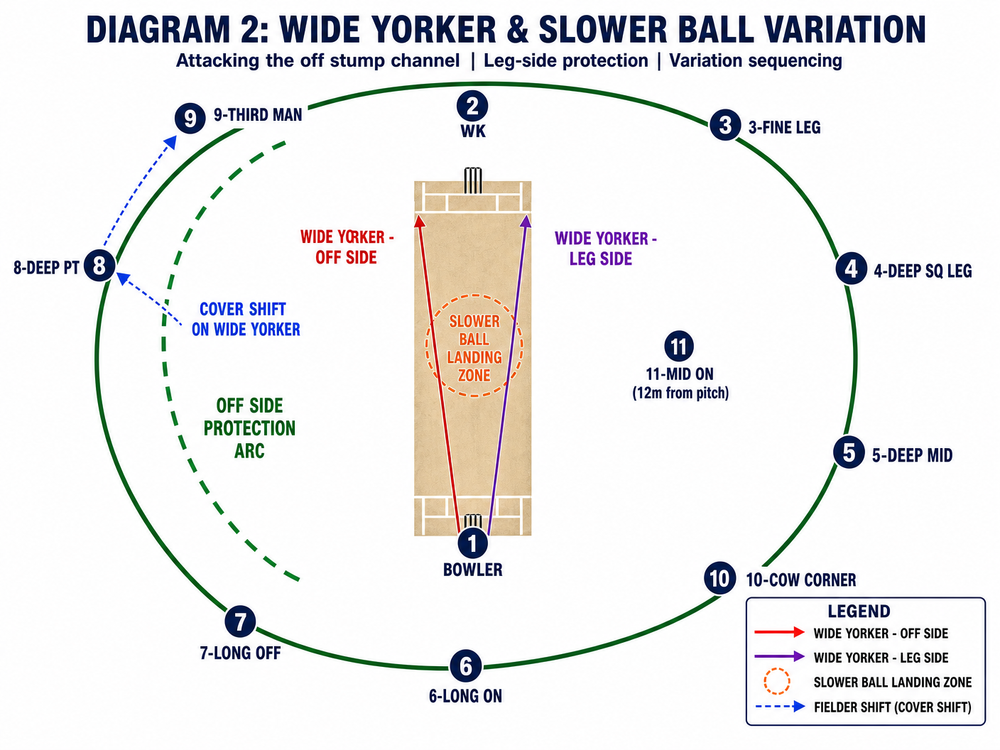
- Read the Batsman: If the batsman is backing away to the leg side to create room, the bowler shifts to the Wide Yorker plan.
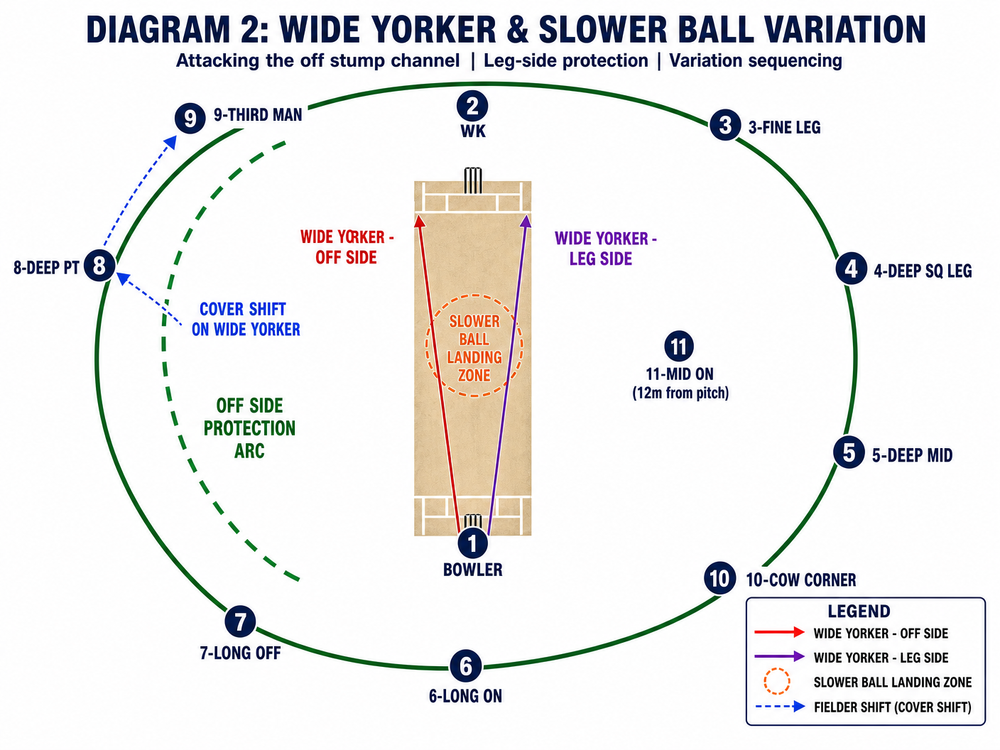
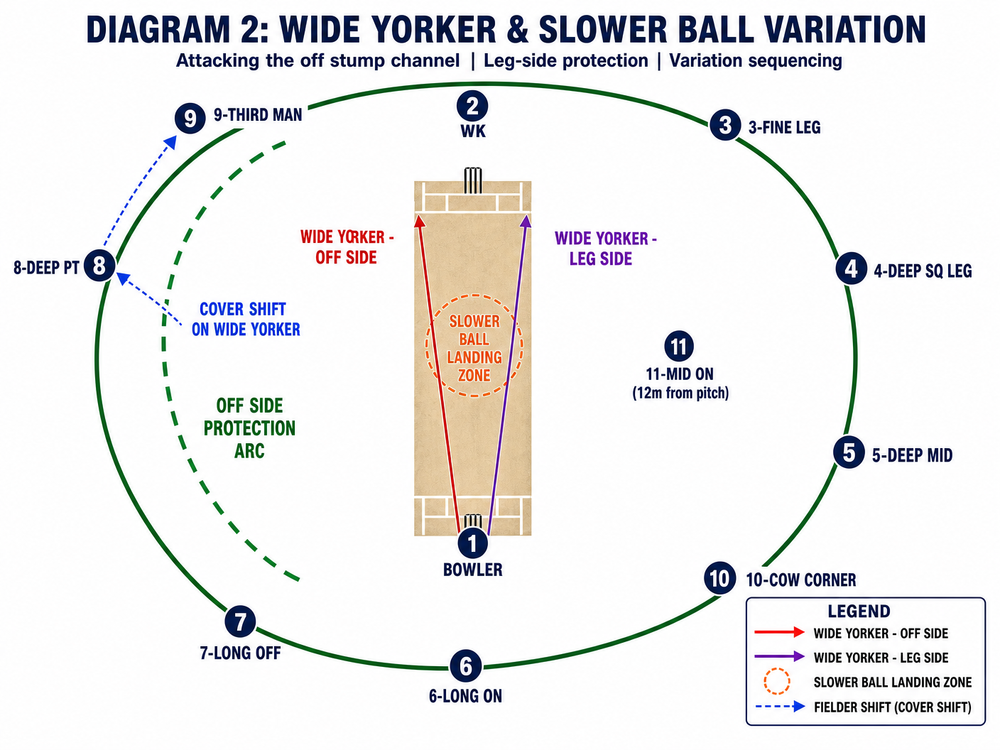
- Adjust the Field (Subtle): The captain or bowler moves Third Man finer and brings Deep Point squarer (as shown by the blue arrows in Diagram 2).
- Target the Wide Line: The bowler aims for the blue channel just inside the wide guideline, keeping the ball full.
- Protect the Leg Side: If the batsman steps across their stumps to sweep or scoop, the bowler can fire the ball into the pads (purple line), protected by Deep Square Leg and Fine Leg.
Phase 3: The Slower Ball Deception
- Select the Variation: The bowler chooses their best slower ball (off-cutter, back-of-the-hand, or knuckleball).
- Maintain Arm Speed: The key is disguise. The run-up and arm speed must perfectly mimic the fast yorker.
- Hit the Landing Zone: The slower ball must land on a good length (the orange dashed circle in Diagram 2) to force the batsman to generate their own power, rather than a full toss which can be easily hit.
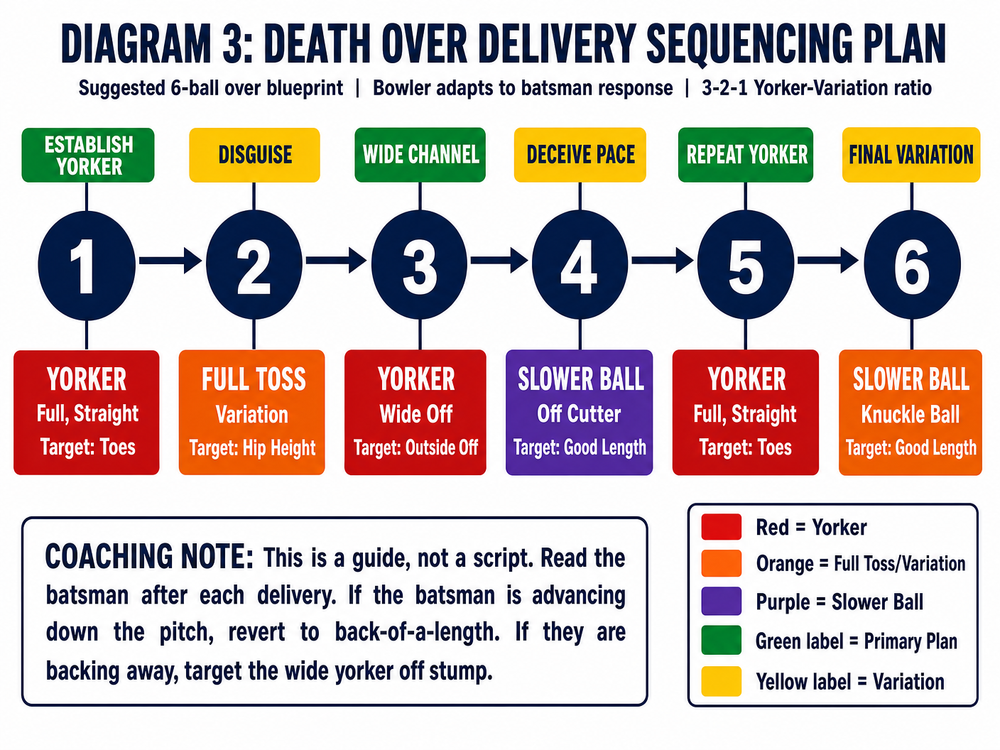
Phase 4: Delivery Sequencing (The 6-Ball Blueprint)
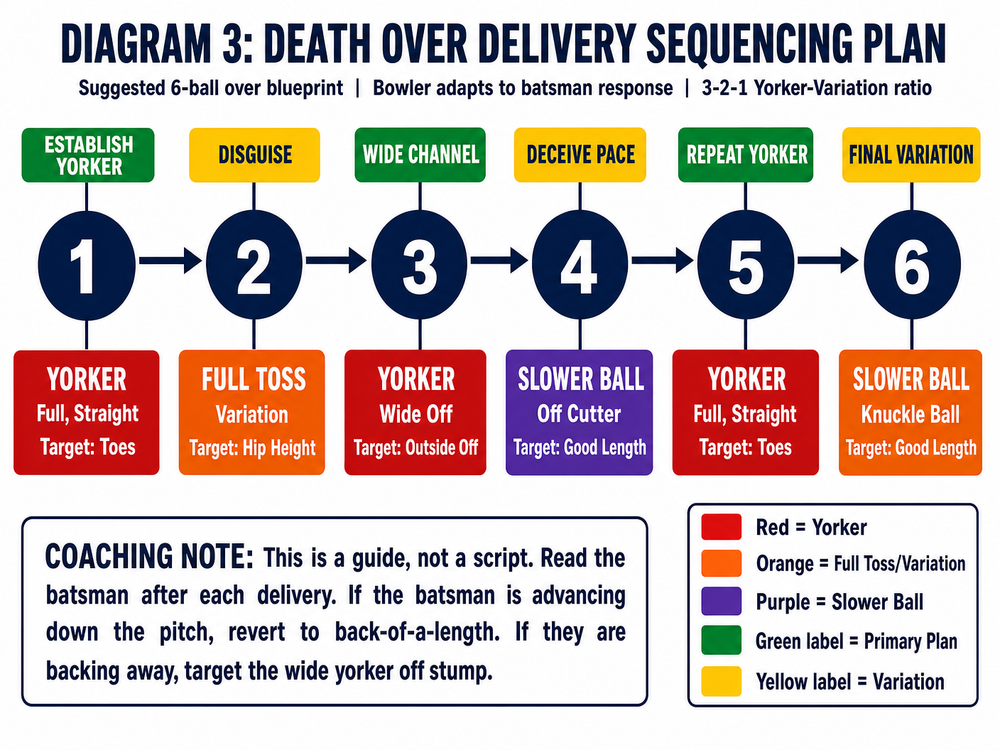
- Ball 1: Establish the straight yorker. Set the tone.
- Ball 2: Bowl a variation or a hard length ball to keep the batsman guessing.
- Ball 3: Target the wide yorker channel.
- Ball 4: Deceive with pace (slower ball into the pitch).
- Ball 5: Re-establish the primary straight yorker.
- Ball 6: Final variation based on the batsman's premeditated movement.
Note: This sequence (Diagram 3) is a guide. Bowlers must adapt based on the match situation and the batsman's form.
4. Key Coaching Points
- Commitment to the Yorker: A missed yorker (full toss) bowled with 100% conviction and pace is often harder to hit than a perfectly pitched ball bowled tentatively.
- Arm Speed on Variations: Slower balls only work if the batsman believes a fast ball is coming. Watch the bowler's arm speed closely during practice.
- Fielding Synergy: The bowler must bowl to their field. If Third Man is up in the circle, the wide off-stump yorker becomes a high-risk delivery.
- Breathing and Resetting: Teach bowlers to take a deep breath at the top of their mark after a boundary. Never rush the next delivery.
- Clear Targets: In practice, always use physical targets (cones/mats) for yorkers. Visualisation is easier when there is a tangible target to hit.
5. Common Mistakes
- Telegraphing the Slower Ball: Bowlers slowing down their run-up or dropping their arm height when attempting a variation.
- Bowling to the Batsman's Strength: Persisting with straight yorkers when the batsman is clearly set up for the helicopter shot or scoop.
- Poor Field Placement: Boundary riders standing 5-10 metres inside the rope, turning potential catches into sixes.
- Predictability: Bowling the exact same sequence of deliveries in every over, allowing the batsman to premeditate.
6. Variations & Progressions
- Progression 1: Pressure Scenarios: Set a target (e.g., "Defend 10 runs off the last over"). Bring in live batsmen who are actively trying to hit boundaries. Add consequences for poor execution.
- Progression 2: Wet Ball Practice: Dip the ball in a bucket of water before bowling to simulate dew conditions, making gripping the yorker and slower balls significantly harder.
- Variation 1: The Bouncer: Introduce the surprise bouncer as a legitimate death overs tactic to push the batsman back in their crease, making the subsequent yorker more effective.
7. Age Adaptations
- Under 12s: Focus purely on the mechanics of bowling a full, straight ball. Do not introduce complex slower balls or wide variations yet. Use larger target zones.
- Under 14s: Introduce one basic variation (like an off-cutter). Begin teaching basic field settings for death bowling.
- Under 16s & Open: Implement the full sequencing plan. Focus heavily on reading the batsman's movements and executing under simulated match pressure.
