

Cricket
Death Overs Bowling Plan: Yorkers, Slower Balls & Defensive Field Craft
Master the final four overs of a T20 or ODI innings with a structured bowling plan that combines yorker execution, slower-ball variation, and intelligent field placement to restrict boundaries and take wickets under pressure.

What you need
Cricket balls (match-weight, 4–6), Stumps and bails (2 sets), Cones (12) for yorker zone and boundary markers, Batting crease target markers (2), Coaching whiteboard or tactics board, Bowling machine (optional, for fielding drills)
Overview
The death overs — conventionally overs 17–20 in a T20 or 46–50 in a 50-over match — are where matches are won and lost. A batting side in full flow can plunder 60 or more runs in this phase; a disciplined bowling unit with a clear plan can restrict that to 35–40 and fundamentally alter the result. This set play provides your bowling group with a repeatable, pressure-tested framework for executing under the most demanding conditions in limited-overs cricket.
The plan is built around three non-negotiable principles: bowl to your field, vary your pace intelligently, and make the batter play your game, not theirs. It is most effective when the batting side has wickets in hand and is targeting a big finish, and it demands that your bowlers have rehearsed their skills in training so that execution under pressure feels automatic.
Setup

Equipment Required
| Item | Quantity | Notes |
|---|---|---|
| Cricket balls (match-weight) | 4–6 | Use worn ball for slower-ball grip practice |
| Stumps & bails | 2 sets | Both ends set up on 22-yard pitch |
| Cones | 12 | Mark yorker landing zone & boundary positions |
| Batting tee / target markers | 2 | Mark yorker zone at batting crease |
| Whiteboard or coaching board | 1 | Pre-session field-setting briefing |
| Bowling machine (optional) | 1 | For fielding reaction drills |
Pitch & Ground Setup
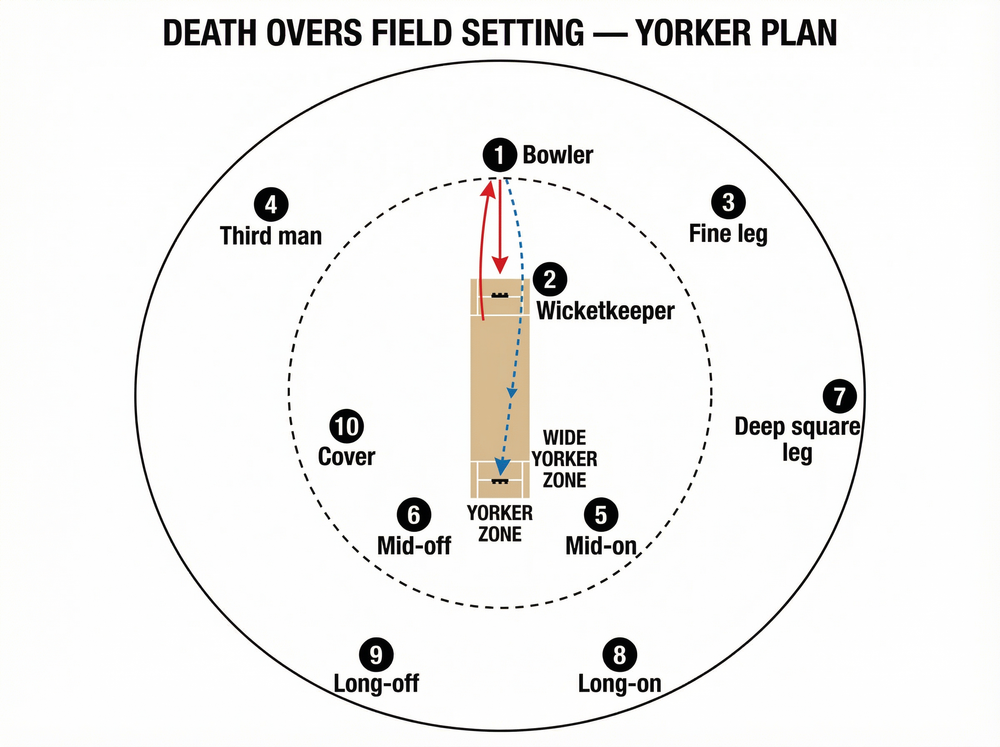
Use a full-length 22-yard pitch on an oval ground. Mark the yorker landing zone with two cones placed at the batting crease, 30 cm either side of off stump — this is the primary target corridor. Mark the wide yorker zone with a cone 60 cm outside off stump. Place boundary cones at the standard 65–70 metre oval boundary to give fielders their precise positions before the session begins.
Player Positions — Yorker Field (Diagram 1)

| Position | Player # | Location | Role |
|---|---|---|---|
| Bowler | 1 | Top of run-up | Primary executor |
| Wicketkeeper | 2 | Behind stumps, up or back | Stumping/catch threat |
| Fine leg | 3 | Deep, 5 m inside boundary | Protect the boundary |
| Third man | 4 | Deep, 5 m inside boundary | Cut-shot protection |
| Mid-on | 5 | 20 m from stumps, straight | Straight-drive block |
| Mid-off | 6 | 20 m from stumps, straight | Straight-drive block |
| Deep square leg | 7 | Boundary, square on leg side | Sweep/pull protection |
| Long-on | 8 | Boundary, 10 m left of straight | Lofted on-side block |
| Long-off | 9 | Boundary, 10 m right of straight | Lofted off-side block |
| Cover/Sweeper | 10 | Inside circle or boundary | Adjust based on batter |
Player Positions — Slower Ball Field (Diagram 2)

When bowling the slower ball, shift Position 7 from deep square leg to deep mid-wicket and Position 10 from cover to sweeper cover on the boundary. This protects the two most common hitting zones when a batter mistimes a slower delivery and gets underneath it.
Step-by-Step Instructions

Step 1 — Pre-Over Briefing (30 seconds)
Before each death over begins, the captain and bowler must have a 15–30 second conversation at the top of the mark. Agree on: (a) the primary ball type for the over — yorker-dominant or slower-ball-dominant; (b) the field for ball one; and (c) the trigger for any mid-over field change. This brief removes hesitation and ensures every fielder is set before the bowler runs in.
Step 2 — Set the Field Decisively
Walk your field into position before the batter is ready. Use loud, clear verbal calls: "Long-on, five metres wider" or "Sweeper cover, on the boundary." Fielders must be stationary and alert before the bowler begins their run-up. A slow field-setting routine wastes time and allows the batter to reset mentally.
Step 3 — Ball One — Establish the Yorker
The first ball of a death over should almost always be a full-length yorker targeting the base of off stump or a wide yorker on the off-side crease line. This immediately puts the batter on the back foot, prevents them from getting under the ball, and sets the tone that you are bowling to a plan. The release point should be high, with the wrist behind the ball at delivery.
Step 4 — Ball Two — Hold the Length or Introduce Variation
If ball one was executed well, repeat the yorker. If the batter played it comfortably, introduce your first variation: a back-of-a-length slower ball (off-cutter or knuckle ball) at 10–15 km/h below your normal pace. The field must shift to the slower-ball setting before you bowl this delivery — communicate the change with a pre-agreed signal (e.g., a hand on the hip as you walk back).
Step 5 — Balls Three and Four — Build Pressure
Maintain the yorker–slower ball pattern, varying the line between stump-to-stump and wide of off stump. Avoid bowling anything above knee height in the arc from mid-on to mid-off — this is the danger zone where a batter can free their arms. If you miss your yorker and bowl a full toss, do not panic; immediately reset to your yorker grip and re-commit to the length.
Step 6 — Balls Five and Six — The Wicket Ball
With pressure built over four balls, the batter is now likely to take a risk. Set a slightly more attacking field for ball five — consider bringing cover up to catching position inside the circle — and bowl a slower-ball bouncer or a wide yorker to invite the big hit. Ball six should be your best yorker of the over, bowled with full conviction at the base of the stumps.
Step 7 — Post-Over Review (60 seconds)
Gather the bowling group for a brief debrief. Ask: Did we execute the plan? Where did we leak runs? What adjustment do we make for the next over? Keep it factual and forward-focused — this is not the time for lengthy analysis.
Key Coaching Points

1. The Yorker Is a Skill, Not a Gamble
Many coaches treat the yorker as a high-risk option. Reframe this for your players: a well-drilled yorker is the safest ball in the death overs because it cannot be hit for six off the front foot. Dedicate a minimum of 15 minutes per training session to yorker-only bowling drills, using the cone markers at the batting crease as the target.
2. Disguise Is Everything
Your slower ball is only effective if the batter cannot pick it from your hand. Insist that your bowlers use the same run-up, same arm speed, and same release point for every delivery type. The deception comes from the grip and wrist position at the point of release, not from a change in body action.
3. Bowl to Your Field — Every Ball
A boundary conceded to a position you have not covered is a planning failure, not a skill failure. Reinforce constantly that the bowler's job is to execute the delivery that matches the field setting. If the field is set for a yorker, bowl a yorker. If you want to bowl a slower ball, change the field first.
4. Manage the Wide Yorker Line
The wide yorker — landing on or just outside the off-stump crease line — is the most effective death-over delivery in modern limited-overs cricket. It is extremely difficult to hit over the boundary because the batter must reach across their body. Practise this line specifically, as it requires a slightly wider release angle than the stump-to-stump yorker.
5. Communicate Field Changes with Signals
In a noisy stadium environment, verbal communication between bowler and fielders is unreliable. Establish a set of pre-agreed signals: hand on hip = slower ball field; tap on thigh = yorker field; arm raised = sweeper cover moves to boundary. Practise these signals in training so they become second nature.
6. Stay Process-Focused Under Pressure
Death bowling is mentally demanding. If a batter hits a six, the worst response is to panic and bowl short. Coach your bowlers to use a consistent pre-delivery routine — a deep breath, a clear visualisation of the target, and a committed run-up — regardless of what happened on the previous ball.
Common Mistakes
Mistake 1 — Bowling Too Short
Under pressure, bowlers instinctively pull their length back to avoid being driven. In the death overs, a back-of-a-length delivery at 130–140 km/h sits up perfectly for a pull or a slog sweep. Correct this immediately: use the cone markers at the batting crease as a visual anchor and remind the bowler that full is safe.
Mistake 2 — Changing the Field After the Ball Is Bowled
A common error is for the captain to set a yorker field but the bowler to bowl a slower ball without communicating the change. The result is a fielder in the wrong position when the ball is mishit. Reinforce the signal system relentlessly and make field-first, bowl-second a non-negotiable habit.
Mistake 3 — Bowling the Same Variation Twice in a Row
Once a batter has seen a slower ball, they will be looking for it. Bowling two consecutive slower balls is a recipe for a boundary. The plan should always alternate between pace and variation, even if the first slower ball was not executed perfectly.
Mistake 4 — Neglecting the Wide Yorker
Many bowlers default to the straight yorker because it feels safer. However, a batter who is set will hit a straight yorker through mid-on or mid-off. The wide yorker is harder to execute but far more difficult to score from. Include it as a required skill in every death-overs training block.
Mistake 5 — Poor Pre-Over Communication
The most preventable mistake in death bowling is a lack of a plan. If the bowler does not know what they are trying to bowl before they walk to their mark, the over will be reactive rather than proactive. Make the 30-second pre-over briefing a mandatory ritual in training so it transfers automatically to match conditions.
Variations & Progressions

Variation 1 — The Bouncer Trap
For batters who are strong on the front foot and looking to drive, introduce a planned bouncer at ball three or four of the over. Set a fine leg and a deep square leg on the boundary, and bowl a bouncer at 85–90% pace aimed at the batter's armpit. Follow it immediately with a yorker — the batter, now expecting another short ball, is caught on the crease and cannot get under the full delivery.
Variation 2 — The Off-Cutter to the Left-Hander
Against a left-handed batter, the off-cutter (which moves away from the left-hander) is devastatingly effective in the death overs. Bowl it on a full length, just outside off stump, with a sweeper cover and third man on the boundary. The ball moves late, the batter chases it, and the leading edge or miscue goes to the fielder in the covers.
Progression 1 — Pressure Simulation Drill
Once players have mastered the basic plan, run a pressure simulation: the batting side needs 24 runs off the last 2 overs with 3 wickets in hand. The bowling side must execute the full plan — pre-over briefing, field signals, yorker–slower ball pattern. Score the over and debrief. Increase the target progressively to simulate higher-pressure scenarios.
Progression 2 — Bowling Machine Fielding Integration
Use a bowling machine set to 130 km/h to fire balls into the boundary positions while your fielders are in their death-overs positions. This trains reaction time and footwork for the specific angles that arise from yorkers and slower balls hit to the deep. Rotate fielders through every position so the entire squad understands their role in the plan.
Age Adaptations

Under 12 & Under 14
At this level, the priority is building a consistent full length rather than the specific yorker. Replace the yorker target with a general "full-pitched" zone — any delivery landing in the last metre of the pitch before the batting crease. Introduce only one variation (the off-cutter) and keep field settings simple: four on the boundary, two straight, two square. Focus the coaching conversation on process ("Did you hit your length?") rather than outcome ("Did they score?").
Under 16
Players at this age can begin learning the genuine yorker and one or two slower-ball variations. Introduce the pre-over briefing ritual and the field-signal system. Run the pressure simulation drill at reduced intensity (e.g., 12 runs off the last over rather than 24). Begin discussing the concept of bowling to the field and the importance of matching delivery type to field placement.
Open / Senior
The full plan as described above applies. Senior players should be able to bowl at least two distinct slower-ball variations (e.g., off-cutter and knuckle ball) and execute the wide yorker consistently. Introduce video review of death-over spells from training and matches to reinforce the plan and identify individual technical adjustments. Senior bowlers should also understand the match context — run rate required, wickets remaining, batter strengths — and be able to adapt the plan in real time.
