

Cricket
Fast Bowling: The 20-Meter Alignment Channel Drill
Master the art of bowling straight by training fast bowlers to maintain a perfectly aligned run-up through a 20-meter constrained channel.
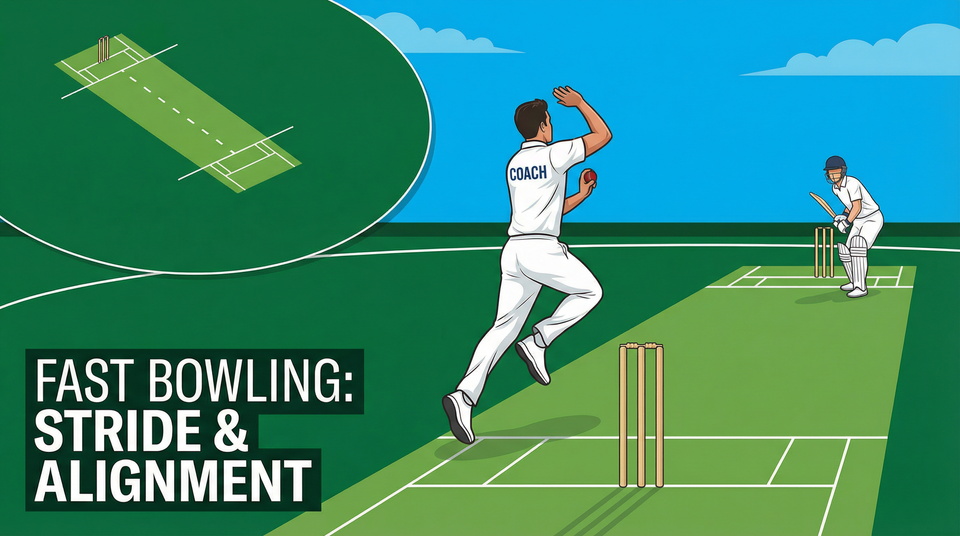
What you need
20-30 Marker Cones, Cricket Balls, 1 Target Stump
Overview
A fast bowler's accuracy is fundamentally determined long before the ball leaves their hand. The alignment of the run-up dictates the momentum vector toward the target. When a bowler weaves, drifts, or runs in at an angle, their body must compensate during the delivery stride, leading to inconsistent lines, loss of pace, and increased injury risk due to mixed actions. The 20-Meter Alignment Channel Drill is designed to hardwire a perfectly straight approach to the crease. By physically constraining the run-up path with visual markers, coaches can help bowlers develop a repeatable, energy-efficient, and highly accurate approach that maximizes momentum transfer directly toward the target stumps.
This drill is essential during the pre-season conditioning phase and remains a valuable technical maintenance tool throughout the competitive season. It is particularly effective for bowlers who struggle with 'falling away' in their delivery stride or those who spray the ball down the leg side.
Setup
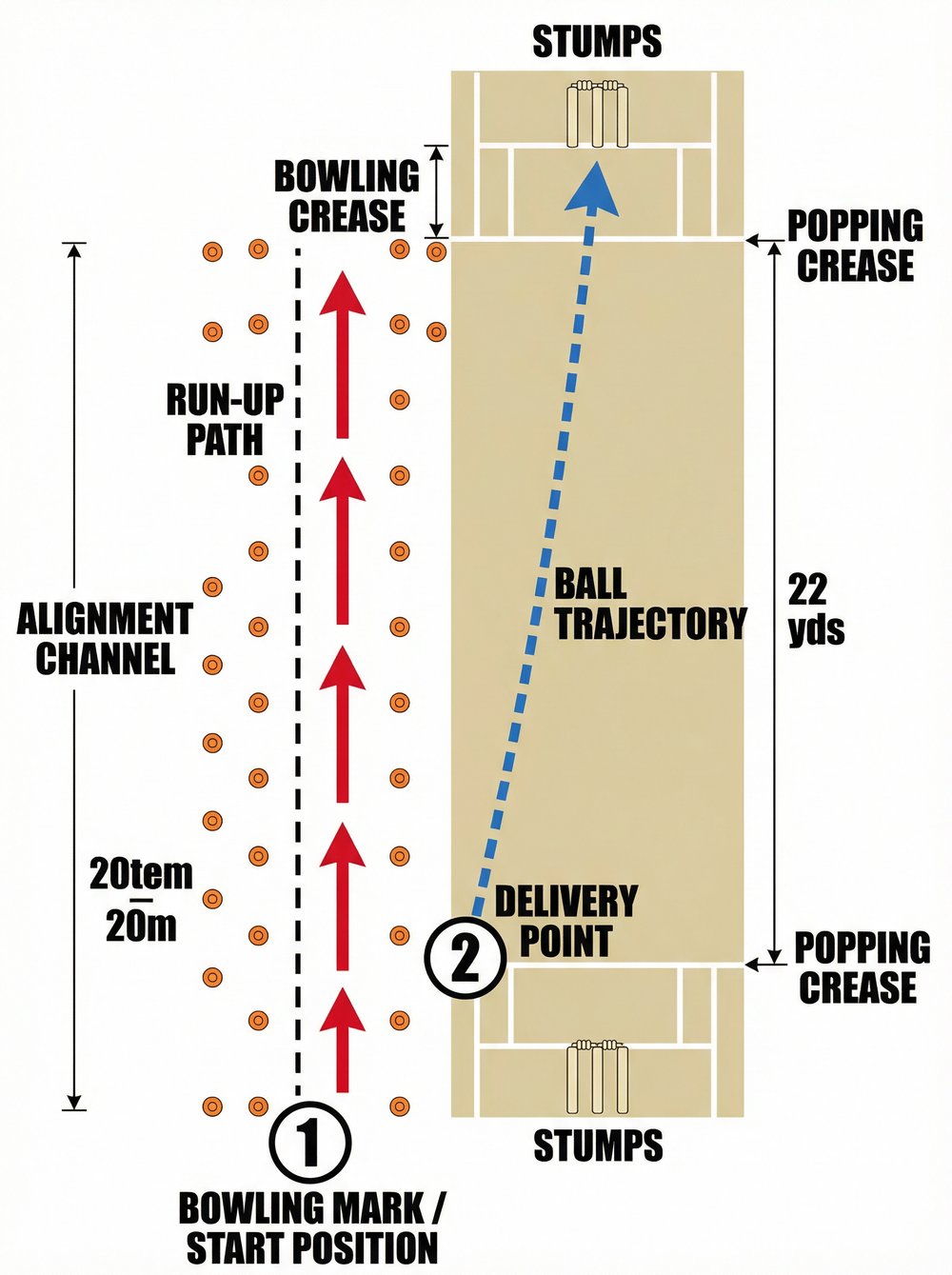
Setting up this drill correctly is critical to its success. You will need a standard 22-yard cricket pitch (or a flat grass area of equivalent length) and approximately 20-30 marker cones.
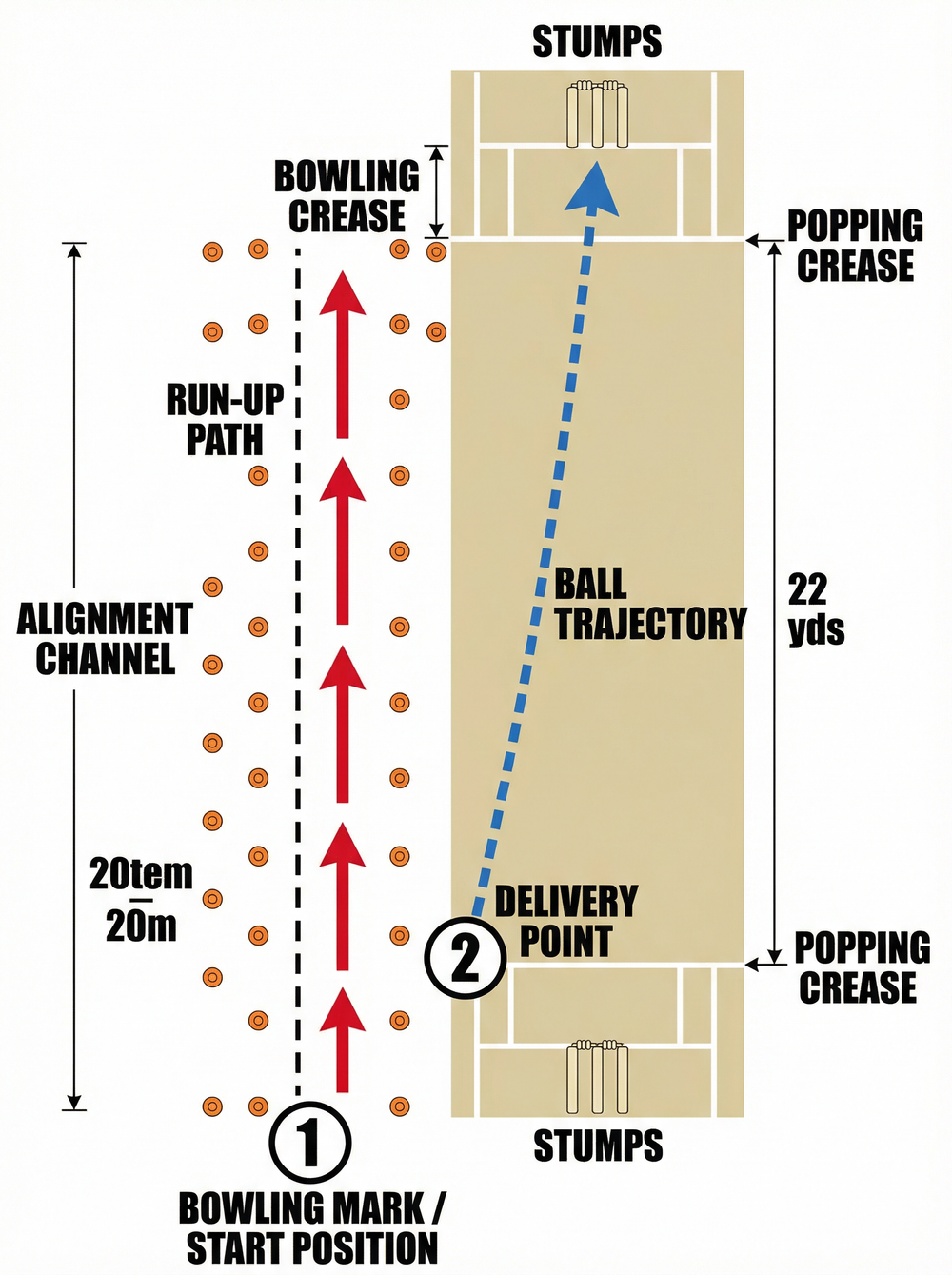
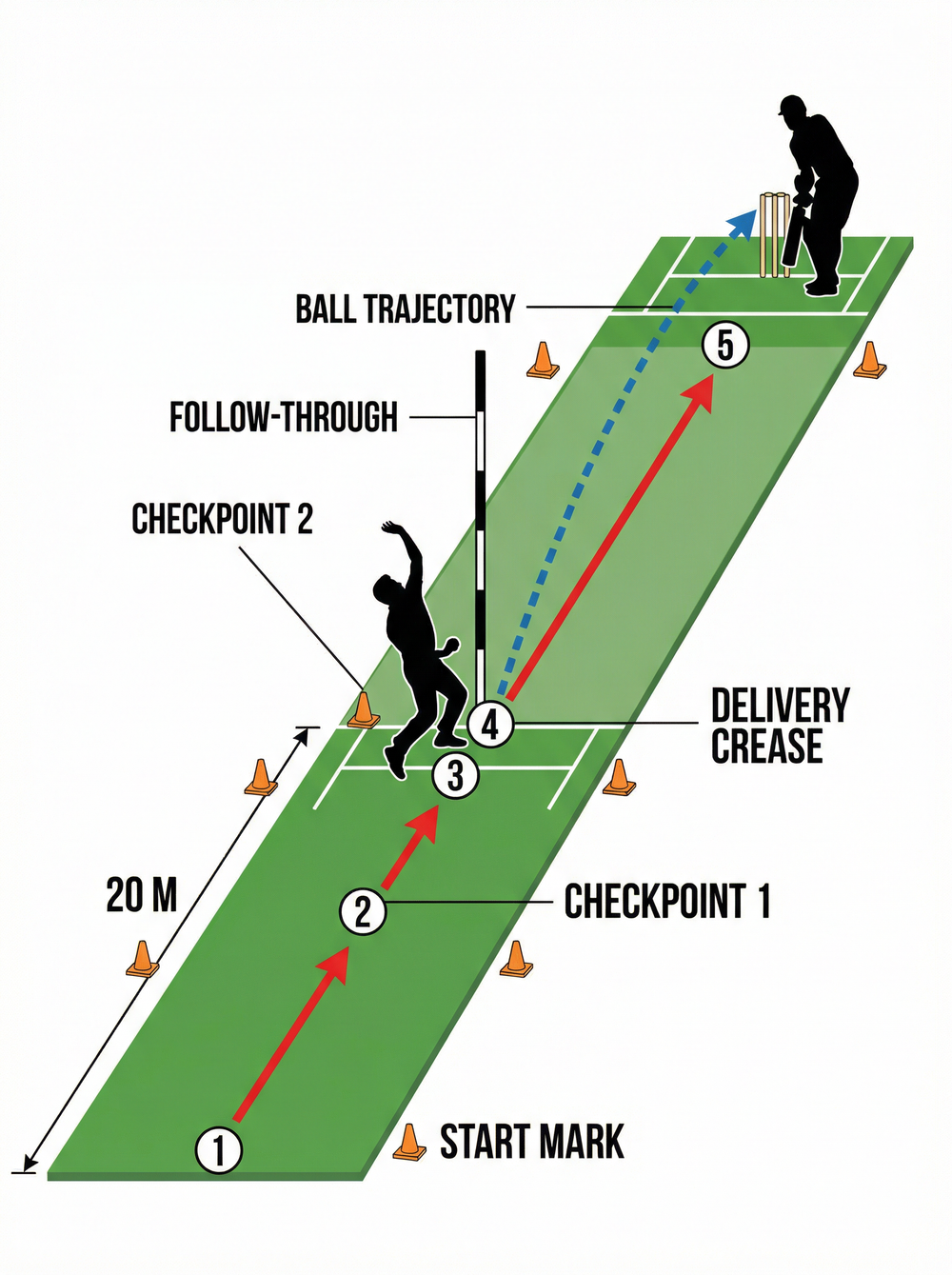
- Identify the Start Point: Ask the bowler to measure out their standard run-up starting from the bowling crease. Mark their starting point with a distinct cone or marker.
- Create the Channel: Starting from the bowling crease, lay out two parallel lines of cones extending back to the bowler's start mark (typically 15 to 20 meters). The channel should be approximately 1.5 meters wide—just enough to allow a comfortable running stride without feeling overly restrictive.
- Set Checkpoints: Place distinctly colored cones at the 10-meter mark and 5-meter mark to serve as visual checkpoints for the bowler's acceleration phases.
- Target Area: Place a single stump or a target cone at the batsman's end, specifically on the line of off-stump.
Step-by-Step Instructions

Follow these steps to execute the drill effectively. Begin without a ball to focus purely on biomechanics before introducing the delivery.
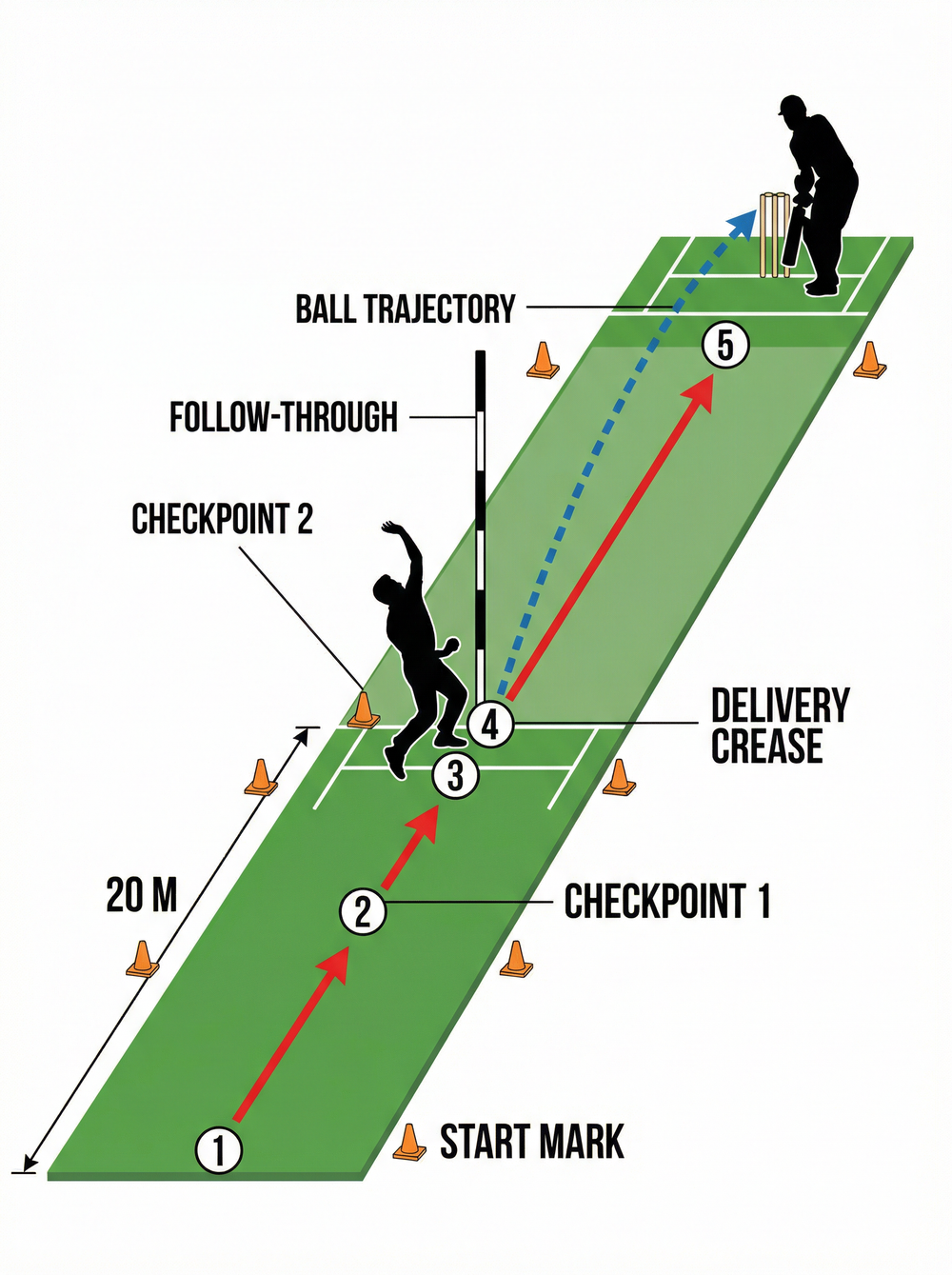
- Walk-Through: Have the bowler start at their mark and simply walk through the channel. The focus here is on keeping the head still, eyes fixed on the target stump, and ensuring both feet land squarely within the channel boundaries.
- Jogging Phase: Progress to a light jog. The coach should stand behind the bowler at the start mark to observe the alignment of the spine and the path of the feet. Any lateral deviation will be immediately obvious as the bowler approaches the cones.
- Full Run-Up (No Delivery): The bowler accelerates to their normal run-up speed but aborts the delivery at the crease, simply running straight through the popping crease. Ensure they maintain their speed and do not decelerate too early. The momentum must carry them straight down the pitch.
- Full Delivery: Introduce the cricket ball. The bowler executes their full run-up, staying strictly within the channel, and bowls the ball at the target stump. The follow-through must also continue straight down the pitch, not veering off excessively to the side.
Key Coaching Points

To maximize the effectiveness of this drill, coaches should focus on the following technical aspects:
- Head Position: The head is the heaviest part of the body. If it falls to the left or right during the run-up, the body will follow. Instruct bowlers to keep their eyes locked on the target stump, keeping the head completely still and level.
- Arm Drive: Efficient running mechanics translate to efficient bowling. Ensure the bowler is driving their arms in straight, linear lines parallel to the channel. Cross-body arm movement will induce rotational forces that pull the bowler off-line.
- Foot Plant: Watch the alignment of the feet as they land. The feet should point directly down the pitch. A foot that plants pointing outward indicates a loss of linear momentum.
- Momentum Transfer: The run-up should build momentum smoothly. The bowler should hit their maximum controlled speed just before the gather and delivery stride. Check that they are not decelerating as they enter the crease.
Common Mistakes
Watch out for these frequent errors and correct them immediately:
- Weaving: The bowler zig-zags within the channel. This usually stems from poor starting alignment or a lack of focus on the target. Correction: Narrow the channel slightly or have them practice walking the line first.
- Deceleration at the Crease: The bowler slows down significantly just before bowling, often due to a lack of confidence in their alignment or a conscious effort to 'steer' the ball. Correction: Emphasize running through the crease, not just to it.
- Looking at the Cones: The bowler looks down at the channel markers instead of the target stump, causing their head to drop and momentum to stall. Correction: Constantly remind them to keep their eyes up and locked on the target.
Variations & Progressions
Adapt the drill to challenge your bowlers as they improve:
- Narrow the Channel: As the bowler becomes more proficient, reduce the width of the channel from 1.5 meters down to 1 meter or even less, demanding absolute precision.
- The Blind Start: Have the bowler start their run-up with their eyes closed for the first 3-4 strides, opening them only as they hit the first checkpoint. This develops kinesthetic awareness and a natural feel for their alignment.
- Target Bowling: Assign points for hitting specific targets (e.g., top of off-stump, yorker length) while maintaining perfect run-up alignment within the channel.
Age Adaptations
- Under 10s / Under 12s: Keep the channel wide and focus entirely on running in a straight line without a ball. Use brightly colored cones and make it a fun 'run the gauntlet' game.
- Under 14s / Under 16s: Introduce the ball and focus heavily on the connection between a straight run-up and an accurate delivery. Begin narrowing the channel to challenge their technique.
- Open / Seniors: Utilize the narrowest channel possible and integrate this drill into high-intensity net sessions, requiring perfect alignment even when fatigued.
