Mastering the Ground Fielding Pick-Up: The Barrier Technique Drill
A comprehensive guide to teaching the fundamental barrier technique for ground fielding, ensuring your players attack the ball safely and efficiently to save runs and execute run-outs.

Equipment Needed
1. Overview
Ground fielding is the bedrock of a strong fielding side. While spectacular diving catches make the highlight reels, it is the consistent, clean pick-up of a rolling ball that saves boundaries and creates run-out opportunities. This drill focuses on the fundamental Barrier Technique, the safest and most reliable method for fielding a ball hit along the ground.
This drill is designed to teach players how to attack the ball at the correct angle, establish a solid base to prevent the ball from passing them, and seamlessly transition into a powerful throwing position. It is an essential foundational drill for players of all ages, from juniors learning the basics to senior players refining their mechanics early in the season.
2. Setup
Proper setup is crucial for maximizing repetitions and ensuring player safety.
Equipment Needed
- 10-12 Cricket Balls (use softer balls for younger age groups)
- 1 Set of Stumps (or target cones)
- Fielding Cones (to mark starting positions and zones)
- Wicketkeeper Gloves (optional, for the player receiving throws)
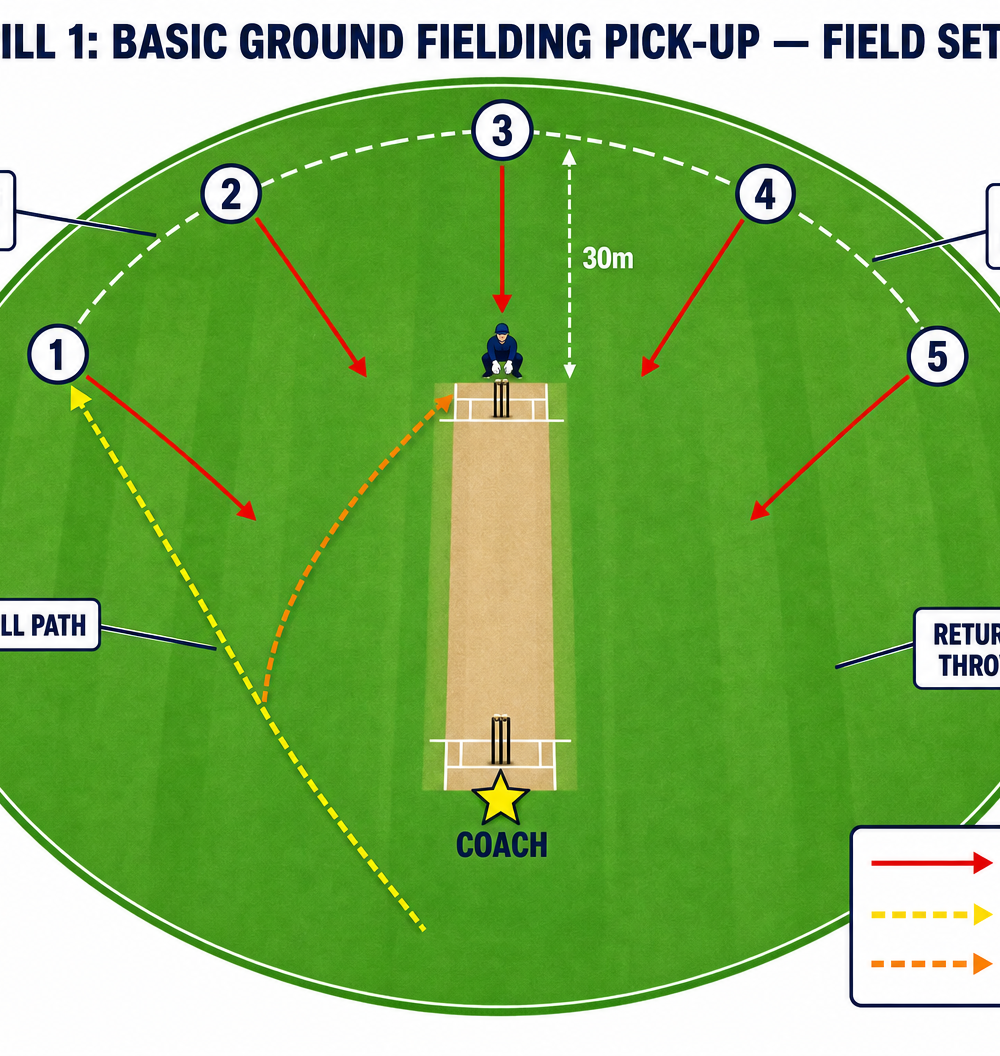
Field Setup
- Location: Use the outfield area of a cricket oval or any flat, grassy space.
- The Target: Set up a single set of stumps to act as the target for returns.
- Coach Position: The coach (or feeder) stands approximately 15-20 metres away from the stumps, acting as the batsman hitting the ball.
- Fielder Positions: Place cones in a semi-circle arc approximately 30 metres from the coach, simulating positions like point, cover, mid-off, mid-on, mid-wicket, and square leg.
3. Step-by-Step Instructions
Run this drill with a focus on technique over speed initially. As players become comfortable, increase the pace of the feed.
Step 1: The Feed
The coach rolls or gently hits the ball along the ground toward one of the fielding positions. The feed should be firm enough to require the fielder to move quickly, but not so hard that it becomes a reaction drill.
Step 2: The Approach
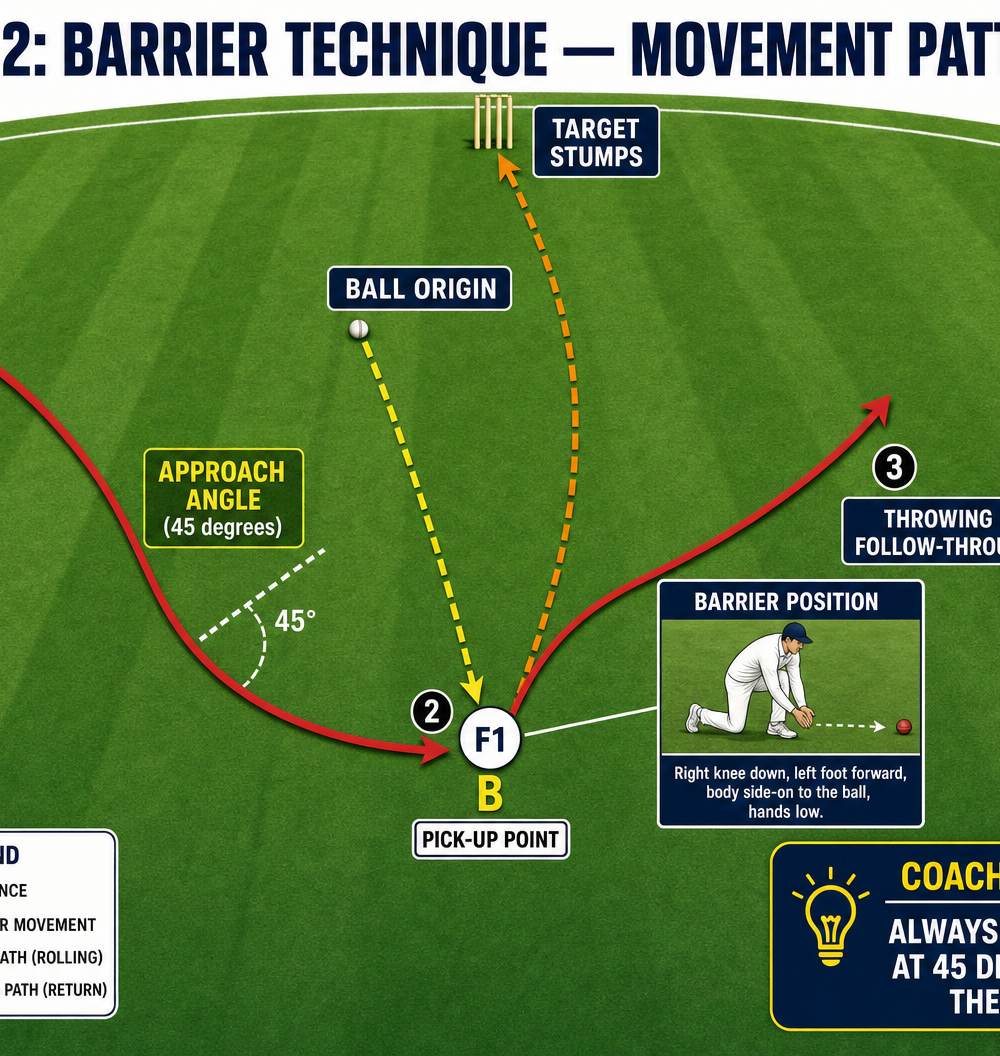
The designated fielder sprints toward the ball. The key here is the angle of approach. The fielder must run in a curved path to attack the ball at a 45-degree angle, rather than running straight at it. This angle allows the fielder's momentum to carry them toward the target (the stumps) after the pick-up.
Step 3: The Barrier Position
As the fielder reaches the ball, they must adopt the barrier position:
- Drop the back knee (right knee for a right-handed thrower) to the ground, perpendicular to the path of the ball.
- The front foot (left foot) is planted flat, creating a 'barrier' with the leg.
- The body is turned side-on to the target.
- Head is over the ball, eyes watching it all the way into the hands.
Step 4: The Pick-Up
The fielder gathers the ball with two hands, scooping it cleanly just in front of the barrier leg. The hands should be 'soft' to absorb the impact.
Step 5: The Throw and Follow-Through
Immediately after gathering the ball, the fielder pushes off their back foot, stands up, and transfers their weight forward to execute a strong, flat throw over the stumps to the coach or a designated catcher. The fielder must follow through with their throwing arm and take a few steps toward the target to ensure power and accuracy.
4. Key Coaching Points
When observing your players, focus on these critical elements:
- Attack the Ball: Don't wait for the ball to come to you. Sprint aggressively to cut down the angle and reduce the time the batsmen have to run.
- The 45-Degree Angle: This is non-negotiable. Approaching straight on kills momentum and makes the throw weak and inaccurate.
- Head Over the Ball: Keep the chin down and eyes fixed on the ball until it is securely in the hands. Looking up too early causes fumbles.
- Solid Barrier: Ensure the knee is firmly on the ground and the gap between the knee and the front foot is closed. The barrier is the safety net if the hands miss the ball.
- Momentum to Target: The entire movement—approach, pick-up, and throw—should flow in one continuous motion toward the stumps.
5. Common Mistakes
Watch out for these frequent errors and correct them immediately:
- The 'Crocodile' Catch: Players trying to snap at the ball with stiff arms rather than using soft hands to gather it smoothly.
- Running Straight At the Ball: This forces the fielder to stop completely, turn their body, and throw from a stationary position, losing all power.
- Lifting the Head Early: Looking at the target before securing the ball is the number one cause of misfields.
- Gaps in the Barrier: Leaving a gap between the knee and the heel allows the ball to slip through for extra runs.
6. Variations & Progressions
Once the basic technique is mastered, introduce these variations to challenge your players:
Progression 1: The Moving Target
Instead of throwing to a stationary coach, have a player run between the wickets. The fielder must now time their pick-up and throw to execute a run-out.
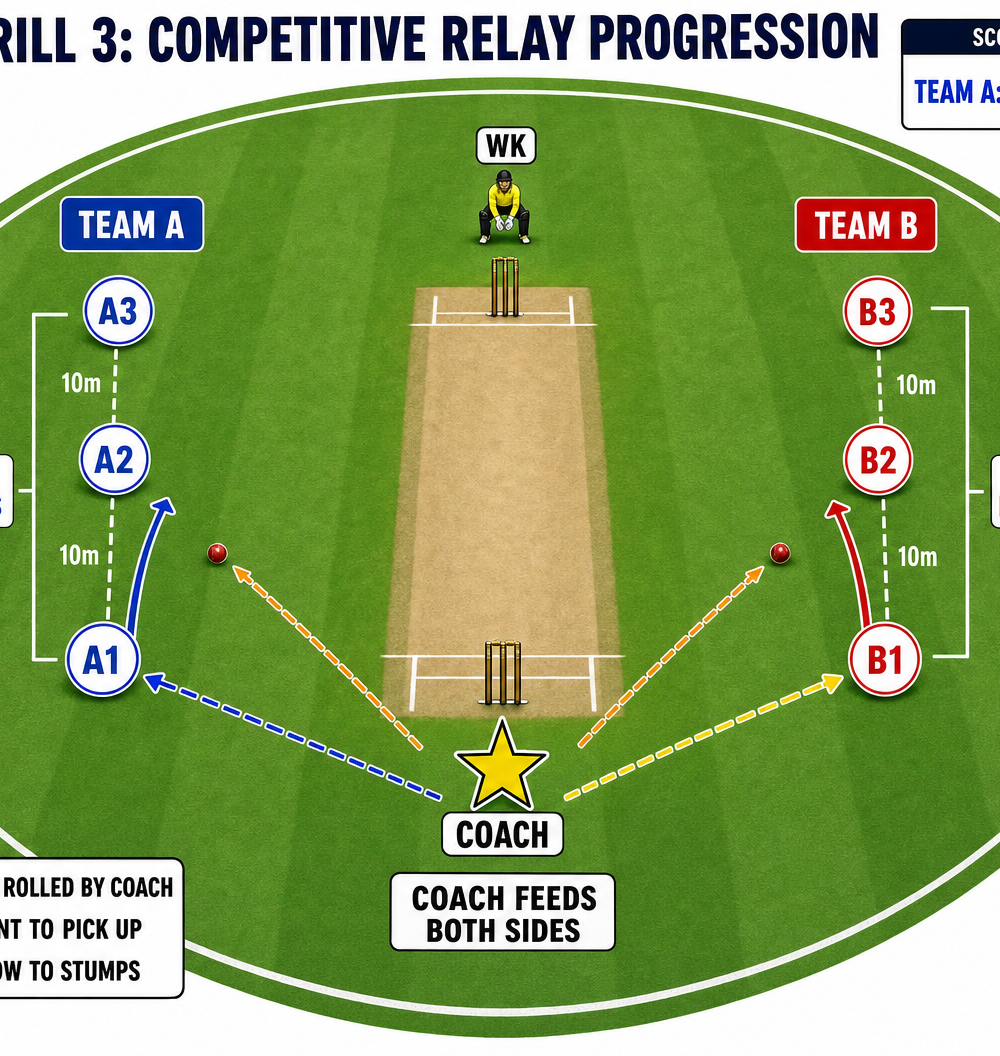
Progression 2: Competitive Relay
Divide the squad into two teams. Set up two identical drill stations side-by-side. The coach feeds both sides simultaneously. The first team to cleanly field and hit the stumps wins the point. This introduces match-pressure and speed.
Variation 1: The One-Handed Pick-Up (Advanced)
For balls hit softly or when extreme speed is required, progress to the one-handed pick-up outside the line of the front foot. This is a high-risk, high-reward skill for advanced players.
7. Age Adaptations
- Under 8s / Under 10s: Use softer incrediballs or tennis balls. Focus entirely on the barrier shape (getting the knee down) and soft hands. Keep the distances short (10-15m).
- Under 12s / Under 14s: Introduce the 45-degree approach angle. Begin focusing on the speed of the transition from pick-up to throw. Introduce the competitive relay progression.
- Under 16s / Open: Focus on explosive speed to the ball, flat and hard throws hitting the base of the stumps, and introduce the one-handed pick-up variation for appropriate game situations.