

Cricket
Middle Overs Masterclass: The Spin-Pace Squeeze Strategy
Master the art of choking the opposition's scoring rate and forcing wickets during the crucial middle overs by deploying a disciplined spin-seam bowling rotation with precision field placements.

What you need
Match ball (slightly worn, 15+ overs old), Stumps and bails, Field markers (cones or discs), Coaching whiteboard
Overview
The middle overs — typically overs 15 to 40 in a 50-over match, or overs 7 to 15 in a T20 — are widely regarded as the phase that most consistently determines the outcome of a limited-overs cricket match. Batting sides aim to consolidate and accelerate; fielding sides must apply sustained pressure to prevent momentum shifts. The Spin-Pace Squeeze is a structured bowling change strategy designed to dry up boundaries, accumulate dot balls, and force batsmen into high-risk shots under mounting pressure.
By rotating a disciplined spin bowler from one end with an accurate seam bowler from the other, your attack presents two contrasting challenges simultaneously. The batsman cannot settle into a single rhythm, and the scoring rate is compressed from both ends. This strategy is most effective when the fielding restrictions have eased, the ball has lost its initial hardness (15+ overs old), and the pitch offers some assistance to both turn and seam movement.
When to use this strategy: Deploy the Spin-Pace Squeeze when a partnership is building without either batsman looking likely to play a big shot, when the required run rate is below 7 per over (giving you room to be patient), or when you need to force a mistake from a set batsman who is playing conservatively.
Setup

Equipment Required
| Item | Specification |
|---|---|
| Match ball | Slightly worn, 15+ overs old |
| Stumps and bails | Standard regulation set |
| Field markers | Cones or discs (for training sessions) |
| Coaching whiteboard | For pre-session field placement briefing |
Pitch and Ground Dimensions
The 22-yard pitch sits at the centre of an oval ground typically ranging from 137 to 150 metres in diameter. The 30-yard inner circle (approximately 27.4 metres from the centre of the pitch) defines the boundary between the infield and outfield. A minimum of four fielders must remain inside this circle at all times during non-powerplay overs.
Player Positions — Spin Bowling End
| Number | Position | Role |
|---|---|---|
| 1 | Bowler (Spinner) | Bowling from the top end |
| 2 | Wicket-keeper | Standing up to the stumps |
| 3 | Point | Cut shot stopper, inside circle |
| 4 | Cover | Drive stopper, inside circle |
| 5 | Mid-off | Straight drive stopper |
| 6 | Mid-on | On-drive stopper |
| 7 | Mid-wicket | Inside circle, sweep stopper |
| 8 | Square leg | Inside circle |
| 9 | Sweeper cover | Boundary rider, off side |
| 10 | Deep mid-wicket | Boundary rider, leg side |
| 11 | Long-on or Long-off | Depending on batsman's dominant shot |

Diagram 1: Full field placement for the Spin Bowling Change — Middle Overs (Overs 15–25). Solid arrows indicate fielder movement transitions; dashed arrows indicate anticipated ball trajectory.
Step-by-Step Instructions
Step 1 — Pre-Over Briefing (2 minutes before the over)
Before the bowling change is made, the captain must gather the incoming bowlers and the wicket-keeper for a 60-second tactical briefing. Confirm the field, the target line and length for each bowler, and the specific batsman's known weaknesses. Use the coaching whiteboard if available. This eliminates confusion and ensures every fielder is in position before the first ball is bowled.
Step 2 — Introduce the Spinner
Bring the spinner on from the end that offers the most assistance (rough outside the right-hander's off stump is ideal). The wicket-keeper moves up to the stumps immediately. Set the field as per the Spin Bowling End positions above, with the sweeper cover and deep mid-wicket protecting the boundaries.
Step 3 — The Spinner's Execution Brief
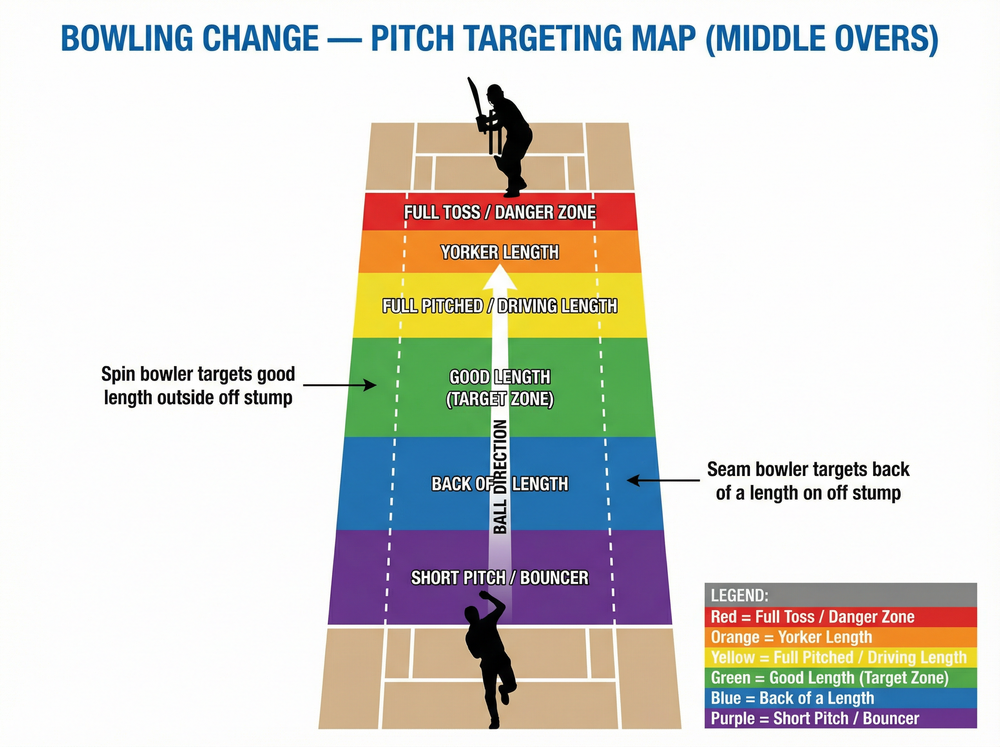
The spinner's primary objective is to bowl a good length, stump-to-stump line at a pace that does not allow the batsman to rock onto the back foot comfortably. Approximately 6–7 metres from the batting crease is the target landing zone. Variations in flight and pace are encouraged, but the line must remain disciplined. A ball outside leg stump is a gift; a ball on the stumps creates pressure.
Step 4 — Introduce the Seam Bowler
From the opposite end, bring on the seam bowler. The field shifts to reflect a 'hit the deck' strategy: third man and fine leg go back to the boundary, mid-off and mid-on remain inside the circle to tempt the batsman into hitting over the top. This is a high-risk shot against a ball that is not coming onto the bat.
Step 5 — The Seam Bowler's Execution Brief
The seam bowler must consistently target the back of a length zone — approximately 8–9 metres from the batting crease — on or just outside off stump. This forces the batsman into awkward cross-batted shots or a defensive push that offers catching chances in the inner ring. The slower ball and off-cutter are the primary variations; deploy them in the third or fourth delivery of an over once the batsman has been softened up by two or three hard-length deliveries.
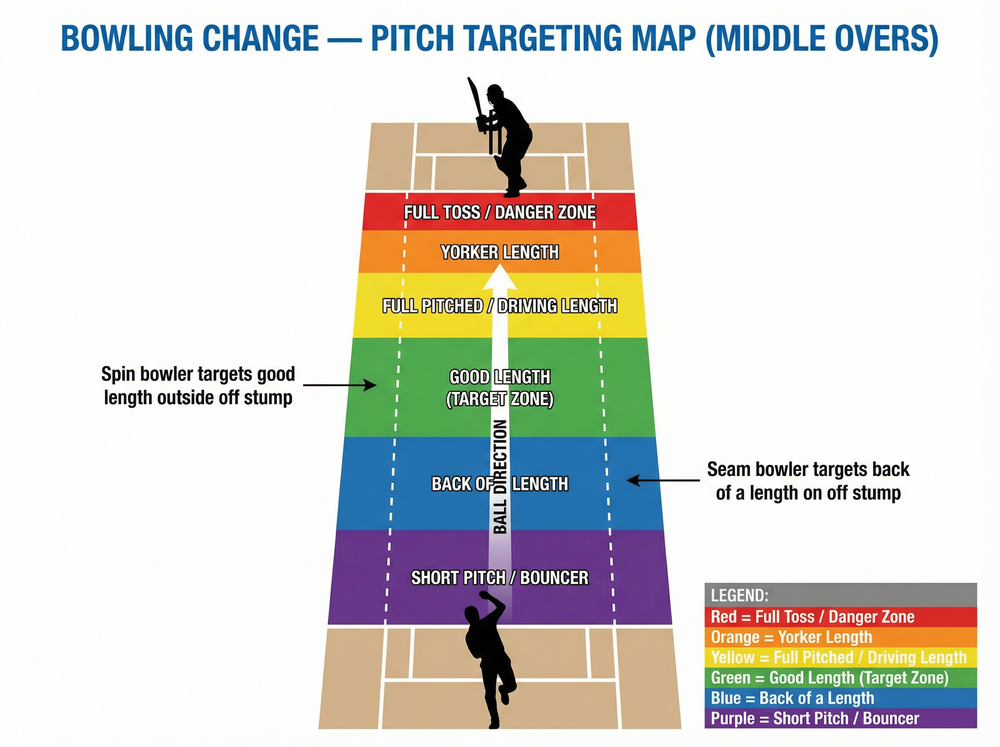
Diagram 2: Pitch Targeting Map for the Middle Overs Bowling Change. The green 'Good Length' zone is the spinner's primary target; the blue 'Back of a Length' zone is the seam bowler's primary target.
Step 6 — The Squeeze Phase (Overs 2–8 of the Strategy)
As dot balls accumulate, the required run rate climbs. The captain must resist the temptation to bring the field up prematurely. Maintain the boundary riders and trust the process. The pressure will build naturally. Communicate constantly with your bowlers — a thumbs up, a word at the end of the over — to maintain confidence and focus.
Step 7 — The Strike Moment
When the required run rate climbs to a point where the batsman must take risks (typically 2–3 runs per over above their current scoring rate), the batsman will either play a false shot against the squeeze bowler or attempt a big hit against a fielder on the boundary. This is the moment to capitalise. Have a catching specialist at mid-wicket or long-on ready for the aerial ball.
Key Coaching Points

Patience is Paramount. Teach your bowlers and captain that in the middle overs, a maiden over is as valuable as a wicket. The pressure created by consecutive dot balls is cumulative and psychological. A batsman who has not scored in three overs will make a mistake.
Fielding Intensity Wins the Phase. The fielders inside the 30-yard circle must be active, aggressive, and loud. Stopping quick singles is the foundation of this strategy. A single taken off a dot ball resets the pressure and rewards the batsman. Every run saved is a run that adds to the required rate.
Bowling to the Field. Bowlers must understand that they are executing a plan, not just bowling. A wide half-volley outside off stump immediately undoes the pressure built by three tight deliveries. If a bowler is struggling with line, the captain must intervene at the end of the over and reset the plan.
Variation at the Right Time. Variations — the arm ball, the slower ball, the cutter — are most effective when the batsman has been conditioned to expect the standard delivery. Do not bowl your variation on the first ball of the over. Bowl it when the batsman is committed to a shot.
Communication is Constant. The captain, wicket-keeper, and bowlers must form a tight unit of communication. The wicket-keeper sees everything from behind the stumps and can read the batsman's footwork and intent. Use this information to adjust the field and the bowling plan ball by ball.
Length Discipline Above All Else. Emphasise hitting the target zone consistently. Too full and the ball is driven through the covers; too short and it is pulled or cut. The good length and back of a length are the two zones that create the most uncertainty for the batsman. Drill this in the nets before match day.
Common Mistakes

Chasing Wickets Too Early. The most common error captains make is bringing the entire field up after a cluster of dot balls, trying to force a run-out or a catch in the ring. This opens up the boundaries and gives the batsman an easy release shot. Trust the plan and keep the boundary riders in place.
Inconsistent Lines. Bowlers straying onto the pads — particularly spinners missing down leg — offer easy runs to fine leg or square leg and break the pressure immediately. This is a training issue. Run specific line-and-length drills in the nets with a target zone marked on the pitch.
Poor Body Language in the Field. If a boundary is hit, some fielders drop their heads or slow down their walk back to position. This is contagious and signals to the batsman that the pressure has been released. Coach your players to reset immediately after a boundary — clap, communicate, and refocus.
Predictability. If the spinner bowls the same delivery six times an over for three consecutive overs, even a moderate batsman will pick the line and length and start scoring. Variations must be planned, not random.
Misreading the Pitch. If the pitch is flat and the ball is not turning or seaming, the strategy must adapt. A flat-pitch spinner without pace variation will be attacked. In these conditions, consider a second seam bowler or a change of pace and angle.
Variations and Progressions
The Double Spin Squeeze. If the pitch is offering significant turn — particularly in subcontinental conditions or on a dry, dusty surface — deploy two spinners simultaneously, one bowling over the wicket and one around the wicket. This creates two different angles of attack and makes it extremely difficult for the batsman to use their feet effectively. The field must be set with two boundary riders on the leg side and one on the off side.
The Enforcer Variation. If a partnership is building and the squeeze is not breaking it, bring back a strike fast bowler for a sharp two-over spell at full pace and aggression. This disrupts the batsman's rhythm and can produce a wicket through sheer pace and hostility. Return to the squeeze immediately after the enforcer's spell.
Fielding Progression Drill (Training). In practice sessions, run a 'Squeeze Game' where batsmen score points for boundaries and sixes, but lose points for dot balls. This forces them to play against the field, which in turn tests the fielders' awareness, communication, and positioning. Increase the difficulty by reducing the number of boundary riders over time.
Age Adaptations
Under 10 and Under 12. At these age groups, focus purely on the fundamentals: bowling straight and stopping the ball in the field. Complex field placements and multi-bowler strategies are developmentally inappropriate. Introduce the concept of a 'good length' using a target zone marked on the pitch with cones.
Under 14 and Under 16. Introduce the concept of bowling in partnerships. Teach players how one bowler keeping it tight from one end creates pressure that helps the other bowler take wickets from the opposite end. Begin using simple two-fielder boundary protection and discuss the idea of a 'plan' for each batsman.
Open and Senior Level. Full implementation of the Spin-Pace Squeeze, including complex field changes ball-by-ball, pre-planned variations based on opposition batsman analysis, and real-time adjustments based on wicket-keeper feedback. Video analysis of the opposition's middle-order scoring patterns should inform the specific field placements used.
