

Cricket
Middle Overs Masterclass: The Spin-to-Seam Transition Strategy
Master the critical transition from attacking spin to containment seam bowling during the middle overs to build pressure and force wickets.

What you need
1 Match ball (20-35 overs old), Standard cricket stumps and bails, Fielding markers / cones (optional, for training)
1. Overview
The middle overs (typically overs 15–35 in a 50-over match) are often where games are won or lost. A critical tactical juncture is the transition from an attacking spin spell back to a seam bowler. This set play is designed to seamlessly shift the fielding dynamic from aggressive wicket-taking — with fielders clustered around the bat — to a defensive, pressure-building containment strategy. By executing this transition smoothly, coaches can ensure the batting side is starved of boundaries, forcing them to take unnecessary risks against the incoming seamer.
This strategy is most effective when the spin bowler has completed a successful spell, perhaps picking up a wicket or two, and the incoming batters are looking to consolidate. The goal is to dry up the runs immediately, creating a pressure-cooker environment in which dot balls accumulate and the batting side is compelled to manufacture runs from deliveries they cannot comfortably hit.
2. Setup
Equipment Needed:
- 1 match ball (in appropriate condition for the middle overs — ideally 20–35 overs old)
- Standard cricket stumps and bails at both ends of the 22-yard pitch
- Fielding markers (cones or discs, optional — useful in training sessions to mark the 30-yard inner circle and key fielding zones)
Pitch & Field Setup:
- Standard 22-yard pitch on a full oval ground (approximately 160m × 140m).
- The 30-yard (27.4m) inner circle must be clearly marked or understood by all fielders.
- Ensure the wicket-keeper is briefed on their repositioning from up-to-the-stumps (for spin) to standing back (for seam).
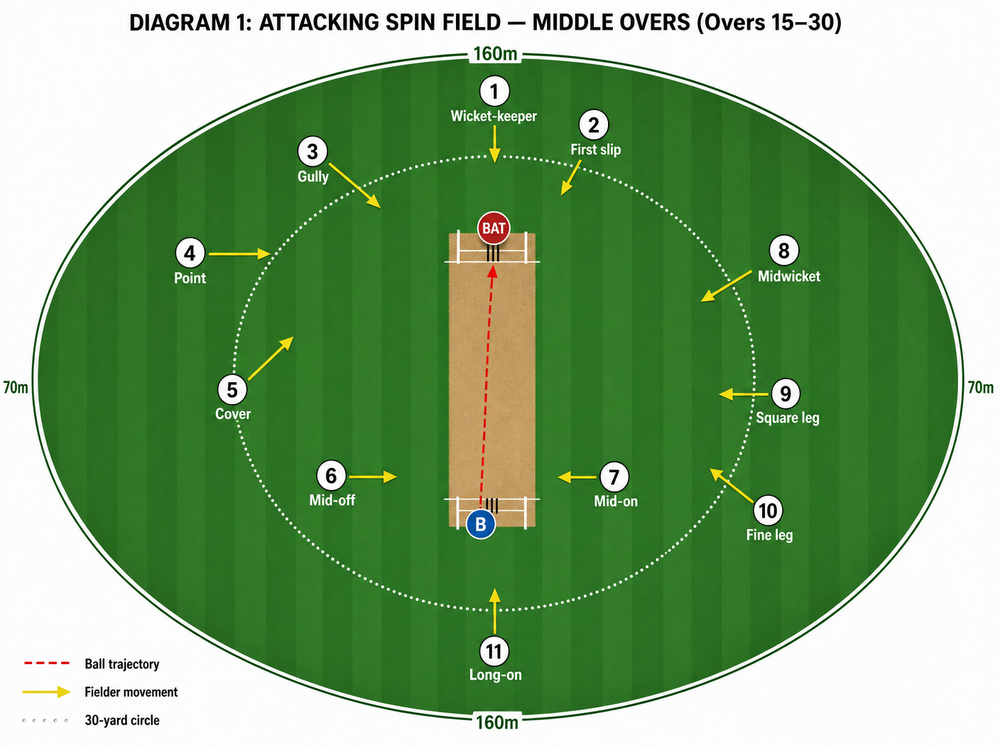
Player Positions at the Point of Change:
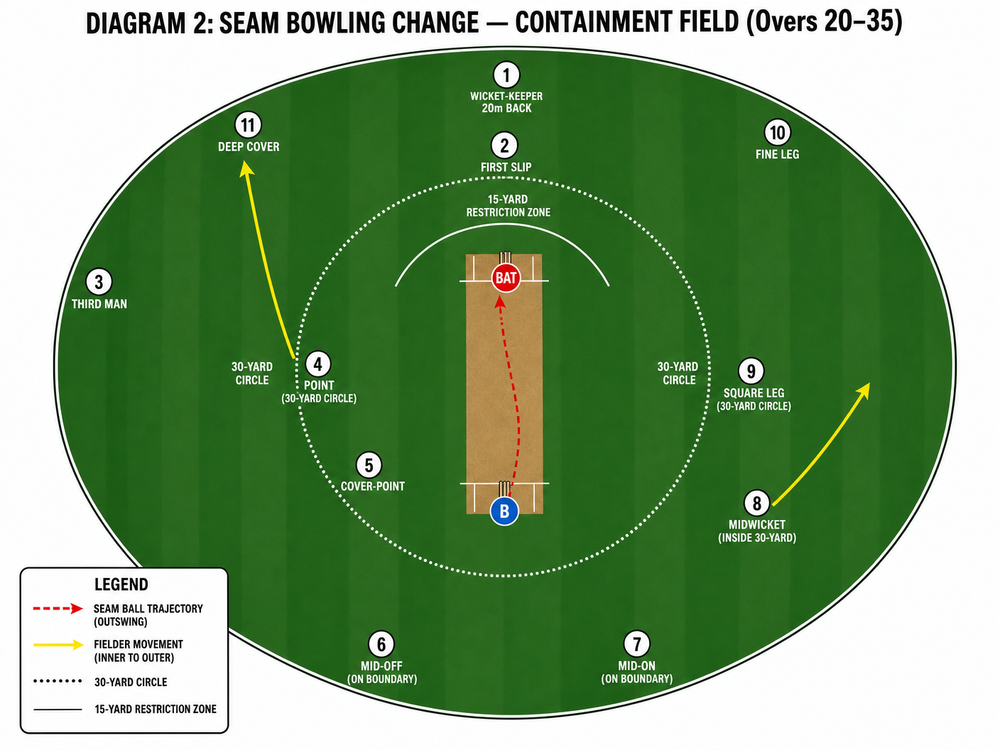
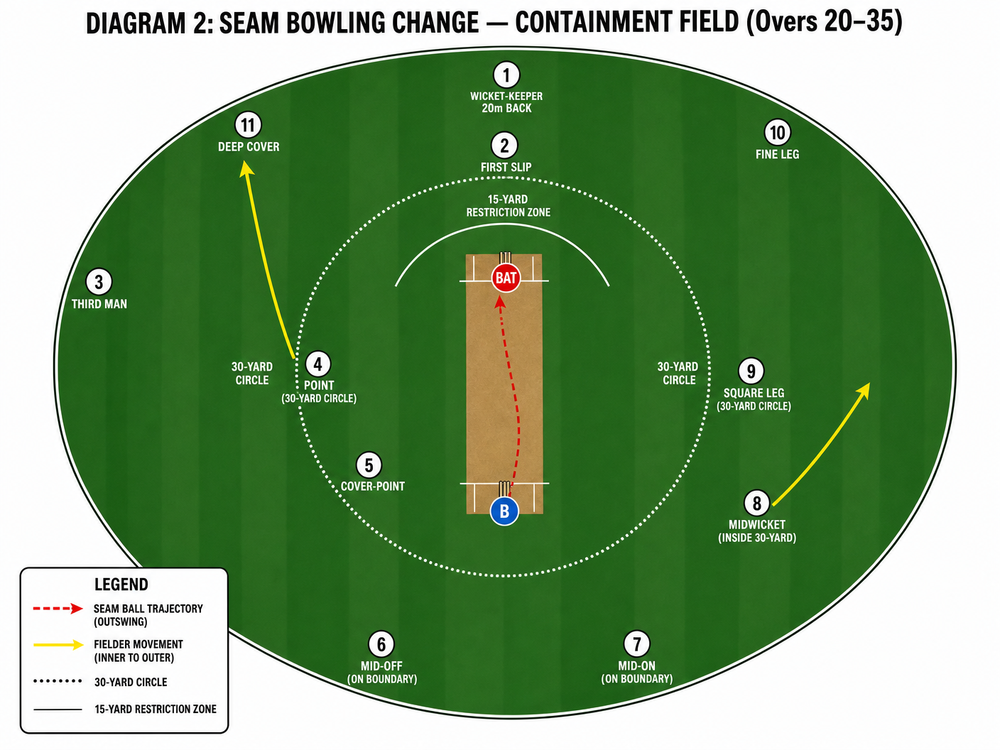
| Position No. | Fielder | Role During Transition |
|---|---|---|
| 1 | Wicket-Keeper | Moves back 18–20m for seamer |
| 2 | First Slip | Remains — sole catching cordon |
| 3 | Third Man | Moves to boundary (fine-leg or third man) |
| 4 | Point | Holds on 30-yard circle |
| 5 | Cover | Holds inside circle or pushes to deep cover |
| 6 | Mid-Off | Pushes to long-off boundary |
| 7 | Mid-On | Pushes to long-on boundary |
| 8 | Midwicket | Adjusts to deep midwicket or holds inside |
| 9 | Square Leg | Holds on 30-yard circle |
| 10 | Fine Leg | Moves to boundary |
| 11 | Deep Cover | Positioned on boundary off-side |
3. Step-by-Step Instructions
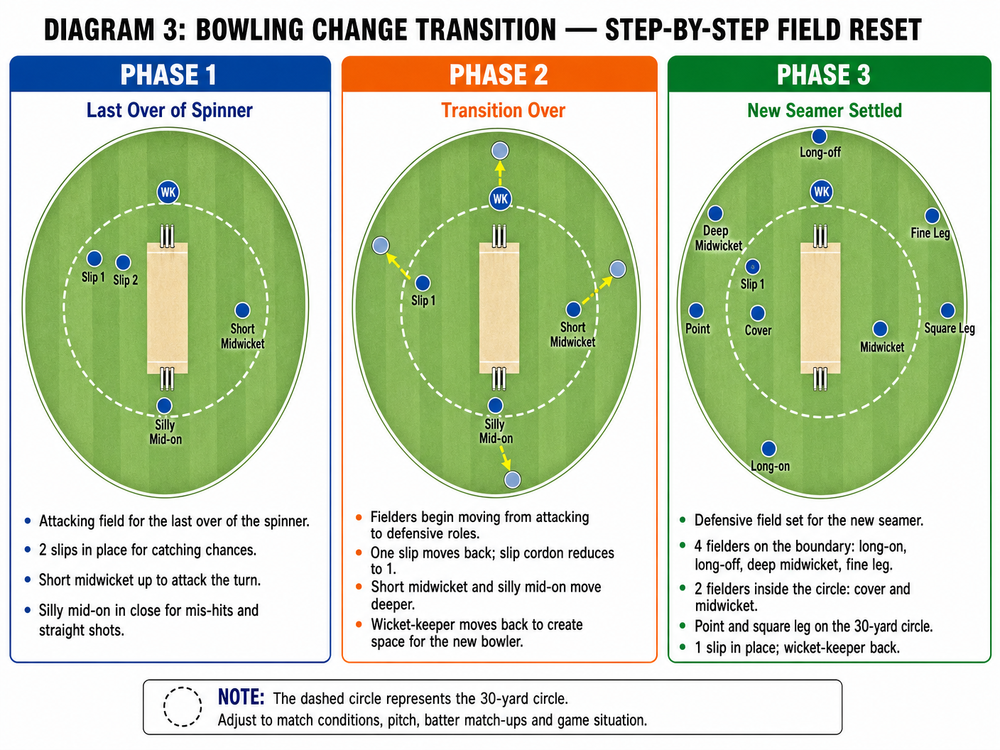
Step 1 — The Final Over of Spin (The Setup)
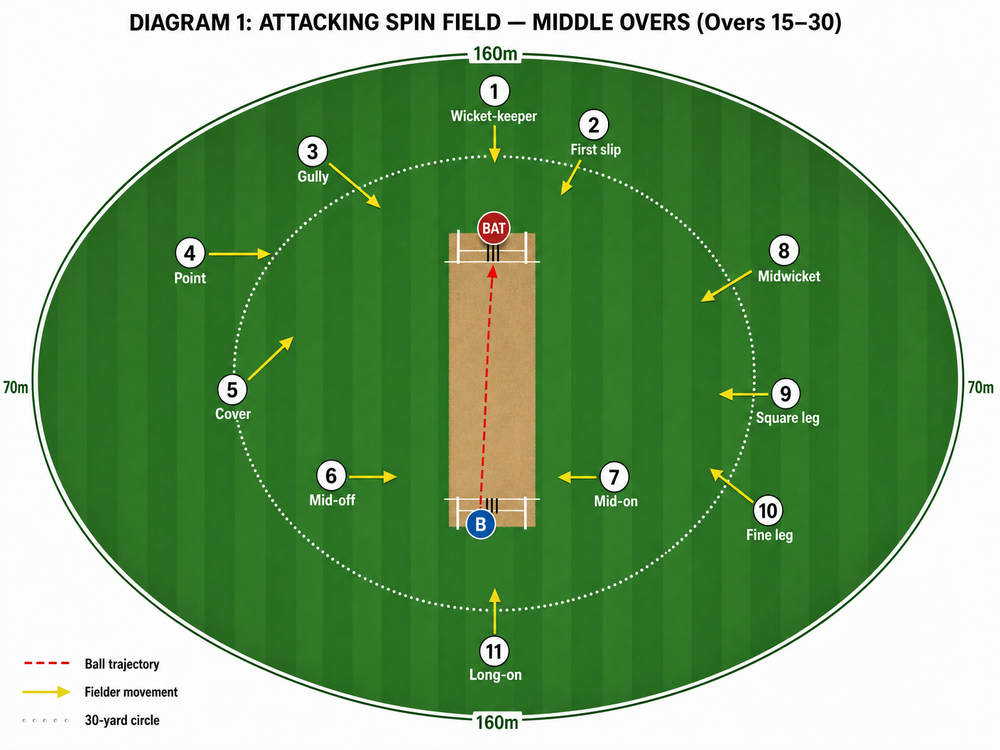
Maintain the attacking field for the spinner's final over. Keep the pressure on with close-in fielders to tempt the batter into a rash shot before the bowling change.
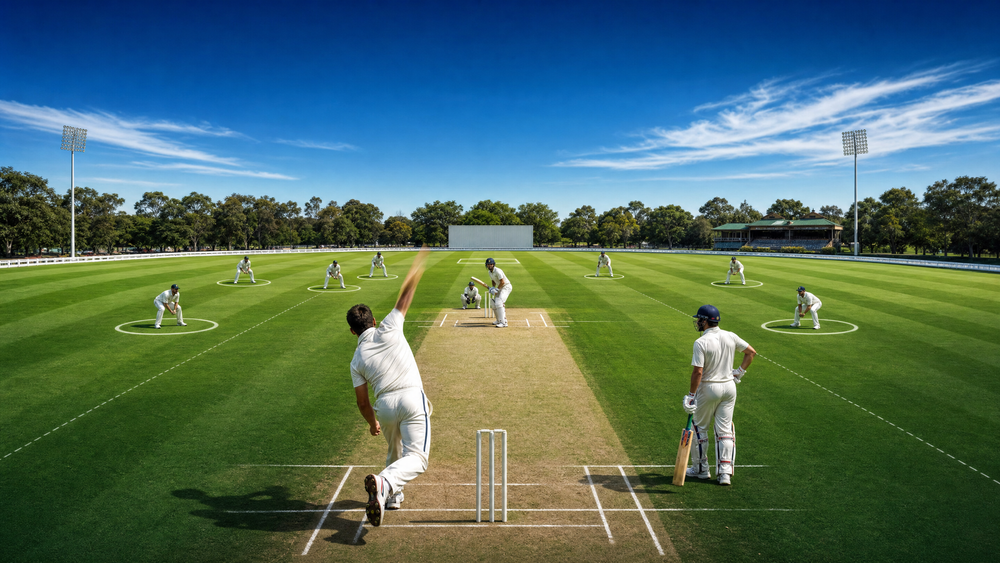
- Ensure the wicket-keeper is up to the stumps for the spinner.
- Maintain at least one slip and one close catching position (short leg, silly point, or short midwicket) if the pitch is offering turn or bounce.
- Mid-off and mid-on should be inside the 30-yard circle, cutting off the drive.
- The captain should mentally prepare the incoming seamer and brief them on the plan during this over.
Step 2 — The Captain-Bowler Consultation (Between Overs)
As the spinner finishes their over, the captain must immediately walk to the incoming seamer at the top of their run-up.
- Confirm the specific line and length required: for a right-arm seamer, this is typically top of off-stump, back of a length (a good length of 6–8m from the batting crease).
- Agree on the primary field placement based on the seamer's natural movement (outswing = third man and fine leg; inswing = mid-on and mid-off on the boundary).
- Identify the batter's known weaknesses and position one specialist fielder to exploit them.
- Set a clear bowling plan for the over: e.g., "Three back-of-a-length deliveries outside off, then one full delivery on the stumps."
Step 3 — The Field Reset (The Transition)
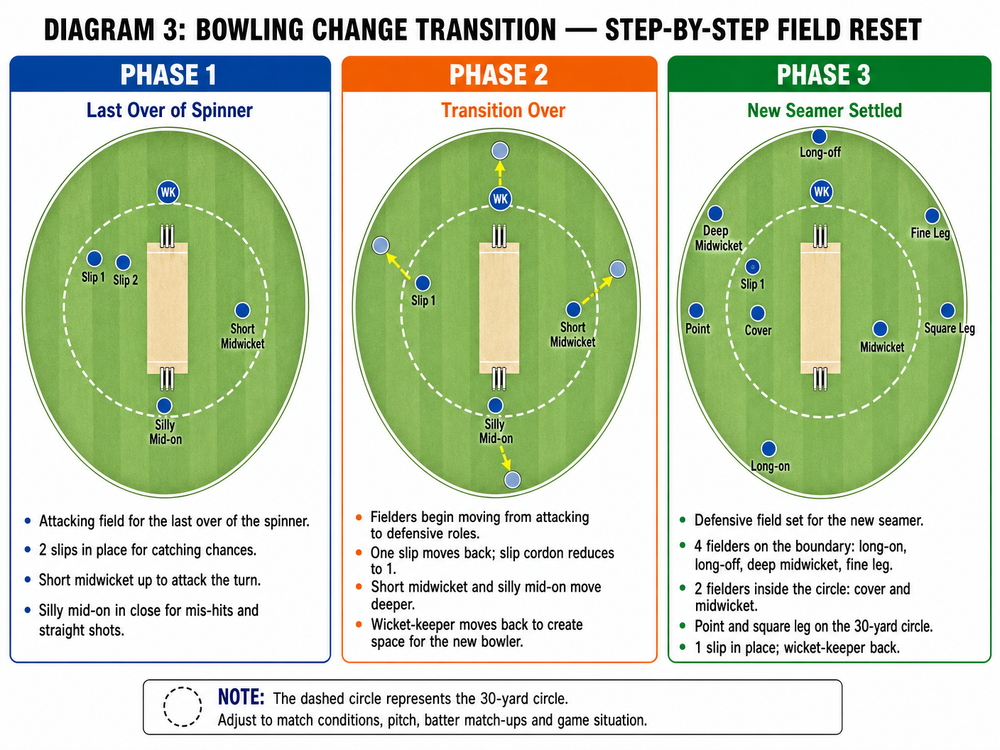
This is the crucial phase where the field transforms from attacking to containment. All fielders must move quickly and decisively.
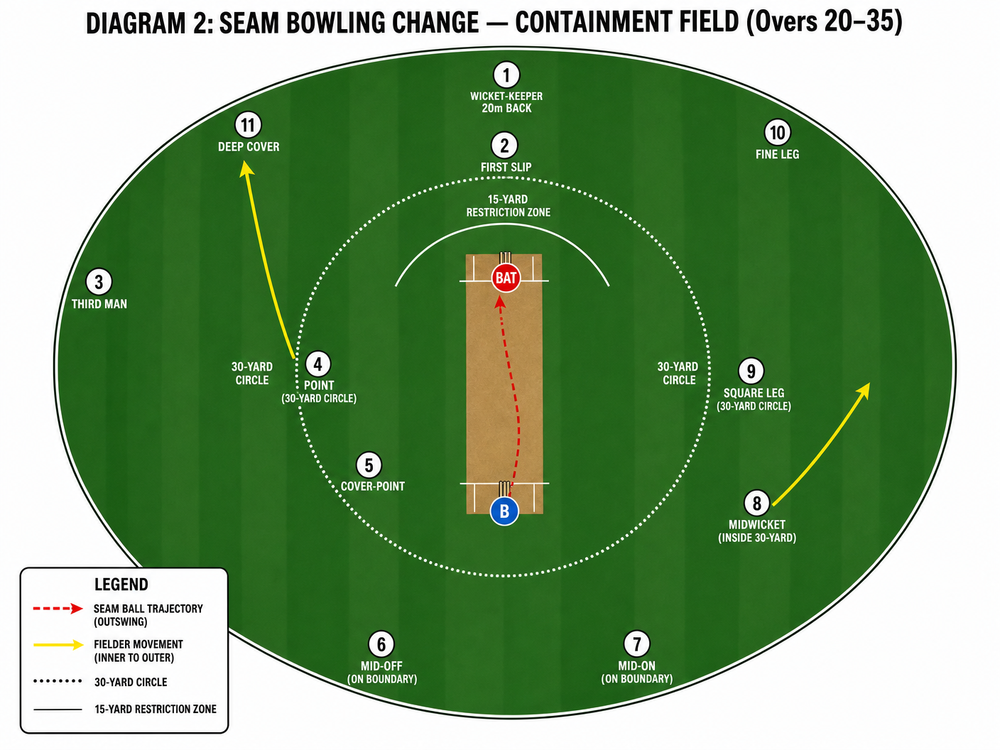
- Wicket-Keeper: Immediately drops back to a comfortable standing-back distance (approximately 18–20m behind the stumps for a medium-fast bowler).
- Slip Cordon: Reduce from two slips to a single conventional first slip, positioned approximately 3m to the right of the keeper.
- Boundary Riders: Push four fielders to the boundary. Standard positions are long-off, long-on, deep midwicket, and fine leg. This protects against the slog and the pull shot.
- Inner Ring: Ensure point, cover, midwicket, and square leg are positioned precisely on the edge of the 30-yard circle to cut off singles and prevent the batting side from rotating the strike.
- All fielders must be in position before the bowler begins their run-up.
Step 4 — The First Over of Seam (The Execution)
The incoming seamer must hit their lengths immediately. There is no room for a 'loosener' in the middle overs.
- The bowler targets the top-of-off-stump corridor consistently, pitching the ball 6–8m from the batting crease.
- Fielders in the inner ring must walk in dynamically with the bowler as they run in, reducing the batters' reaction time and making quick singles difficult.
- The boundary riders must communicate effectively to cover the gaps and avoid misfields.
- If the seamer beats the bat or induces a false shot, the captain should acknowledge it to reinforce the plan and maintain team energy.
4. Key Coaching Points
Immediate Accuracy is Non-Negotiable: The incoming seamer must not bowl any 'release deliveries' (half-volleys or long hops) in their first over. The pressure built by the spinner must be maintained from ball one. A single boundary in the first over of the change can reset the batting side's momentum entirely.
Dynamic Fielding Saves Runs: Fielders inside the 30-yard circle must be active — walking in as the bowler runs in, anticipating the ball, and reacting quickly. A flat-footed inner ring is the fastest way to leak singles and allow the batting side to rotate the strike comfortably.
Communication is a Team Skill: The captain must clearly communicate the plan to the bowler and every fielder before the over begins. Everyone must know their role, their position, and the bowling plan. Confusion during the transition is a gift to the batting side.
Patience Builds Pressure: The objective of this strategy is containment, not instant wickets. Wickets will come as a consequence of the pressure built by consecutive dot balls. Coaches must reinforce this mindset — a maiden over in the middle overs is a significant victory.
Read the Batter's Intent: Fielders and the bowler must read the batter's body language. If a batter is looking to charge down the pitch, the bowler should shorten their length. If they are backing away, the bowler should follow them with a full delivery targeting the stumps.
Manage the Bowling Change Proactively: The best captains plan the bowling change two overs in advance, not at the end of the spinner's over. This allows the seamer to warm up properly and the captain to brief the team without rushing.
5. Common Mistakes
Sloppy Transition: Fielders taking too long to get into their new positions, or walking slowly between overs. This allows the batters to settle, survey the new field, and plan their attack. Every second between overs is valuable — fielders must sprint to their positions.
Poor First Over from the Seamer: The incoming seamer bowling too full (half-volleys inviting the drive) or too short (long hops inviting the pull) in their first over. This releases all the pressure built by the spinner and can shift the momentum decisively to the batting side.
Static Inner-Ring Fielding: Fielders in the inner ring standing flat-footed and not walking in with the bowler. This allows the batters to push the ball into gaps and rotate the strike, keeping the scoreboard ticking and preventing the pressure from building.
Over-Attacking with the Seamer: The captain leaving too many close catchers in place for the seamer (e.g., maintaining two slips and a gully), which exposes the boundaries and allows the batters to score freely through the gaps. A seamer in the middle overs generally requires a more defensive field than a spinner.
Failure to Brief the Whole Team: The captain only briefing the bowler and not communicating the field plan to all fielders. This results in fielders being out of position, covering the wrong areas, and creating confusion that the batting side can exploit.
6. Variations & Progressions
The 'Squeeze' Variation: If the batters are struggling to rotate the strike and are becoming frustrated, bring the boundary riders slightly finer (e.g., moving deep cover to a deep backward point) to cut off specific scoring areas and increase the pressure further. This is particularly effective against a batter who favours the cut shot.
The 'Bouncer Trap' Progression: Once containment is established after two or three overs, introduce a well-directed bouncer (aimed at the body of the batter) to unsettle them, followed immediately by a full delivery targeting the top of off-stump. This two-ball combination can induce a mistimed pull or a drive to a catching position.
The 'Reverse Swing' Adaptation: In the later middle overs (overs 30–40), if the ball is reversing, adjust the field to a more attacking shape — bringing mid-off and mid-on inside the circle and adding a second slip — to capitalise on the late movement.
7. Age Adaptations
Under 12s: Focus purely on the bowler hitting a consistent length on the stumps. Simplify the field placements to five fielders inside the circle and four on the boundary. Teach players the fundamental difference between 'saving one' (inner ring) and 'saving four' (boundary rider). Use cones to mark exact fielding positions during practice.
Under 14s / Under 16s: Introduce the concept of bowling to a specific field. Encourage the captain to take ownership of the field changes and communicate the plan to the team. Begin introducing the idea of match-ups — identifying which fielding positions are most important against a specific batter's strengths and weaknesses.
Open / Senior Level: Expect flawless execution of the transition, with all fielders in position before the first ball is bowled. Incorporate detailed batter analysis (video, statistics) to tailor the containment field precisely to the opposition's strengths and weaknesses. Introduce the concept of 'bowling in partnerships' — where the seamer's plan is designed to complement the spinner's spell and create a sustained period of pressure across multiple overs.
