

Cricket
New Ball Opening Attack Plan: Seam & Swing Masterclass
Master the first 10 overs with this comprehensive tactical guide to setting attacking fields, bowling in partnerships, and exploiting the new ball.
What you need
New 4-piece cricket ball, Stumps and bails (both ends), Full batting protective gear (helmet, pads, gloves, box), Wicket-keeping gloves and pads, Measuring tape (for marking zones in training), Cones or markers (for training drill setup)
1. Overview
The "New Ball Opening Attack Plan" is designed to maximize the advantage of a hard, shining new cricket ball during the crucial first 10 overs of an innings. A successful opening spell sets the tone for the entire fielding innings, applying early pressure and securing vital top-order wickets. This set play focuses on creating a cohesive strategy between two opening bowlers, utilizing aggressive field placements, and demanding disciplined line and length to exploit early swing and seam movement.
By implementing this structured approach, coaches can transition their opening bowlers from operating as individuals to hunting as a coordinated partnership. It ensures that every delivery has a purpose, supported by a field that encourages the bowlers to attack the stumps and the outside edge.
2. Setup

To effectively run this set play in a training environment or execute it in a match, the following setup is required:
- Equipment: A high-quality new cricket ball (preferably a 4-piece ball to ensure pronounced seam and swing), full protective gear for the batsmen, and standard stumps with bails.
- Pitch: A standard 22-yard prepared turf or synthetic cricket pitch.
- Field Dimensions: A standard oval ground (approximately 140m to 160m in diameter) with a clearly marked 30-yard inner circle if playing limited-overs formats.
- Player Positions: A full fielding side of 11 players. The primary focus is on the attacking cordon and inner ring.
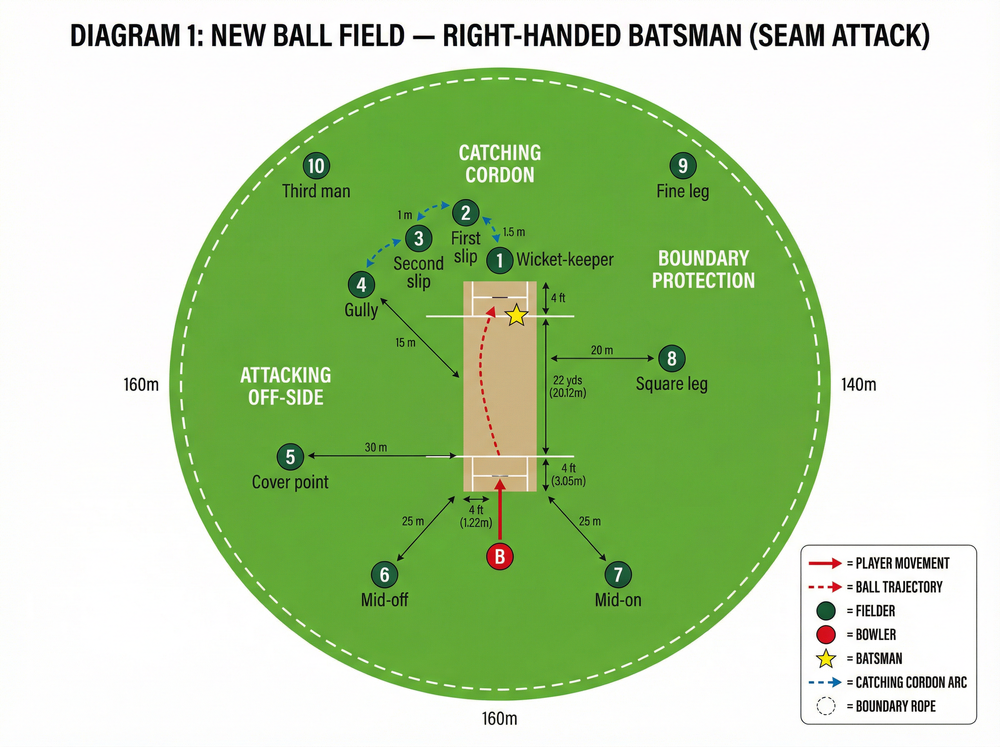
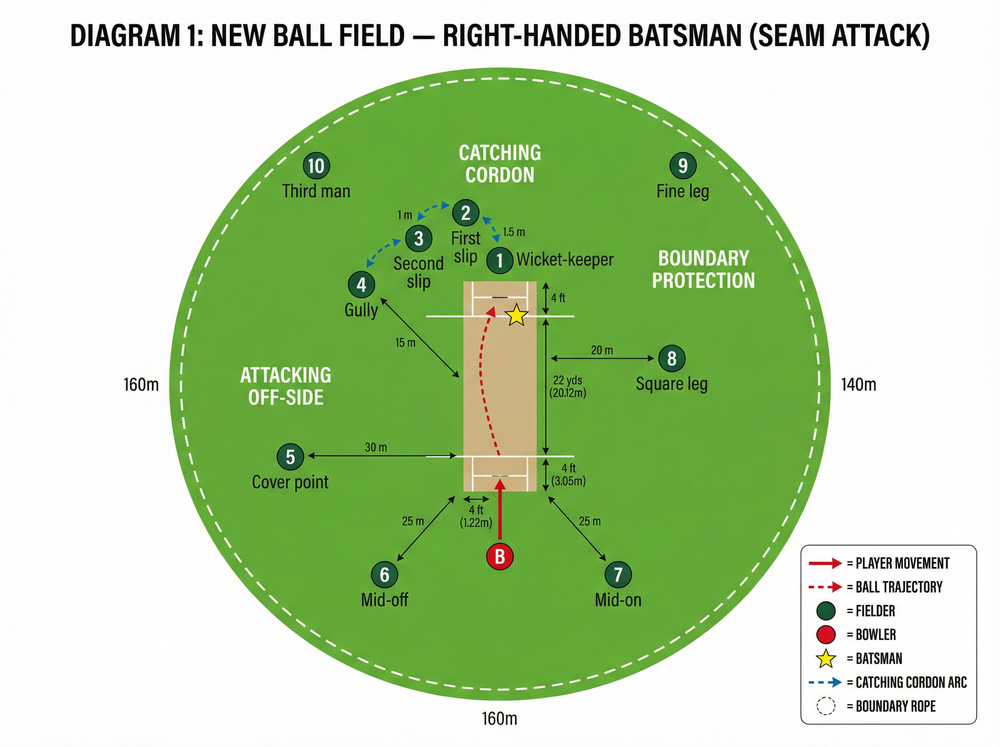
As shown in Diagram 1, the standard attacking field for a right-handed batsman facing a right-arm seam bowler includes:
| Position No. | Position Name | Role |
|---|---|---|
| 1 | Wicket-keeper | Primary catcher, standing back |
| 2 | First slip | Edge catcher, 1.5m from keeper |
| 3 | Second slip | Edge catcher, 1m outside first slip |
| 4 | Gully | Angled edge/cut catcher, 15m from bat |
| 5 | Cover point | Off-side run saver, 30m from bat |
| 6 | Mid-off | Straight boundary protection, 25m |
| 7 | Mid-on | Straight boundary protection, 25m |
| 8 | Square leg | Leg-side run saver, 20m from bat |
| 9 | Fine leg | Deep leg-side boundary protection |
| 10 | Third man | Deep off-side boundary protection |
3. Step-by-Step Instructions

Executing the New Ball Opening Attack Plan requires precision and communication. Follow these steps to implement the strategy:
Establish the Attacking Field: Before the first ball is bowled, set an aggressive field. For a standard seam attack, position a wicket-keeper, two slips, and a gully. Ensure the catching cordon is correctly spaced (approximately 1–1.5 metres apart) and staggered in depth to cover the trajectory of the ball off the edge.
Target the Optimal Zone: The primary objective for the opening bowlers is to consistently hit the "Good Length" area (Zone B, as shown in Diagram 2), which is approximately 6 to 8 yards from the batsman. This length forces the batsman into an uncomfortable decision — play forward or play back — maximising the likelihood of an error.
Command the Off-Stump Channel: Bowlers must consistently target the "corridor of uncertainty" — the line on or just outside the off stump. This line forces the batsman to play at the ball, bringing the slips and wicket-keeper into action while minimising scoring opportunities.
Bowl in Partnerships: The two opening bowlers must communicate and complement each other. If Bowler A is swinging the ball away (outswinger), Bowler B should focus on bowling tight lines into the stumps (inswinger or seam up) to build pressure from the other end. Refer to Diagram 3 for an over-by-over rotation plan.
Assess and Adjust: After the first two overs, the captain and bowlers must assess conditions. If the ball is swinging prodigiously, maintain the attacking field. If the pitch is flat and the ball is not moving, consider moving a slip to a run-saving position such as cover or mid-wicket to build pressure through dot balls.
Execute the Variation Delivery: Once the batsman has settled into the rhythm of the good-length, off-stump line, introduce a planned variation — a fuller yorker, a back-of-length bouncer, or a change of pace — to disrupt their footwork and force a mistake.
4. Key Coaching Points

To ensure your bowlers execute this plan effectively, focus on these critical coaching points during training:
- Patience and Discipline: The golden rule is consistency. Bowlers must aim to land 80% of their deliveries in the optimal zone (Zone B) on an off-stump line. Avoid the temptation to bowl "magic balls" too early in the spell.
- Seam Presentation: Encourage bowlers to focus on a pronounced, upright seam position upon release. A stable seam is essential for maximising both swing in the air and movement off the pitch.
- Active Catching Cordon: The slips and gully must be engaged and anticipating an edge on every delivery. They should maintain a low, athletic posture and move as a synchronised unit, reacting to the bowler's release.
- Communication is Key: The wicket-keeper, captain, and bowlers must constantly communicate regarding the batsman's weaknesses, the condition of the ball, and any necessary field adjustments between overs.
- Run-Up Rhythm: A smooth, controlled run-up is the foundation of consistent bowling. Coaches should monitor the bowler's approach to ensure they are not overstriding or rushing at the crease.
- Ball Maintenance: Assign responsibility for ball maintenance to specific players. Keeping one side dry and one side polished is critical for sustaining swing throughout the opening spell.
5. Common Mistakes

Watch out for these frequent errors that can undermine the opening attack:
- Bowling Too Short (Zone C): Bowlers often drop short in an attempt to be aggressive. This allows the batsman time to adjust and score easily off the back foot, releasing the pressure the field is designed to create.
- Bowling Too Full (Zone A): Over-pitching in search of swing results in half-volleys that are easily driven for boundaries, destroying the bowler's rhythm and confidence.
- Inconsistent Line: Straying onto the batsman's pads (leg-stump line) allows for easy rotation of strike and negates the attacking off-side field entirely.
- Static Fielding: Fielders in the inner ring not walking in with the bowler, resulting in missed run-out opportunities, leaked singles, and a general loss of intensity.
- Ignoring the Partnership: Both opening bowlers bowling the same style and line simultaneously, rather than creating contrast and building pressure from both ends.

6. Variations & Progressions
Adapt the set play based on the match situation and the skill level of your players:
- The Inswing Trap: If the bowler is generating significant inswing, adjust the field by removing the second slip and adding a short mid-wicket or leg gully. The target line shifts from outside off stump to middle-and-leg stump, aiming for LBW or bowled dismissals.
- The Bouncer Barrage (Advanced): For experienced fast bowlers, introduce a targeted short-ball plan. Push mid-on back to deep square leg or fine leg, and have the bowler deliver a well-directed bouncer to unsettle the batsman, followed immediately by a full, swinging delivery to the base of the stumps.
- Spin Opening (Variation): On a turning track or in certain conditions, consider opening with a finger spinner. The field changes drastically, requiring a slip, short leg, and an aggressive inner ring to capitalise on early bounce and turn.
7. Age Adaptations

Modify the expectations and setup based on the age group you are coaching:
| Age Group | Focus | Field Complexity | Tactical Expectation |
|---|---|---|---|
| Under 10s / Under 12s | Accuracy — hit the stumps | Keeper + 1 slip only | Bowl straight, no swing required |
| Under 14s | Off-stump channel | Keeper + 2 slips + gully | Introduce partnership bowling concept |
| Under 16s | Line, length, and variation | Full attacking field | Introduce planned variation delivery |
| Open / Seniors | Full tactical plan | Dynamic field adjustments | Execute individual batsman plans |
For younger age groups, the "New Ball Attack Plan" should be simplified to a core message: bowl good length, bowl straight, and back yourself. As players mature, layer in the tactical complexity of field placements, bowling partnerships, and planned variations.
