

Cricket
Mastering the Powerplay: The Essential Right-Handed Field Setting Play
Learn how to deploy an aggressive yet balanced powerplay field setting to restrict scoring and create early wicket opportunities against right-handed batsmen.

What you need
1 new cricket ball, Full protective gear (batsman/wicketkeeper), 6 marker cones (optional)
1. Overview
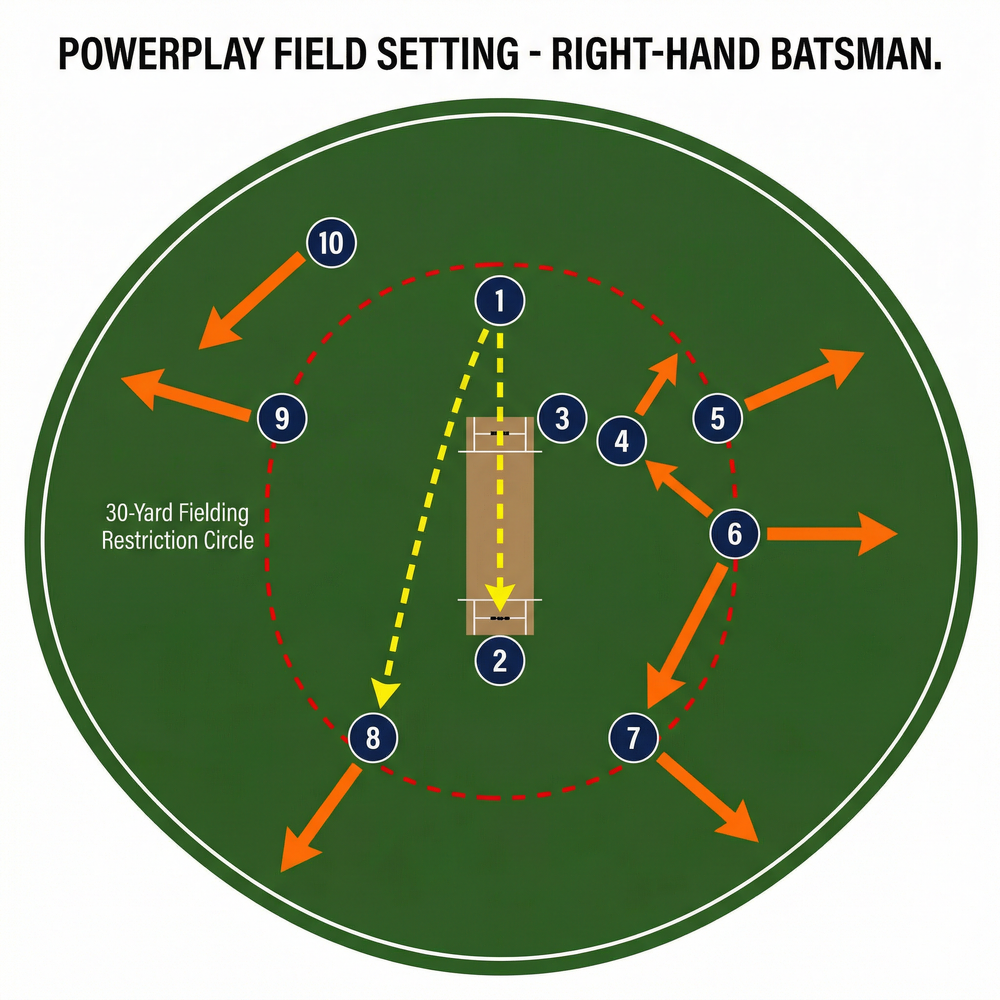
The Powerplay in modern cricket is the critical phase where setting the tone can dictate the entire innings. This set play focuses on a standard, aggressive Powerplay field setting against a right-handed batsman, specifically designed for a fast or medium-fast bowler. The goal is twofold: protect the boundaries while maintaining enough catching positions (like slips and gully) to exploit the new ball's swing and seam movement. By understanding the geometry of the 30-yard circle and the 22-yard pitch, coaches can teach their captains how to choke the scoring rate early on.
2. Setup

- Equipment: 1 new cricket ball, full protective gear for the batsman and wicketkeeper, 6 marker cones (optional, for training positioning).
- Field Setup: Standard oval cricket ground with a clearly marked 30-yard fielding restriction circle and a 22-yard pitch.
- Player Positions: All 10 fielders must be positioned inside the 30-yard circle to comply with standard Powerplay rules (assuming T20 or ODI formats).
3. Step-by-Step Instructions

- Establish the Core Battery: Position the Wicketkeeper (2) at a comfortable distance back for the pace bowler. Place the First Slip (3) relatively fine to cover the outside edge.
- Set the Off-Side Trap: Position a Gully (4) slightly squarer than the slip to catch thick edges. Place a Point (5) square of the wicket on the off-side, right on the edge of the 30-yard circle.
- Secure the Covers: Position a Cover (6) and a Mid-off (7) inside the circle. Mid-off should be fairly straight to prevent the easy single down the ground.
- Lock Down the On-Side: Place a Mid-on (8) straight on the leg side, mirroring Mid-off. Position a Square Leg (9) to stop the pull shot and a Fine Leg (10) inside the circle.
- Execute the Delivery: The Bowler (1) should aim for the 'corridor of uncertainty' — on or just outside the off-stump, on a good length.

4. Key Coaching Points

- Discipline in Line and Length: The field setting is useless if the bowler bowls too straight (onto the pads) or too wide. The primary target must be the top of off-stump.
- Ring Fielder Anticipation: Fielders at Point, Cover, and Mid-off must be on their toes, walking in as the bowler delivers the ball.
- Slip Cordon Spacing: Ensure the gap between the Wicketkeeper, First Slip, and Gully is not too wide; they must move as a cohesive unit.
- Cutting the Angles: Mid-off and Mid-on need to cut the angles on straight drives, forcing the batsman to play high-risk aerial shots to find the boundary.
5. Common Mistakes

- Bowling to the Wrong Field: A bowler drifting onto the pads with this predominantly off-side field will leak easy runs through the leg side.
- Static Fielders: Fielders standing flat-footed inside the circle rather than walking in with the bowler, resulting in missed run-out opportunities.
- Slip Too Deep/Shallow: If the slip is too deep, edges will fall short. If too shallow, the ball will fly over their head. Adjust based on the pitch's pace and bounce.

6. Variations & Progressions

- The In-Swinger Variation: If the bowler is consistently swinging the ball into the right-hander, move the Gully to a Short Mid-wicket position to catch the chipped drive on the leg side.
- The Two-Slip Attack: For exceptional swing conditions, remove the Point fielder and add a Second Slip to increase the catching threat.
- Mid-Over Adjustment: If the batsman starts targeting the square leg boundary, shift the Cover to Backward Point to block the square cut.
7. Age Adaptations

- Under 10 / Under 12: Focus on basic positional awareness. Place fielders in standard run-saving positions like Mid-wicket and Extra Cover. Emphasize bowling straight.
- Under 14 / Under 16: Introduce the 'corridor of uncertainty' concept and the role of Gully and Slip. Teach ring fielders how to 'walk in' and cut off angles.
- Open / Senior: Full implementation of tactical nuances, including mid-over adjustments based on batsman tendencies and precise execution of plans.
