

Cricket
Mastering the Powerplay: Phase 1 Fielding Restrictions Strategy
Equip your bowlers with the ultimate tactical field setting to restrict runs and take early wickets during the crucial first 6 overs of a limited-overs match.

What you need
Standard cricket ball, Stumps and bails, Measuring tape or markers, Cones
1. Overview
The Powerplay (Overs 1-6 in T20s, Overs 1-10 in ODIs) is arguably the most critical phase of a limited-overs cricket match. With only two fielders allowed outside the 30-yard inner circle, the batting team aims to maximize run-scoring by hitting over the infield. As a coach, your objective is twofold: restrict easy singles and create wicket-taking opportunities. This set play focuses on a disciplined, attacking field setup that supports an opening pace bowler looking to exploit the new ball through swing and seam movement.
By employing a structured field, you force the batsman to take high-risk options. The field setting we explore here is designed for a right-arm fast bowler delivering to a right-handed batsman, aiming to hit the top of off-stump consistently.
2. Setup
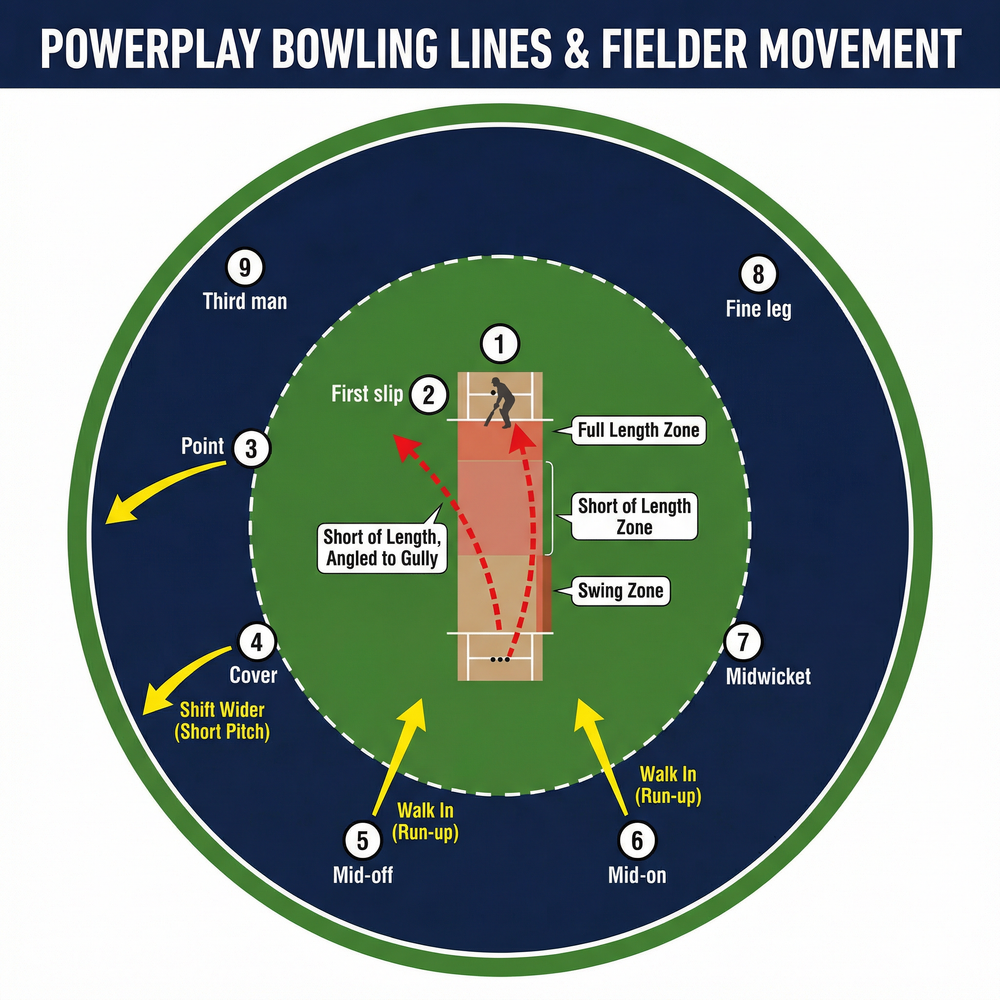
Proper setup is essential for this set play to function effectively. Ensure your players understand their specific roles and the geometry of the field.
Equipment Needed
- Standard cricket ball (new ball preferred to simulate match conditions)
- Stumps and bails
- Measuring tape or markers (to define the 30-yard circle if not painted)
- Cones (optional, for marking specific fielder zones during practice)
Pitch and Field Dimensions
- Pitch Length: 22 yards (20.12 metres)
- Inner Circle: 30-yard (27.43 metres) radius from the centre of each wicket, connected by parallel lines.
- Boundary: Typically 65-70 metres from the centre of the pitch.
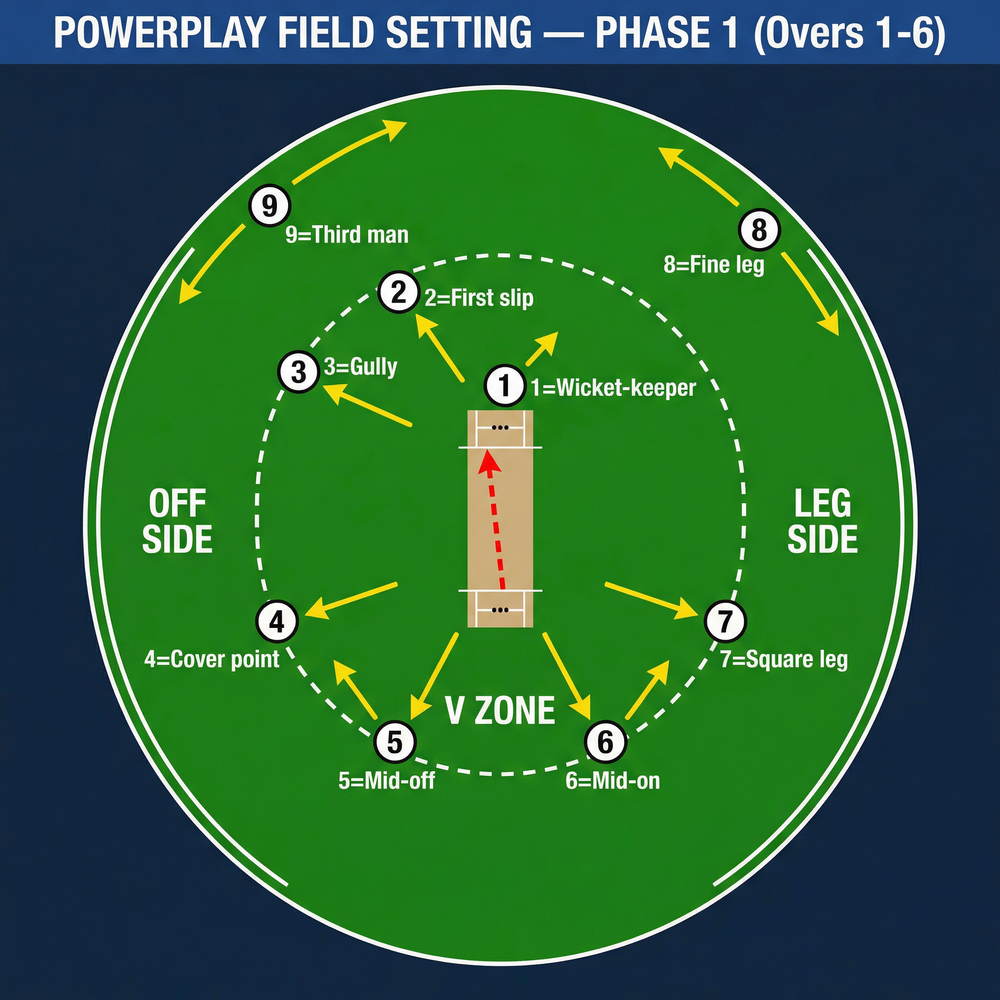
Player Positions

- Wicket-keeper: Standing back for the fast bowler.
- First Slip: Positioned for the outside edge.
- Gully: Catching position for backward point/gully area.
- Cover Point: Inside the circle, cutting off the square drive.
- Mid-off: Inside the circle, stopping the straight drive.
- Mid-on: Inside the circle, stopping the straight drive on the leg side.
- Square Leg: Inside the circle, saving the single on the leg side.
- Fine Leg: On the boundary (one of the two allowed outside).
- Third Man: On the boundary (the second fielder allowed outside).
3. Step-by-Step Instructions
Executing this set play requires coordination between the bowler and the fielding unit.
- Establish the Line and Length: The bowler must commit to bowling a 'top of off-stump' line. The length should be full enough to encourage the drive but not a half-volley.
- Set the Infield Trap: Position Cover Point, Mid-off, and Mid-on tightly inside the 30-yard circle. These fielders must be agile, ready to cut off firmly struck drives and prevent quick singles.
- Deploy the Catching Cordon: Place First Slip and Gully in aggressive catching positions. They must be perfectly aligned with the wicket-keeper, maintaining a staggered depth to avoid collisions.
- Secure the Boundaries: Position Third Man and Fine Leg on the boundary. These fielders act as sweepers for edges (Third Man) and stray deliveries on the pads (Fine Leg).
- Bowler's Approach: As the bowler begins their run-up, the infielders (specifically Mid-off and Mid-on) should take a couple of steps in ('walking in'). This builds pressure and reduces the batsman's reaction time for quick singles.
- Execution and Adjustment: The bowler delivers the ball. If the ball swings away, the slip cordon is in play. If it nips back, Mid-on and Square Leg become the primary run-savers.
4. Key Coaching Points
- Discipline in Line and Length: The entire field setting relies on the bowler's accuracy. A wide delivery renders the leg-side field useless, while a short, wide ball easily pierces the off-side ring.
- Fielder Anticipation: Infielders must 'walk in' with the bowler. Standing flat-footed allows the batsman to steal quick singles.
- Slip Cordon Spacing: Ensure First Slip and Gully are spaced correctly. Too close, and they obstruct each other; too wide, and edges will fly between them.
- Communication: The wicket-keeper is the captain of the fielding unit. They must continuously communicate with the slip cordon and adjust their depth based on the pitch's bounce.
- Protecting the 'V': Mid-off and Mid-on must be resolute. Boundaries hit straight down the ground during the Powerplay are demoralizing and disrupt the bowler's rhythm.
5. Common Mistakes
- Bowler Chasing Wickets: Often, bowlers try too hard to swing the ball and end up bowling too full (half-volleys) or too straight (on the pads), leading to easy boundaries.
- Static Infielders: Fielders inside the circle failing to move as the ball is bowled. This lack of energy allows the batting side to rotate the strike effortlessly.
- Incorrect Boundary Placement: Placing Third Man or Fine Leg too square or too fine. They must be positioned based on the bowler's exact line of attack and the batsman's known strengths.
- Neglecting the Captain-Bowler Dynamic: The captain failing to consult the bowler when making minor field adjustments, leading to a disconnect between the field set and the ball bowled.
6. Variations & Progressions
Variation 1: The Aggressive Off-Side Trap
If the ball is swinging significantly away from the right-hander, move the Fine Leg inside the circle (perhaps to Short Mid-wicket) and place a Deep Point on the boundary. This allows the bowler to attack the off-stump relentlessly without fear of the square cut going for four.
Variation 2: The Leg-Side Strangle
For a bowler who naturally angles the ball into the right-hander, move the Gully to Short Mid-wicket or Short Square Leg. Keep Fine Leg on the boundary and move Third Man inside the circle (to Short Third Man). The bowler targets the stumps and pads, daring the batsman to hit through the heavily populated leg side.
Progression: Scenario Training
Set up a match simulation where the batting team needs 45 runs off the 6 Powerplay overs. The fielding team must use this exact field setting to defend the target. This applies pressure and tests the players' ability to execute the strategy under match-like conditions.
7. Age Adaptations
- Under 10 / Under 12: Focus on the absolute basics. Ensure players understand the concept of the 30-yard circle. Don't worry about slip cordons; place those fielders in standard run-saving positions like Cover and Mid-wicket. Emphasize the bowler hitting the pitch rather than specific tactical lines.
- Under 14: Introduce the concept of protecting boundaries and stopping singles. You can introduce a single slip fielder. Focus heavily on the 'walking in' technique for infielders.
- Under 16 / Open: Implement the full strategy. Players should understand the nuance of moving fielders a few yards left or right based on the batsman's movements. Emphasize communication and tactical awareness.
