

Cricket
Mastering the Powerplay: Attacking & Containment Field Settings
Learn how to strategically set attacking and containment fields during the crucial first 6 overs to take early wickets and restrict scoring.

What you need
Cricket Ball, Stumps and Bails, Marker Cones (for 30-yard circle)
1. Overview
The Powerplay (typically the first 6 overs in a T20 match or the first 10 overs in an ODI) is the most critical phase of a limited-overs cricket match. During this period, fielding restrictions are in place, allowing only two fielders outside the 30-yard circle. This creates a high-stakes environment where batsmen look to exploit the gaps, while the fielding captain must balance the aggressive pursuit of early wickets with the need to restrict boundaries.
This set play resource provides a comprehensive guide for coaches and captains to deploy two distinct strategies: an Attacking Field designed to induce edges and take wickets, and a Containment Field aimed at protecting boundaries when the batsmen are on the offensive.
2. Setup
Equipment Needed:
- 1x Cricket Ball (new ball preferred for realistic swing/seam movement)
- Full set of stumps and bails
- Marker cones (to outline the 30-yard circle if not painted)
Pitch & Field Setup:
- Standard 22-yard cricket pitch.
- Clearly marked 30-yard fielding restriction circle.
- 11 players on the fielding team (1 Bowler, 1 Wicket-keeper, 9 Fielders).
3. Tactical Formations & Step-by-Step Instructions
Strategy A: The Attacking Powerplay Field
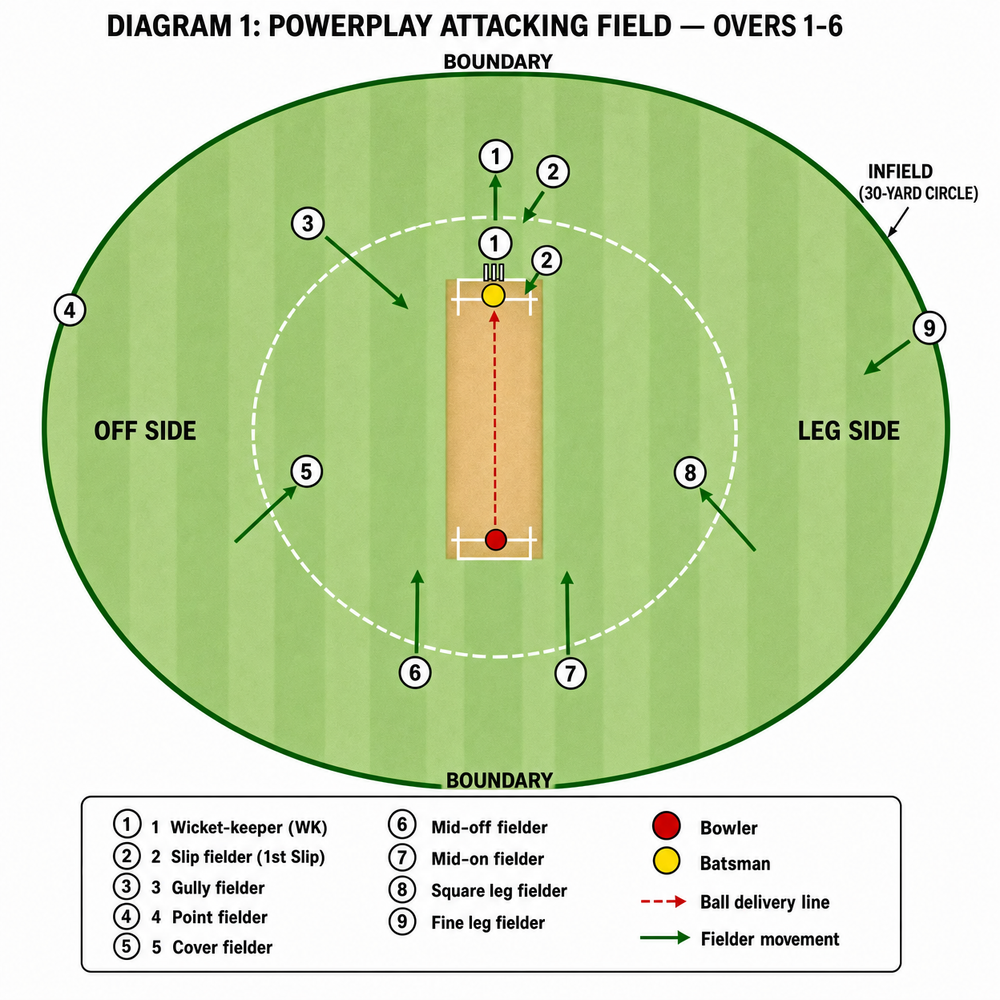
This field is used in the first 2-3 overs when the ball is new, hard, and likely to swing or seam. The goal is to take wickets by catching the ball behind the wicket or inside the circle.

Step-by-Step Instructions:
- Wicket-keeper (1): Stand back for fast bowlers, ready to catch edges.
- Slip Cordon (2 & 3): Position a 1st Slip and a Gully to catch outside edges induced by outswingers.
- Infield Ring (5, 6, 7, 8): Place Cover, Mid-off, Mid-on, and Square Leg inside the 30-yard circle to cut off singles and pressure the batsmen.
- Boundary Riders (4 & 9): Position Point and Fine Leg on the boundary to protect against the cut shot and the stray leg-side delivery.
- Bowler Execution: The bowler must pitch the ball up (full length) outside the off stump, inviting the drive to bring the slips and gully into play.
Strategy B: The Containment Powerplay Field
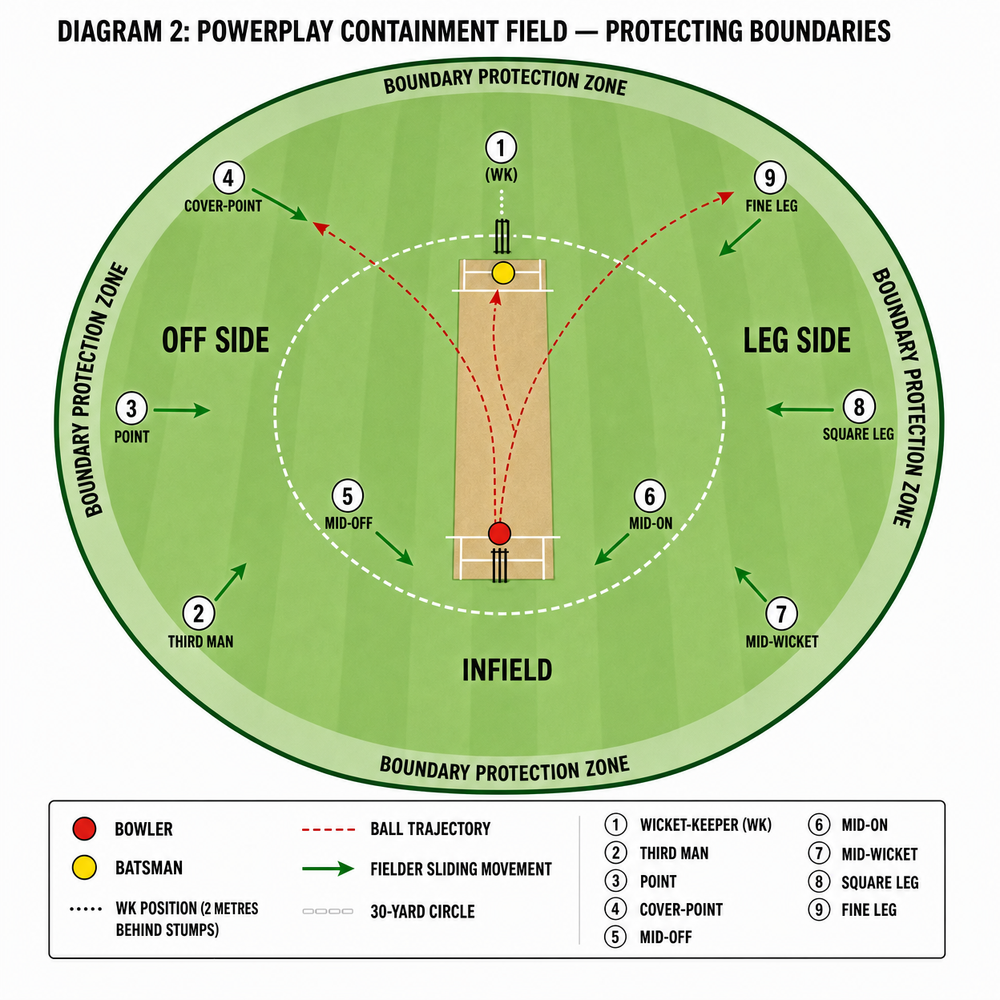
If the batsmen start aggressively and boundaries are flowing, the captain must shift to a containment strategy. The goal here is to force the batsmen to hit straight to the fielders or take risky aerial routes.
Step-by-Step Instructions:
- Remove the Slips: Drop the slip and gully fielders back to save runs.
- Widen the Ring (3, 4, 5, 6, 7): Spread the infielders wider. Point, Cover-point, Mid-off, Mid-on, and Mid-wicket should be positioned to cut off the angles.
- Boundary Protection (2, 8, 9): Use the two allowed boundary riders effectively. Common positions are Third Man (to protect against the ramp/steer) and Fine Leg or Deep Square Leg (to protect against the pull/sweep).
- Bowler Execution: The bowler must change their line and length. Bowling 'back of a length' or targeting the stumps/pads restricts the batsman's room to free their arms.
Bowling Execution: Hitting the Right Zones
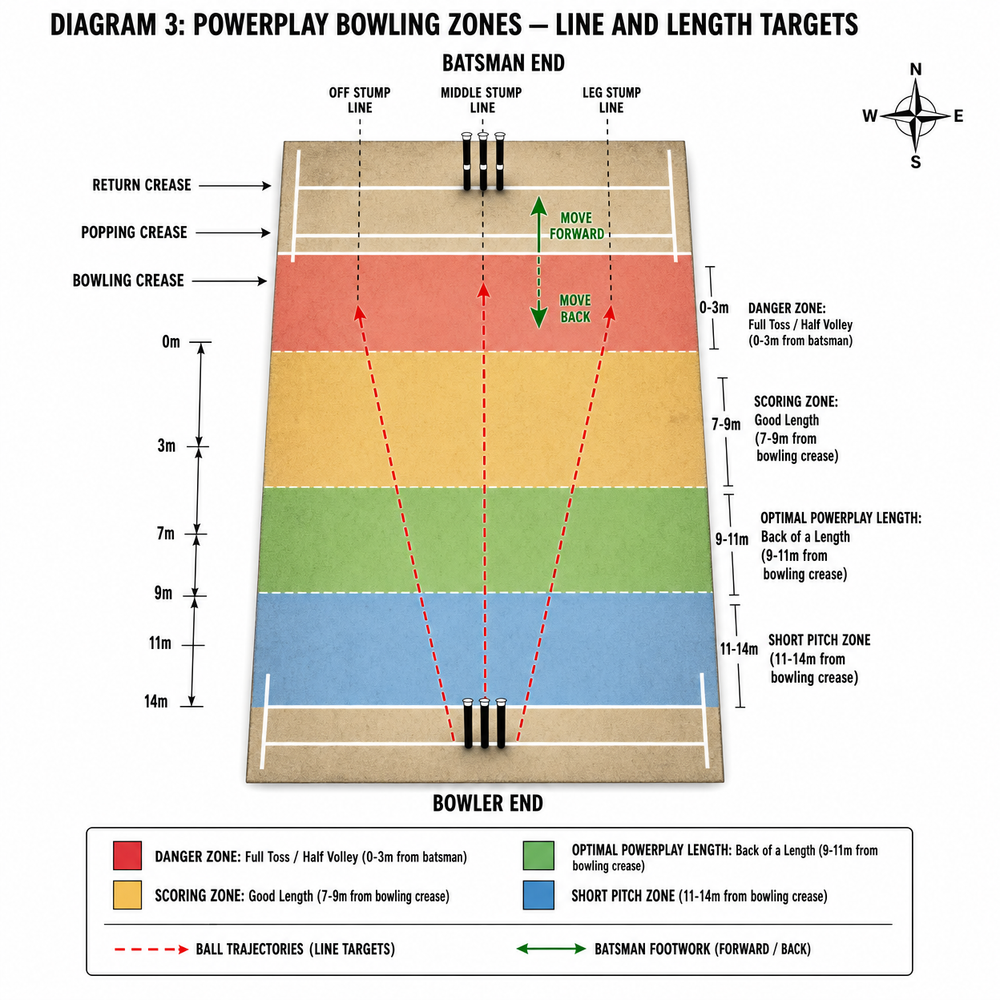
The success of any field setting relies entirely on the bowler hitting the correct line and length.
- Danger Zone (0-3m): Avoid bowling full tosses or half volleys, as these are easily driven for boundaries.
- Scoring Zone (7-9m): While a 'good length' is standard, it can be dangerous in the Powerplay if the batsman steps down the pitch.
- Optimal Powerplay Length (9-11m): 'Back of a length' is often the hardest to hit for boundaries over the infield.
4. Key Coaching Points
- Bowler-Fielder Synergy: The field setting must match the bowler's plan. If the field is set for outswing (slips in place), the bowler MUST bowl outside off stump.
- Ring Fielder Anticipation: Fielders inside the 30-yard circle must walk in with the bowler and be on their toes, ready to dive and save the single.
- Communication: The captain, bowler, and wicket-keeper must constantly communicate to adjust the field based on the batsman's movements and weaknesses.
- Adaptability: Don't be rigid. If a batsman hits two boundaries through the covers, immediately adjust the field to plug that gap.
5. Common Mistakes
- Bowling to the Wrong Field: A bowler delivering down the leg side when the field is heavily packed on the off side.
- Static Fielding: Fielders standing flat-footed in the ring, allowing easy singles.
- Over-attacking: Keeping slips in place for too long even after the ball has stopped swinging and the batsmen are scoring freely.
6. Variations & Progressions
- Progression 1 (Spin in the Powerplay): Introduce a spinner. Bring the wicket-keeper up to the stumps and use a slip and a short third man.
- Progression 2 (Targeting Weaknesses): If a batsman is weak against the short ball, push mid-on back to the boundary and bring a fielder to short leg or leg gully.
7. Age Adaptations
- Under 10 / Under 12: Focus purely on bowling straight and basic fielding positions. Avoid complex slip cordons. Emphasize stopping the ball in the ring.
- Under 14 / Under 16: Introduce the concept of bowling to a specific field. Practice setting fields for outswing vs. inswing bowlers.
- Open / Senior: Full implementation of attacking vs. containment strategies, including real-time adjustments based on match situations.
