

Cricket
Running Between the Wickets: The Call, Commit & Ground Drill
A complete, game-realistic drill that teaches batsmen to communicate clearly, judge runs decisively, and ground their bat efficiently — turning hesitant runners into confident, match-winning partners.

What you need
Cricket pitch (22 yards) or marked equivalent, 2 sets of stumps with bails (or 4 cones), 6-8 cricket balls or tennis balls, 2 cricket bats, Batting pads (optional), Cones for crease marking, Stopwatch or coaching timer, Whiteboard or scoreboard (for scoring version)
Overview
Running between the wickets is one of the most undercoached skills in the game, yet it is responsible for a disproportionate number of run-outs at every level. This drill — the Call, Commit & Ground sequence — isolates the three non-negotiable habits of elite running: a loud, early call from the striker, an immediate and committed response from the non-striker, and a decisive bat-grounding action at the crease. Used as a warm-up activity or as a standalone 20-minute block, it is equally effective for junior development squads and senior club sides.
Coaches should deploy this drill early in a pre-season programme to establish the vocabulary and habits that will carry through the entire season. It is also an excellent reset drill mid-season when a team has been losing wickets to avoidable run-outs.
Setup

Equipment Required
- 1 full-length cricket pitch (22 yards) or marked equivalent on any flat surface
- 2 sets of stumps with bails (or 4 cones as substitutes)
- 6-8 cricket balls (or tennis balls for junior groups)
- 1 batting pad set per active batsman (optional but recommended)
- 1 bat per active batsman
- Cones to mark the batting crease if stumps are unavailable
- Stopwatch or coaching timer
Pitch & Field Setup
Use a standard 22-yard pitch. Mark both the popping crease (4 feet in front of the stumps) and the return crease clearly with chalk or cones. No wider field setup is required for the foundational version of this drill. For the progression version (Drill 2), place 5 fielders at: Mid-on (1), Mid-off (2), Square Leg (3), Cover (4), and Fine Leg (5) as shown in the diagram below.
Player Positions
| Role | Label | Starting Position |
|---|---|---|
| Striker (Batsman 1) | B1 | Striker's end crease |
| Non-Striker (Batsman 2) | B2 | Non-striker's end crease |
| Ball Feeder / Coach | CF | 10 yards from B1, off-side |
| Fielder 1 | F1 | Mid-on (approx. 25 yards from pitch) |
| Fielder 2 | F2 | Mid-off (approx. 25 yards from pitch) |
| Fielder 3 | F3 | Square Leg (approx. 20 yards from pitch) |
Pairs rotate every 8 runs or 2 minutes, whichever comes first. With 8-12 players, run two simultaneous pairs on adjacent pitches.
Step-by-Step Instructions


Phase 1 — The Foundational Drill (No Fielders)
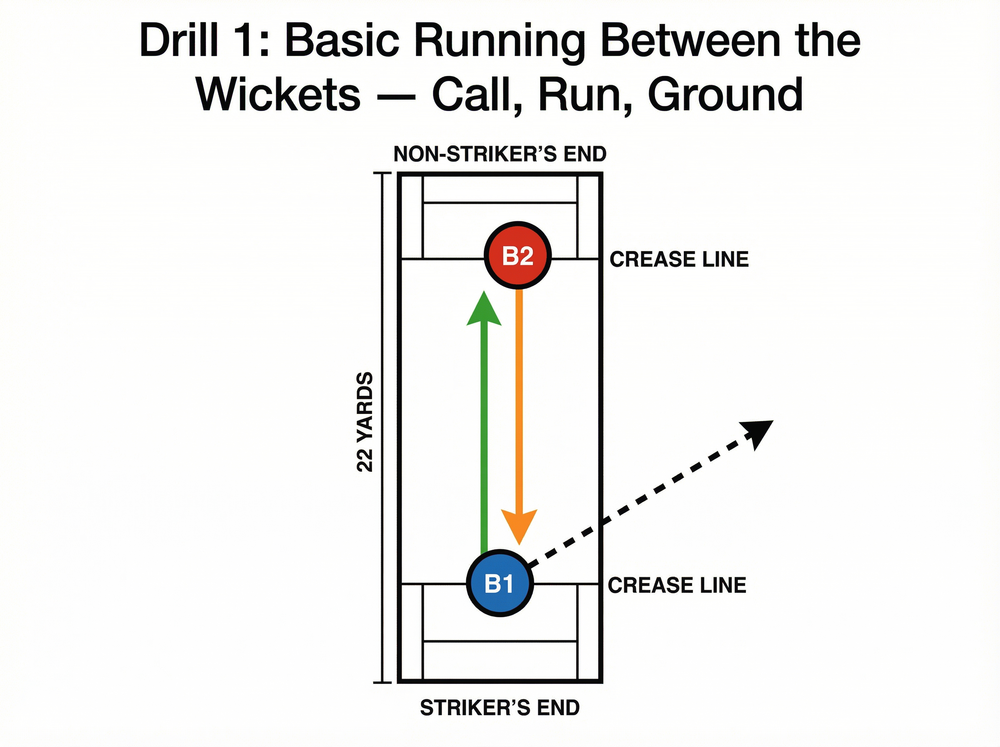
- Position B1 at the striker's end and B2 at the non-striker's end. Both batsmen stand behind their respective popping creases, bats grounded.
- The coach or ball feeder rolls or underarms a ball to B1's off-side, simulating a defensive push or a flick into the leg-side gap. The ball should travel 5-8 yards from the pitch.
- B1 watches the ball leave their bat (or the feeder's hand), immediately assesses whether a run is available, and calls loudly: YES, NO, or WAIT. The call must be made within 1 second of contact.
- B2 responds to the call — if YES, B2 immediately sets off from behind the crease, running hard and low, bat carried in the hand closest to the stumps. B2 does not wait to see where the ball goes.
- Both batsmen sprint the full 22 yards, running in a straight line along the edge of the pitch (not down the centre, to avoid collision).
- At the receiving end, each batsman grounds their bat behind the popping crease — bat slides along the ground, arm fully extended — before decelerating. This is the Ground phase.
- B1 then assesses the second run: if the ball is still moving away from the fielder, B1 calls YES again. If the fielder has the ball, B1 calls NO and both batsmen stay put.
- Repeat the sequence 8 times per pair. The coach records any hesitations, late calls, or failure to ground the bat.
Phase 2 — Pressure Running with Live Fielders

- Set up 3-5 fielders in the positions described above (Mid-on, Mid-off, Square Leg, Cover, Fine Leg).
- The coach feeds the ball to different zones — sometimes into a gap (inviting a run), sometimes directly at a fielder (inviting a NO call).
- B1 must call within 1 second of the ball leaving the feeder's hand. Fielders react immediately and attempt to run out either batsman.
- Introduce a scoring system: 1 point for each completed run, minus 2 points for each run-out. This creates genuine decision-making pressure.
- After 8 feeds, rotate the batting pair and bring in fresh fielders. Keep a running team score on a whiteboard.
- The coach should vary the pace and direction of feeds to simulate different shot types: a firm drive to cover, a tickle to fine leg, a push to mid-on.
Key Coaching Points

The call is the striker's responsibility — always. When the ball is hit in front of the wicket (cover, mid-off, mid-on, mid-wicket), the striker can see the ball and the fielder simultaneously. The call must be loud, clear, and immediate — not a whisper or a gesture.
The non-striker must be ready to move at the moment of contact. B2 should be standing just behind the crease, weight forward, eyes on B1's bat. A non-striker who is flat-footed or looking at the bowler will always be a half-step slow.
Run hard to the crease, not to the ball. Many junior batsmen slow down when they see the fielder gathering the ball. Teach players: your job is to get your bat over the line — let the fielder worry about the throw.
Ground the bat, do not jump it. The bat must be slid along the ground behind the popping crease. A bat that is lifted and tapped down can be beaten by a fast throw. The slide is always safer and faster.
Turn at the crease on the inside shoulder. When completing a run and considering a second, batsmen should turn toward the ball — this keeps them facing the fielder and allows a faster reassessment. Turning away from the ball means a blind second run.
WAIT is a valid call — but it must be followed by a decision. A WAIT call means both batsmen hold their ground momentarily while the striker reassesses. It must be resolved within 2 seconds with either a YES or NO — a prolonged WAIT creates hesitation and is a leading cause of run-outs.
Common Mistakes

| Mistake | What It Looks Like | How to Correct It |
|---|---|---|
| Late or silent call | B1 hits the ball and begins running before calling, leaving B2 stranded mid-pitch | Enforce a rule: if no call is heard within 1 second, the run is void. Repeat the feed until the call is instinctive. |
| Non-striker not ready | B2 is standing upright or looking away at the point of contact, losing 1-2 metres of reaction time | Have B2 adopt a ready position — weight on the balls of the feet, bat in hand, eyes on B1's bat — before every feed. |
| Bat lifted over the crease | Batsman taps or lifts the bat rather than sliding it along the ground | Drill the grounding action in isolation: have players sprint 5 yards and slide the bat 10 times before adding the full run. |
| Running down the centre of the pitch | Both batsmen converge toward the middle, risking collision and obstructing the fielder's line of sight | Use two parallel cone lines 1 yard either side of the pitch centre. Each batsman must stay outside their cone line. |
| Calling for a second run too early | B1 calls YES for a second run before reaching the crease, causing B2 to turn prematurely | Teach the rule: the second-run call is only made after the bat is grounded at the receiving end. |
Variations & Progressions

Variation 1 — Blind Ball Feed
The coach hides the ball behind their back and releases it in a random direction. This prevents batsmen from pre-reading the ball and forces a genuine real-time call. Excellent for intermediate and advanced groups.
Variation 2 — Timed Runs Challenge
Use a stopwatch to time how long it takes both batsmen to complete 3 consecutive runs (6 crease-groundings in total). Target times: Under-12: under 28 seconds; Under-16: under 24 seconds; Open: under 21 seconds. Post times on a leaderboard to build competitive motivation.
Progression — Live Throw-Down with Wicketkeeper
Add a wicketkeeper at each end. Fielders now throw at the stumps in real time. The drill becomes a full run-out simulation. Batsmen must ground the bat before the stumps are broken. This is the most game-realistic version and is recommended for senior club and representative players.
Age Adaptations
| Age Group | Key Modifications |
|---|---|
| Under 8 / Under 10 | Shorten the pitch to 14-16 yards. Use tennis balls. Simplify the call to just YES or NO — remove WAIT. Focus only on the call and the sprint; do not introduce fielders until the call habit is established. Celebrate every correct call loudly. |
| Under 12 / Under 14 | Use the full 22-yard pitch. Introduce the WAIT call. Add 2 fielders (Mid-on and Cover only). Introduce the scoring system to build decision-making pressure. Begin timing runs to introduce accountability. |
| Under 16 / Open | Full drill as described, including all 5 fielders, live throws, and wicketkeeper. Add the Blind Ball Feed variation. Introduce video review — film the drill from behind the stumps and review calls and grounding technique with players post-session. |
Drill designed for use on a standard oval cricket ground with a 22-yard pitch. Suitable for net sessions, pre-match warm-ups, and dedicated skills sessions. Recommended session frequency: once per week during pre-season, once per fortnight in-season.
