

Cricket
Mastering the Slip Cordon: Setup, Spacing, and Catching Dynamics
A comprehensive guide for coaches to establish an impenetrable slip cordon, focusing on precise positioning, staggered depth, and elite catching technique that can be drilled from the very next session.

What you need
6-8 cricket balls (new or good condition), 1 bat, wicket-keeping gloves and pads, field marker cones (4-5), slip cradle or deflection board (optional, for progressions)
Overview
The slip cordon is arguably the most critical catching area on a cricket field, particularly in the longer formats of the game or when the new ball is in play. A well-organized slip cordon not only creates sustained pressure on the batsman but is responsible for the majority of edge-induced dismissals across all levels of cricket. This resource provides coaches with the exact mechanics of setting up a cohesive slip cordon — ensuring correct spacing, staggered depth, and synchronized movement to maximize every catching opportunity.
This set play is most effective when bowling with a new or swinging ball, on pitches with uneven bounce, or when targeting a technically uncertain batsman who plays away from their body. It is equally applicable in Test, first-class, and club cricket, and can be adapted for junior formats with minor modifications.
Setup
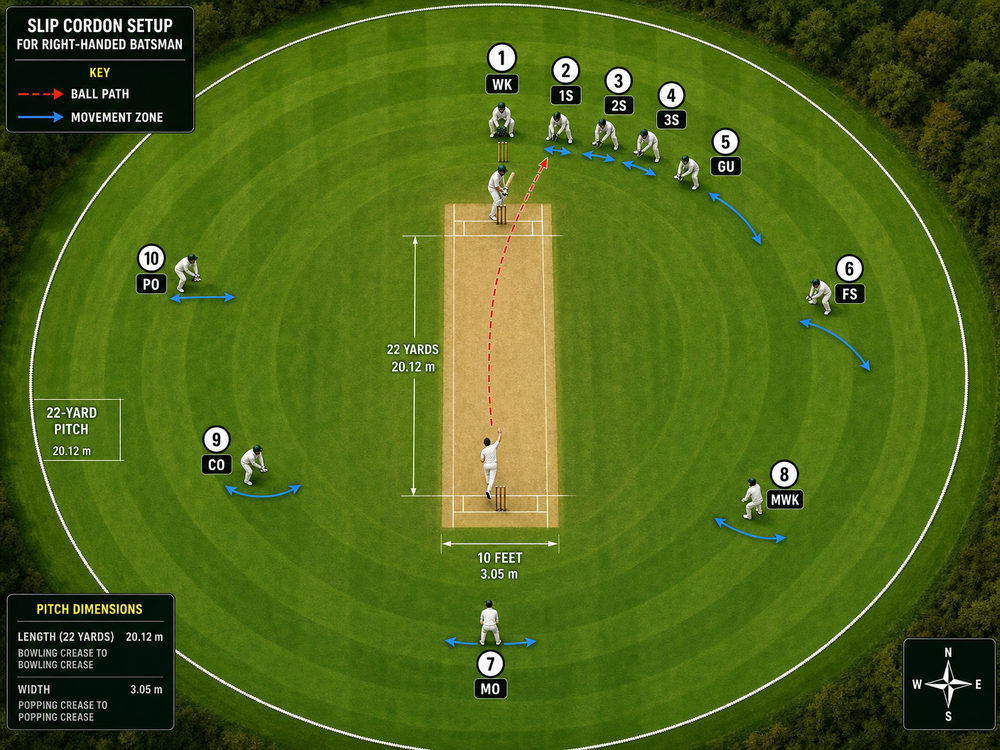
Proper setup is the foundation of a successful slip cordon. Positioning must be precise, taking into account the pace of the bowler, the bounce of the pitch, and the handedness of the batsman.
Equipment Needed
| Item | Quantity | Purpose |
|---|---|---|
| Cricket balls (new or good condition) | 6–8 | Simulate true bounce and swing |
| Bat | 1 | Coach provides realistic edges |
| Wicket-keeping gear | 1 set | Full gloves and pads for WK |
| Cones or field markers | 4–5 | Mark initial starting positions during training |
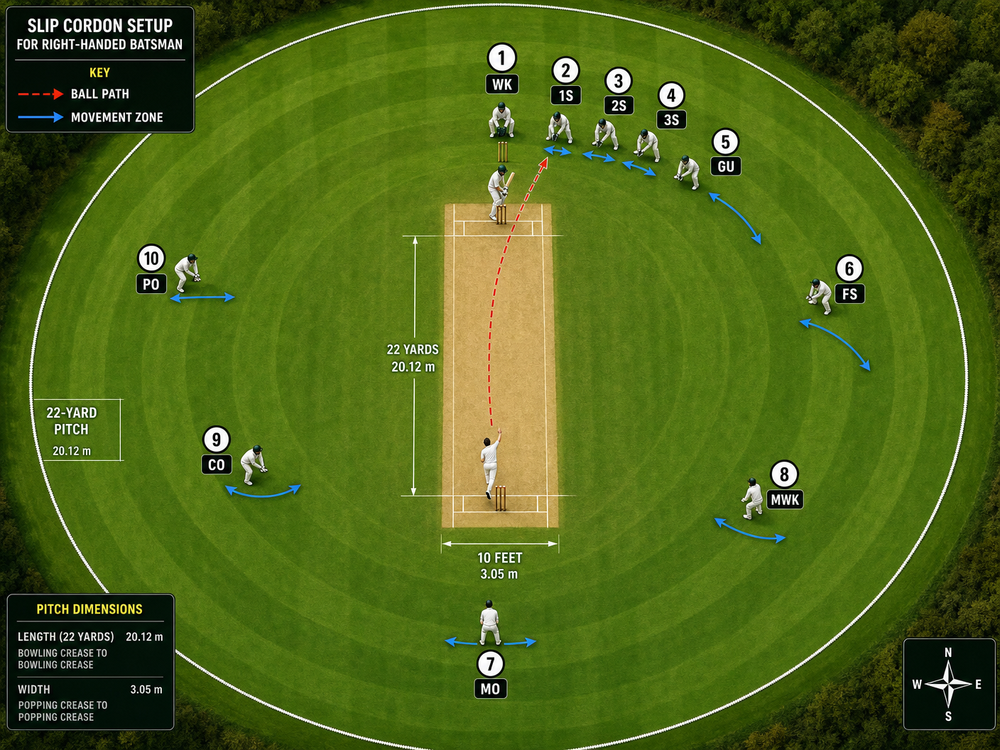
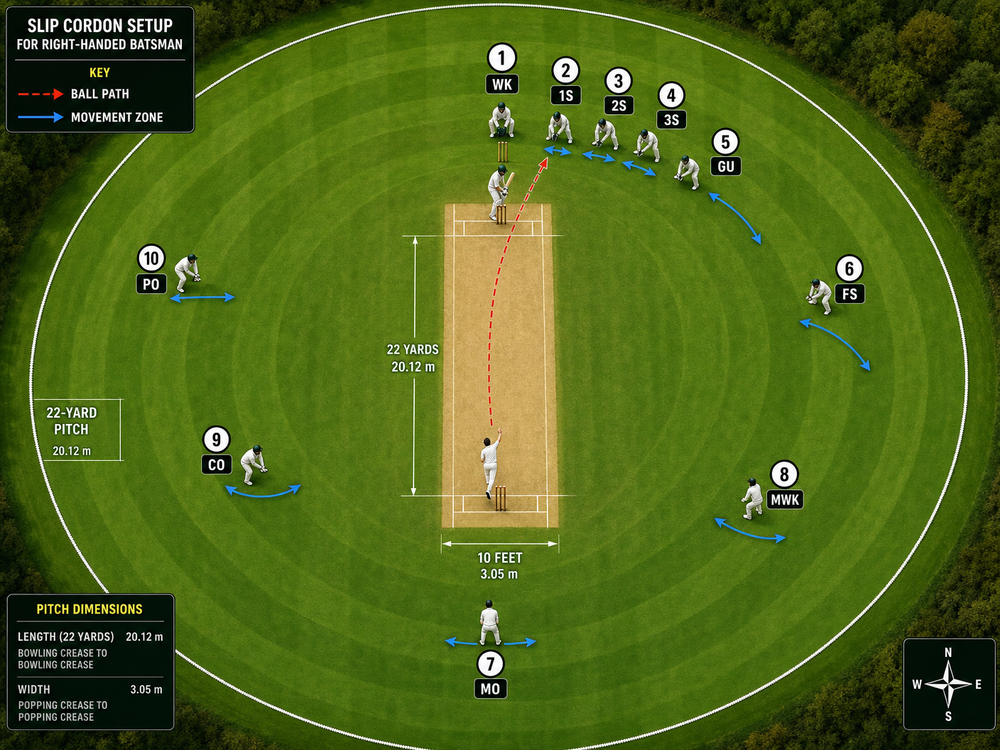
Pitch and Field Dimensions: Use a standard 22-yard (20.12 m) pitch on a full-size oval ground. The slip cordon setup focuses entirely on the area behind the batsman's stumps on the off-side.
Player Positions (Right-Handed Batsman)
| Position | Abbreviation | Placement |
|---|---|---|
| Wicket-Keeper | WK | Directly behind the stumps; depth varies with bowler pace |
| First Slip | 1S | 1–1.5 m to the right of WK, slightly deeper |
| Second Slip | 2S | 1.5–2 m to the right of 1S, slightly deeper again |
| Third Slip | 3S | 1.5–2 m to the right of 2S, slightly deeper again |
| Gully | GU | Wider and squarer than 3S, behind the popping crease |

Diagram 1: Full field view showing the complete slip cordon setup for a right-handed batsman, with ball trajectory (dashed red) and fielder movement zones (solid blue).
Step-by-Step Instructions
Anchor the Wicket-Keeper. The WK sets the depth for the entire cordon. For a fast bowler, the WK should stand back approximately 2–3 metres behind the stumps. For medium pace, 1–1.5 metres. The WK's position is the reference point from which all slips are measured.
Place First Slip. 1S positions themselves approximately 1 to 1.5 metres to the right of the WK (off-side), and crucially, slightly deeper. This stagger is non-negotiable — it prevents 1S from obscuring the WK's view and allows both fielders reaction time on the same edge.
Place Second and Third Slip. Each subsequent slip follows the same principle: roughly 1.5 to 2 metres wider and slightly deeper than the previous fielder. The cordon should form a gentle diagonal arc, not a straight line.
Place Gully. Gully sits wider and squarer than the slip cordon, positioned to intercept thick edges, cut shots, or balls that deflect off the shoulder of the bat. Gully typically stands at roughly 45 degrees from the batsman's off-stump.
Adopt the Ready Stance. As the bowler enters their delivery stride, all slip fielders must adopt a low, balanced athletic stance simultaneously. Weight is on the balls of the feet, knees bent, back flat, and hands hanging loose and relaxed in front of the body. This synchronized movement is a hallmark of elite cordons.
Execute the 'Walk In' (Optional). Many experienced cordons use a gentle synchronized walk-in as the bowler approaches the crease, settling into their final stance just before the ball is released. This keeps fielders alert and prevents flat-footed reactions.
React and Communicate. On the delivery, all fielders track the ball from the bowler's hand. On an edge, the fielder in whose zone the ball travels moves decisively. For balls falling between two fielders, the first to call "Mine!" loudly and clearly takes ownership. The other fielder immediately yields.
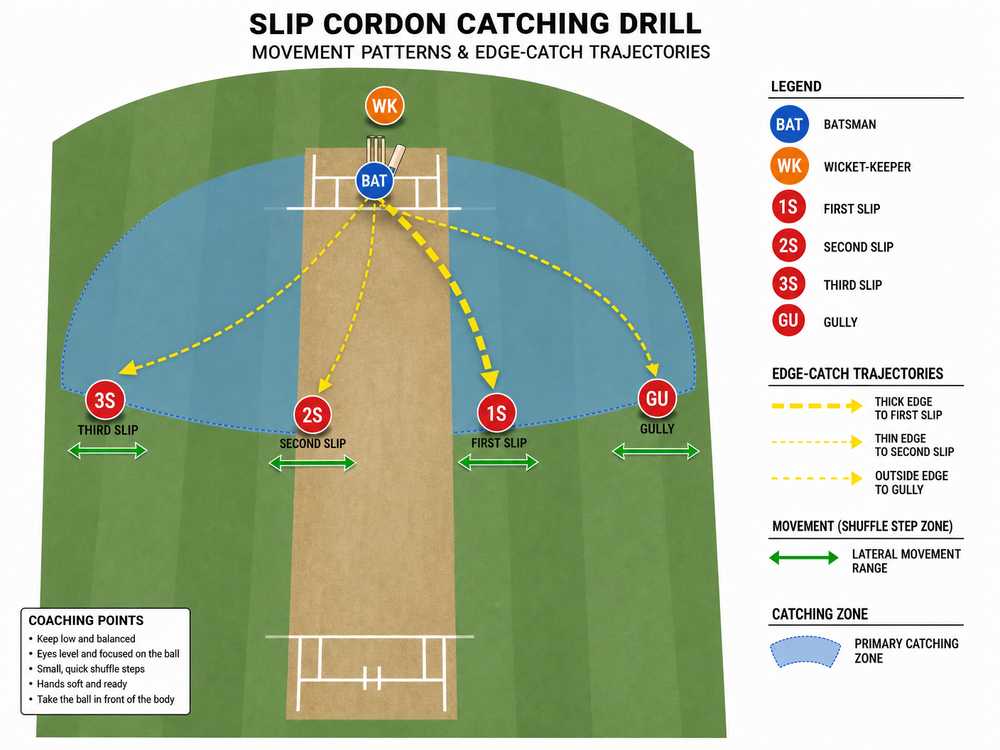
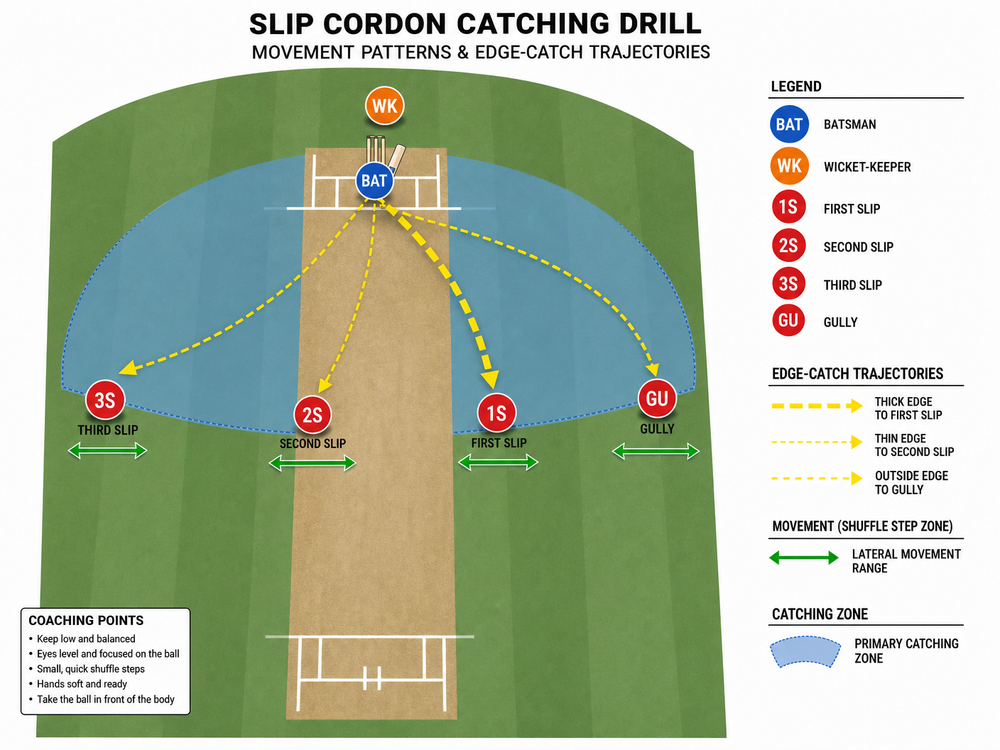
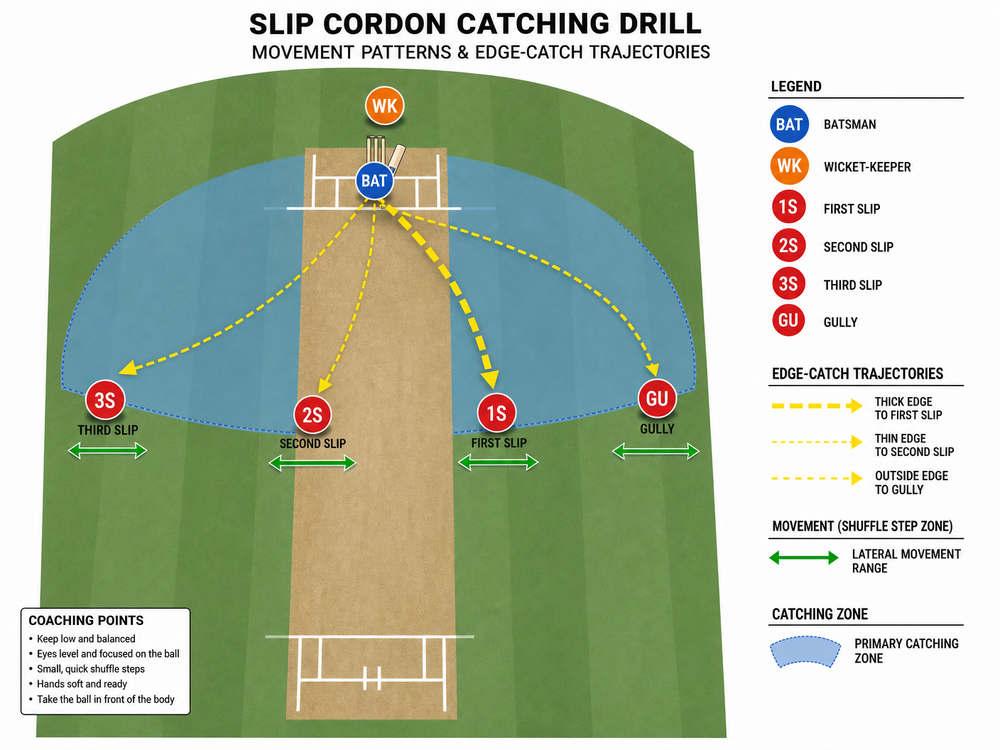
Drill the Cordon. The coach stands at the batting crease and hits varied edges — thick, thin, high, low, and deflections — into the cordon using a bat or slip cradle. Fielders react, communicate, and execute catches. Run the drill in sets of 10 edges, rotating the focus between different positions.
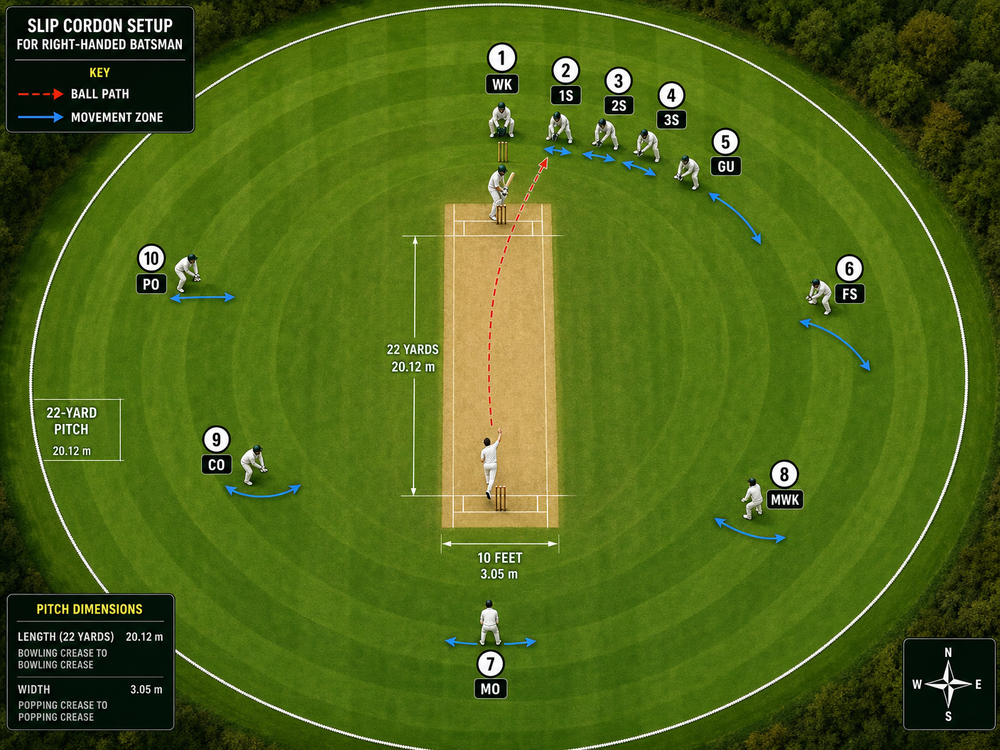
Diagram 2: Close-up of the slip cordon showing edge-catch trajectories (dashed yellow) and each fielder's lateral shuffle-step movement range (green arrows).
Key Coaching Points
1. Staggered Depth is Non-Negotiable.
Slips must form a diagonal arc from the WK outward, with each position progressively deeper. This prevents fielders from blocking each other's line of sight and eliminates dangerous collisions on shared catches. Reinforce this constantly — it is the single most common structural error at junior and club level.
2. Stay Low for as Long as Possible.
It is significantly easier to push upward to a high catch than to drop down to a low, dying edge. Coaches should emphasize that the stance must be maintained until the ball has clearly passed the bat. Premature rising is a leading cause of dropped catches in the slip cordon.
3. Soft Hands are Everything.
When catching, the hands must give with the ball — absorbing the pace rather than fighting it. Hands that are rigid or that snatch aggressively at the ball will cause the ball to pop out. Teach fielders to think of their hands as a cradle, not a clamp.
4. Watch the Ball, Not the Bat.
Fielders should lock their eyes onto the ball as it leaves the bowler's hand and track it continuously. Watching the bat leads to anticipatory movements that are frequently wrong. The ball tells the truth; the bat is a distraction.
5. Communicate Early and Loudly.
On any catch in a shared zone, the first call wins. Hesitation is the enemy. Coach your fielders to be decisive and vocal — a dropped catch due to a communication failure is entirely preventable.
6. Synchronize the Stance.
The cordon should move as a single unit. A fielder who is still upright when the ball is edged is already too late. Use video review in training to show fielders how synchronized elite cordons are, and replicate that discipline.
Common Mistakes
Mistake 1: Standing Too Close Together Laterally.
Fielders who are too close to one another will hesitate on shared catches, each assuming the other will take it. Enforce the arm's-length-plus spacing rule rigorously during setup.
Mistake 2: Standing in a Straight Line.
A flat cordon with no staggered depth is a structural failure. Fielders block each other's vision and cannot react independently. Use cones during training to physically mark the correct staggered positions until the habit is ingrained.
Mistake 3: Rising Out of the Stance Too Early.
This is the most common individual error. Fielders anticipate a short-pitched delivery or a ball that passes through and stand up before the edge occurs. Drill the stance discipline relentlessly — fielders must hold their low position through the entire delivery.
Mistake 4: Snatching at the Ball.
Fielders who push their hands aggressively toward the ball, rather than letting it come into their hands, will drop catchable edges consistently. Introduce soft-hands drills using a tennis ball thrown from close range to build the correct muscle memory.
Mistake 5: Poor Communication on Shared Catches.
Silence on a shared catch is a dropped catch waiting to happen. Make communication a non-negotiable part of every catching drill, not just slip cordon practice.
Variations and Progressions
Progression 1 — Slip Cradle or Deflection Board.
Replace the coach's bat with a slip cradle or angled deflection board. This creates highly unpredictable, rapid edges that fielders cannot anticipate, significantly increasing the difficulty and realism of the drill.
Progression 2 — Fatigue Drill.
Run the full slip cordon drill at the end of a training session when players are physically and mentally tired. This simulates the concentration demands of the final session of a long day's play — precisely when catches are most likely to be dropped in match conditions.
Variation 1 — Pace Variation.
Alter the speed of the edges hit by the coach to simulate different bowler types. Slow, looping edges replicate spin bowling; sharp, flat edges replicate fast bowling. This trains the cordon to adjust their depth and reaction time accordingly.
Variation 2 — Left-Handed Batsman Setup.
Mirror the entire cordon to the leg-side, repositioning the WK and all slips to the left of the stumps. This is an important variation that is often neglected in training, yet left-handed batsmen appear regularly in match play.
Age Adaptations
| Age Group | Key Modifications |
|---|---|
| Under 10 / Under 12 | Use Incrediballs or soft training balls. Limit the cordon to WK and 1st Slip only. Focus entirely on basic stance and soft hands. No stagger required at this stage — build confidence first. |
| Under 14 | Introduce 2nd Slip and the concept of staggered depth. Begin communication drills on shared catches. Use a tennis ball for reaction work before progressing to a cricket ball. |
| Under 16 | Full three-slip cordon plus gully. Introduce the walk-in routine. Begin video review of stance and catching technique. |
| Open / Senior | Full cordon with all tactical nuances. Introduce fatigue drills, slip cradle work, and left-handed batsman variations. Focus on consistency and match-simulation pressure. |
