

Cricket
Mastering Spin Bowling Variations: The 'Mystery Spinner' Circuit
A comprehensive station-based drill designed to help spin bowlers develop, control, and execute variations like the arm ball, googly, and top-spinner under pressure.
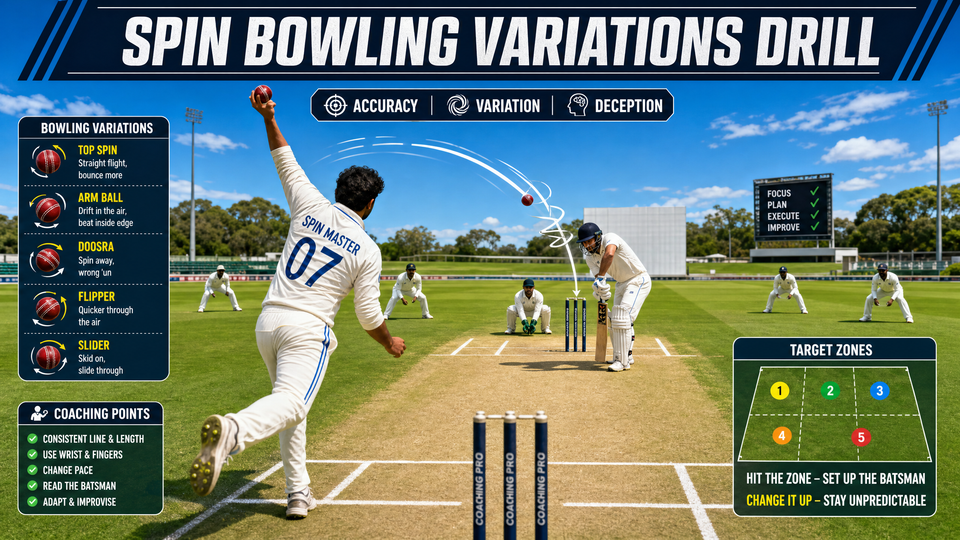
What you need
Full set of stumps, Single stump, 12-15 flat markers or cones, 18 cricket balls, Measuring tape
1. Overview
Spin bowling is as much about deception as it is about turning the ball. A spinner who only bowls their stock delivery becomes predictable, allowing the batsman to settle into a rhythm. This drill, the 'Mystery Spinner' Circuit, is designed to help spin bowlers (both off-spin and leg-spin) develop and perfect their variations. By isolating specific deliveries in a controlled environment and then gradually introducing pressure, bowlers learn not just how to bowl a variation, but when and where to land it.
This drill is ideal for intermediate to advanced bowlers who already have a consistent stock delivery and are looking to add weapons to their arsenal, such as the arm ball, the top-spinner, the googly, or the flipper.
2. Setup
To run this drill effectively, you need a full 22-yard pitch and clear target areas.
Equipment Needed:
- 1 full set of stumps (batsman's end)
- 1 single stump (bowler's end)
- 12-15 flat markers or cones (various colors)
- 6 cricket balls per station (ideally a mix of new and slightly worn balls)
- Measuring tape (optional, for precise target placement)
Pitch Setup:
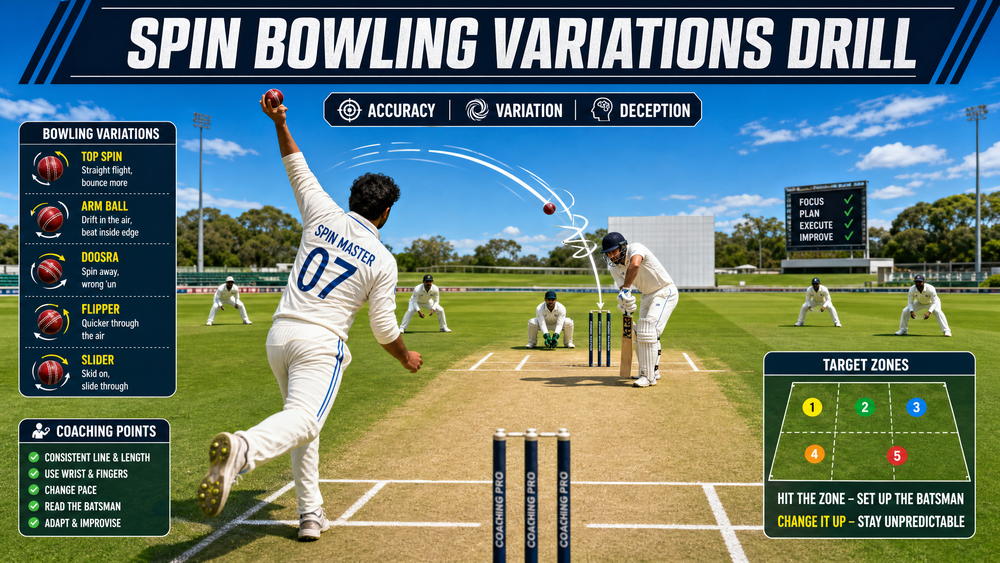
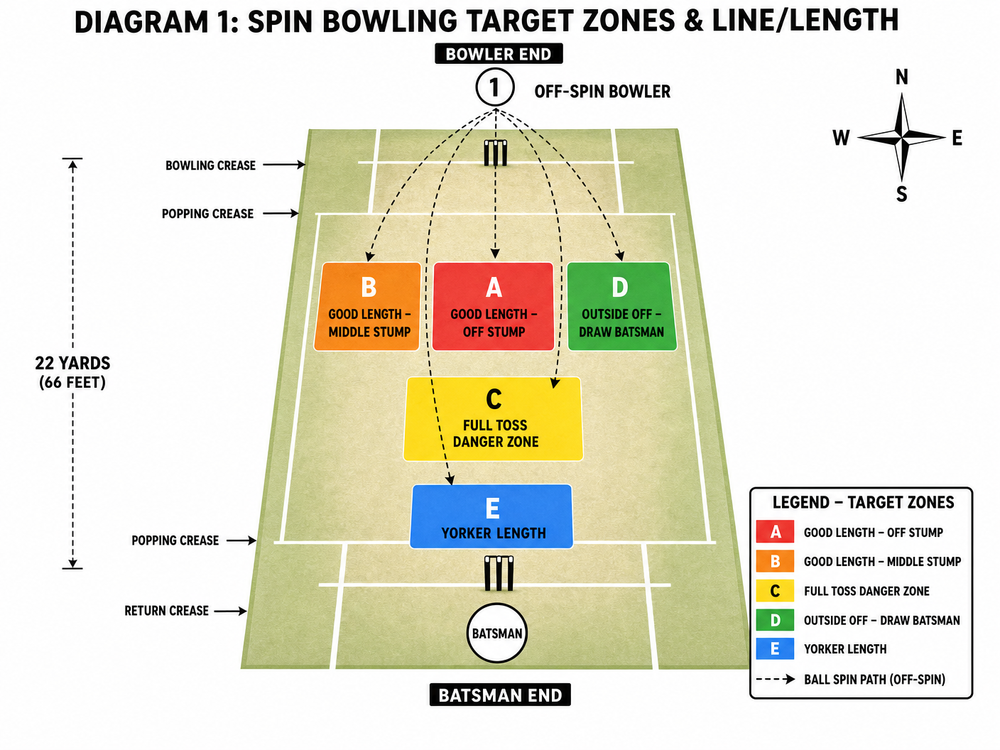
As shown in Diagram 1, set up specific target zones on the pitch using the flat markers.
- Zone A (Red): Good length, off stump line (The standard stock delivery zone).
- Zone B (Orange): Good length, middle/leg stump line.
- Zone C (Yellow): Full toss danger zone (Avoid this area).
- Zone D (Green): Outside off stump (To draw the batsman out).
- Zone E (Blue): Yorker length.
For a standard off-spinner, the stock ball should pitch in Zone D or A and turn into the stumps. An arm ball should pitch in Zone A or B and skid straight on.
3. Step-by-Step Instructions
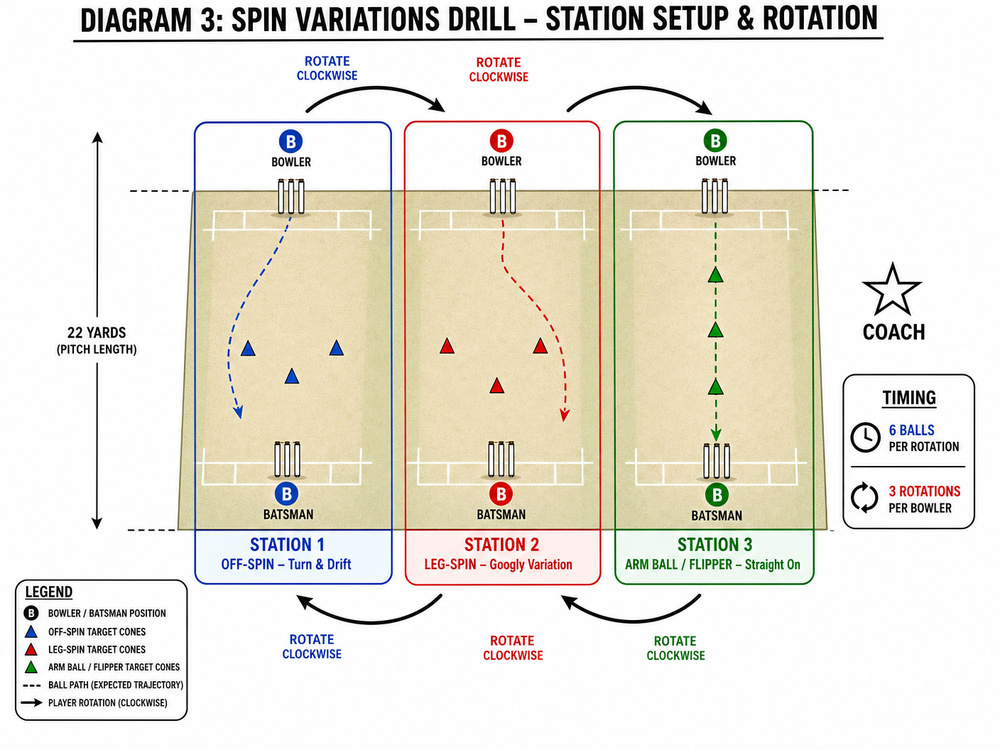
This drill is run as a circuit with three distinct stations.
Station 1: The Stock Delivery (Consistency)
- The bowler starts at Station 1.
- The goal is to bowl 6 consecutive stock deliveries (e.g., standard off-breaks or leg-breaks).
- The bowler must hit the primary target zone (Zone A or D depending on the bowler type) at least 4 out of 6 times.
- Focus purely on heavy revolutions on the ball, a consistent release point, and a repeatable action.
Station 2: The Primary Variation (Deception)
- The bowler moves to Station 2.
- Here, the focus shifts entirely to their primary variation (e.g., the arm ball for an off-spinner, or the googly for a leg-spinner).
- The bowler delivers 6 balls, aiming for the specific target zone for that variation (e.g., Zone B for an arm ball targeting LBW).
- The coach stands behind the stumps to observe the seam position and release point, ensuring the action doesn't noticeably change from the stock delivery.
Station 3: The Match Scenario (Execution)
- At the final station, the bowler must mix their deliveries.
- The coach calls out the required delivery just as the bowler begins their run-up (e.g., "Stock!", "Variation!", "Yorker!").
- The bowler must adjust quickly and execute the called delivery, hitting the corresponding target zone.
- This station tests the bowler's ability to disguise their variations and execute under cognitive pressure.
4. Field Placement Integration
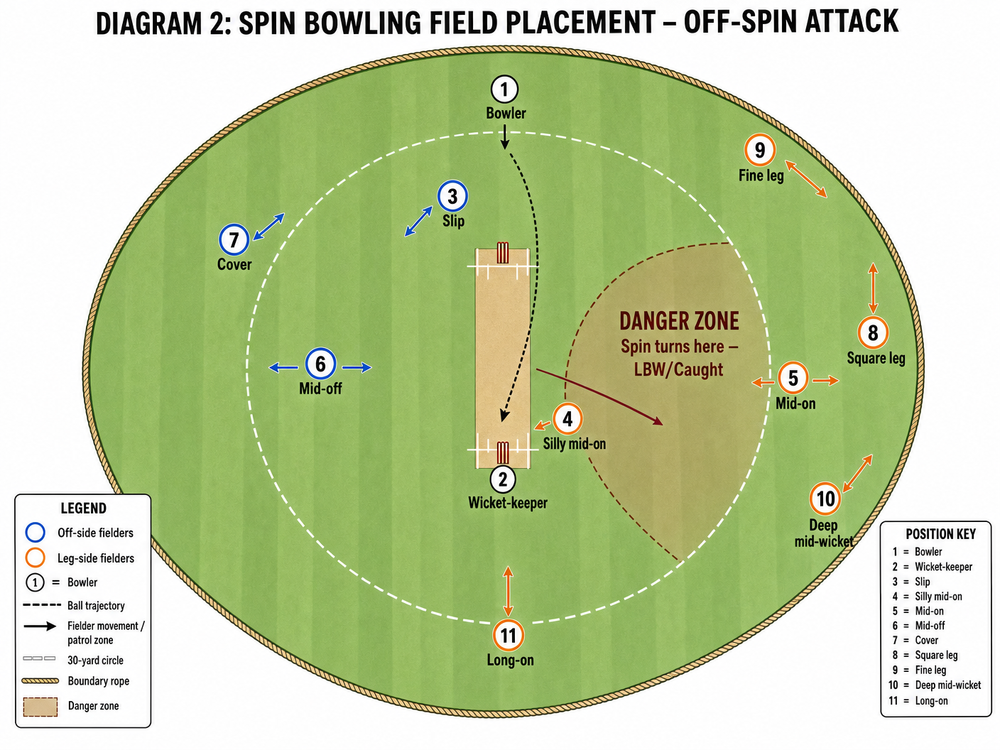
Understanding where to bowl a variation is directly tied to the field placement. Diagram 2 shows a standard attacking field for an off-spinner.
When bowling the arm ball (which skids straight on), the bowler is primarily targeting LBW or bowled. Therefore, fielders at silly mid-on (Position 4) or short leg become crucial catchers for inside edges, while mid-on (Position 5) and mid-wicket (Position 10) are in play for mistimed drives.
5. Key Coaching Points
- Maintain Arm Speed: The most common tell for a variation is a slower arm speed. Ensure the bowler maintains the same arm speed for the variation as they do for their stock ball.
- Disguise the Grip: Work with the bowler to ensure the grip change happens late in the run-up or is hidden within the bowling action.
- Seam Position: Observe the seam. A good stock delivery usually has a prominent seam position, while variations like the arm ball or slider may have a scrambled seam or a seam pointing straight down the pitch.
- Follow-Through: A strong, complete follow-through is essential for both the stock ball and the variation to ensure maximum energy is transferred to the ball.
6. Common Mistakes
- Telegraphing the Delivery: Changing the run-up speed, jump height, or arm angle when bowling a variation. The batsman will spot this immediately.
- Over-Bowling Variations: Bowling too many variations in an over. The variation is only effective if it's a surprise. A good ratio is 1 variation for every 5 stock balls.
- Losing Accuracy: Sacrificing line and length in the pursuit of turning the ball or executing a complex variation. Accuracy must always come first.
7. Variations & Progressions
- Add a Batsman: Introduce a batsman who is instructed to play defensively. This adds realistic visual cues for the bowler and pressure to execute.
- Point System: Assign points for hitting specific target zones (e.g., 3 points for a perfect arm ball hitting Zone B, -1 point for a full toss in Zone C). Make it a competition between bowlers.
- Blindfold Call: The coach calls the variation when the bowler is in their delivery stride, forcing rapid neural adaptation and decision-making.
8. Age Adaptations
- Under 10 / Under 12: Focus entirely on the stock delivery. Do not introduce complex variations like the doosra or googly until the stock ball is completely mastered and accurate.
- Under 14 / Under 16: Introduce one simple variation (like the arm ball or top-spinner). Focus heavily on the grip and maintaining arm speed. Use larger target zones.
- Open / Seniors: Run the full circuit as described, focusing on subtle changes in release, trajectory, and exploiting specific batsman weaknesses.
