

Cricket
T20 Innings Acceleration: A Tactical Guide for Coaches
A phase-by-phase tactical blueprint for coaches to train their players to structure a T20 innings for maximum run-scoring — from a dominant powerplay to a devastating death-overs assault.
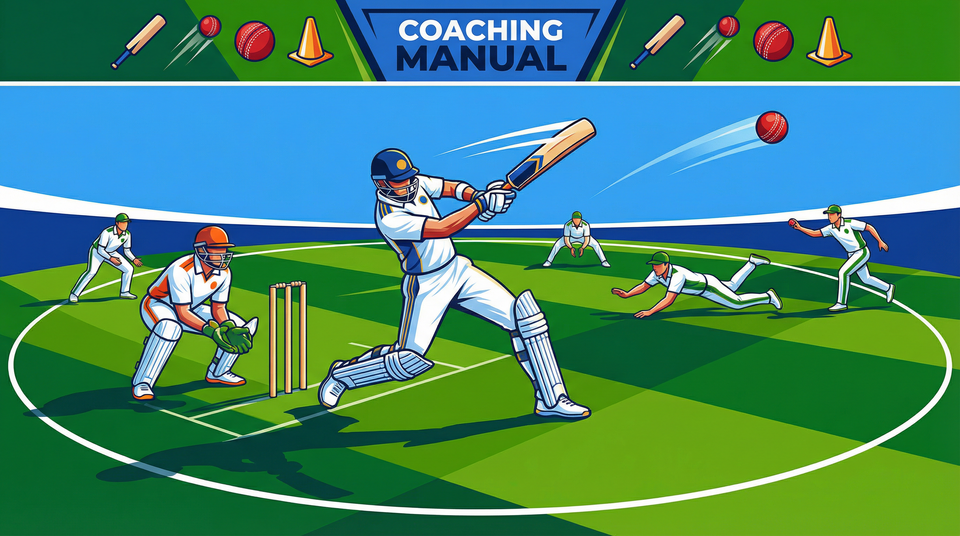
What you need
Cricket bats, White cricket balls, Stumps and bails, Cones or markers (for 30-yard circle), Full protective batting gear (helmets, pads, gloves, guards), Wicket-keeping gloves and pads
1. Overview
The T20 format is a game of calculated aggression and strategic momentum shifts. A well-paced innings is not about reckless hitting from ball one; it is a structured plan executed in phases. This set play resource provides a blueprint for structuring a T20 innings to maximise scoring potential by breaking it down into three critical phases: the Powerplay (Overs 1–6), the Middle Overs (Overs 7–15), and the Death Overs (Overs 16–20). The objective is to establish a strong foundation, consolidate through the middle, and launch an explosive assault at the end.
This guide will help coaches train their players to understand their roles, assess game situations in real time, and execute with precision to consistently post match-winning totals. It is suitable for club-level coaches through to high-performance environments.
2. Setup
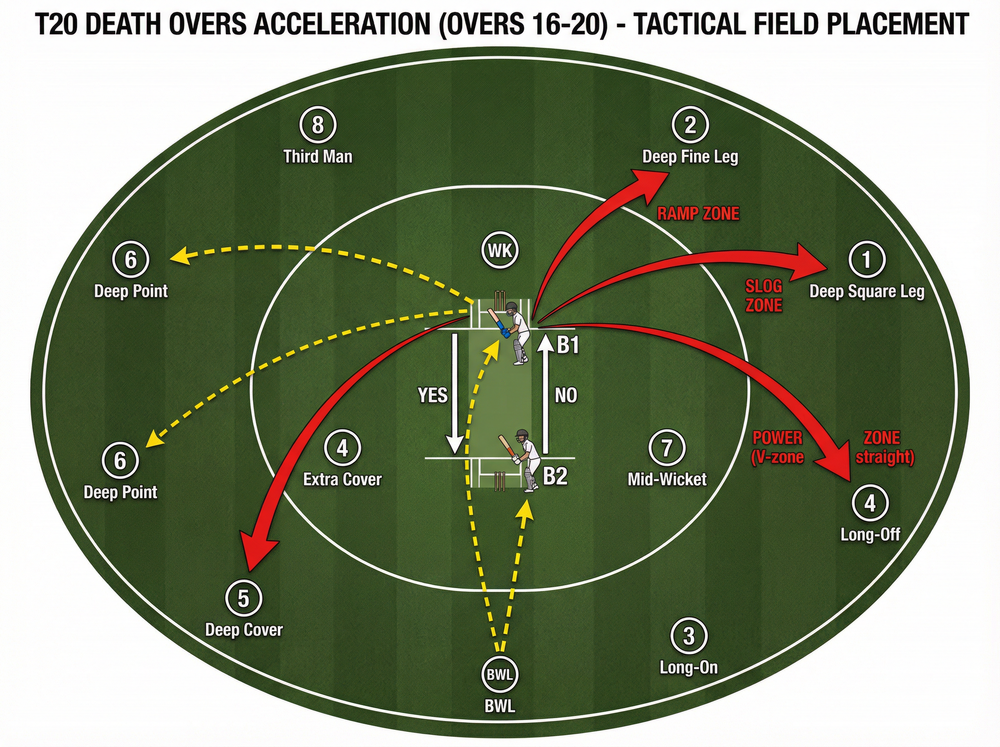
This plan is designed for a full 11-a-side match scenario on a standard oval ground.
| Item | Detail |
|---|---|
| Ground | Standard oval cricket ground |
| Pitch | 22-yard (20.12 m) cricket pitch |
| Fielding Circles | 30-yard (27.4 m) inner circle marked with cones |
| Players Required | 11 per side (full match scenario) |
| Duration | Approximately 120 minutes of practice |
Equipment Needed: Standard cricket gear including white cricket balls, bats, full protective equipment for batsmen (helmets, pads, guards), stumps, and field markers or cones to mark the 30-yard circle.
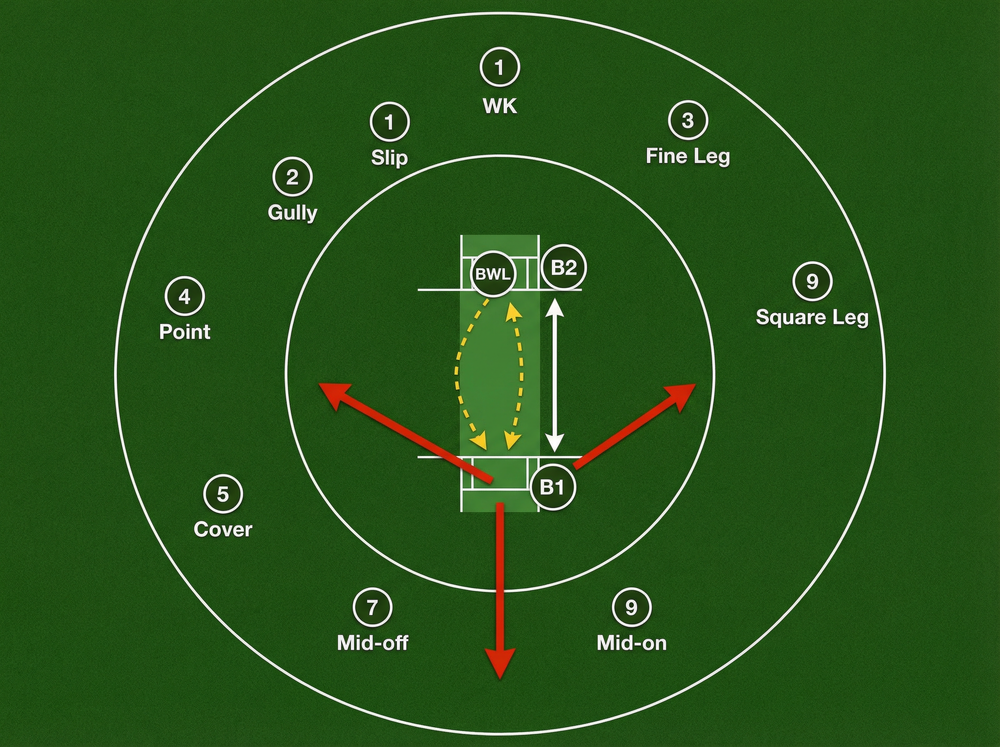
Player Positions: A full team of 11 players is required — 2 opening batsmen, a batting order down to at least number 7, a wicket-keeper, and a varied bowling attack. Field placements change dynamically based on the phase of the innings, as detailed in the tactical diagrams below.
3. Step-by-Step Instructions

A T20 innings is broken down into three distinct, manageable phases. Coaches should drill each phase in net sessions and practice matches before combining them into a full innings simulation.
Phase 1: The Powerplay (Overs 1–6) — The Launch
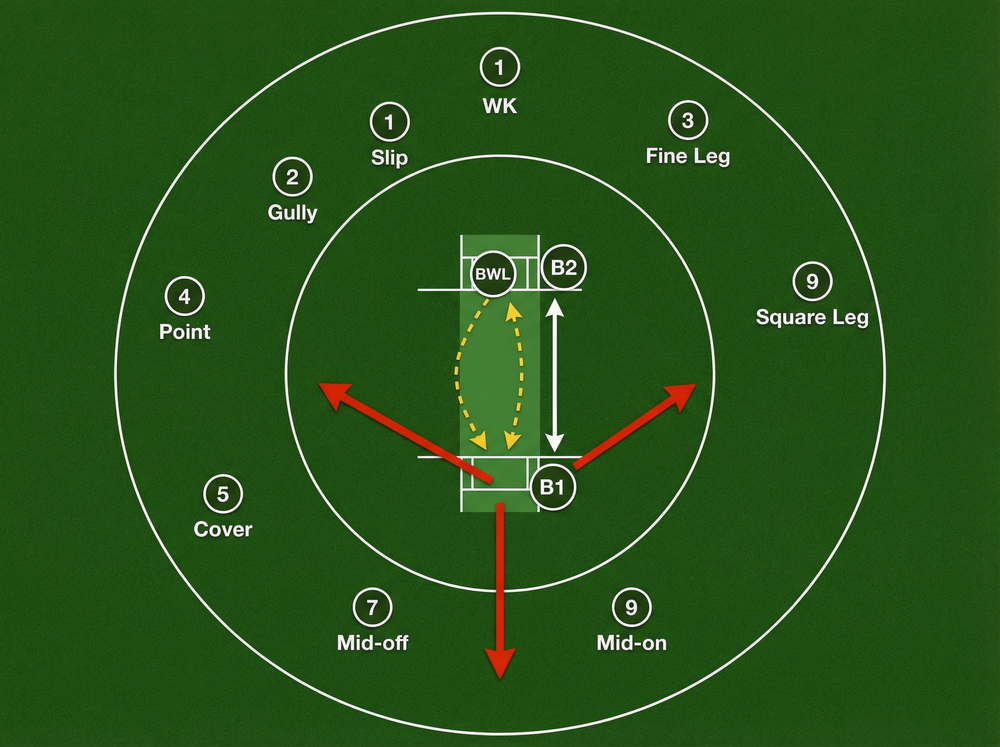
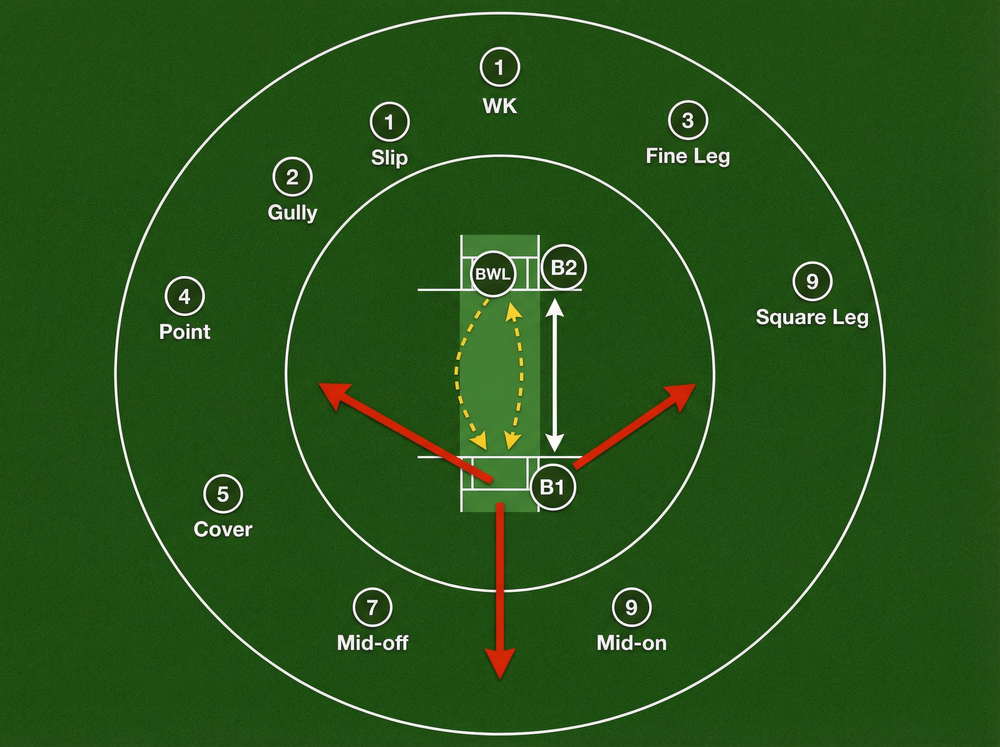
Objective: Score at a high run rate (target: 9–10 runs per over) while preserving wickets. Only two fielders are permitted outside the 30-yard circle during this phase.

Step 1 — Assess Conditions: The opening batsmen must quickly assess the pitch and bowling within the first 3–4 balls. Is the ball swinging? Is there pace or bounce? This assessment dictates the risk level for the over.
Step 2 — Target Gaps: With only two fielders outside the circle, the primary focus is hitting the ball into the vast open spaces along the ground. Strong, conventional cricket shots through cover, mid-off, and mid-on are the priority.
Step 3 — Calculated Aerial Shots: Encourage batsmen to go aerial over the infielders, but only when the ball is in their designated hitting zone. Straight down the ground and over square leg are the most reliable aerial targets in the powerplay.
Step 4 — Maximise Running: Convert ones into twos and apply relentless pressure on the fielders. Aggressive running between the wickets is non-negotiable in this phase and can add 8–12 extra runs to the powerplay total alone.
Phase 2: The Middle Overs (Overs 7–15) — Consolidation and Rotation
Objective: Maintain a steady run rate (target: 7–8 runs per over), rotate the strike, and set up for the final assault. Five fielders are now permitted outside the 30-yard circle.
Step 1 — Identify and Target Bowlers: Set batsmen should identify the weakest bowler in the opposition line-up and plan to take them for 10–15 runs in a single over.
Step 2 — Strike Rotation: With the field spread, hitting boundaries becomes harder. The focus shifts to eliminating dot balls. Batsmen must work the ball into gaps for singles and twos consistently.
Step 3 — The Anchor and the Aggressor: A productive middle-overs partnership often features one player who holds an end and ensures the scoreboard ticks over, while the other takes calculated risks against the right bowlers.
Step 4 — Keep Wickets in Hand: The golden rule of this phase is wicket preservation. Entering the final five overs with at least 6–7 wickets in hand is critical to launching a big finish.
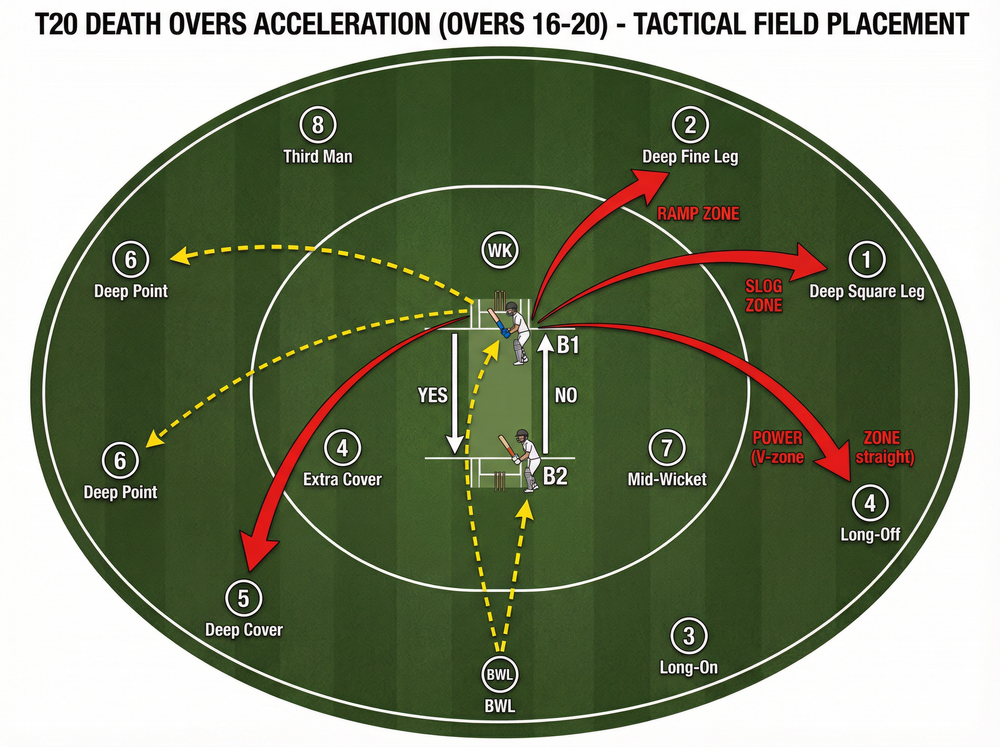
Phase 3: The Death Overs (Overs 16–20) — The Acceleration
Objective: All-out attack. Target 12–15+ runs per over. The score achieved in this phase most often determines the outcome of the match.
Step 1 — License to Hit: Batsmen have a full license to play high-risk, high-reward shots. The entire batting line-up must be prepared to contribute, even if they only face a few balls.
Step 2 — Know Your Zones: Players should have practised and perfected their boundary options before the match. This includes power hitting straight down the ground (the 'V-Zone'), slog-sweeping over the leg side, and inventive shots like ramps and scoops over the wicket-keeper.
Step 3 — Target the Boundary: The mindset shifts entirely from finding gaps to clearing the ropes. Batsmen should be looking for a boundary option on almost every ball.
Step 4 — Eliminate Dot Balls: At this stage, even a scrambled single is a win. A dot ball is a victory for the fielding side. Running hard on every hit is essential, and the non-striker must be backing up aggressively.
4. Key Coaching Points

- Intent from Ball One: Players must walk to the crease with a positive, scoring mindset. Passive batting in T20 cricket is a losing strategy.
- Calculated Risk-Taking: Differentiate between reckless slogging and smart aggression. Teach players to pick their balls, their bowlers, and their moments before committing to a big shot.
- Running Between the Wickets: Aggressive running can add 15–20 runs to a team total without any extra risk. Emphasise calling loudly and early, and backing up at the non-striker's end.
- Adaptability: The plan is a blueprint, not a rigid script. Players must be trained to adapt to the match situation — for example, an early wicket loss in the powerplay requires a recalibration of risk.
- Boundary Hitting in Practice: Dedicate specific sessions to practising power-hitting and executing shots against different types of bowling, particularly the yorker and the slower ball.
- Partnership Building: Remind players of the importance of communication and building partnerships to execute the plan effectively. A 30-ball partnership of 50 runs is far more valuable than two individual 25-run cameos that include a wicket.
5. Common Mistakes
| Mistake | Why It Happens | Correction |
|---|---|---|
| Losing 3+ wickets in the powerplay | Batsmen try to hit every ball for six | Drill the concept of 'boundary options, not boundary attempts on every ball' |
| Dot ball clusters in the middle overs | Batsmen go into their shell against spin | Practise specific drills for rotating strike against off-spin and leg-spin |
| Poor execution of power-hitting | Batsmen swing too hard under pressure | Focus on balance and timing in the hitting zone, not raw power |
| No designated finisher | Batting order not planned for the death | Identify and develop a specialist finisher who bats at 6 or 7 |
6. Variations and Progressions
Progression 1 — Live Pressure Scenarios: Set up a practice match where one team must execute this three-phase plan to chase a specific target within 20 overs. Adding real match pressure is the most effective way to cement the plan.
Progression 2 — Bowler-Specific Death Nets: Have batsmen face specific types of 'death' bowling in the nets — wide yorkers, slower-ball bouncers, and off-cutters — to hone their execution before they encounter them in a match.
Variation 1 — The Floating Pinch-Hitter: If the platform is set by over 10, promote a known power-hitter up the order during the middle overs to surprise the opposition and inject immediate momentum. This is a high-risk, high-reward tactical call.
7. Age Adaptations
| Age Group | Focus | Modifications |
|---|---|---|
| Under 10 / Under 12 | Powerplay concept only | Use softer balls, smaller boundaries, and focus on hitting into gaps rather than over fielders |
| Under 14 / Under 16 | Introduce middle-overs rotation | Begin discussing risk vs. reward. Focus on game awareness and building partnerships |
| Open Age | Full three-phase plan | Players should execute all three phases with tactical nuance and adaptability |
For younger age groups, simplify the language. Instead of 'V-Zone power hitting', use 'hit it straight and hard'. The principles are the same; the vocabulary should match the player's level of understanding.
