

Cricket
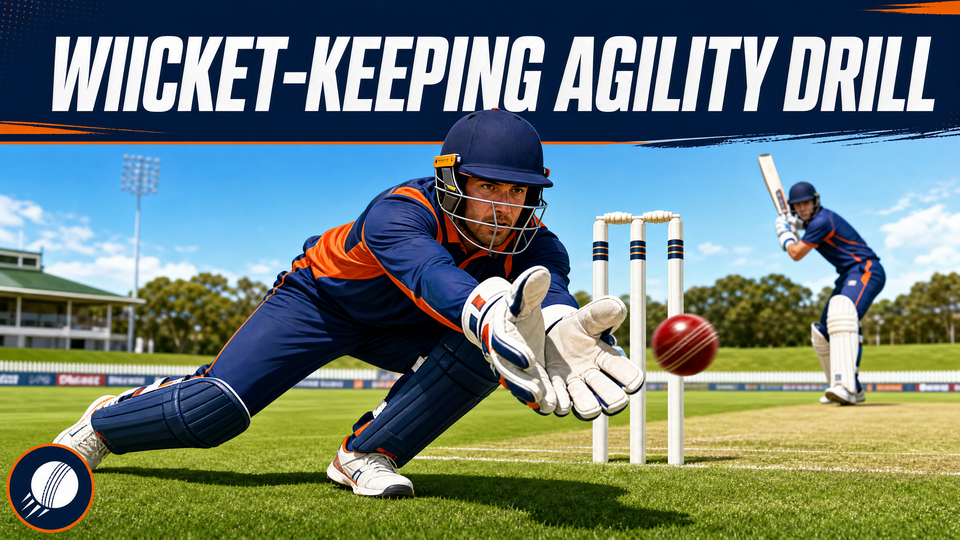
Elite Wicket-Keeping Lateral Agility & Reaction Drill
Develop explosive lateral movement, lightning-fast reaction times, and flawless catching technique with this essential wicket-keeping drill.
What you need
Wicket-keeping gloves, Wicket-keeping pads, Helmet, 4 Marker cones, 10-15 Cricket balls, Stumps
1. Overview
The Wicket-Keeping Lateral Agility and Reaction Drill is a high-intensity, match-specific exercise designed to improve a wicket-keeper's footwork, explosive lateral movement, and hand-eye coordination. In modern cricket, wicket-keepers must cover immense ground, often diving full-stretch to intercept thick edges or wide deliveries. This drill isolates the explosive first step and the subsequent dive or rapid shuffle, conditioning the keeper to react instinctively rather than premeditating movement.
It is best utilized during the skill-development phase of a training session, ensuring the keeper is fresh and capable of maximum explosive effort.
2. Setup
Proper setup is crucial for replicating match conditions. Ensure the surface is safe for diving.
Equipment Needed:
- 1 pair of wicket-keeping gloves and inner gloves
- 1 pair of wicket-keeping pads
- 1 helmet (optional but recommended for match realism)
- 4 high-visibility marker cones
- 10-15 cricket balls (leather or incrediballs depending on age)
- 1 sidearm thrower or baseball mitt for the coach (optional)
Field Setup & Player Positions:
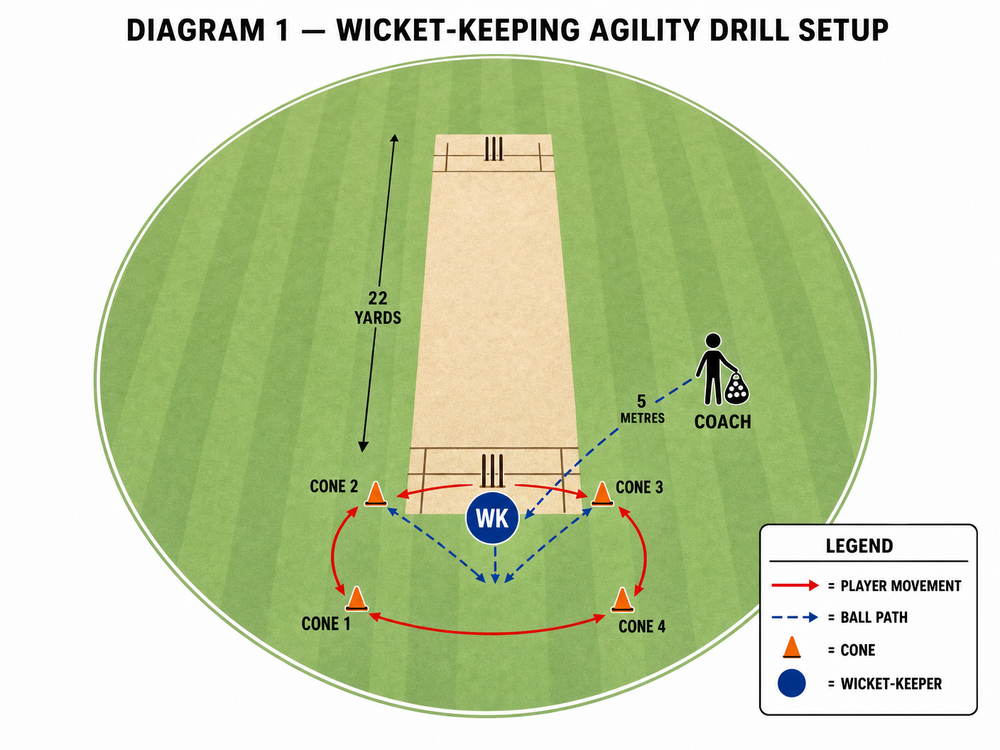
- Position the wicket-keeper (WK) directly behind a set of stumps on a standard 22-yard pitch.
- Place four cones in a semi-circle around the keeper.
- Cone 1 & 4: Placed 3 metres to the left and right of the stumps, representing the edge of the keeper's standard diving range.
- Cone 2 & 3: Placed 1.5 metres to the left and right, representing standard shuffling distance for medium-paced bowling.
- The coach stands approximately 5-7 metres away on the leg side or off side, armed with a bucket of balls.
3. Step-by-Step Instructions
Execute the drill with high intensity and adequate rest between sets.
- The Stance: The wicket-keeper adopts their standard crouching stance behind the stumps, weight evenly distributed on the balls of the feet, hands relaxed and forming a large catching area.
- The Trigger: The coach calls out a cone number (1, 2, 3, or 4) or points to a specific side.
- Explosive Movement: The keeper immediately pushes off their outside foot to move laterally toward the designated cone.
- For Cones 2 and 3, this is a rapid shuffle.
- For Cones 1 and 4, this requires a full-stretch dive.
- The Feed: As the keeper initiates movement, the coach underarms or firmly throws a ball toward the designated cone area.
- The Take: The keeper must watch the ball into the gloves, ensuring soft hands and giving with the impact. If diving, they must aim to catch the ball two-handed if possible, or with the bottom hand extended.
- Recovery: The keeper quickly returns to the starting position behind the stumps, ready for the next delivery. Complete 6-8 repetitions per set.
4. Key Coaching Points
- Stay Low: Maintain a low centre of gravity during the lateral shuffle. Popping up too early reduces explosive power and slows reaction time.
- Head Position: Keep the head still and eyes level. The head should lead the movement, with the body following.
- Soft Hands: "Give" with the ball upon impact to prevent it from popping out of the gloves. Imagine catching an egg.
- Push-Off Mechanics: Generate power by pushing aggressively off the foot opposite to the direction of travel (e.g., push off the right foot to dive left).
5. Common Mistakes
- Premeditation: Guessing the direction before the coach signals or throws the ball, leading to being wrong-footed.
- Hard Hands: Snatching at the ball rather than letting it come into the gloves, resulting in dropped catches.
- Standing Up Early: Rising out of the crouch before moving laterally, which completely destroys the base of power needed for a dive.
- Crossing the Legs: During a shuffle, crossing the feet instead of sliding them, which causes a loss of balance and agility.
6. Variations & Progressions
Once the basic drill is mastered, introduce match-specific variables to increase difficulty.
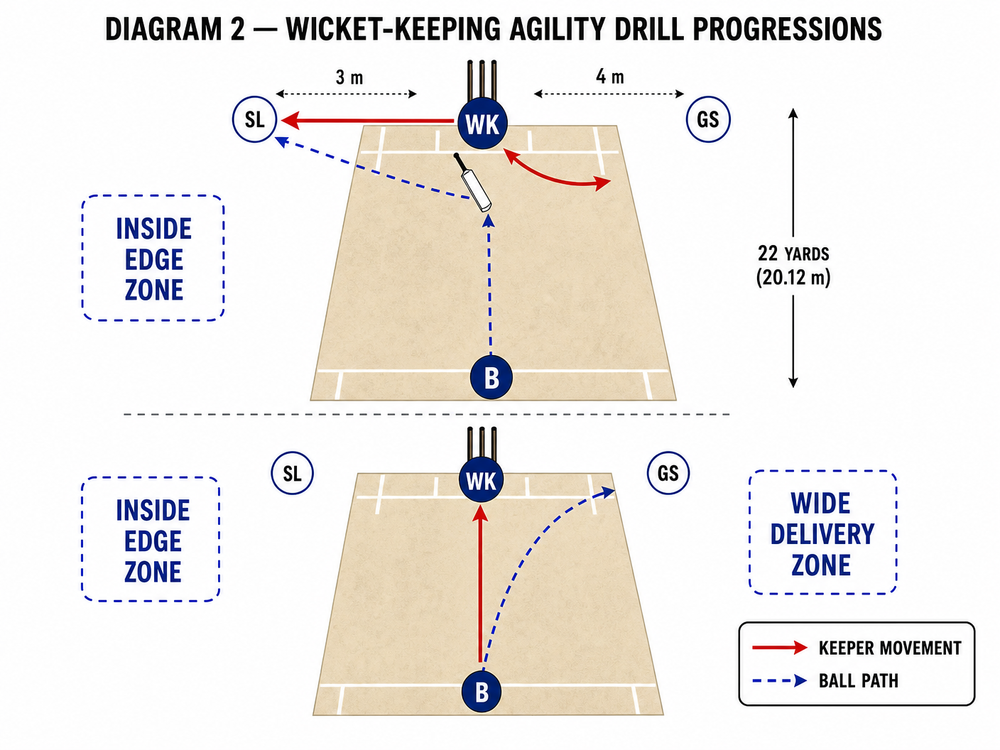
- Deflection Drill: Have the coach throw the ball onto a slip cradle or a deflection ramp positioned in front of the keeper to simulate unpredictable edges.
- Blind Start: The keeper starts facing away from the coach and turns only when the coach shouts "Go!", drastically reducing reaction time.
- The Wide Delivery Scenario: Move the coach further down the pitch to simulate a bowler. The coach throws deliberate wide deliveries (down leg or far outside off), forcing the keeper to cover massive ground to prevent byes.
7. Age Adaptations
- Under 8 - Under 10: Use tennis balls or incrediballs. Focus purely on the basic shuffle and catching technique rather than diving. Reduce the cone distances to 1 metre.
- Under 12 - Under 14: Introduce soft leather balls. Begin teaching the mechanics of safe diving on soft grass. Emphasize the importance of staying low.
- Under 16 - Open: Full match intensity with hard leather balls. Incorporate sidearm throwers for increased pace and unpredictable bounce. Focus on one-handed diving saves.
