

Cricket
Diamond Agility: The Wicket-Keeper's Four-Cone Reaction Drill
A high-intensity, cone-based agility drill that sharpens a wicket-keeper's lateral speed, diving technique, and glove-work under fatigue — ready to run in your next session.
What you need
Cricket stumps (1 full set), Wicket-keeping gloves, Wicket-keeping pads, Helmet, Cricket balls or incrediballs (6–10), Agility cones — orange (4), Measuring tape, Coaching mitt (optional), Gym mat (for diving progressions)
Overview
The Diamond Agility Wicket-Keeping Drill is a purpose-built conditioning and skill exercise designed to develop the three physical qualities that separate elite keepers from average ones: explosive lateral movement, rapid recovery to the stumps, and clean glove-work under physical stress. It replicates the unpredictable, multi-directional demands of a live innings — where a keeper must respond to a wide down the leg side, recover, then take a sharp return throw — all within the same over.
This drill is most effective when used in the warm-up activation phase (as a movement primer) or as a skill-conditioning block midway through a session. It is equally valuable for keepers standing up to the stumps against spin or standing back against pace, as the footwork patterns are transferable to both disciplines. Use it at least twice per week during the pre-season preparation block, and once per week as a maintenance drill in-season.
Setup

Equipment Required
| Item | Quantity | Notes |
|---|---|---|
| Cricket stumps (full set) | 1 set | Planted at the batting-end crease |
| Wicket-keeping gloves | 1 pair | Match-standard gloves |
| Wicket-keeping pads | 1 pair | Full-length pads |
| Helmet | 1 | Mandatory for all standing-up work |
| Cricket balls (or incrediball) | 6–10 | Mix of new and worn for varied grip |
| Agility cones (orange) | 4 | Placed in a diamond pattern |
| Measuring tape | 1 | For accurate cone placement |
| Coaching mitt (optional) | 1 | For coach to feed varied deliveries |
Field & Pitch Setup
This drill takes place at the batting end of the 22-yard pitch on an oval cricket ground. The keeper operates on the prepared pitch surface or on a practice mat that replicates pitch hardness.
Place four cones in a diamond pattern centred on the keeper's starting position, directly behind the stumps:
- Cone 1 (Forward Left): 2 metres forward and 2 metres to the leg side of the keeper's starting position.
- Cone 2 (Forward Right): 2 metres forward and 2 metres to the off side.
- Cone 3 (Rear Left): 2 metres behind and 2 metres to the leg side.
- Cone 4 (Rear Right): 2 metres behind and 2 metres to the off side.
The coach/feeder (C) stands at the bowling crease (approximately 20 yards from the keeper), feeding balls underarm or with a short-arm throw. For standing-back variations, the coach moves to the top of their run-up mark (18–22 metres).

Diagram 1: Basic drill setup showing the keeper (WK) in the diamond cone pattern with the coach (C) feeding from the bowling crease. Solid blue arrows indicate keeper movement; dashed red arrows indicate ball path.
Step-by-Step Instructions

Step 1 — Establish the Ready Position.
The keeper sets up directly behind the stumps in a low, athletic stance: feet shoulder-width apart, weight on the balls of the feet, gloves held low and together in front of the body, eyes level and focused on the coach's hand. Knees should be bent at approximately 90 degrees. Remind the keeper: "Chin up, gloves down, weight forward."
Step 2 — Coach Calls the Cone.
The coach calls out a cone number ("One!", "Two!", "Three!", or "Four!") and simultaneously feeds a ball in that direction. The feed should be timed so the ball arrives just as the keeper reaches the cone — this is the key to making it a reaction drill rather than a sprint drill.
Step 3 — Keeper Moves to the Cone.
The keeper uses a side-shuffle for lateral cones (1 and 2) and a crossover step for rear cones (3 and 4). They must reach the cone and touch it with the outside hand before the ball arrives. This simulates the reach and collection of a wide delivery.
Step 4 — Collect the Ball.
The keeper takes the ball cleanly with both gloves, absorbing the ball into the body. For leg-side feeds (Cones 1 and 3), the keeper must rotate the body to present the gloves correctly — a common technical fault point. For off-side feeds, the keeper extends the outside glove first, then brings the inside glove across to complete the take.
Step 5 — Return to the Stumps.
Immediately after collecting, the keeper sprints back to the stumps and breaks the wicket with a single bail removal using the gloved hand. This simulates a run-out or stumping opportunity and reinforces the habit of always attacking the stumps after a collection.
Step 6 — Reset and Repeat.
The keeper resets to the ready position behind the stumps. Allow a 3-second recovery between each repetition. Complete 6 repetitions per set (one to each cone, then two random calls), rest for 60 seconds, and repeat for 3–4 sets.
Step 7 — Record and Review.
After each set, give the keeper one specific piece of feedback. Use a phone to video one set per session — keepers benefit enormously from seeing their own footwork patterns.
Key Coaching Points
1. The Ready Position is Non-Negotiable.
Every repetition must begin from a correct ready stance. A keeper who starts upright or with weight on the heels will always be a fraction late. Reinforce this constantly — it is the foundation of everything else in this drill.
2. Move First, Then Look for the Ball.
Train the keeper to initiate movement the instant they hear the call, trusting that the ball will be there. Hesitation — waiting to see where the ball is going before moving — is the single biggest cause of missed takes. The feet must move before the eyes confirm the ball's direction.
3. Gloves Lead the Body on the Leg Side.
On all leg-side takes (Cones 1 and 3), the keeper must rotate the hips and present the gloves palm-upward. A common fault is reaching across the body with the back of the glove facing up — this is a weak position and causes drops. Cue: "Show the palms to the ball."
4. Soft Hands on Collection.
The keeper should absorb the ball into the gloves with slightly bent elbows, drawing the hands back slightly on contact. Rigid, stiff arms lead to the ball popping out. Cue: "Catch it like an egg — don't break it."
5. Attack the Stumps After Every Take.
The habit of returning to the stumps and breaking the wicket must be automatic. In match conditions, the keeper who hesitates after a wide misses the run-out. Make stump-breaking a mandatory part of every repetition from day one.
6. Maintain Low Body Height Throughout.
The keeper should stay low throughout the entire movement sequence — not rising up between the cone touch and the collection. Rising up adds time and disrupts the glove position. Cue: "Stay in the chair — don't stand up until the ball is in your gloves."
Common Mistakes

Mistake 1 — Rising Out of the Crouch Too Early.
Many keepers, especially younger players, instinctively stand up as they move laterally. This raises the centre of gravity and slows the movement. Correction: Place a low hurdle or a second cone at chest height as a visual reminder to stay low. Reduce the feed speed until the movement pattern is grooved.
Mistake 2 — Crossing the Feet on Lateral Movement.
Crossing the feet during a side-shuffle creates a tripping hazard and slows the change of direction back to the stumps. Correction: Slow the drill right down and walk through the footwork pattern. Use the cue: "Shuffle, don't cross." Only increase speed once the pattern is clean.
Mistake 3 — One-Handed Takes.
Under pressure, keepers revert to reaching with one glove rather than presenting both. This dramatically increases the drop rate. Correction: Make it a rule that any one-handed take is a "no-take" and the repetition is repeated. The second glove must always be present.
Mistake 4 — Forgetting the Stump Break.
In the early stages of learning this drill, keepers focus so hard on the collection that they forget to return to the stumps. Correction: The coach should withhold verbal praise until the stump break is completed. Make it a habit by counting it as an incomplete rep if the stumps are not broken.
Mistake 5 — Slow Reset Between Reps.
A keeper who ambles back to the ready position between repetitions is not training the recovery speed that matters in a match. Correction: Use a stopwatch and set a 3-second reset window. If the keeper is not in the ready position within 3 seconds, the coach calls the next cone immediately — creating productive pressure.
Variations & Progressions


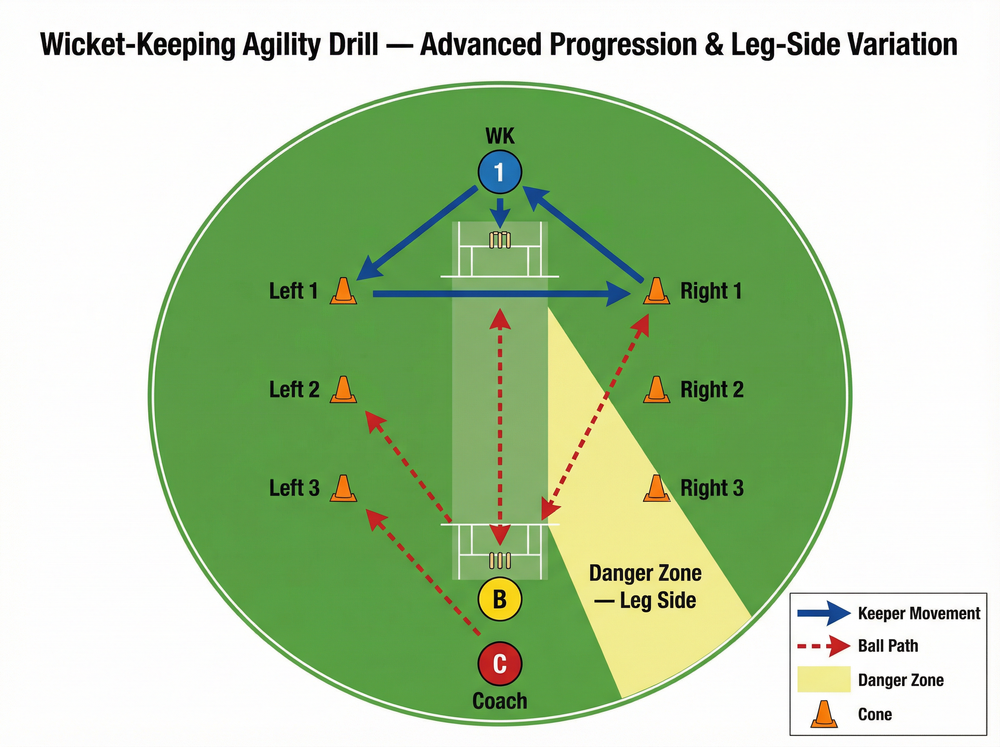
Diagram 2: Advanced progression showing the keeper (WK) working against a live batter (B) with varied feeds from the coach (C). The yellow shaded zone highlights the leg-side "Danger Zone" — the area where most stumping opportunities are missed.
Variation 1 — Blind Call (Intermediate)
Instead of the coach calling the cone number before feeding, the coach feeds the ball first and the keeper must react to the ball's direction without a verbal cue. This removes the anticipation element and more closely replicates match conditions. Reduce the feed speed by 20% initially to allow the keeper time to read the ball.
Variation 2 — Live Batter Distraction (Advanced)
Introduce a batter (B) standing at the crease playing a shot (without hitting the ball). The keeper must track the ball past the batter's body — replicating the visual obstruction that occurs in a real innings. The batter can be instructed to play a forward defensive, a sweep, or a pull shot to vary the visual challenge.
Progression 1 — Extended Diamond (Harder)
Increase the cone distance from 2 metres to 3.5 metres. This demands a full diving take rather than a step-and-reach, developing the keeper's confidence and technique in full-extension dives. Ensure the surface is safe for diving before implementing this progression — use a gym mat or outfield grass rather than a hard pitch surface.
Progression 2 — Fatigue Protocol (Hardest)
Precede the drill with 10 burpees or a 30-second sprint shuttle. Begin the cone drill immediately after, with no recovery. This trains the keeper to maintain technical quality under cardiovascular fatigue — the exact condition they face in the 40th over of a T20 innings or the final session of a Test match.
Age Adaptations

| Age Group | Cone Distance | Feed Type | Sets × Reps | Key Focus |
|---|---|---|---|---|
| Under 10 | 1 metre | Rolled ball along ground | 2 × 4 | Fun, basic glove presentation |
| Under 12 | 1.5 metres | Underarm toss, slow | 2 × 5 | Footwork pattern, two-handed take |
| Under 14 | 2 metres | Underarm toss, medium pace | 3 × 6 | Ready position, stump break |
| Under 16 | 2–2.5 metres | Short-arm throw | 3 × 6 | Leg-side rotation, soft hands |
| Open/Senior | 2.5–3.5 metres | Full-pace throw or live bowling | 4 × 6 | Full match simulation, fatigue protocol |
Under 10s: Remove the stump-breaking element entirely — focus purely on the joy of moving and catching. Use a softer incrediball or a tennis ball. Keep sets short (no more than 4 minutes of active work) and celebrate every clean take enthusiastically.
Under 12s and 14s: Introduce the stump-breaking element from Under 12 onwards, but use a single stump in a base rather than a full set to reduce the risk of injury from a falling stump. At Under 14, begin introducing the verbal cue system and the 3-second reset rule.
Under 16s and Senior: Full match-standard equipment, full cone distances, and the fatigue protocol should be standard. At senior level, video analysis of one set per session is strongly recommended — keepers at this age respond exceptionally well to self-review and can self-correct technical faults when shown the footage immediately after the set.
