

Cricket
Mastering Defensive Field Settings for Spin Bowling
Learn how to build pressure, cut off boundaries, and force errors by deploying an effective defensive field setting for your spin bowlers.

What you need
Standard cricket balls, Stumps and bails, Cones or markers (for practice), 22-yard pitch on an oval ground
1. Overview
When a batting pair is established and scoring freely, or when the match situation demands run restriction, a well-executed defensive field setting for spin bowling becomes critical. The primary objective of this set play is to dry up boundaries, force the batters to take risks for their runs, and build sustained pressure that ultimately leads to a mistake. By strategically placing fielders to protect the boundaries while maintaining a core ring to cut off easy singles, coaches can help their spin bowlers dictate the pace of the game.
This field setting is particularly effective during the middle overs of a limited-overs match or when trying to break a stubborn partnership in longer formats. It relies on the bowler maintaining a consistent line and length, forcing the batter to hit against the spin or target heavily protected areas of the field.
2. Setup
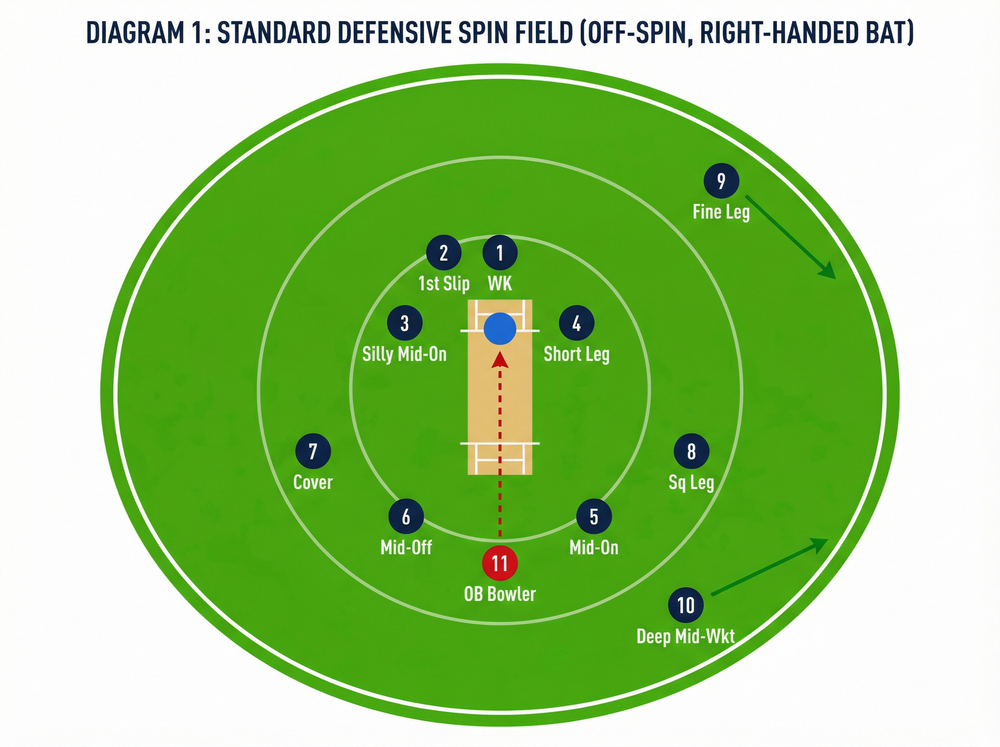
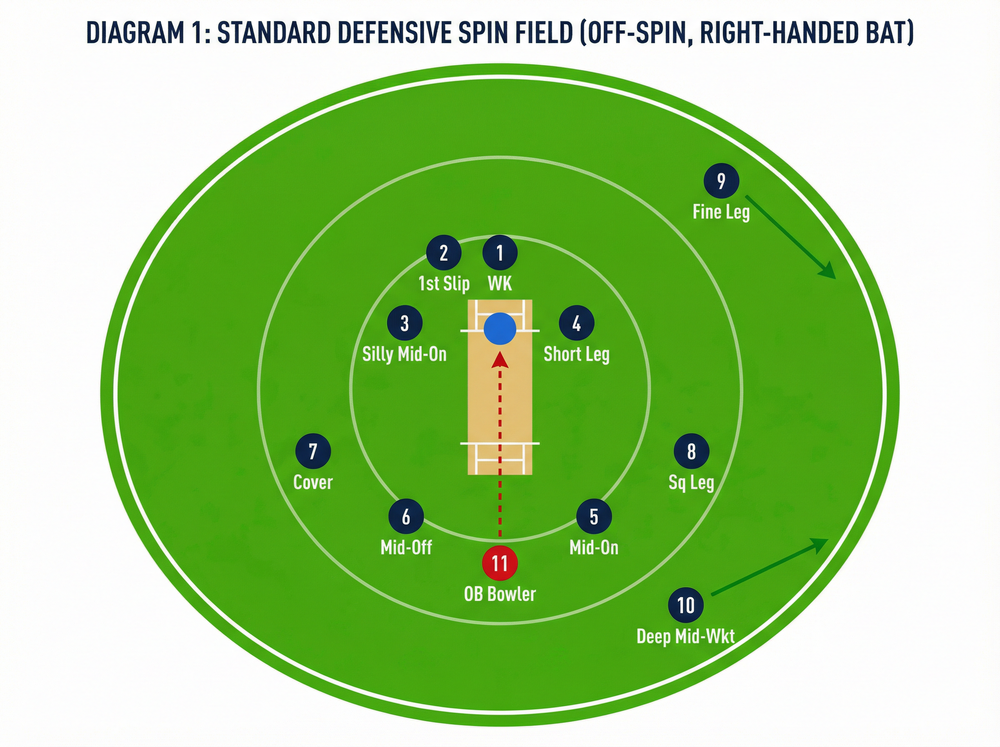
To effectively practice and implement this defensive field setting, ensure you have the correct setup and understand the precise positioning required.
Equipment Needed
- Standard cricket balls (appropriate for the age/level)
- Stumps and bails
- Cones or markers (for practice sessions to clearly define fielding zones)
- A well-prepared 22-yard pitch on an oval ground
Pitch and Field Setup
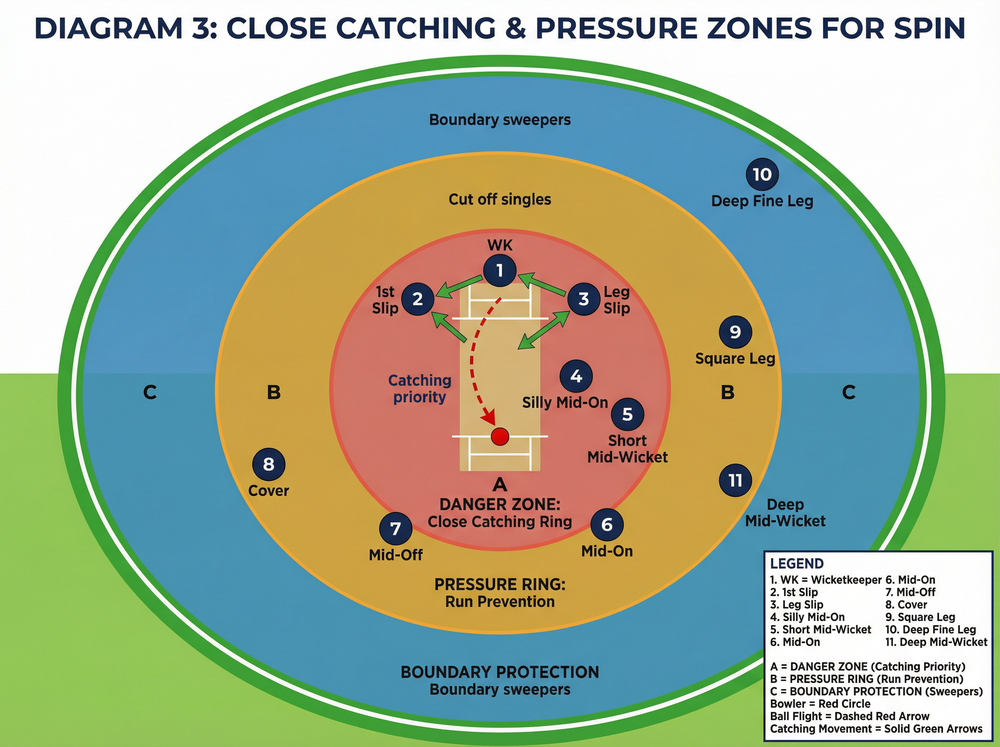
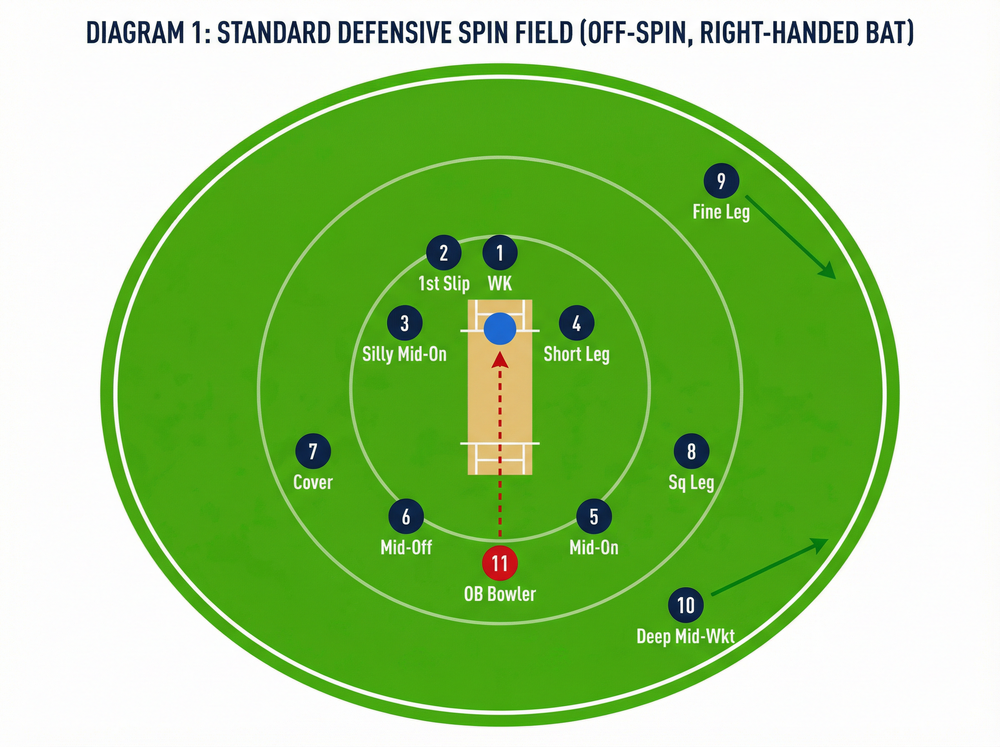
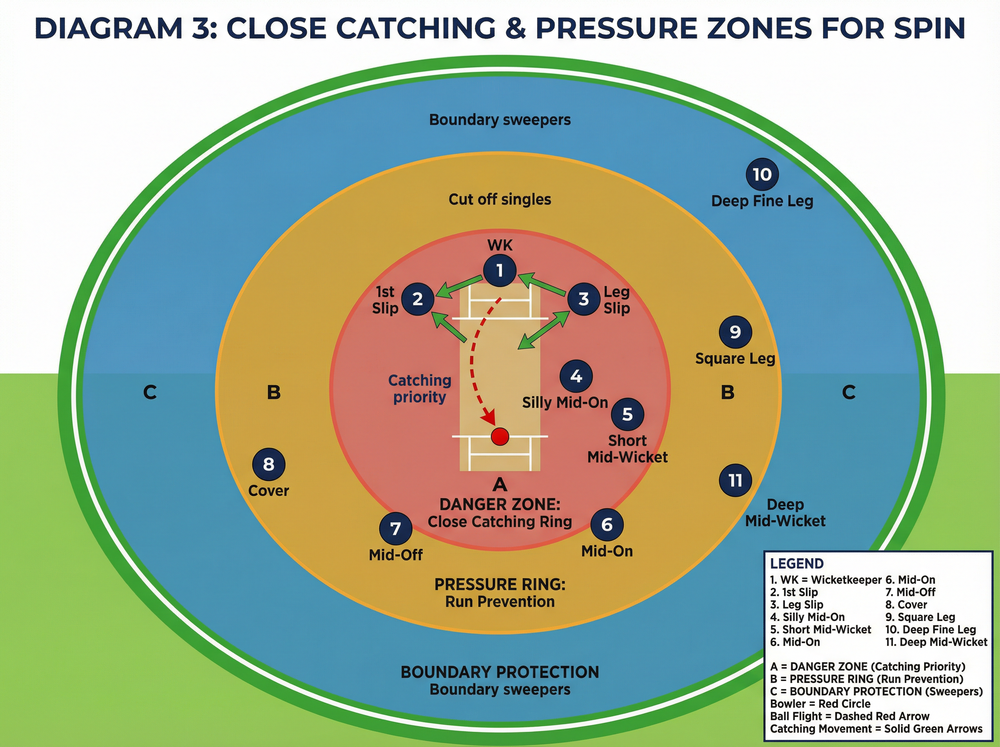
The field is divided into three distinct zones: the Danger Zone (close catching), the Pressure Ring (run prevention at 10–25 yards), and the Boundary Protection Zone (sweepers at 25+ yards).
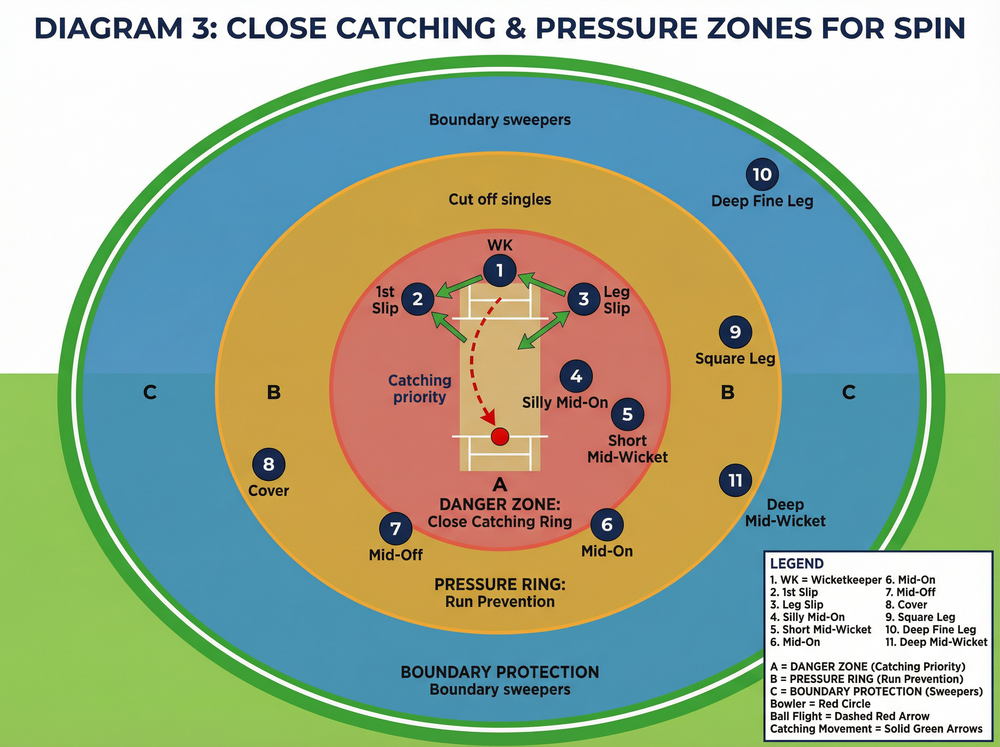
Player Positions (Standard Off-Spin, Right-Handed Batter)
- Wicket-keeper (WK): Positioned directly behind the stumps, ready for edges and stumpings.
- 1st Slip: Positioned slightly wider than standard to cover the genuine edge.
- Silly Mid-On: Placed very close on the on-side to catch bat-pad deflections.
- Short Leg: Positioned close on the leg side, primarily for catches off the pad or inside edge.
- Mid-On: Positioned at approximately 25 yards straight down the ground.
- Mid-Off: Positioned at approximately 25 yards straight down the ground.
- Cover: Placed at roughly 30 yards on the off side to stop the drive.
- Square Leg: Positioned at 30 yards to cut off the sweep or pull.
- Fine Leg: Placed on the boundary to protect against sweeps and paddles.
- Deep Mid-Wicket: Placed on the boundary to protect against the slog sweep or powerful pull shots.
- Bowler: Operating from the bowling crease.
3. Step-by-Step Instructions
Implementing this defensive field setting requires clear communication and disciplined execution from both the bowler and the fielders.
Step 1: Assess the Situation and the Batter
Before setting the field, the captain and bowler must assess the batter's strengths, the match situation, and the pitch conditions. If the batter is scoring freely, a defensive setup is warranted.
Step 2: Establish the Boundary Sweepers
Position your key boundary riders first. For an off-spinner to a right-handed batter, place fielders at Deep Mid-Wicket and Fine Leg. These players are crucial for stopping boundaries and must be athletic and possess strong throwing arms.
Step 3: Set the Pressure Ring
Deploy fielders at Cover, Mid-Off, Mid-On, and Square Leg. Their primary role is to cut off easy singles and force the batter to hit over the top to score boundaries. Ensure they are positioned at the correct depth (typically 25–30 yards) to maximize their coverage.
Step 4: Position the Close Catchers
Even in a defensive setup, maintaining some catching pressure is essential. Position a 1st Slip and a Short Leg or Silly Mid-On. These fielders must remain alert for edges and bat-pad catches, ensuring the batter cannot simply defend without risk.
Step 5: Execute the Bowling Plan
The bowler must bowl to the field. For an off-spinner, this means targeting a consistent line just outside off stump, forcing the batter to hit towards the protected areas on the leg side or risk hitting against the spin on the off side.
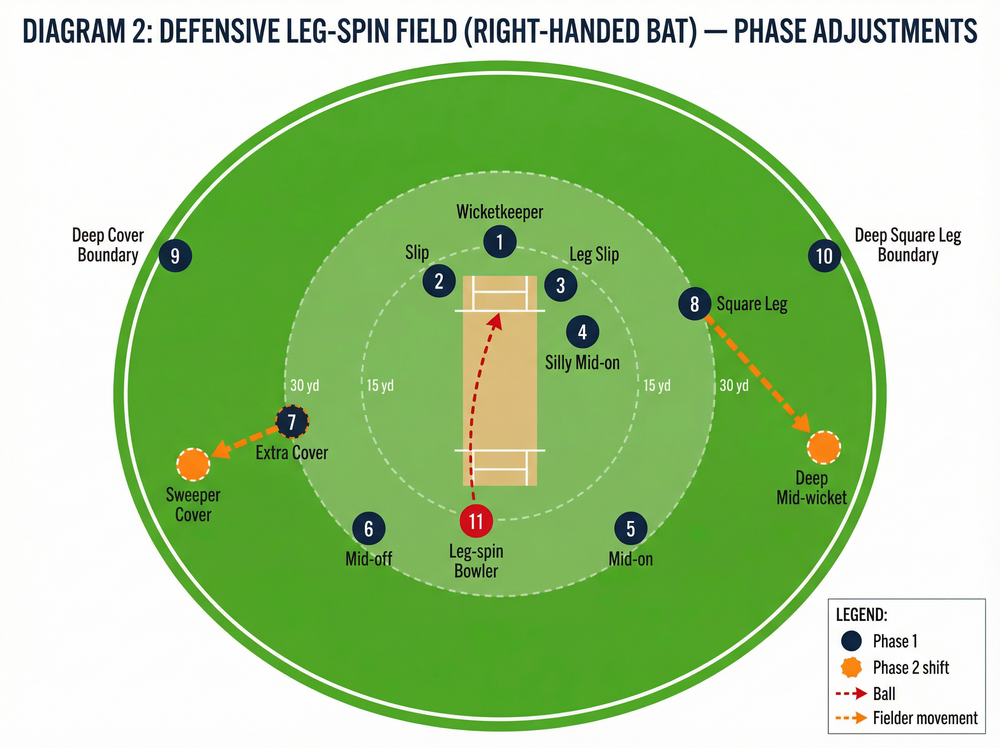
Step 6: Adjust and Adapt (Phase 2)
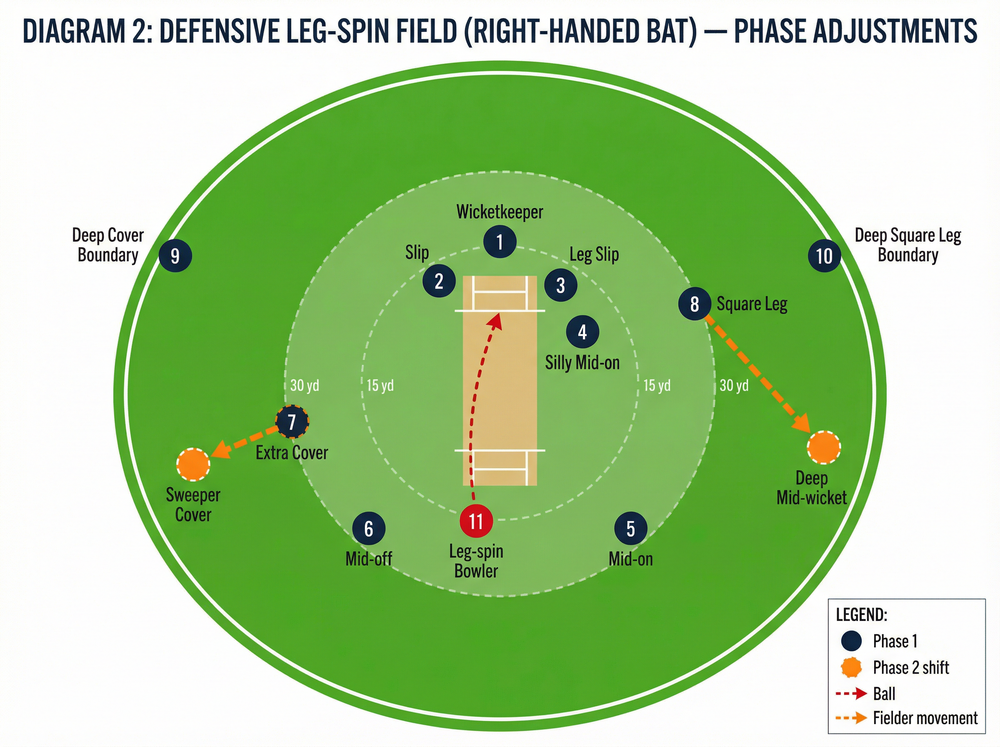
If the batter begins to manipulate the field, be prepared to adjust. For example, if a leg-spinner is bowling and the batter is repeatedly driving through the covers, shift the Cover fielder to Sweeper Cover and move Square Leg to Deep Mid-Wicket to counter the threat.
4. Key Coaching Points
- Bowl to the Field: The entire strategy relies on the bowler maintaining a disciplined line and length that complements the field placement.
- Active Ring Fielding: Fielders in the 25–30 yard ring must be active, anticipating the ball and attacking it to prevent easy singles.
- Communication is Key: The captain, bowler, and wicket-keeper must constantly communicate to ensure everyone is in the correct position and understands the plan.
- Maintain Catching Pressure: Never completely abandon close catchers. Even one or two close fielders can create doubt in the batter's mind and force errors.
- Adaptability: Be prepared to shift fielders based on the batter's scoring areas. A static field is easily manipulated by a skilled batter.
5. Common Mistakes
- Bowling Too Short or Too Wide: This allows the batter to easily score boundaries, rendering the defensive field useless.
- Passive Fielding in the Ring: If fielders in the 25–30 yard ring sit back on their heels, batters will easily accumulate singles, releasing the pressure.
- Ignoring the Batter's Strengths: Setting a generic defensive field without considering the specific batter's preferred scoring areas will lead to failure.
- Over-Defending: Removing all close catchers can make the batter too comfortable, allowing them to dictate the pace of the innings without fear of dismissal.
6. Variations & Progressions

- The 'In-Out' Field: To make it harder for the batter, alternate the depth of fielders in the ring (e.g., bring Cover slightly closer while pushing Mid-Off deeper) to create confusion and disrupt their rhythm.
- The 7-2 Off-Side Field: For an off-spinner bowling to a right-hander, stack the off-side with 7 fielders and bowl a strict line outside off stump, challenging the batter to hit against the spin.
- Target Practice: In training, place cones in the areas the bowler should target and award points for consistently hitting those zones while the field is set defensively.
7. Age Adaptations
- Under 10s / Under 12s: Focus on the basic concept of protecting the boundary. Simplify the field by using fewer specialized positions (like Silly Mid-On) and prioritize teaching players to stop the ball and return it quickly.
- Under 14s / Under 16s: Introduce the concept of the 'Pressure Ring' and the importance of cutting off singles. Begin teaching bowlers how to bowl to specific field settings and the importance of line and length.
- Open / Senior Level: Full implementation of the tactical nuances, including dynamic field adjustments (Phase 1 to Phase 2) and exploiting specific batter weaknesses through precise field placements.
