

Football
Mastering the Defensive Transition: Re-establishing Shape When the Press Fails
Learn how to train your team to quickly drop and re-establish a compact defensive block when the initial high press is bypassed.
What you need
Footballs, Bibs (2 colours), Cones, 1 Full-size goal, 3 Mini-goals
1. Overview
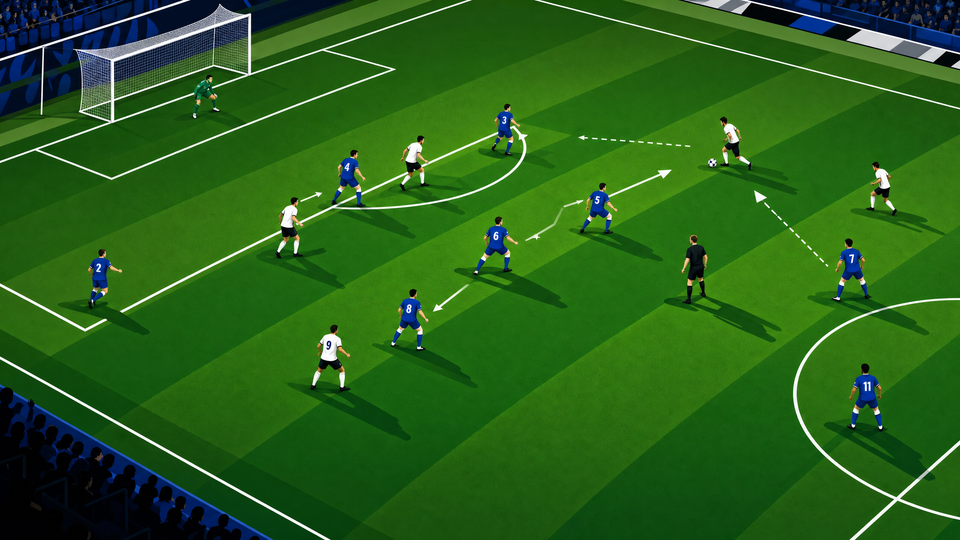
Modern football demands high-intensity pressing, but even the best-coordinated press can be broken. When the opposition successfully plays through or over your initial pressing line, the immediate priority shifts from winning the ball to protecting the goal. This session focuses on the critical transition moment: dropping rapidly to re-establish a compact, organised defensive shape (typically a 4-4-2 mid-block or low-block) when the press is beaten. It teaches players to recognize the trigger that the press has failed, execute recovery runs at maximum intensity, and immediately restore horizontal and vertical compactness to deny central penetration.
2. Setup
Pitch Area: Use roughly two-thirds of a full-size pitch (approx. 70m x 70m). Mark out a 'Pressing Zone' in the attacking third and a 'Compactness Zone' in the middle third.
Equipment: 1 full-size goal, 3 mini-goals (or target areas) at the opposite end, bibs (2 colours), footballs, cones to mark zones.
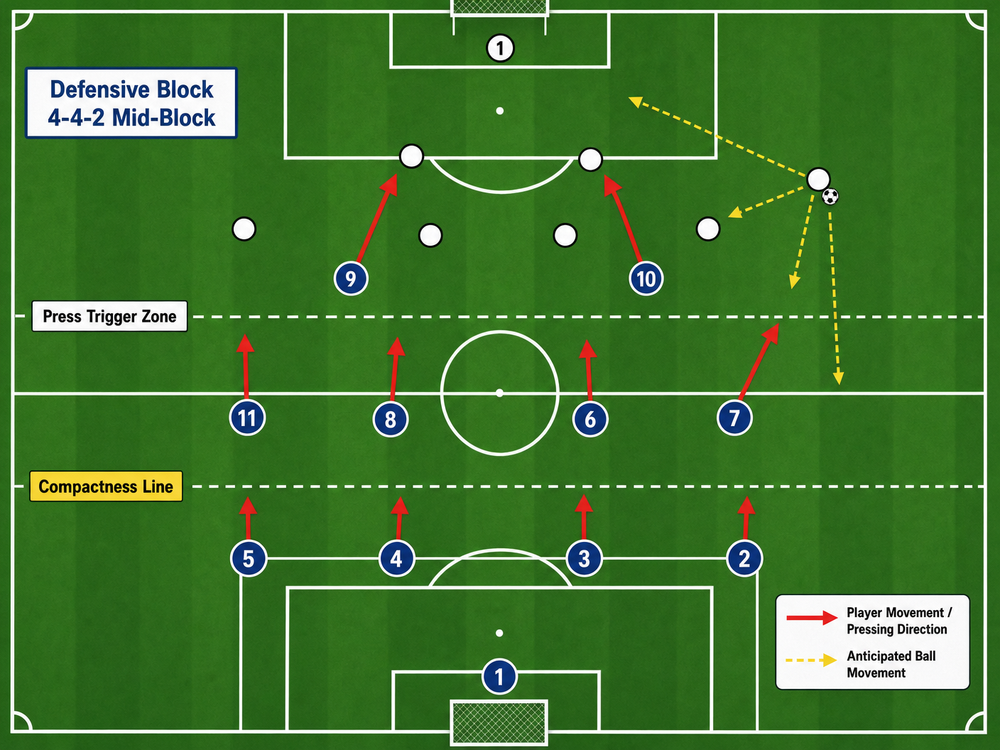
Players: 16-18 players. Set up as an 8v8 or 9v9. The defending team (Blue) sets up in a 4-4-2 (minus the goalkeeper if 8v8, or full team for 11v11 scaled down). The attacking team (White) builds out from the back.
3. Step-by-Step Instructions
- Starting Position: The attacking team (White) starts with the ball deep in their own half. The defending team (Blue) starts in a high or mid-high pressing shape, aiming to win the ball back high up the pitch.
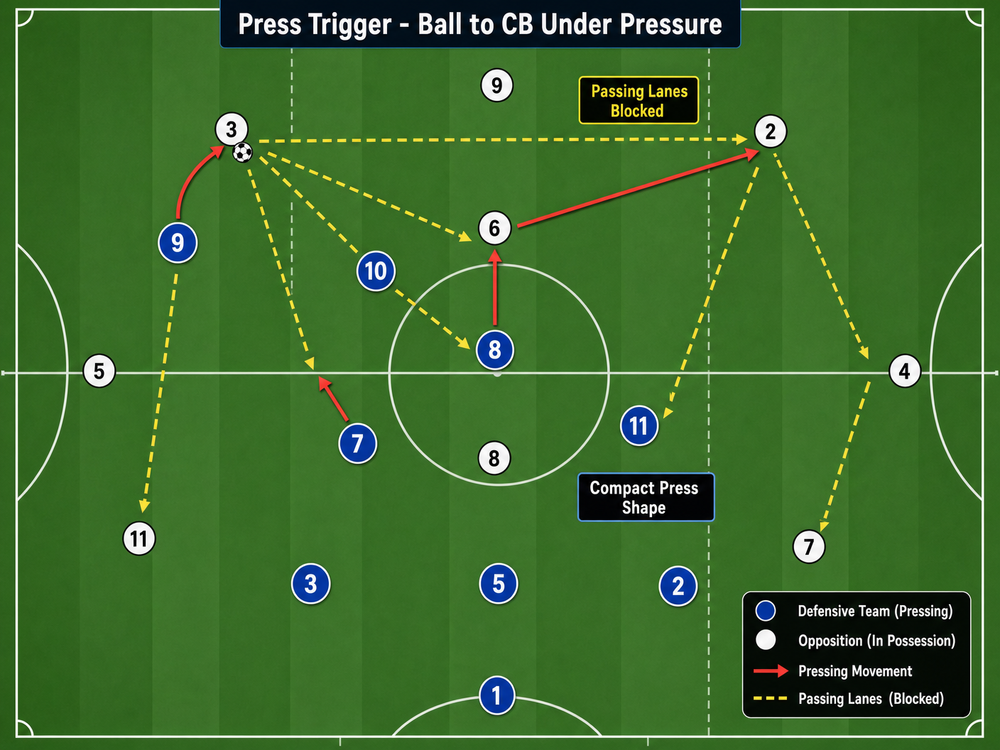
- The Trigger (Pressing Phase): The Blue team initiates the press based on a predefined trigger (e.g., a pass to a wide centre-back or full-back). The front players aggressively close down space while the midfield steps up to lock on.
- Breaking the Press: The coach dictates that the White team must successfully play a pass that breaks the initial pressing line (either a vertical pass into midfield or a clipped ball over the top of the pressing forwards).
- The Transition Trigger: The moment the ball bypasses the first line of pressure and the pressing team is exposed, the transition phase begins.
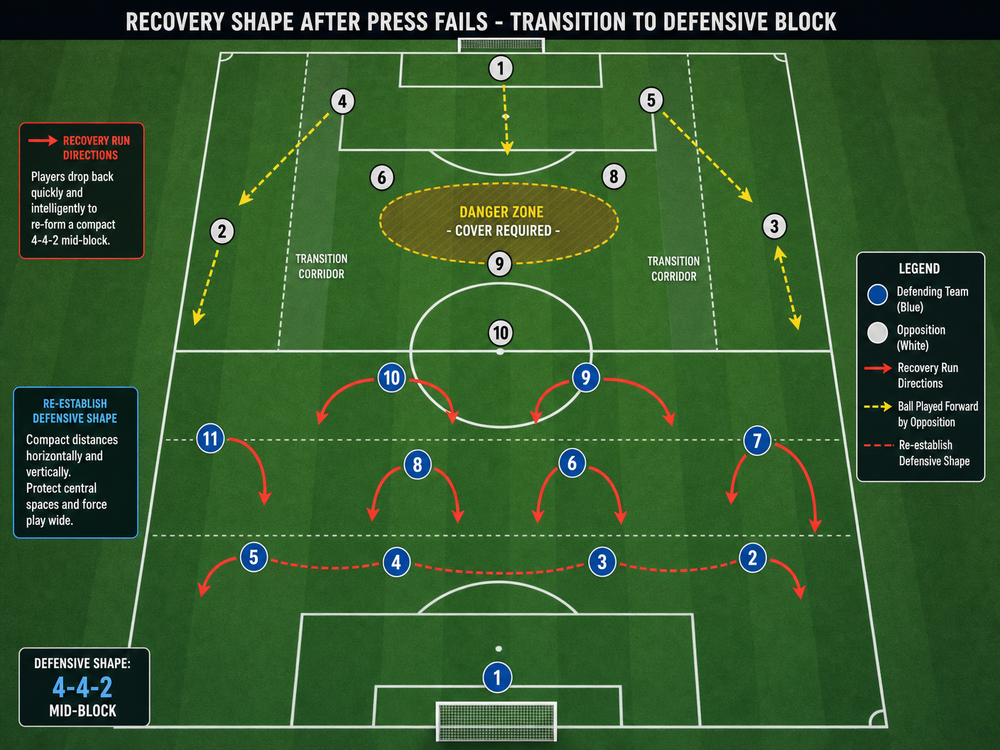
- Recovery Runs: The Blue team must instantly react. Forwards drop to become the first line of the mid-block. Midfielders sprint back to get goal-side of the ball and re-form a flat four. Defenders drop to protect the space in behind and squeeze the play.
- Re-establishing Shape: The Blue team must arrive in the 'Compactness Zone' and immediately establish a tight 4-4-2 shape, ensuring distances between lines are no more than 12-15 metres, and horizontal distances between players are tight to force play wide.
- Defending the Block: Once the shape is set, the Blue team defends the goal against the continuing White attack. If Blue wins the ball, they have 10 seconds to score in the mini-goals.
4. Key Coaching Points
- Immediate Reaction (The 'Flick of the Switch'): The transition from pressing to recovering must be instantaneous. There can be no hesitation or frustration when the press is beaten; the mentality must immediately switch to protection.
- Sprint to Recover, Jog to Adjust: Players must execute their recovery runs at maximum sprint speed to get back goal-side of the ball. Only once they are in the correct defensive zone should they slow down to adjust their micro-positioning.
- Protect the Centre First: The priority during recovery is always to protect the central corridor (the 'Danger Zone'). Players should funnel back centrally, forcing the opposition into wider, less dangerous areas.
- Communication and Leadership: The centre-backs and central midfielders must be vocal, organizing the lines, calling players back into position, and dictating the height of the defensive line.
- Vertical and Horizontal Compactness: Once the shape is re-established, emphasize tight distances. The team must move as a cohesive unit, sliding side-to-side in relation to the ball.
5. Common Mistakes
- Jogging Back: Players jogging or walking back after the press is beaten, leaving massive gaps between the midfield and defensive lines for the opposition to exploit.
- Ball Watching During Recovery: Players watching the ball rather than scanning their shoulders to identify opposition runners and the space they need to cover.
- Dropping Too Deep, Too Early: The defensive line dropping all the way into their own penalty area prematurely, inviting pressure rather than holding a solid mid-block.
- Lack of Communication: Silent recovery where players end up occupying the same spaces or leaving obvious gaps because they aren't talking to each other.
6. Variations & Progressions
- Progression 1 — Time Limit on Recovery: Introduce a strict time limit (e.g., 6 seconds) for the defending team to re-establish their shape in the designated zone after the press is broken. If they fail, the attacking team gets a free shot.
- Progression 2 — Overload the Attack: Add a neutral player ('joker') who always plays for the team in possession, creating a numerical disadvantage for the defending team and making the recovery phase even more challenging.
- Variation — Different Starting Shapes: Practice the transition from different initial pressing structures (e.g., a 4-3-3 high press transitioning into a 4-5-1 mid-block).
7. Age Adaptations
- Under 8 – Under 10: Focus purely on the concept of 'getting back behind the ball' when possession is lost. Use fun, simple games where they have to race back to a safe zone.
- Under 12 – Under 14: Introduce the idea of specific lines (defenders, midfielders, forwards) recovering together. Start working on the distances between these lines.
- Under 16 – Open: Full tactical implementation. Demand high-speed recovery, precise positioning, complex communication, and immediate re-engagement once the block is set.
