The 'Diamond' Full Court Press Break
Master the Diamond press break to confidently beat full-court pressure, create high-percentage transition scoring opportunities, and turn defensive traps into offensive advantages.
Equipment Needed
1. Overview
Full-court pressure can disrupt your team's rhythm, force costly turnovers, and shift momentum in an instant. The Diamond Press Break is a structured, highly effective set play designed to systematically dismantle full-court man-to-man or zone pressure. By utilizing proper spacing, sharp cuts, and decisive passing, this play not only secures possession but actively looks to punish the defense by creating transition scoring opportunities.
Use this set when facing aggressive full-court traps, such as a 1-2-1-1 or 2-2-1 press. The primary goal is to advance the ball past half-court within 8 seconds while maintaining an offensive advantage.
2. Setup
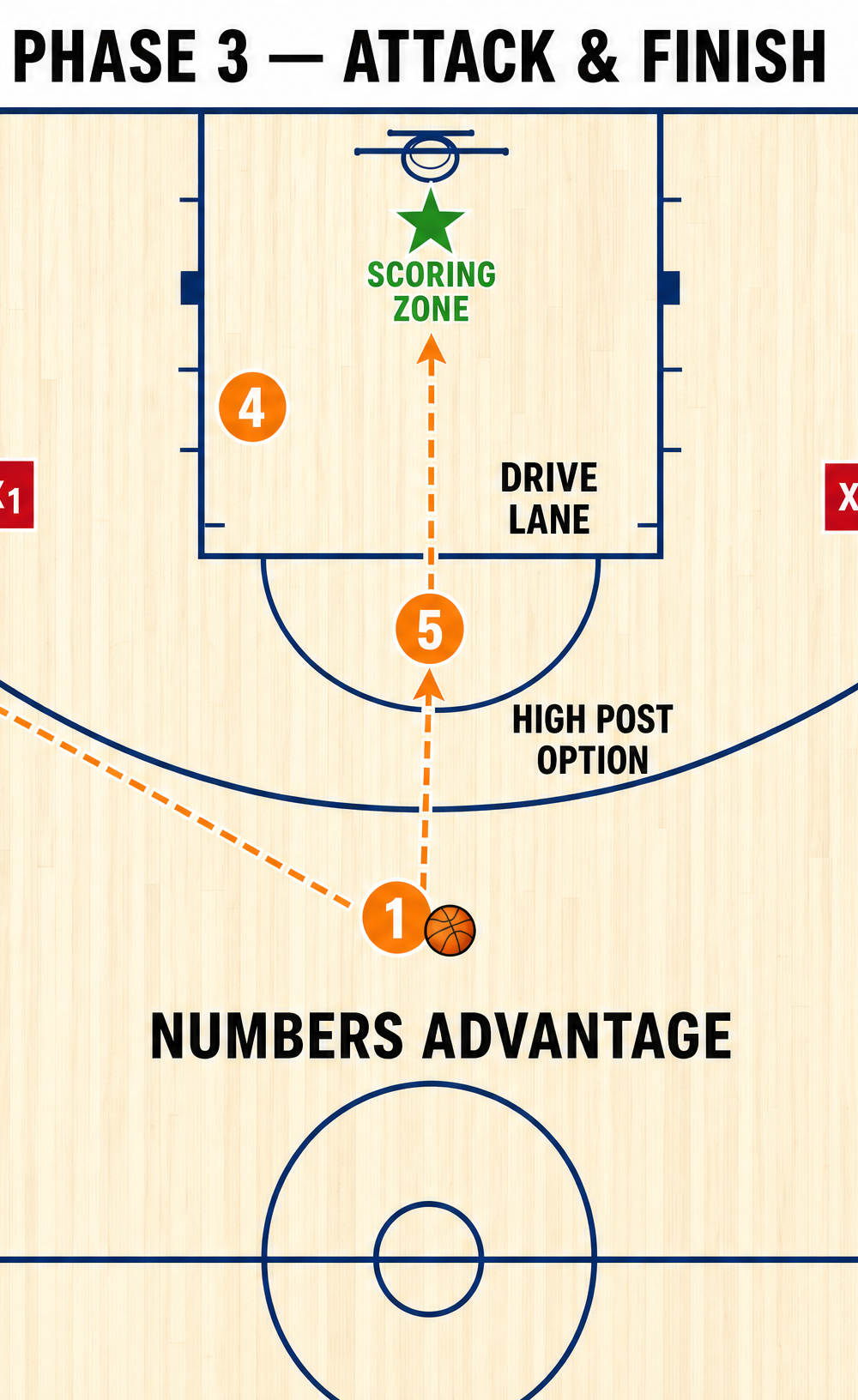
To run this play effectively, you need a standard FIBA basketball court (28m x 15m) and a clear understanding of player roles. The initial formation resembles a diamond shape.
- 1 (Point Guard): Inbounder on the baseline. Must have strong passing skills and composure.
- 2 (Shooting Guard): Positioned on the left sideline, free-throw line extended.
- 3 (Small Forward): Positioned on the right sideline, free-throw line extended.
- 4 (Power Forward): Positioned near the half-court line on the left side.
- 5 (Center): Positioned near the half-court line on the right side, acting as the safety valve.
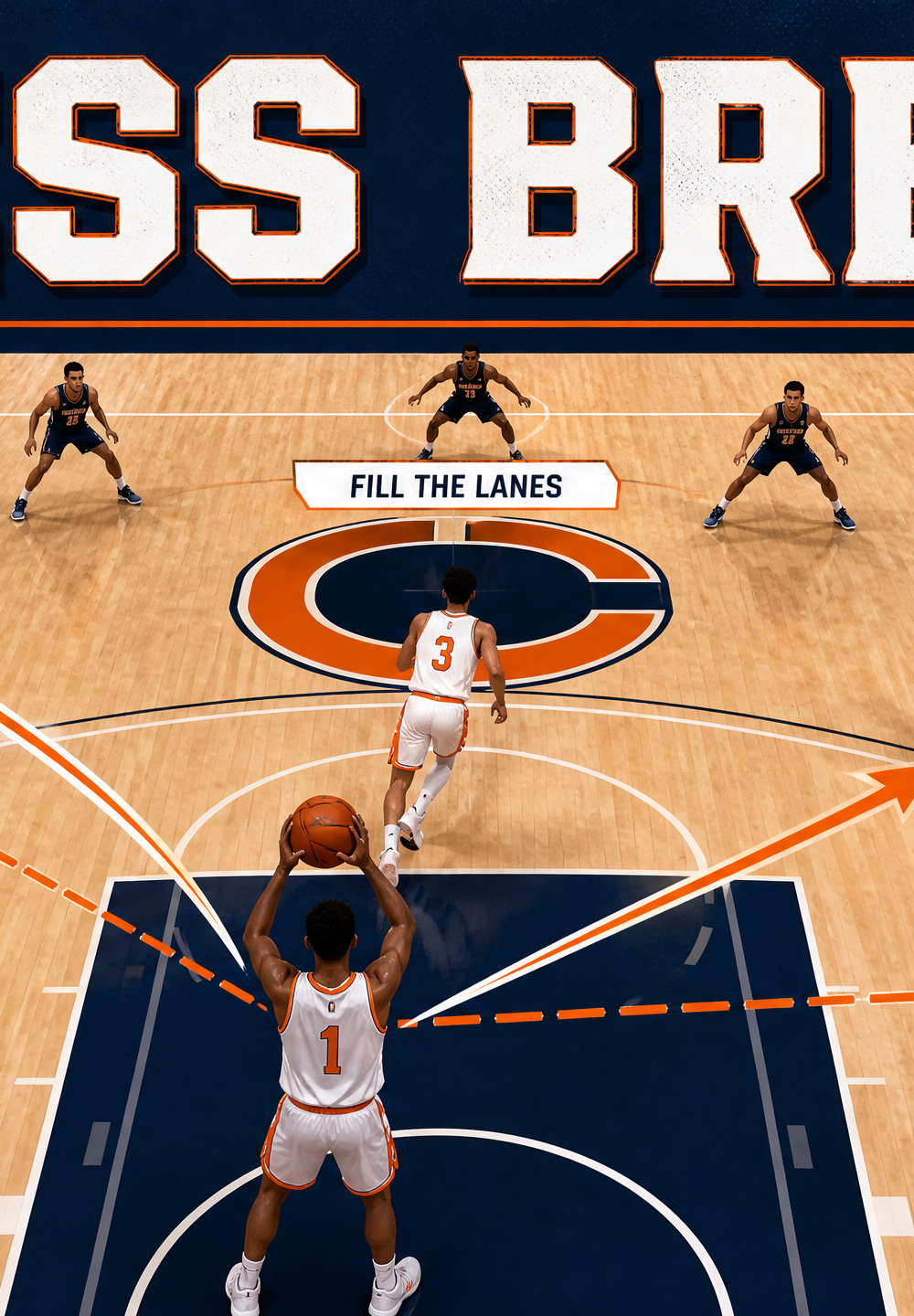
3. Step-by-Step Instructions
Phase 1: The Inbound and Initial Reads
- Player 1 secures the ball out of bounds and surveys the floor. They have 5 seconds to inbound.
- Players 2 and 3 make hard V-cuts to get open on the wings. They must create separation from their defenders.
- Player 1 passes to the open guard (e.g., Player 2 on the left side). If both are covered, Player 4 flashes to the middle.
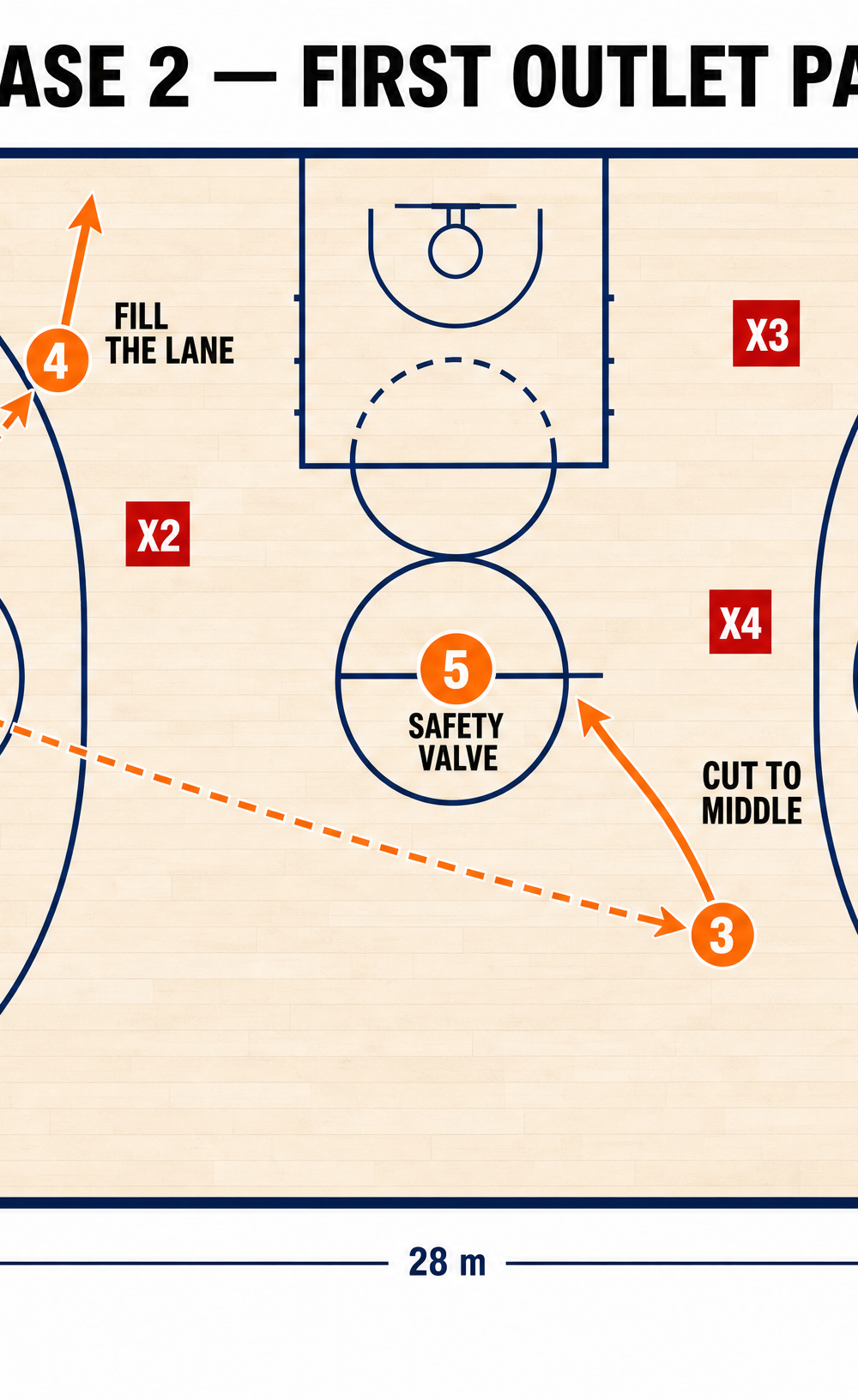
Phase 2: Advancing the Ball
- Once Player 2 receives the ball, they immediately face up and look up the court. Do not dribble immediately.
- Player 3 (weak side wing) cuts diagonally toward the middle of the court to provide a high-percentage passing option.
- Player 4 sprints hard up the left sideline to stretch the defense and fill the running lane.
- Player 5 moves to the center circle to act as a safety valve in case the primary options are denied or trapped.
- Player 2 makes a quick, decisive pass to either Player 3 cutting middle or Player 4 running the lane.
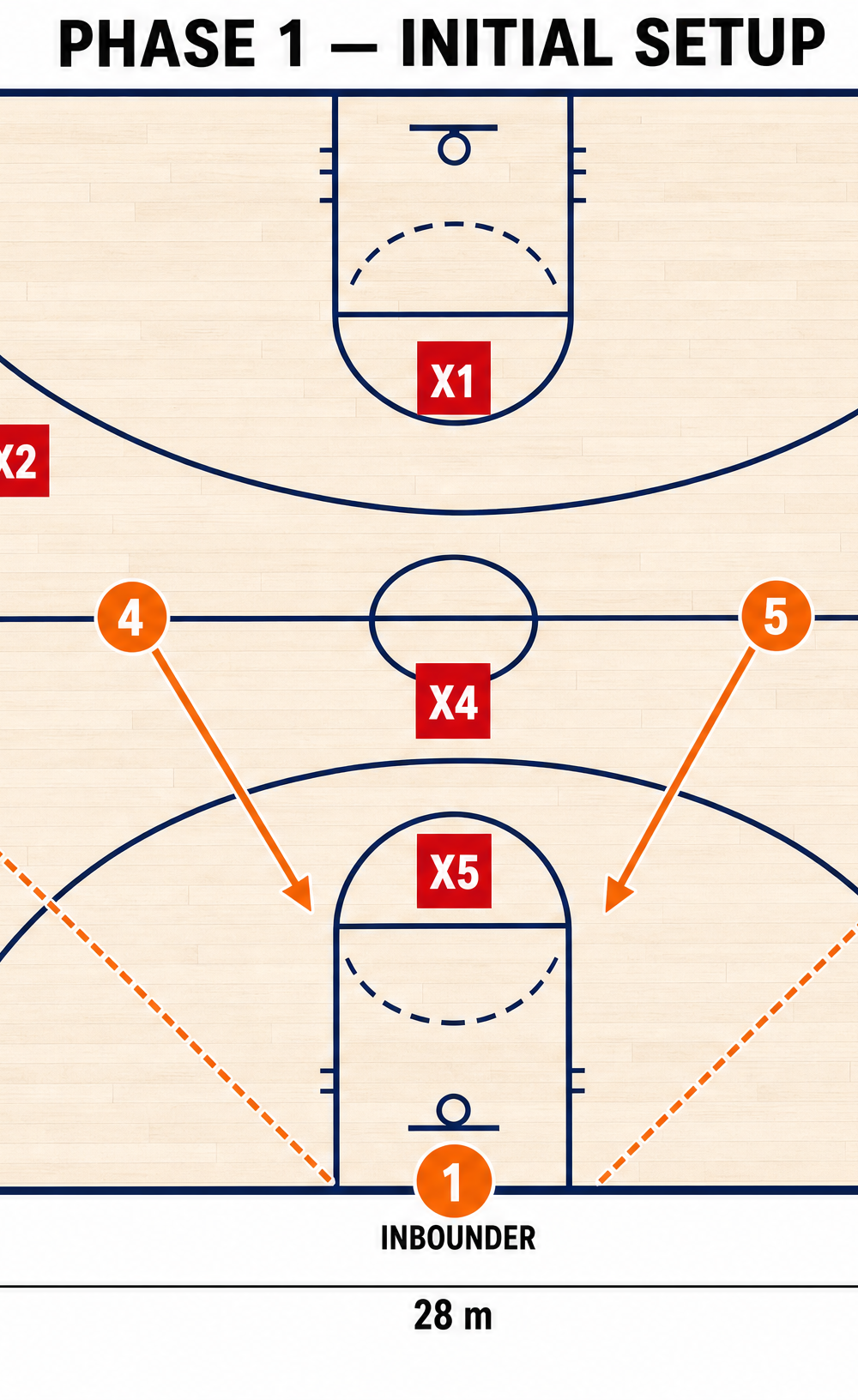
Phase 3: Attack and Finish
- As the ball crosses half-court, the offense should have a numerical advantage (e.g., a 3-on-2 or 2-on-1 fast break).
- The ball handler (now Player 1 trailing or the player who received the outlet) attacks the middle of the floor.
- Player 2 and Player 3 fill the wide wings to the three-point line.
- Player 4 runs to the low block, and Player 5 trails to the high post.
- The ball handler reads the defense: drive for a layup, pass to the wing for an open three, or drop it to the post.
4. Key Coaching Points
- Meet All Passes: Receivers must aggressively step toward the ball to prevent interceptions. Never wait for the ball to come to you.
- Look Before You Dribble: The player receiving the inbound pass must catch, face the court, and look for the next pass before putting the ball on the floor. Passing beats the press faster than dribbling.
- Stay Wide: Maintain proper spacing. If players bunch up, one defender can guard two offensive players, making traps highly effective.
- Use the Middle: The middle of the floor is the weakest point of most press defenses. Always have a player flashing to the middle to relieve pressure.
- Stay Calm: Panic leads to turnovers. Instill confidence in your players to trust the structure of the play.
5. Common Mistakes
- Dribbling into Traps: Players immediately putting the ball on the floor and dribbling into the corners where traps are set.
- Soft Cuts: Players jogging through their cuts, failing to create the necessary separation to receive a clean pass.
- Throwing High, Looping Passes: Weak passes give the defense time to recover and intercept. Passes must be crisp and direct.
- Forgetting the Safety: If the primary options are covered, players often force a pass rather than looking back to the safety valve (Player 5).
6. Variations & Progressions
- The 'Clear Out' Variation: If the defense is heavily denying the inbound, have Player 4 and Player 5 set screens for the guards to get them open.
- Dribble Advance Progression: If the initial pass is made and the defense immediately drops back, allow the receiver to aggressively dribble up the sideline to initiate the offense quickly.
- Secondary Break Integration: Transition smoothly from the press break directly into your secondary fast-break offense without stopping to set up.
7. Age Adaptations
- Under 10 / Under 12: Focus heavily on the fundamentals of pivoting, passing under pressure, and meeting the ball. Simplify the reads—just get the ball in and advance it safely. Do not emphasize scoring off the break yet.
- Under 14 / Under 16: Introduce the concept of punishing the press. Teach players to recognize numerical advantages and make the right decisions in 3-on-2 situations.
- Open / Advanced: Execute at high speed. Emphasize advanced reads, such as skipping the ball across the court to exploit the weak side of the press.