

Rugby
Dominant Ruck Clear-Out and Clean-Out Drill
Master the breakdown with this essential drill focused on body height, gate entry, and aggressive clear-outs to secure quick ball for your attack.
What you need
4-6 Cones, 1-2 Tackle bags or ruck shields, 3 Rugby balls, Bibs
1. Overview
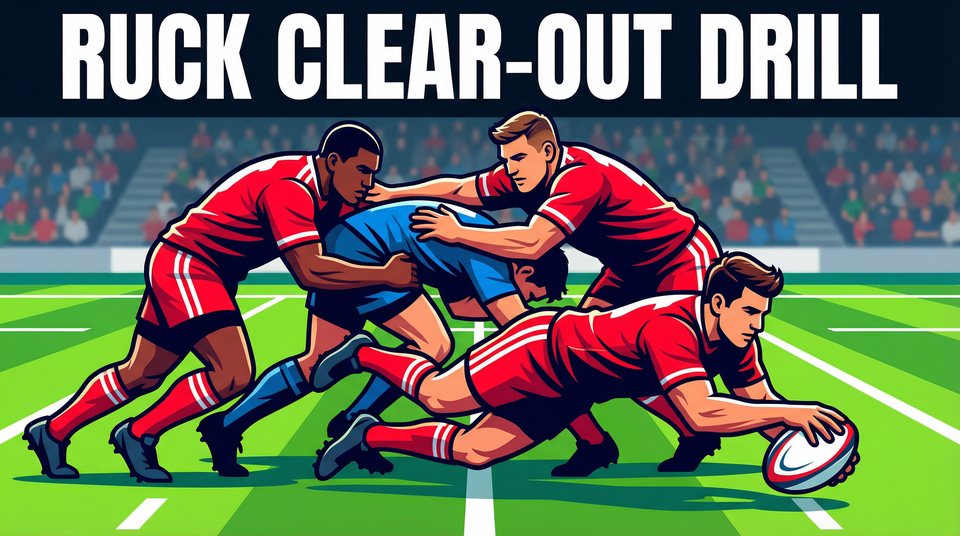
The ruck is the heartbeat of any successful rugby attack. If you cannot secure your own ball quickly and efficiently, your offensive structure will crumble. This drill is designed to isolate and perfect the mechanics of the clear-out and clean-out at the breakdown. It emphasizes entering through the 'gate' squarely, dropping body height before contact, and driving beyond the ball to eliminate threats. By running this drill regularly, coaches can instill the muscle memory required for forwards and arriving backs to dominate the collision area and present lightning-fast ball for the scrum-half (9).
2. Setup
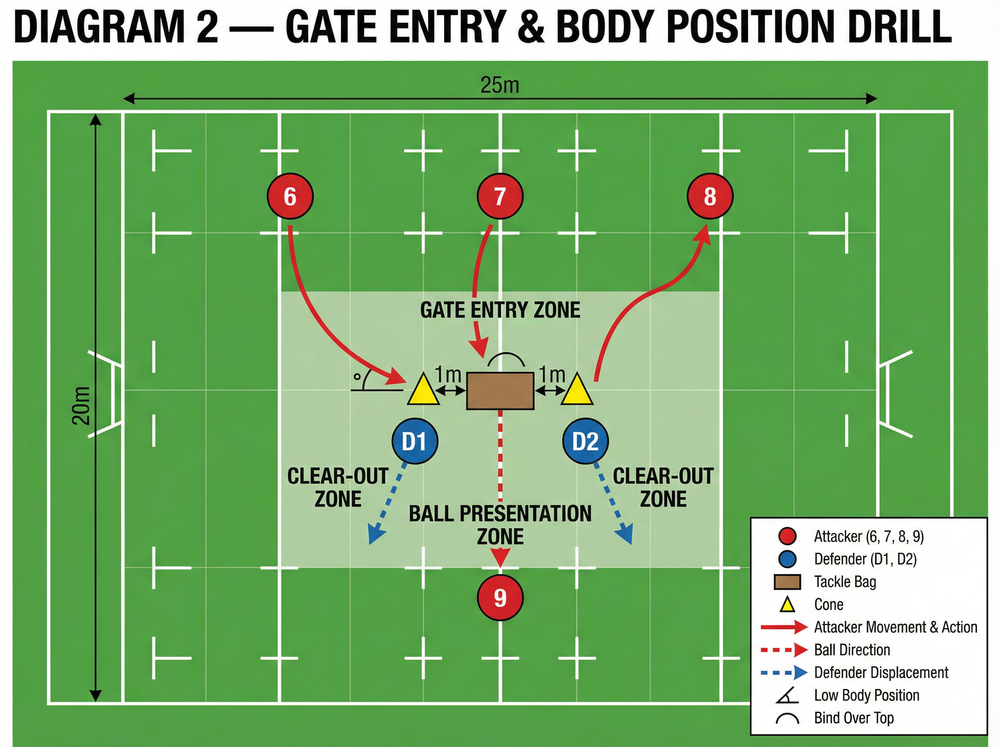
To run this drill effectively, you will need a 25m x 20m grid on the pitch.
Equipment needed:
- 4-6 Cones (to mark the grid and the gate)
- 1-2 Tackle bags or ruck shields
- 3 Rugby balls
- Bibs (to differentiate attackers and defenders)
Player Positions:
Set up groups of five players per station.
- Attackers: Three players (e.g., 6, 7, 8) starting 5 meters back from the breakdown point.
- Defenders: Two players (D1, D2) holding tackle bags, positioned directly over the breakdown point.
- Scrum-half: One player (9) waiting at the base to clear the ball.
Place a ball on the ground to simulate a tackled player presenting the ball. Place two cones exactly 1 meter on either side of the ball to clearly define the 'gate'.

3. Step-by-Step Instructions
- Starting Position: The three attacking players start on their stomachs or one knee, 5 meters away from the breakdown point, facing the gate. The coach yells "GO!"
- The Approach: The attackers sprint toward the breakdown. They must decelerate slightly in the final 2 meters to adjust their feet (short, choppy steps) and drop their hips.
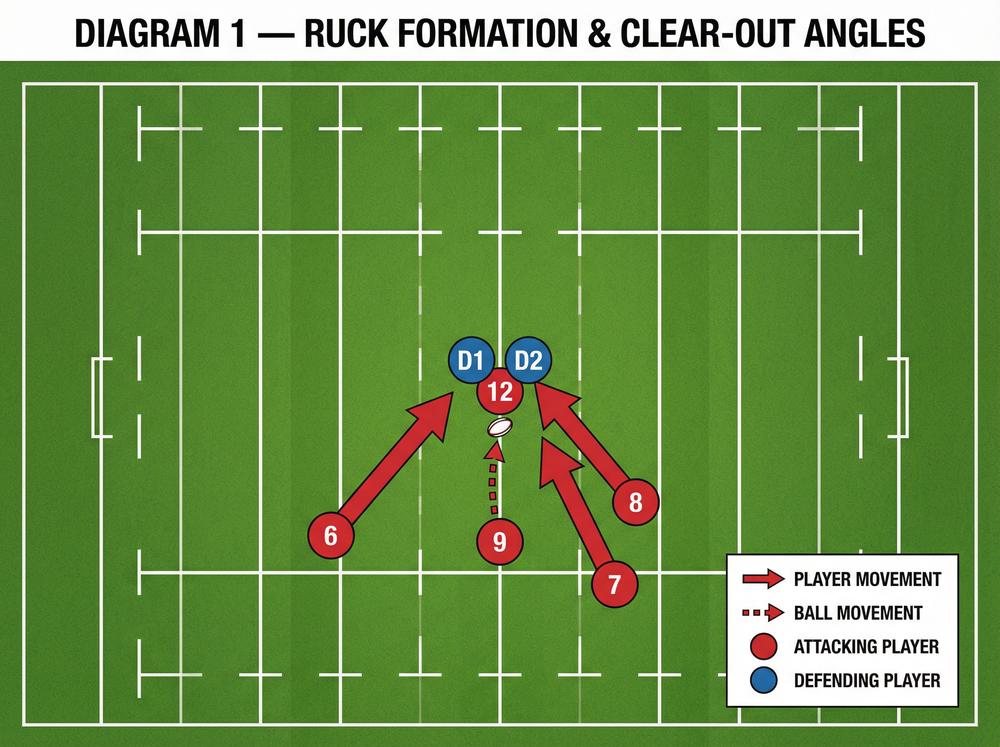
- First Arriver (The Clear-Out): The first arriving player (e.g., 6) targets the primary threat (D1). They must enter squarely through the cones (the gate), sink their hips below the defender's pad level, and make contact with the shoulder. They drive D1 back and away from the ball.
- Second Arriver (The Clean-Out/Seal): The second player (e.g., 7) reads the situation. If D2 is threatening the ball, player 7 executes a similar low drive on D2. If the threat is neutralized, player 7 binds onto player 6 to anchor the ruck and protect the ball.
- Third Arriver (The Guard): The third player (e.g., 8) arrives to secure the fringes, ready for the next phase, or picks and goes if the defense is completely fractured.
- The Clearance: The scrum-half (9) steps in, puts hands on the ball, and passes to a waiting receiver to reset the drill.
4. Key Coaching Points
- Win the Shoulder Battle: The player with the lowest shoulders entering the contact zone usually wins the collision. Emphasize dropping the hips, not just bending at the waist, to maintain a strong, flat back.
- Square Up: Players must enter through the gate with their hips and shoulders square to the opposition goal line. Entering from the side is a penalty and compromises power.
- Short Steps Before Contact: Attackers should shorten their stride length 1-2 meters before the ruck. This 'pitter-patter' footwork allows them to adjust their angle instantly and generate explosive power on contact.
- Drive Beyond the Ball: The job isn't done at the point of contact. Players must keep their legs pumping and drive the defender at least 1-2 meters past the ball to create a clean pocket for the 9.
- Eyes Up: Arriving players must scan the breakdown as they approach to identify the biggest threat. Don't just hit a body; hit the right body.
5. Common Mistakes
- Coming in Too High: Players running upright into the ruck will get easily driven backward or held up, creating a choke tackle situation or a turnover.
- Side Entry: In their eagerness to hit the ruck, players often take a shortcut and enter from the side of the gate. This will result in an immediate penalty in a game.
- Diving Over the Top: Players losing their footing and diving over the ruck rather than staying on their feet and driving. This seals off the ball illegally.
- Stopping at Contact: Hitting the defender but failing to keep the legs driving. The momentum stops, and the defense can easily counter-ruck.
6. Variations & Progressions
- Live Defense (Progression): Remove the tackle bags and have the two defenders contest the ruck live (in full pads if necessary). This forces the attackers to deal with dynamic, moving bodies rather than static targets.
- Varying Numbers (Variation): Change the numbers arriving. Run 2v2, 3v2, or even 2v3 to simulate chaotic game situations where the attack is outnumbered and must fight harder to secure the ball.
- Fatigue Factor (Progression): Have the attacking players complete a 20-meter down-and-up sprint or 5 burpees before approaching the ruck to simulate late-game fatigue.
7. Age Adaptations
- Under 8s - Under 10s: Focus entirely on safety and body position. Use very soft pads. Emphasize the 'crocodile' roll or simply driving over a static ball without heavy contact. The concept of the 'gate' should be introduced visually with large cones.
- Under 12s - Under 14s: Introduce live but controlled contact. Focus heavily on the "chin off the chest" and "flat back" cues to ensure spinal safety during the drive. Emphasize teamwork (the second arriver binding correctly).
- Under 16s - Open: Full intensity. Focus on decision-making at speed (who to hit, when to seal, when to pick and go). Introduce complex defensive threats like jackalers and aggressive counter-rucking.
