

Netball
The Double-Screen Shooting Circle Play: Dominating the Goal Third
Master this advanced attacking set play to create high-percentage shooting opportunities by effectively neutralising the Goal Keeper using a coordinated double screen.
What you need
1 Netball, Positional Bibs (GS, GA, WA, C), Standard Netball Court (30.5m x 15.25m)
1. Overview
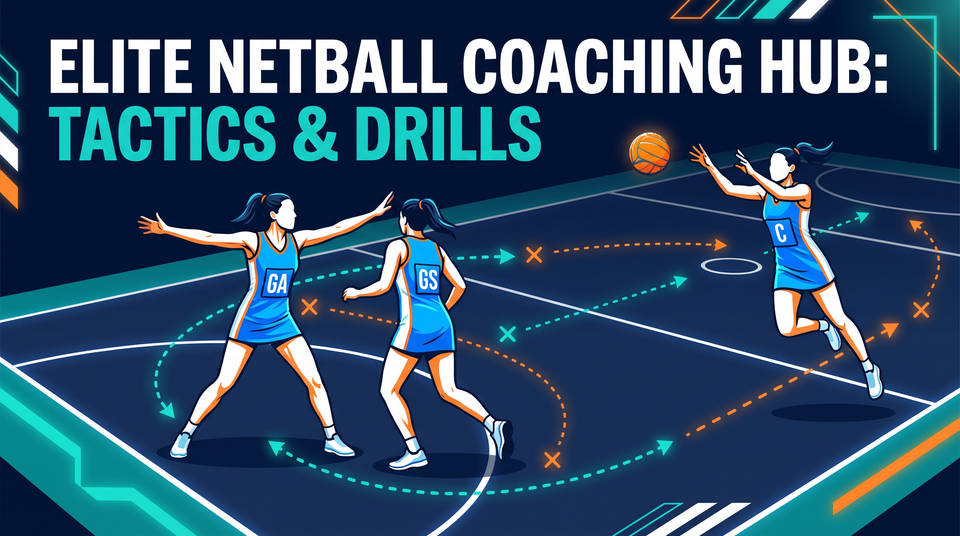
The double-screen shooting circle play is a highly effective attacking strategy designed to isolate the Goal Shooter (GS) and create a clear, high-percentage scoring opportunity close to the post. By utilising both the Goal Attack (GA) and Wing Attack (WA) to set sequential screens on the edge of the shooting circle, the attacking team can effectively block the Goal Keeper's (GK) movement path. This play is particularly useful when facing a dominant, highly athletic GK who typically intercepts direct feeds or contests strongly in the air. It requires precise timing, strong holds, and accurate feeding, making it an excellent weapon to deploy during crucial moments in a match, such as after a timeout or when needing to break a scoring drought.
2. Setup
To run this play successfully, you need the following setup:
- Equipment: 1 Netball, standard court markings (30.5m x 15.25m with a 4.9m radius shooting circle), and positional bibs.
- Player Positions:
- GS (Goal Shooter): Starts deep in the circle, holding position near the goal post.
- GA (Goal Attack): Positions themselves near the top edge of the shooting circle, ready to set the first screen.
- WA (Wing Attack): Starts outside the circle, slightly wide, acting as the ball carrier and secondary screener.
- C (Centre): Can be used as a reset option or decoy outside the transverse line.
- Court Setup: The play occurs entirely within the attacking goal third, specifically focusing on the interaction around the shooting circle edge.
3. Step-by-Step Instructions

- The Initiation: The play begins with the Wing Attack (WA) receiving the ball near the transverse line and driving towards the top edge of the shooting circle.
- The First Screen: As the WA approaches, the Goal Attack (GA) moves deliberately to the top of the circle and sets a strong, stationary screen. The GA must plant their feet shoulder-width apart, establishing a solid base to impede the Goal Defence (GD) or force a switch.
- The Second Screen: Immediately following their pass or movement, the WA repositions alongside the GA, effectively creating a 'wall' or double screen on the circle edge. This seals the lane and creates a significant physical barrier.
- The Cut: The Goal Shooter (GS), who has been holding their defender (GK) near the post, waits for the double screen to be established. With explosive pace, the GS cuts sharply from the post, running a curved path behind the GA and WA double screen.

- The Feed: The ball carrier (which could be the Centre who received a reset pass, or the WA if they didn't join the screen) reads the GS's movement. As the GS clears the double screen and leaves the GK trapped behind the 'wall', the feeder delivers a crisp, perfectly timed pass into the newly created space.
- The Shot: The GS receives the ball in stride, turns smoothly to face the post, and executes an uncontested, high-percentage shot.
4. Key Coaching Points
- Screening Technique: The GA and WA must establish their position before contact occurs. They need a wide, stable base, keeping their arms tucked in to avoid offensive contact penalties. They must hold their ground firmly.
- Timing is Everything: The GS must not begin their cut too early. If they move before the double screen is fully set, the GK will easily slip through. The cut must be explosive and perfectly timed with the screen's establishment.
- The Angle of the Cut: The GS needs to run a tight arc around the screeners. Running too wide gives the GK time to recover; running too tight risks an offensive contact call on their own teammates.
- Feeder Vision: The player delivering the final pass must have excellent court vision and anticipate the GS's arrival in the open space. The pass should lead the GS, allowing them to catch and shoot in one fluid motion.
- Communication: Silent communication through eye contact between the feeder and the GS is crucial for the timing of the final pass.
5. Common Mistakes
- Moving Screens: The GA or WA shifting their feet or leaning into the defender while setting the screen, resulting in an offensive contact penalty.
- Premature Cutting: The GS initiating their drive before the screens are set, allowing the GK to stay attached and contest the pass.
- Weak Holds: The screeners not establishing a strong enough base, allowing the defenders to easily push through or disrupt the wall.
- Poor Pass Placement: The feeder delivering the ball behind the GS or too close to the recovering defenders, resulting in an interception or a contested shot.
6. Variations & Progressions
- The Roll-Off (Progression): If the defenders switch aggressively and anticipate the GS cut, the GA (who set the first screen) can immediately roll off the screen and cut directly to the post for a quick dump pass.
- Fake the Screen (Variation): The GA and WA set up for the double screen, but instead of cutting behind them, the GS fakes the high cut and drops back to the baseline for a lob pass over the top of the distracted defenders.
- Add a Decoy (Progression): Have the Centre make a hard, distracting drive to the opposite pocket just before the GS cuts, forcing the defenders to split their attention.
7. Age Adaptations
- Under 10s & 12s: Focus primarily on the basic concept of a single screen (the GA screening for the GS). Emphasise correct stationary screening technique (feet still, arms in) and basic timing. The double screen may be too complex.
- Under 14s: Introduce the double screen concept, but allow more time for the setup. Focus heavily on the GS's timing and the angle of their cut around the screeners.
- Under 16s & Open: Run the full play at match speed. Incorporate the variations (like the roll-off) and demand high-level decision-making from the feeder based on how the defence reacts.
