

Basketball
The 'Elevator' Baseline Inbound: End-of-Game Buzzer Beater
A high-percentage, multi-option baseline inbound play designed to get your best shooter a clean look with under 3 seconds remaining.
What you need
Basketball, Full or half court
1. Overview
When the game is on the line and you have possession under your own basket with less than 3 seconds remaining, you need a play that creates immediate separation. The 'Elevator' Baseline Inbound is a versatile set play that forces the defense to make split-second decisions, often resulting in a wide-open look for your primary shooter. This play is particularly effective because it incorporates three distinct scoring options: a primary shooter coming off a screen, a secondary backdoor cut, and a tertiary safety valve at the rim.
This set play is best utilized in late-game, high-pressure situations where a quick basket is required. It exploits defensive over-aggression and miscommunication, making it a staple for coaches looking to secure a crucial victory at the buzzer.
2. Setup
Equipment Needed:
- 1 Basketball
- Full or half court with FIBA standard markings (28m x 15m)
Court Setup:
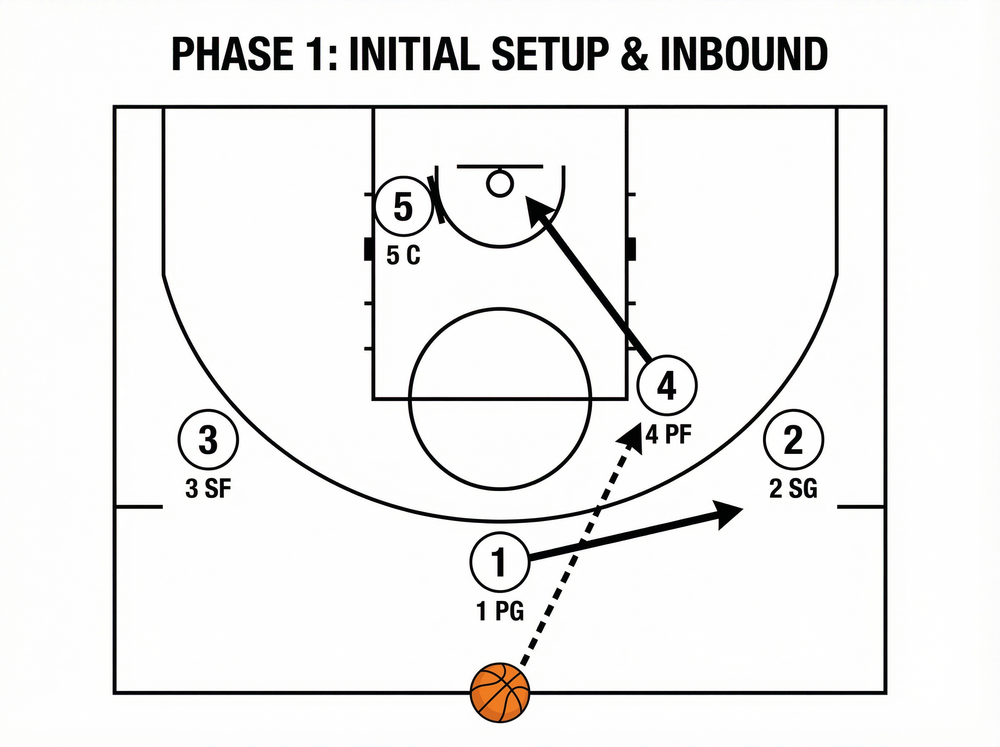
- The play begins as a baseline inbound from under the offensive basket.
Player Positions:
- Player 1 (Point Guard): Positioned at the top of the key.
- Player 2 (Shooting Guard - Primary Shooter): Positioned on the right wing, just outside the three-point line.
- Player 3 (Small Forward): Positioned on the left wing, just outside the three-point line.
- Player 4 (Power Forward): Positioned at the right elbow of the free throw line.
- Player 5 (Center - Inbounder): Positioned out of bounds on the baseline, ready to inbound the ball.

3. Step-by-Step Instructions
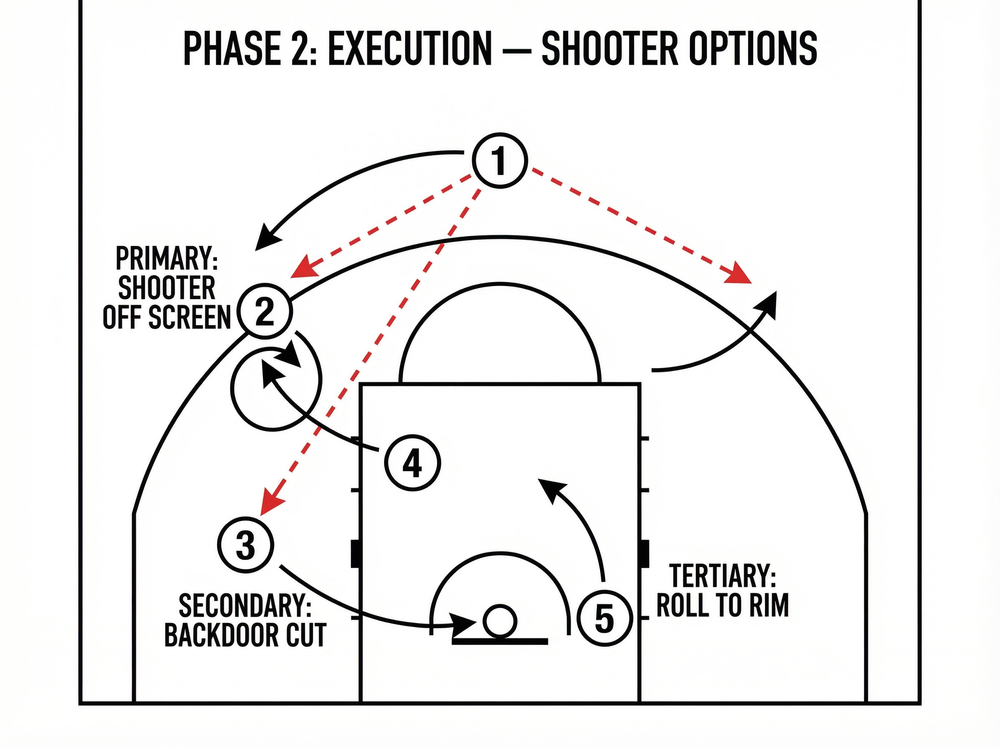
- The Trigger: The referee hands the ball to Player 5 on the baseline. Player 5 slaps the ball to signal the start of the play.
- The Decoy: Player 1 (Point Guard) immediately cuts hard toward the left wing, drawing their defender away from the primary action area.
- The Screen: Simultaneously, Player 4 (Power Forward) steps down from the right elbow to set a solid, wide-based screen on Player 2's defender.
- The Primary Cut: Player 2 (Shooting Guard) fakes a cut toward the baseline, then explodes off Player 4's screen, curling tightly toward the top of the key/right wing area.
- The Secondary Cut: As Player 2 comes off the screen, Player 3 (Small Forward) executes a hard backdoor cut from the left wing toward the basket, exploiting any defensive help that shifted toward Player 2.
- The Roll: After setting the screen for Player 2, Player 4 immediately rolls hard to the basket.
- The Read and Pass: Player 5 reads the defense:
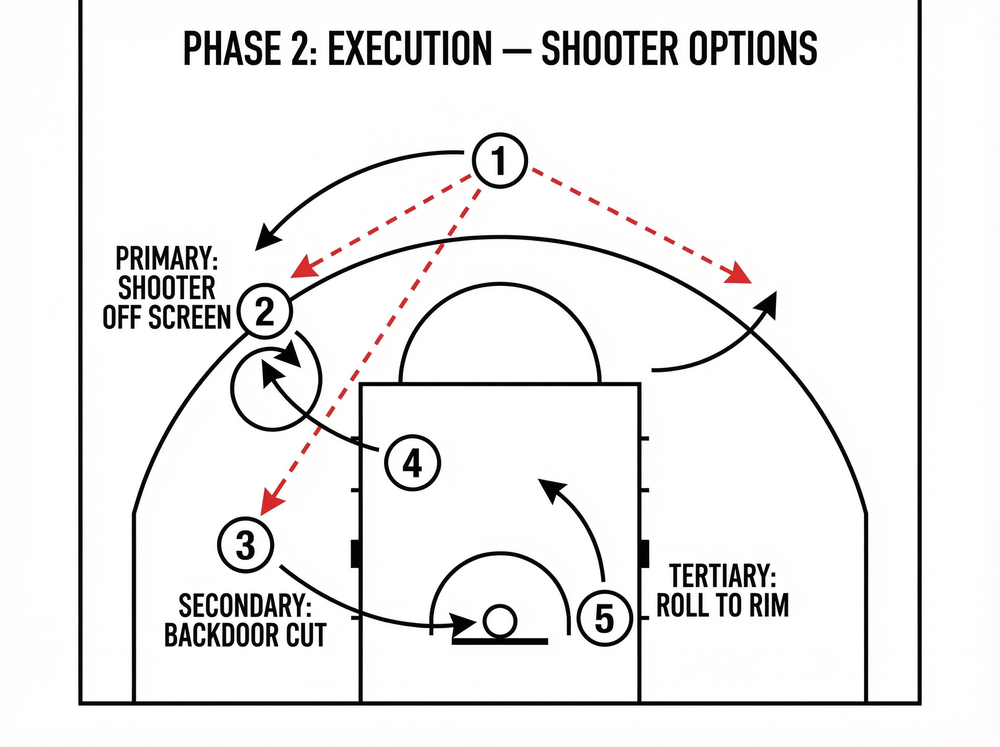
- Option 1 (Primary): If Player 2 is open coming off the screen, deliver a crisp chest pass for the catch-and-shoot.
- Option 2 (Secondary): If Player 2's defender fights over the screen or help arrives, look for Player 3 on the backdoor cut for a quick layup.
- Option 3 (Tertiary): If both options are covered, look for Player 4 rolling to the rim or Player 1 spacing out on the left wing as a safety outlet.
4. Key Coaching Points

- Timing is Everything: The success of this play relies entirely on synchronized movement. Player 2 must not start their cut until Player 4 is completely set in their screening position.
- Screening Angle: Player 4 must set the screen at an angle that forces Player 2's defender to go under or trail the play, creating the necessary separation for the shot.
- Selling the Fake: Player 2 must sell the initial baseline fake to get their defender off balance before exploding off the screen.
- Inbounder Vision: Player 5 must remain calm and read the defense. They should not predetermine their pass but rather react to how the defense plays the screen.
- Game Situation Awareness: Ensure players know exactly how much time is left on the clock. If there is less than 1 second, the pass must be caught and shot in one motion.
5. Common Mistakes

- Moving Screens: Player 4 moving before Player 2 has cleared the screen, resulting in an offensive foul.
- Telegraphing the Pass: Player 5 staring down Player 2 the entire time, allowing the defense to anticipate the pass and jump the passing lane.
- Poor Spacing: Players 1 and 3 not clearing out or spacing correctly, cluttering the primary action area and bringing extra defenders into the play.
- Curling Too Wide: Player 2 taking too wide of a path around the screen, allowing the defender time to recover and contest the shot.
6. Variations & Progressions
- The 'Slip' Variation: If the defense anticipates the screen and tries to jump the passing lane to Player 2, Player 4 can 'slip' the screen and dive immediately to the basket for a quick layup.
- The 'Elevator Doors' Variation: Instead of a single screen, Player 4 and Player 5 (if someone else is inbounding) set a double screen at the free throw line. Player 2 runs between them, and they 'close the doors' on the defender.
7. Age Adaptations
- Under 10 / Under 12: Focus on the basic mechanics of setting a stationary screen and making a clean pass. Simplify the options—perhaps only focus on the primary shooter and one safety valve.
- Under 14 / Under 16: Introduce the secondary backdoor cut and emphasize the importance of reading the defense. Work on the timing of the slip variation.
- Open / Advanced: Execute the play at full game speed with aggressive defensive pressure. Incorporate the 'Elevator Doors' variation and emphasize split-second decision-making for the inbounder.
