

Basketball
The 'Elevator' Buzzer Beater: Full-Court Game Winner
A high-percentage, full-court inbound play designed to get your best shooter an open look with less than 3 seconds on the clock.
What you need
Basketball, Full Court (FIBA 28m x 15m)
1. Overview
The 'Elevator' is a high-leverage, full-court baseline inbound play specifically engineered for end-of-game situations where you need a three-point shot and have less than 3 seconds remaining on the clock. It utilizes a deceptive initial alignment and a double-screen action (the 'elevator doors') to free up your primary shooter. This set is particularly effective because it forces the defense to navigate multiple screens in a compressed timeframe, often leading to miscommunication and a clean look at the basket.
2. Setup

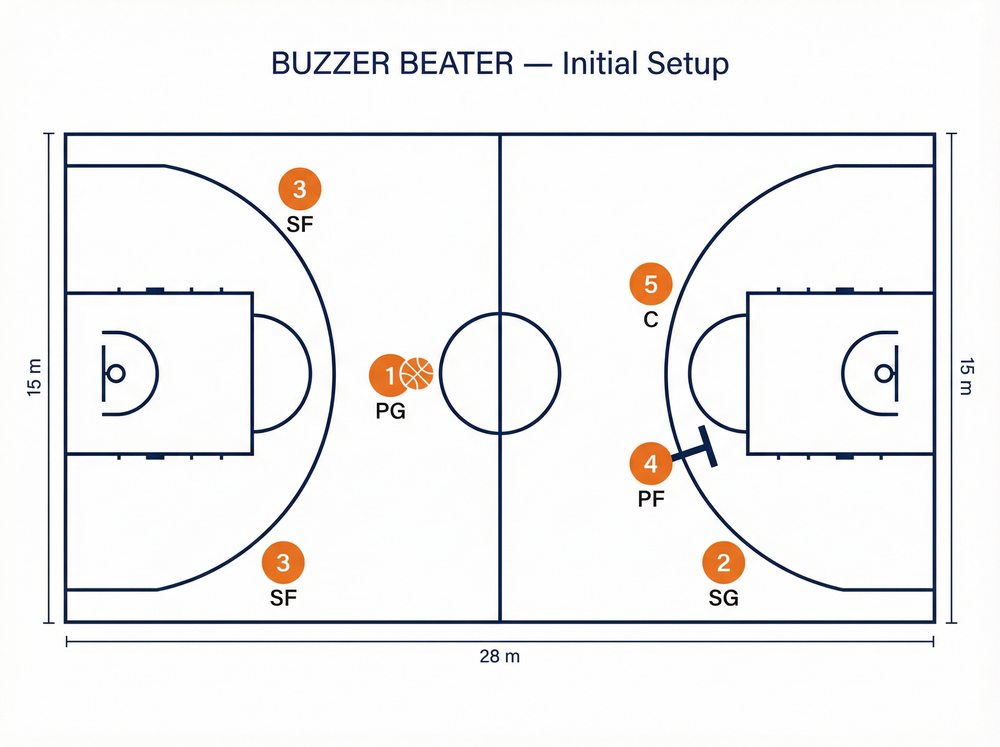
To execute this play effectively, you will need a standard FIBA basketball court (28m x 15m) and a full team of five players. The play is initiated from a baseline inbound on the opposite end of the court.
Player Positions:
- Player 1 (PG): The inbounder, positioned on the baseline.
- Player 2 (SG): The primary shooter, starting at the opposite free-throw line extended (right wing).
- Player 3 (SF): The secondary option/decoy, starting at the opposite free-throw line extended (left wing).
- Player 4 (PF): The first screener, positioned at the top of the key.
- Player 5 (C): The second screener, positioned near the left elbow.

3. Step-by-Step Instructions

- The Trigger: The play begins when the referee hands the ball to Player 1 (PG) on the baseline. Player 1 slaps the ball to signal the start of the action.
- The Decoy Cut: Player 3 (SF) immediately sprints from the left wing toward the left corner, utilizing a down-screen set by Player 4 (PF). This action is designed to draw the defense's attention away from the primary action and create a potential secondary passing option if the primary read is covered.
- The Primary Action: Simultaneously, Player 2 (SG) fakes a cut toward the basket to freeze their defender, then sharply changes direction and sprints toward the top of the key.
- The 'Elevator Doors': As Player 2 approaches the top of the key, Player 4 (PF) and Player 5 (C) step together to form a tight double-screen. Player 2 runs directly between them. Once Player 2 passes through, Player 4 and Player 5 immediately close the gap (closing the 'elevator doors'), effectively sealing off Player 2's trailing defender.
- The Pass and Shot: Player 1 (PG) throws a precise, long-distance pass (often a baseball pass) to Player 2, who should now be wide open at the top of the key. Player 2 catches the ball, turns, and shoots in one fluid motion before the buzzer sounds.

4. Key Coaching Points

- Timing is Everything: The success of this play hinges on the synchronization between Player 2's cut and the closing of the 'elevator doors' by Players 4 and 5. If the screeners close too early, Player 2 won't get through; if they close too late, the defender will slip through.
- The Inbound Pass: Player 1 must possess the arm strength and accuracy to deliver a crisp, on-target pass over a long distance. A weak or floating pass will allow the defense time to recover and contest the shot.
- Selling the Fake: Player 2 must aggressively sell the initial cut toward the basket to force their defender to commit, creating the necessary separation for the sprint to the top of the key.
- Solid Screens: Players 4 and 5 must set firm, legal screens. They need to establish position and brace for contact, ensuring the defender cannot easily push through the 'elevator doors'.
5. Common Mistakes

- Weak Inbound Pass: The most frequent point of failure is a poorly thrown inbound pass that is either intercepted or arrives too late, allowing the defense to recover.
- Moving Screens: If Players 4 and 5 move while setting the 'elevator doors' screen, they risk an offensive foul, resulting in a turnover and loss of possession.
- Lack of Misdirection: If Player 3's decoy cut is half-hearted, the defense will focus entirely on Player 2, making it much more difficult to execute the primary action successfully.
6. Variations & Progressions

- The Lob Option: If the defense anticipates the pass to the top of the key and overplays Player 2, Player 5 (C) can slip the screen and cut hard to the basket for a potential lob pass from Player 1.
- The Secondary Shooter: If Player 2 is heavily denied, Player 3 (SF) can curl off Player 4's down-screen and look for a pass in the left corner or wing area.
7. Age Adaptations
- Under 12s: This play is generally too complex and requires too much arm strength for this age group. Focus on simpler inbound plays closer to the basket.
- Under 14s/16s: Introduce the concept of the 'elevator' screen, but you may need to initiate the play from half-court rather than full-court to ensure a higher percentage pass.
- Open/Adult: Execute the play as drawn, emphasizing precise timing, strong screening, and accurate long-distance passing.
