

Basketball
Elite Ball Handling and Dribbling Circuit
Develop elite ball control, ambidexterity, and court awareness with this high-intensity, multi-station dribbling circuit designed for game-like scenarios.

What you need
Basketballs (1 per player), Marker cones (6-8), Whistle
1. Overview
The Elite Ball Handling and Dribbling Circuit is a comprehensive, high-intensity drill designed to build foundational and advanced dribbling mechanics. This drill achieves multiple objectives simultaneously: it improves weak-hand confidence, reinforces low-stance dribbling posture, and conditions players to execute explosive moves while maintaining court vision. Coaches should use this circuit during the early phases of practice to set a high-energy tone, or as a dedicated skill-development block to refine individual technique under fatigue.
2. Setup
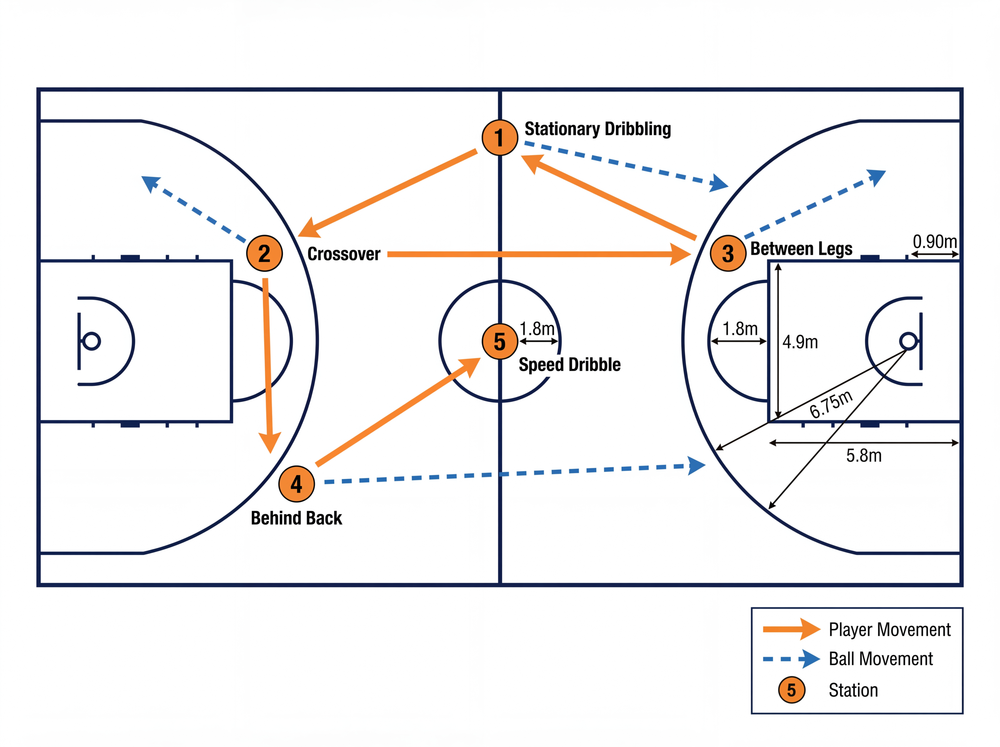
- Equipment Needed: 1 basketball per player, 6-8 marker cones, and a whistle for the coach.
- Court Setup: Utilize a standard FIBA basketball court (28m x 15m). Set up five distinct stations on one half of the court. Station 1 is at the top of the key. Station 2 is at the left elbow. Station 3 is at the right elbow. Station 4 is on the left wing (extended free-throw line). Station 5 is near the center court logo.
- Player Positions: Divide the team evenly among the stations. Players should start in a triple-threat position, ready to initiate the dribble upon the whistle.

3. Step-by-Step Instructions
- Station 1 (Top of Key - Stationary Dribbling): On the whistle, players execute rapid-fire stationary pound dribbles, alternating hands every 10 seconds. Keep the ball below knee level and eyes scanning the rim.
- Station 2 (Left Elbow - Crossover): Players perform continuous wide crossovers, shifting their weight from side to side. The focus is on snapping the ball quickly across the body.
- Station 3 (Right Elbow - Between the Legs): Players execute continuous between-the-legs dribbles in a figure-eight pattern or a rhythmic side-to-side motion, emphasizing footwork and balance.
- Station 4 (Left Wing - Behind the Back): Players practice continuous behind-the-back wraps. The ball must hit the floor exactly midway between the feet to ensure a smooth transition to the opposite hand.
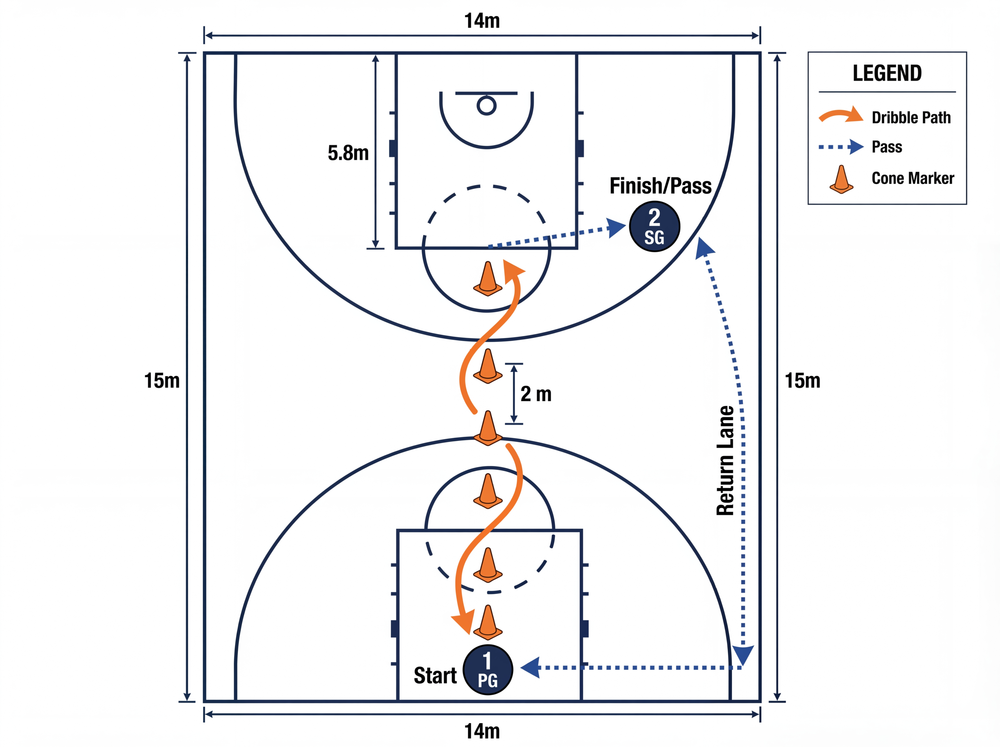
- Station 5 (Center Court - Speed Dribble): Players explode into a full-court speed dribble, pushing the ball out in front and covering maximum ground with minimal dribbles, before returning to the start.
- Rotation: Blow the whistle every 45-60 seconds to signal a rotation. Players sprint to the next numerical station, with Station 5 returning to Station 1.
4. Key Coaching Points

- Maintain a Low Stance: Players must drop their hips and bend their knees, not their waists. A low center of gravity provides better balance and explosive first steps.
- Eyes Up Always: Force players to read the floor. Hold up numbers with your fingers and have them call the numbers out loud to ensure they aren't looking at the ball.
- Pound the Ball: Emphasize aggressive, forceful dribbles. The ball should return to the hand as quickly as possible to minimize the time it is exposed to defenders.
- Change of Pace: Encourage players to vary their dribbling speed. A rhythmic dribble lulls defenders, while an explosive change of pace creates separation.
5. Common Mistakes

- Looking Down at the Ball: This is the most prevalent error. It eliminates court vision and prevents players from seeing open teammates or incoming defenders.
- Standing Too Upright: Playing with straight legs makes players slow and vulnerable to steals. Constantly remind them to drop their hips.
- Carrying or Palming the Ball: Ensure players keep their hands on top of or slightly behind the ball, rather than sliding underneath it during hesitation moves.
- Weak Off-Hand: Players naturally favor their dominant hand. Watch for players avoiding weak-hand reps and force them to balance their effort.
6. Variations & Progressions
- Two-Ball Dribbling: Introduce a second basketball at the stationary stations (1, 2, and 3) to overload the nervous system and rapidly improve hand-eye coordination.
- Tennis Ball Toss: Have players toss and catch a tennis ball with their off-hand while maintaining a continuous dribble with their primary hand.
- Defensive Pressure: Add a passive or active defender at the speed dribble station to simulate game-like pressure and force the ball handler to protect the ball.

7. Age Adaptations
- Under 8 / Under 10: Focus purely on stationary dribbling and basic control. Reduce the duration of each station to 30 seconds to maintain attention. Use smaller basketballs (Size 5).
- Under 12 / Under 14: Introduce the crossover and between-the-legs stations. Emphasize correct form over speed. Introduce the tennis ball variation for advanced players.
- Under 16 / Open: Run the full circuit at maximum intensity. Implement the two-ball and defensive pressure variations. Demand game-speed execution and perfect posture.
