

Football
Elite Goalkeeper Shot-Stopping & Angle Play Drill
A high-intensity goalkeeper drill designed to improve reaction speed, positional awareness, and angle management against multi-angle shots.
What you need
1 Full-sized goal, 10-15 Footballs, 3 Cones or Mannequins, Goalkeeper gloves
1. Overview
This high-intensity shot-stopping drill is designed to sharpen a goalkeeper's reaction speed, positional awareness, and angle management. By incorporating rapid-fire shots from multiple angles around the penalty area, goalkeepers are forced to quickly reset their feet, adjust their body shape, and make split-second decisions. It is an excellent session for simulating the chaotic environment of a match where rebounds and secondary phases of play frequently occur.
2. Setup
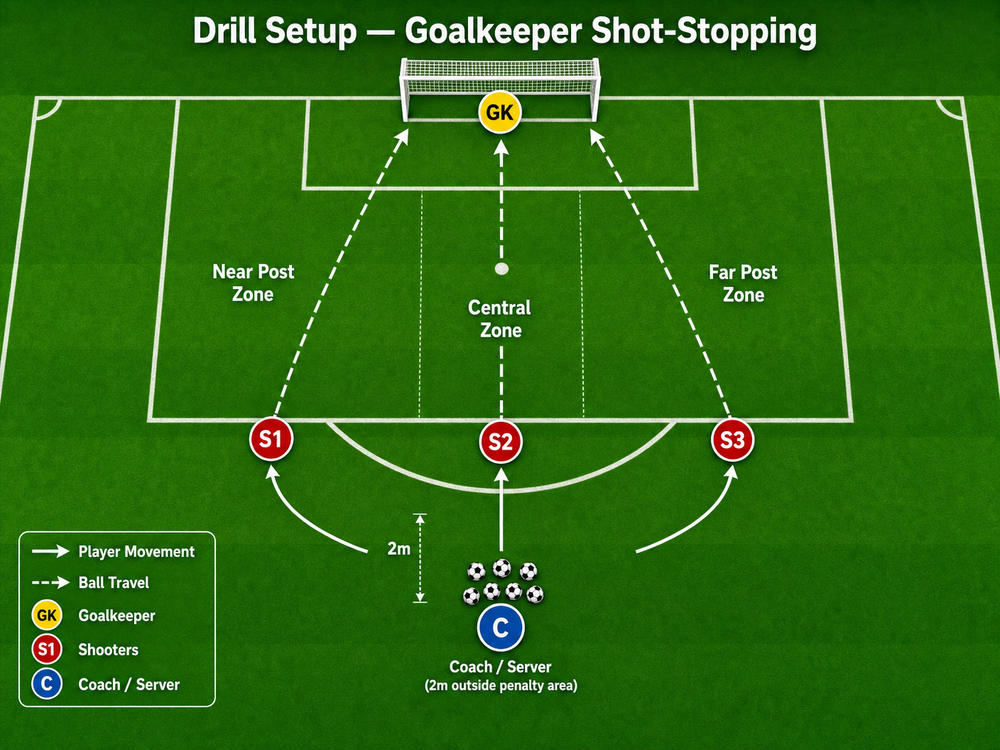
Pitch Dimensions: Standard penalty area (16.5m x 40.3m) using a full-sized goal (7.32m x 2.44m).
Equipment Needed:
- 1 Full-sized goal
- 10-15 Footballs
- 3 Cones/Mannequins (to mark shooter starting positions)
- Goalkeeper gloves and appropriate training gear
Player Positions:
- 1 Goalkeeper (GK): Starts centrally on the goal line.
- 3 Shooters (S1, S2, S3): Positioned in a semicircle at the edge of the penalty area (approximately 18-20 yards from goal). S1 is positioned on the left side (Near Post Zone), S2 is central (Central Zone), and S3 is on the right side (Far Post Zone).
- 1 Coach/Server (C): Standing 2 meters outside the penalty area with the supply of balls.
3. Step-by-Step Instructions
- Starting Position: The Goalkeeper (GK) begins on the goal line in a central, balanced set position, ready to react.
- The First Shot: The Coach (C) passes a ball to the central shooter (S2). As the pass is made, the GK must step forward to narrow the angle and set their feet before S2 strikes the ball.
- The Save & Recovery: S2 takes a first-time or two-touch shot at goal. The GK attempts to make the save, prioritizing catching the ball or parrying it safely wide of the goal frame.
- The Reset: Immediately after the first shot (whether saved, scored, or missed), the GK must quickly recover and reset their position.
- The Second Phase: The Coach (C) immediately feeds a second ball to either S1 or S3. The GK must rapidly adjust their positioning, moving across the goal mouth to cover the new angle.
- The Final Action: The selected shooter (S1 or S3) strikes the ball. The GK executes the save, focusing on explosive lateral movement and strong hands.
- Rotation: After a set of 4-6 repetitions, rotate the shooters or switch goalkeepers to maintain high intensity and allow for adequate recovery.
4. Key Coaching Points
- Set Position: Ensure the goalkeeper is in a balanced, athletic stance with weight slightly forward on the balls of their feet before every shot. The feet must be set when the striker makes contact with the ball.
- Angle Play: Goalkeepers must actively step out to narrow the angle, making the goal appear smaller to the shooter. Use the 'nose to the ball' principle to ensure the body is squarely facing the shot.
- Recovery Speed: Emphasize the importance of quick footwork (side steps or crossover steps) to recover and reposition after the initial save. The transition from the ground back to a set position must be explosive.
- Decision Making: Train the goalkeeper to make split-second decisions on whether to catch, parry, or block the ball. Parries must be directed safely away from the danger zone (wide of the posts).
- Handling: Focus on clean handling techniques, particularly the 'W' catch for high balls and the scoop for low shots.
5. Common Mistakes
- Being Caught 'On the Move': Goalkeepers often fail to set their feet before the shot is taken, resulting in a loss of balance and power when diving.
- Poor Starting Position: Standing too deep on the goal line, which gives the shooter a larger target and more time to pick a spot.
- Weak Parrying: Parrying the ball back into the central 'danger zone' rather than pushing it wide, leading to easy rebound opportunities for attackers.
- Slow Recovery: Taking too long to get back up after a dive, leaving the goal exposed for secondary shots.
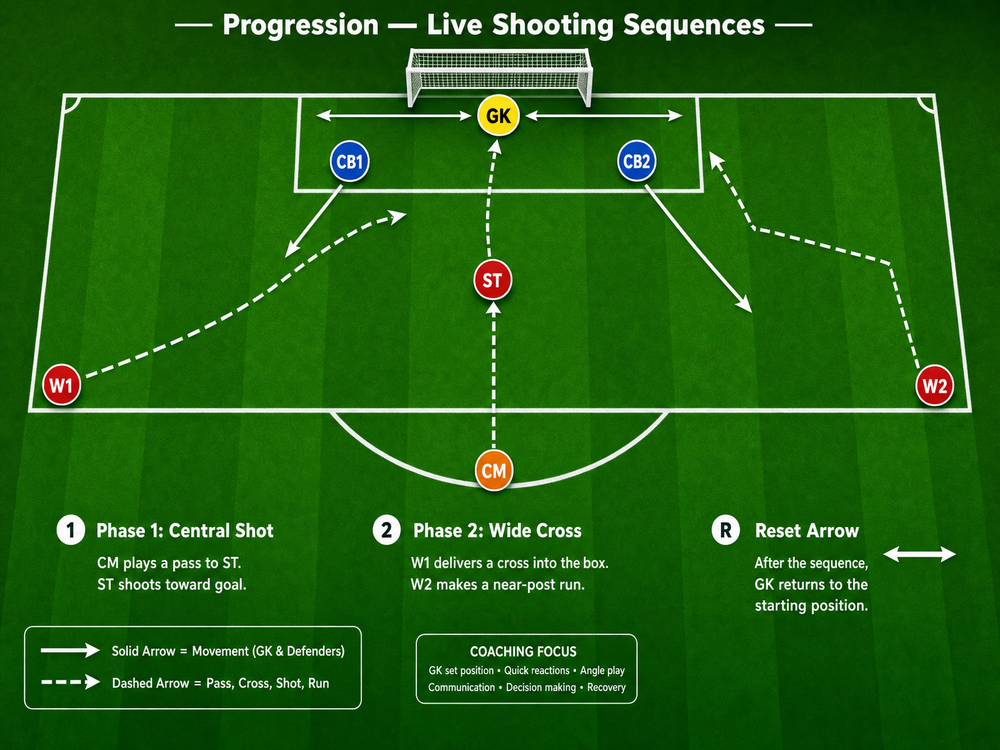
6. Variations & Progressions
- Add Defenders: Introduce two central defenders (CB1, CB2) who must track the runs of the shooters or clear rebounds. This adds realistic traffic and visual obstruction for the goalkeeper.
- Live Play Integration: Transition the drill into a live phase where the shooters can follow up on rebounds, forcing the goalkeeper into double or triple save scenarios.
- Cross and Finish: Instead of a direct pass from the coach, the sequence begins with a wide cross into the box, requiring the goalkeeper to assess the flight of the ball before dealing with a close-range shot.
7. Age Adaptations
- Under 8 - Under 10: Focus primarily on basic handling and the correct set position. Reduce the distance of the shots (10-12 yards) and use a smaller goal if possible. Keep the pace manageable.
- Under 12 - Under 14: Introduce the concept of angle play and narrowing the goal. Increase the speed of the service and encourage quick recovery after dives.
- Under 16 - Open: Run the drill at match intensity. Demand explosive movements, perfect angle management, and rapid decision-making. Incorporate the variations to simulate complex, high-pressure match scenarios.
