

Football
Elite Goalkeeper Shot-Stopping & Reaction Drill
Develop your goalkeeper's shot-stopping reflexes, positioning, and distribution under high-pressure match scenarios.
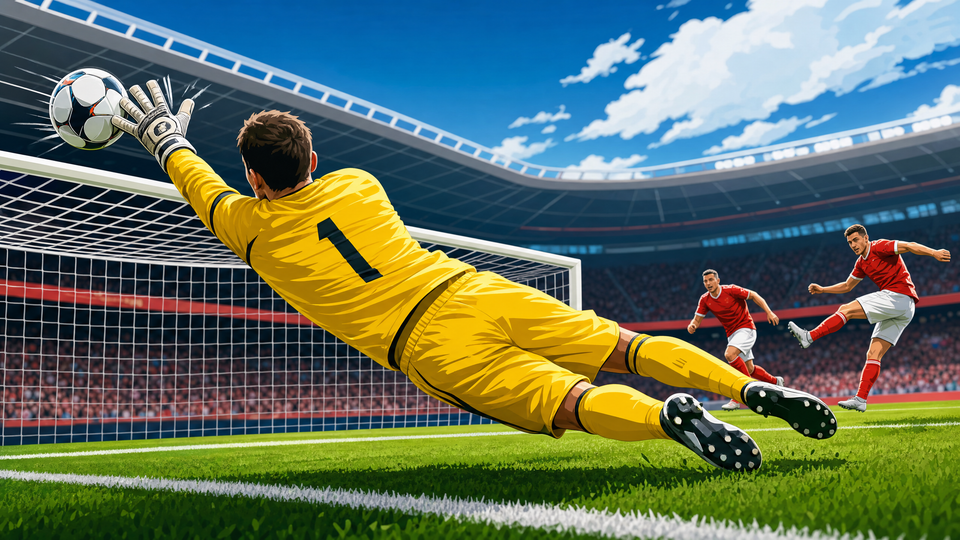
What you need
1 full-size goal, 10-12 footballs, 6 marker cones
1. Overview
This high-intensity shot-stopping drill is designed to replicate the unpredictable nature of match-day scenarios. It challenges the goalkeeper's ability to adjust their feet quickly, make explosive saves, and immediately transition into distribution. By incorporating multiple shooters and dynamic angles, coaches can effectively evaluate a goalkeeper's positioning, reaction time, and decision-making under pressure. Use this drill during the main technical phase of your session to sharpen reflexes and build confidence.
2. Setup
- Pitch Dimensions: Standard penalty area (18-yard box) and surrounding D.
- Equipment Needed: 1 full-size goal, 10-12 footballs, 6 marker cones (orange).
- Players Required: 1 Goalkeeper (GK), 1 Coach/Server (CM), and 3-4 Shooters/Attackers (S1-S3 or A1-A4).
- Positions:
- The Goalkeeper starts on the goal line, central to the goal.
- Shooters are positioned just outside the penalty area, spread across different angles.
- The Coach/Server is positioned centrally, around the penalty spot or edge of the D, managing the flow of the drill.
3. Step-by-Step Instructions
Phase 1: Basic Shot Stopping
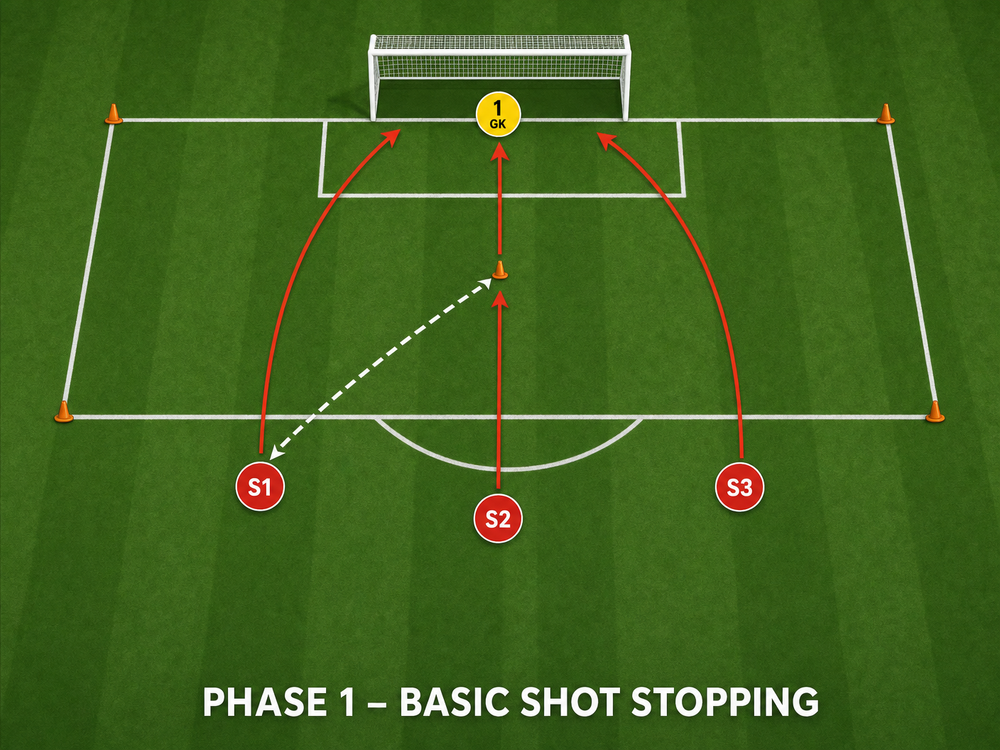
- Initial Position: The GK starts in a central set position on the goal line.
- The Trigger: The Coach (CM) plays a pass to one of the shooters (S1, S2, or S3).
- Footwork & Angle: As the ball travels, the GK must quickly adjust their feet to narrow the angle against the receiving shooter.
- The Shot: The shooter takes a touch (optional) and strikes firmly at goal.
- The Save & Recovery: The GK attempts the save. If the ball is parried into a dangerous area, the drill remains live for a rebound. If held or cleared, the GK quickly resets to the centre.
- Rotation: Repeat the sequence, varying the shooter to ensure the GK faces shots from multiple angles.
Phase 2: Reaction & Distribution
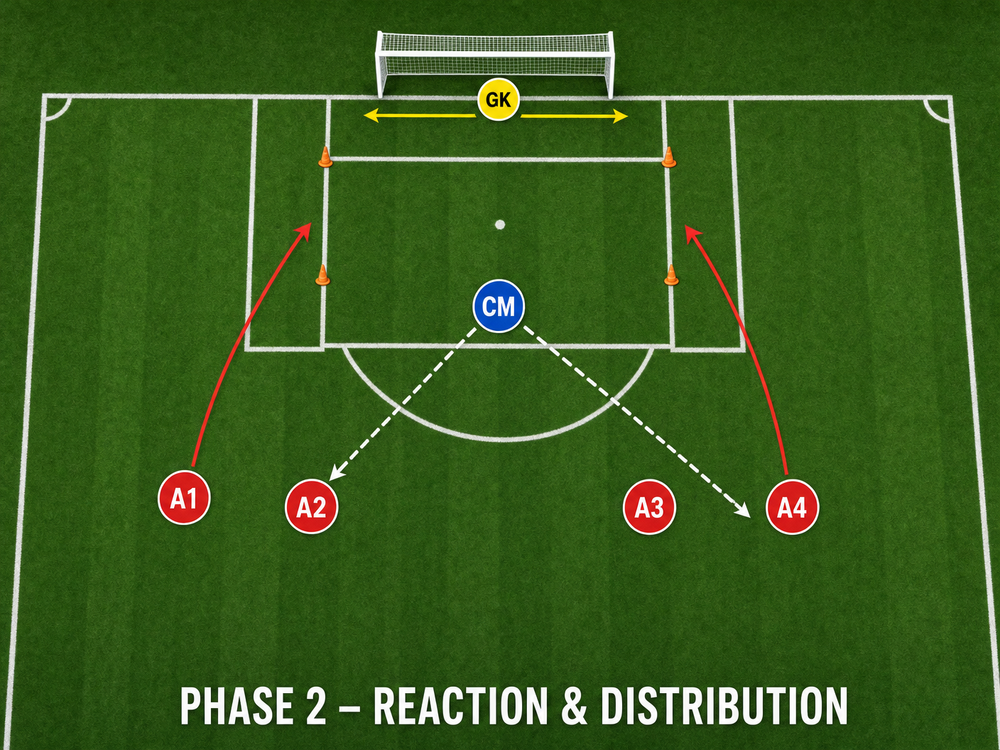
- Dynamic Movement: The GK is required to move laterally across the goal line before the shot is taken.
- The Delivery: The Coach (CM) passes to an attacker (A2 or A4) who lays it off to a runner (A1 or A3) penetrating the box.
- The Save: The GK must set their feet instantly as the shot is struck from inside the penalty area.
- Distribution: Upon making a clean catch, the GK immediately looks to distribute the ball (via throw or roll) to designated target zones marked by cones on the wings.
- Reset: The GK resets to the starting position for the next repetition.
4. Key Coaching Points
- The Set Position: Ensure the GK is balanced, weight slightly forward on the balls of their feet, hands positioned at waist height ready to react.
- Footwork: Emphasise quick, small steps to get across the goal rather than crossing legs. The GK must be stationary and 'set' at the exact moment the ball is struck.
- Angle Play: Encourage the GK to step out and narrow the angle, making the goal appear smaller to the shooter.
- Handling & Deflection: Prioritise clean catches. If a catch isn't possible, the GK must actively parry the ball wide and away from the danger zone, not back into the centre.
- Quick Recovery: Train the instinct to get back on their feet immediately after a dive to address potential rebounds.
5. Common Mistakes
- Moving While the Shot is Struck: The GK is still adjusting their feet when the ball is hit, leading to poor balance and delayed reactions.
- Deep Positioning: Staying glued to the goal line rather than stepping out to close down the angle, giving the shooter too much of the net to aim at.
- Poor Parrying Technique: Pushing the ball back into the central 'danger zone' instead of turning it around the post or wide.
- Dropping Hands: Starting with hands too low or by their sides, increasing the time it takes to reach high shots.
6. Variations & Progressions
- Add Traffic: Introduce a passive or active defender and an attacking player inside the box to obscure the GK's vision and create realistic match traffic.
- First Touch Finish: Require the shooters to hit the ball first time without taking a controlling touch, reducing the GK's reaction time.
- Double Save Scenario: The coach immediately serves a second ball as soon as the first save is made, forcing a rapid recovery and secondary save.
7. Age Adaptations
- Under 8 - Under 10: Focus heavily on the basic set position and safe handling. Use a smaller goal if possible and keep shots relatively central and low-powered.
- Under 12 - Under 14: Introduce the concept of angle play and footwork. Start demanding better parrying decisions (pushing the ball wide).
- Under 16 - Open: Full intensity. Demand explosive dives, immediate recovery for rebounds, and precise, rapid distribution after a catch.
