

Cricket
Elite Slip Catching & Reaction Drill
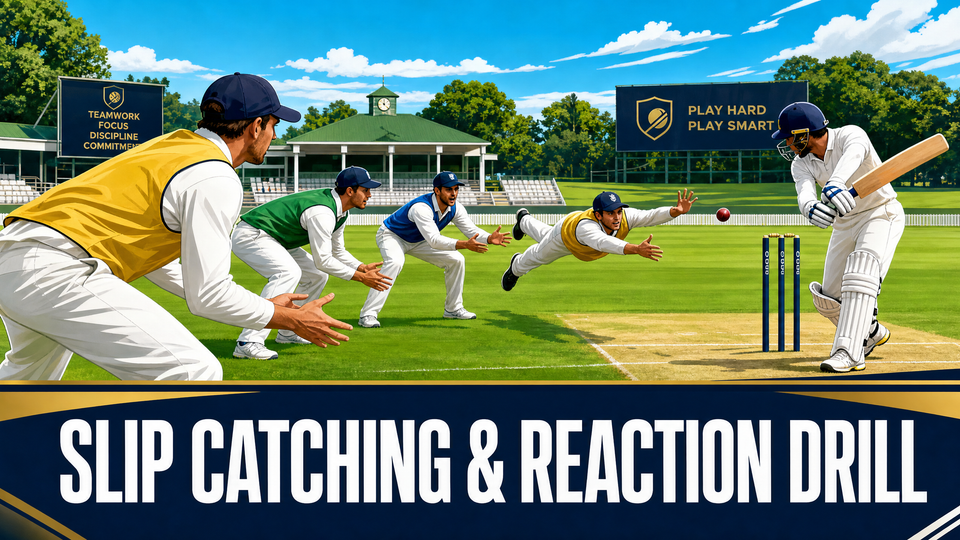
A high-intensity, progressive fielding drill designed to sharpen reaction times, reinforce soft hands, and perfect the slip catching stance.
What you need
12-18 Cricket balls, Slip cradle or Katchet board, Cricket bat, Marker cones
1. Overview
The Elite Slip Catching & Reaction Drill is a fundamental yet high-intensity fielding exercise designed to simulate the unpredictable nature of edges in the slip cordon. This drill focuses on three critical components of elite slip fielding: posture, reaction speed, and soft hands.
By progressively decreasing the reaction time and varying the trajectory of the ball, coaches can challenge fielders to maintain concentration and technique under pressure. This drill is ideal for pre-match warm-ups or dedicated fielding sessions, ensuring your cordon is sharp and ready to capitalise on every half-chance.
2. Setup
Proper setup is crucial to replicate match conditions. The drill can be run on the outfield, in the nets, or indoors.
Equipment Needed:
- 12-18 Cricket balls (mix of new and slightly worn)
- Slip cradle or Katchet board (optional but recommended for deflection)
- Fielding gloves (optional for the coach)
- 4-6 Marker cones
Field Setup:
Set up a realistic slip cordon spacing. Use cones to mark the starting positions to ensure fielders don't drift too close or too wide between deliveries.
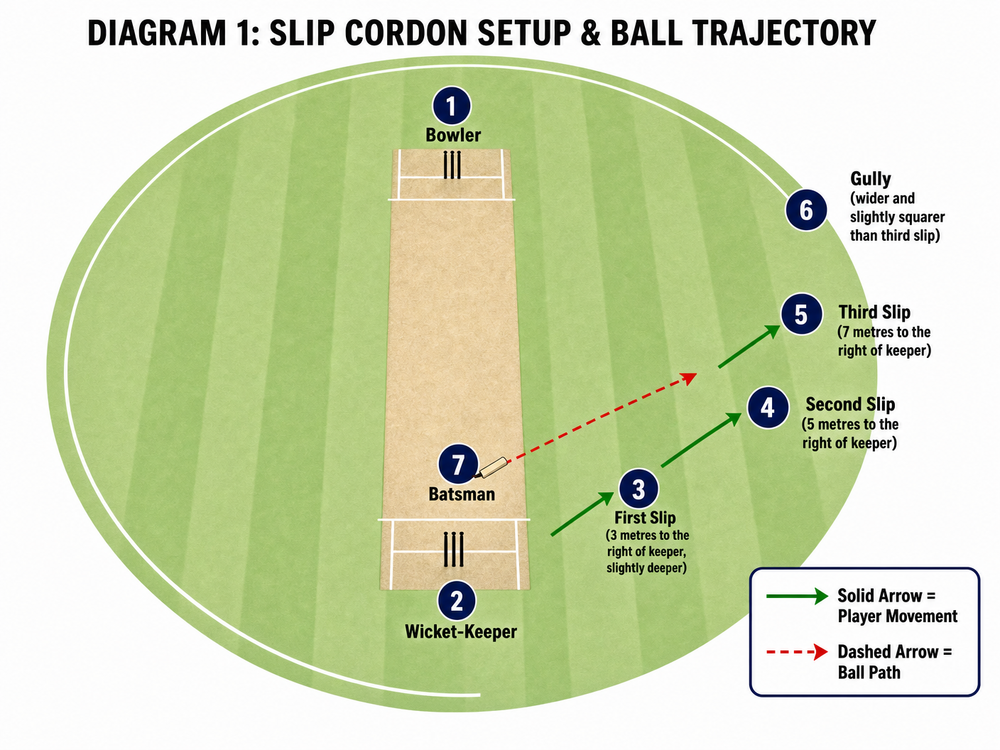
- Wicket-Keeper: Positioned directly behind the stumps (or an imaginary stump line if on the outfield).
- First Slip: Approximately 3 metres to the right of the keeper (for a right-handed batsman), slightly deeper to account for the angle of the edge.
- Second Slip: 2 metres to the right of First Slip, staggered slightly forward.
- Third Slip / Gully: A further 2-3 metres to the right, depending on the pace of the bowling being simulated.
3. Step-by-Step Instructions
Phase 1: The Stationary Feed (Warm-up)
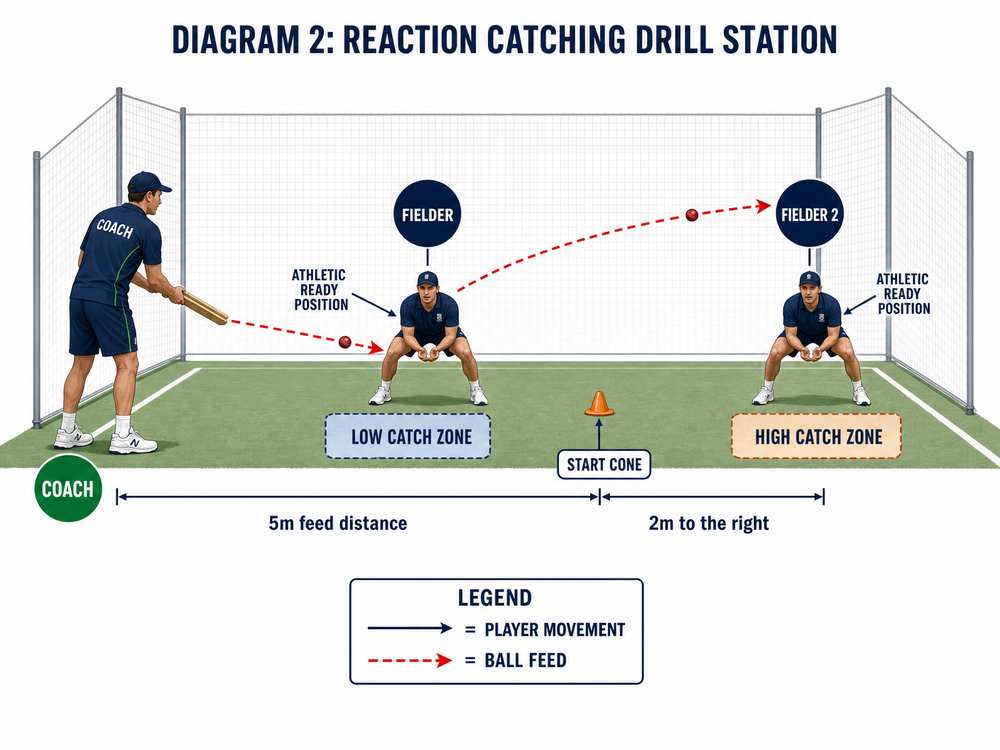
- The coach stands 5-7 metres away from the cordon, facing the fielders.
- Fielders adopt their set position: knees bent, weight on the balls of the feet, hands resting lightly on the knees or out in front, head still.
- The coach throws the ball underarm directly to each fielder, focusing on chest and waist height catches.
- Fielders must catch the ball with 'soft hands', bringing the ball into their body to cushion the impact.
Phase 2: The Deflection (Match Simulation)
- Introduce a slip cradle or Katchet board placed 3-4 metres in front of the cordon.
- The coach throws the ball firmly onto the board to create unpredictable deflections (edges).
- Fielders must react to the deviation. Emphasise staying low and not committing too early.
- Rotate the fielders through the positions (1st, 2nd, 3rd slip) after every 6 deliveries.
Phase 3: The Rapid-Fire Reaction (Pressure)
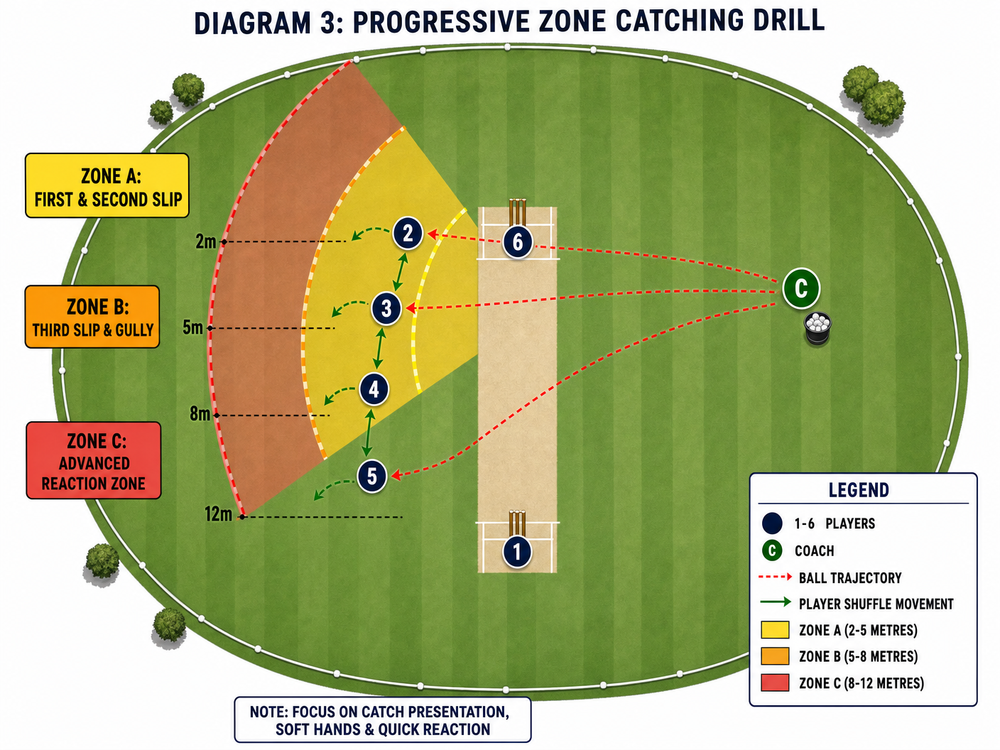
- The coach moves closer (4-5 metres) and uses a cricket bat to hit the ball directly at the fielders.
- The pace of the feed increases significantly.
- Mix up the heights: low ankle-height catches, wide diving catches, and sharp chest-high chances.
- If a catch is dropped, the fielder must immediately reset for the next rapid feed.
4. Key Coaching Points
- The 'Ready' Position: Keep the base wide. Weight should be slightly forward on the balls of the feet, not flat-footed or on the heels. The head must remain perfectly still at the point of release/deflection.
- Watch the Ball, Not the Bat: Train the eyes to pick up the ball as it leaves the bat or deflection board. Tracking the ball all the way into the hands is non-negotiable.
- Soft Hands (The 'Give'): Catch the ball with relaxed fingers pointing downwards (for low catches) or upwards (for high catches). 'Give' with the ball upon impact, bringing it softly into the midriff to prevent it popping out.
- Stay Low: It is always easier to come up for a catch than to go down. Maintain a low centre of gravity and only rise if the trajectory of the ball dictates it.
- Clear Calling: If a ball goes exactly between two slip fielders, clear and loud calling ('Mine!') is essential to avoid collisions and dropped catches.
5. Common Mistakes
- Snatching at the Ball: Pushing the hands out aggressively towards the ball ('hard hands'), causing it to bounce out of the palms.
- Standing Up Too Early: Breaking posture before the ball is edged, resulting in the fielder being too high to reach low catches.
- Resting Hands on Knees: While acceptable in the setup, hands must be free and ready in front of the body as the ball is delivered. Hands locked on knees delay reaction time.
- Drifting Positions: Fielders unconsciously moving closer together or further apart between deliveries, creating gaps in the cordon.
6. Variations & Progressions
- The Blind Turn: Fielders face away from the coach. The coach shouts 'Turn!' as they throw the ball onto the deflection board. The fielder must spin around, locate the ball, and complete the catch. This drastically reduces reaction time.
- Coloured Ball Call: The coach mixes a red ball and a white ball in the bucket. As the ball is hit, the fielder must shout the colour of the ball before catching it. This forces intense visual concentration.
- One-Handed Focus: Fielders hold a tennis ball in their non-dominant hand and must catch the cricket ball with only their dominant hand. This isolates hand-eye coordination.
7. Age Adaptations
- Under 10s: Use softer incrediballs or tennis balls. Focus entirely on the stationary feed (Phase 1) and basic catching technique (cupping the hands). Remove the deflection board.
- Under 12s / 14s: Introduce the deflection board but use a softer ball or throw at a reduced pace. Focus heavily on the correct stance and staying low.
- Under 16s / Open: Full match intensity. Use hard cricket balls, high-speed bat feeds, and implement the 'Blind Turn' progression to challenge elite reflexes.
