

Cricket
Elite Slip Catching & Reaction Rotation Drill
Develop razor-sharp reflexes, soft hands, and positional discipline in the slip cordon with this high-intensity rotation drill.
What you need
1x Cricket Bat or Katchet board, 6-12x Cricket Balls, 1x Set of Stumps, Marker cones, Rebound board (optional for advanced variation)
1. Overview
The slip cordon is where matches are won and lost. A dropped catch at first slip can cost your team 100 runs, while a blinder at gully can change the momentum of an entire session. This Elite Slip Catching & Reaction Rotation Drill is designed to simulate match intensity, testing fielders' reaction times, visual tracking, and catching technique under pressure.
By incorporating a rotation system, coaches can keep multiple players engaged, maintaining a high heart rate and simulating the physical and mental fatigue fielders experience during long spells in the field. This drill is ideal for pre-season training, match-day warm-ups, or dedicated fielding sessions.
2. Setup
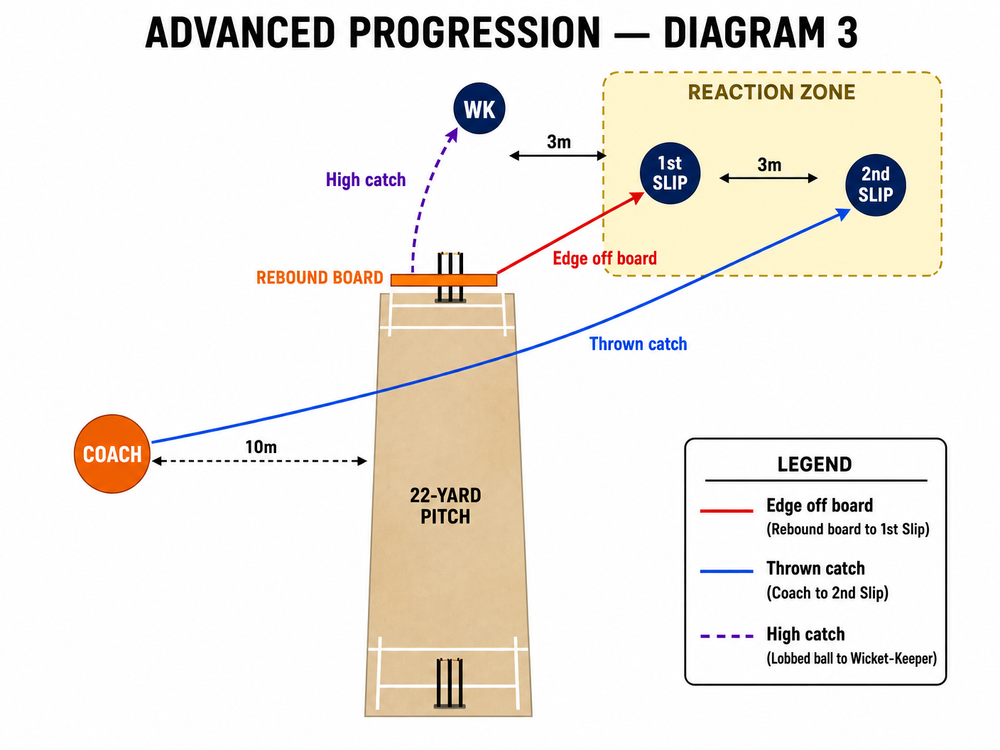
To run this drill effectively, you need to replicate the exact dimensions and spacing of a match-day slip cordon. The spacing between fielders is critical to prevent collisions and ensure clear areas of responsibility.
Equipment Needed
- 1x Cricket Bat (preferably a 'Katchet' board or a bat with a taped edge for consistent deflections)
- 6–12x Cricket Balls (use match-condition balls if possible)
- 1x Set of Stumps
- Marker cones (optional, to mark starting positions)
- Rebound board or slip cradle (for advanced variations)
Field Setup
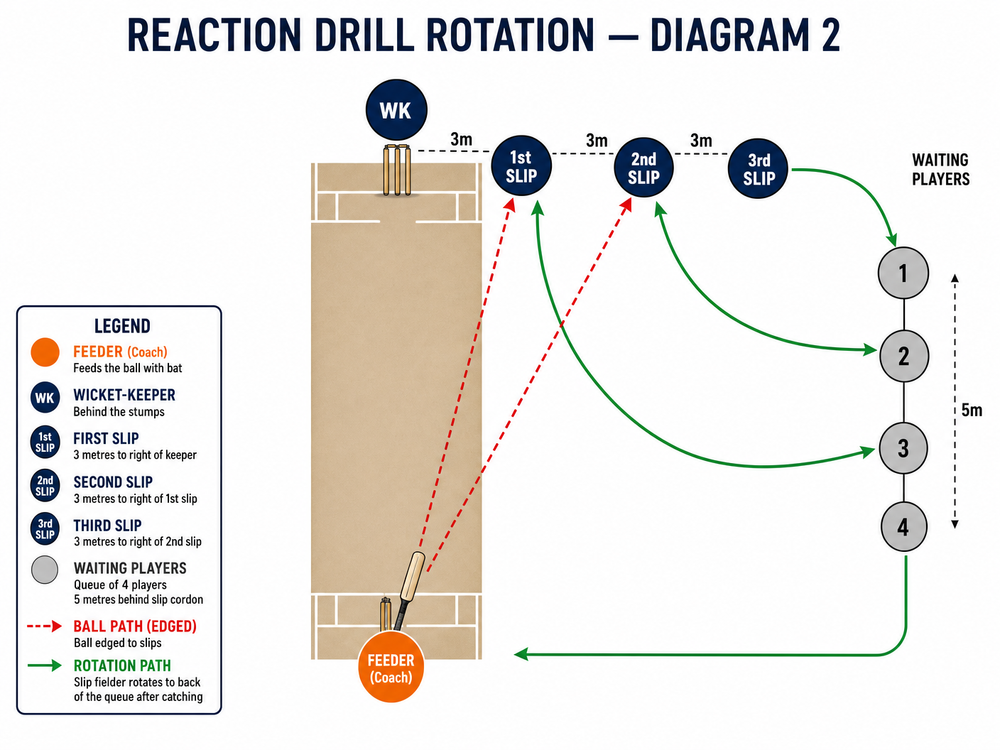
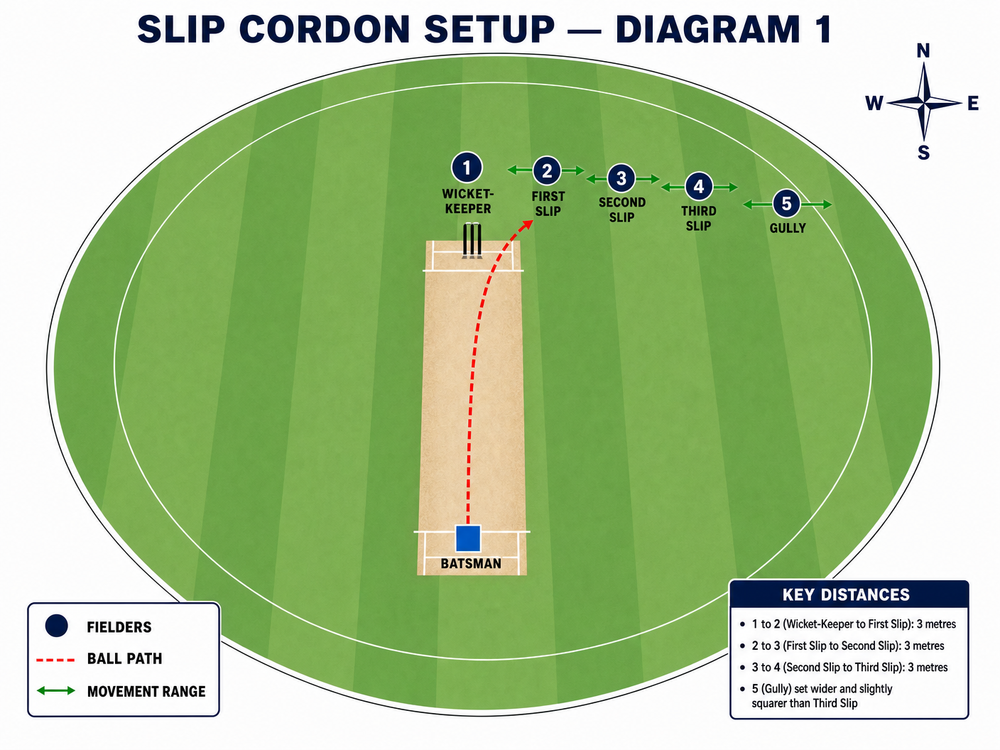
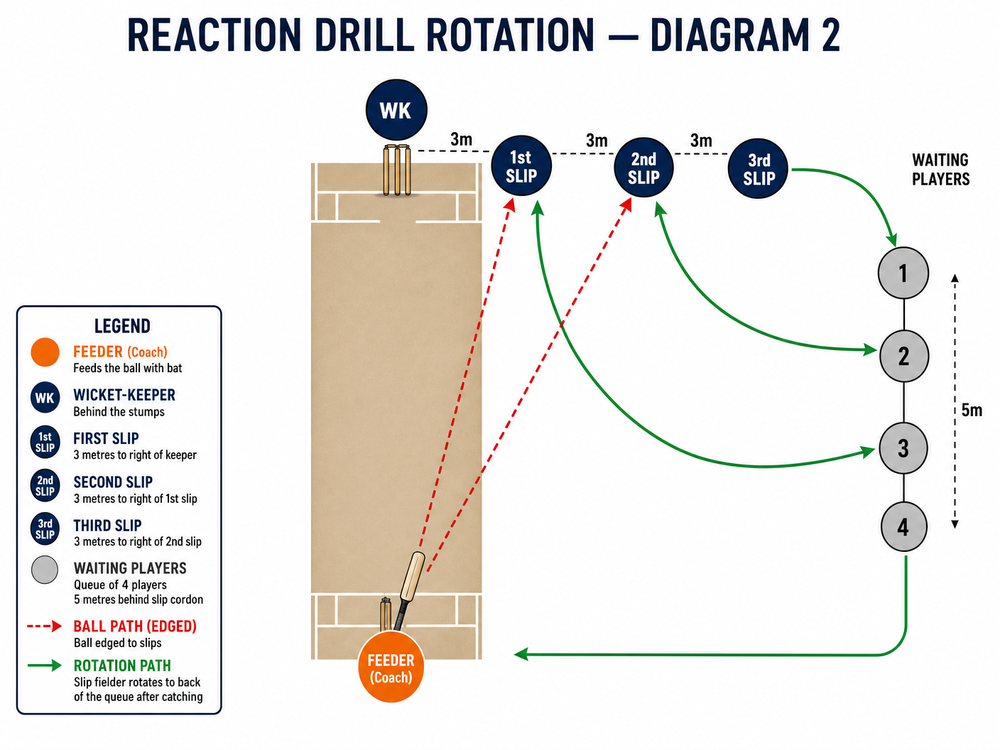
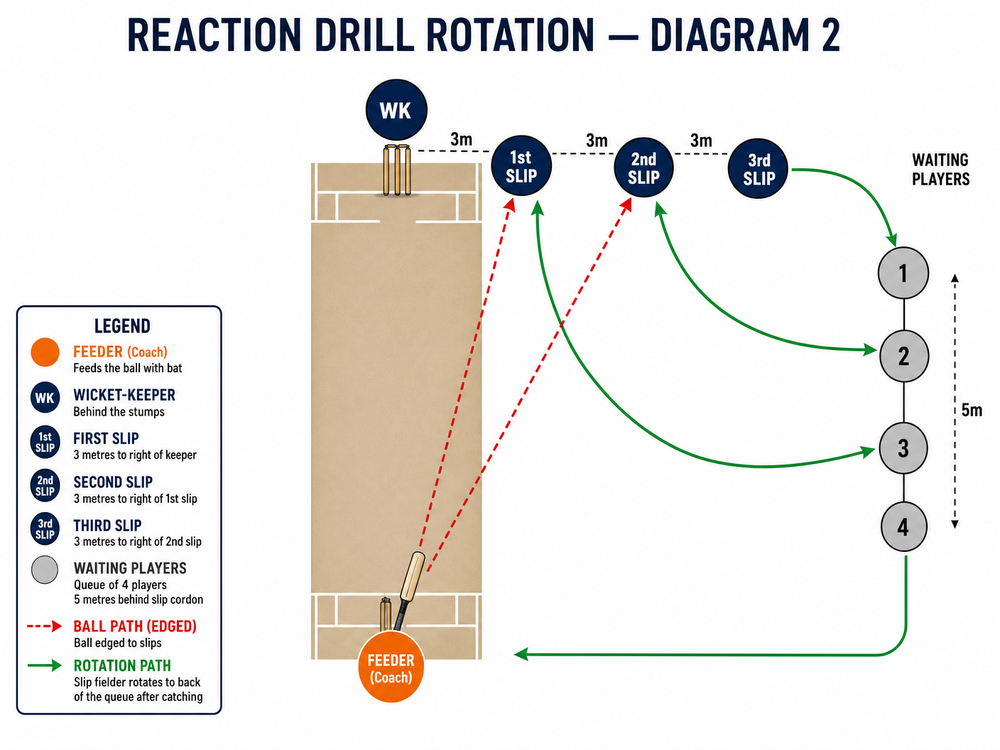
Use a standard 22-yard pitch or a designated fielding area on the oval. The Wicket-Keeper (WK) is positioned directly behind the stumps at a depth appropriate for the bowler's pace. First Slip is positioned approximately 3 metres to the right of the WK (for a right-arm bowler over the wicket). Second Slip is positioned 3 metres to the right of First Slip, slightly staggered back to allow for the natural angle of the edge. Third Slip / Gully is positioned 3 metres to the right of Second Slip, or wider for a true Gully position. The Waiting Queue stands 5 metres behind the cordon to ensure safety and clear sightlines.
3. Step-by-Step Instructions
The core of this drill relies on a smooth rotation system to maximise repetitions and keep players active.
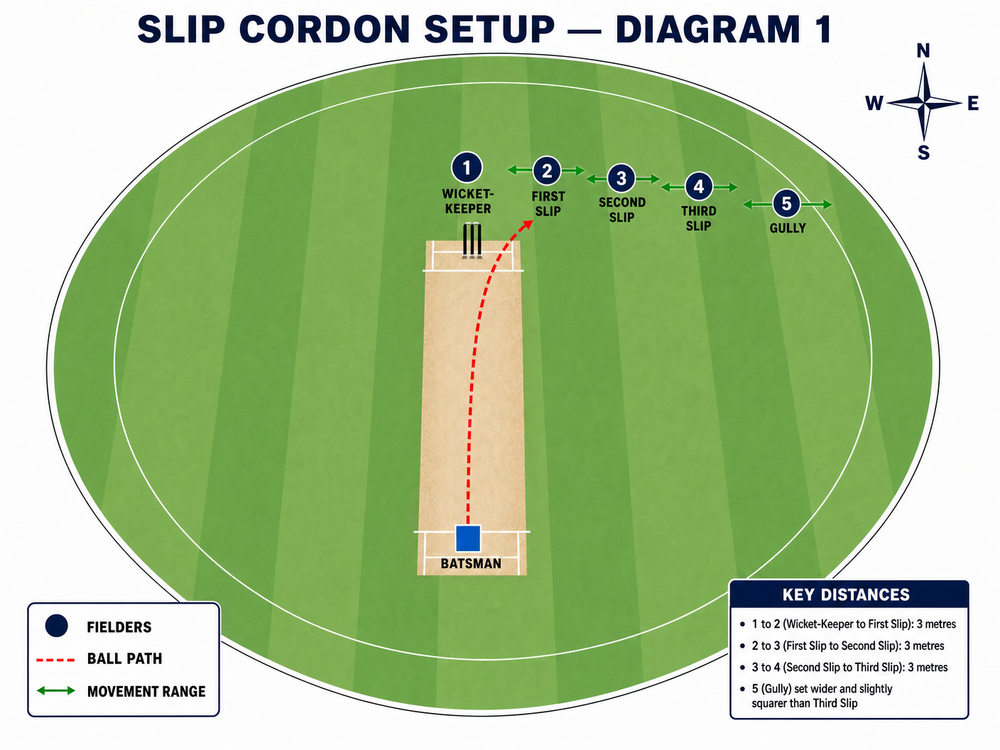
- Establish the Cordon. Set up your Wicket-Keeper, 1st Slip, 2nd Slip, and 3rd Slip in their designated positions. The remaining players form a queue 5 metres behind the cordon.
- The Feed. The Coach (Feeder) stands at the bowling crease — or closer, depending on the required reaction time. The Coach strikes the ball firmly, aiming to create a realistic edge towards the slip cordon.
- The Catch. The designated fielder reacts to the edge, tracking the ball from the bat face into their hands. They must call "Mine!" if the ball falls between positions.
- The Rotation. Once the catch is completed (or dropped), the fielder immediately returns the ball to the Coach or a designated ball collector.
- Rotate Out. The fielder who attempted the catch sprints to the back of the waiting queue.
- Rotate In. The player at the front of the queue sprints into the vacant position in the cordon.
- Continuous Feed. The Coach feeds the next ball as soon as the new fielder is set. The goal is a rapid, continuous cycle of catching and rotating — aim for no more than 8 seconds between feeds.
4. Key Coaching Points
To maximise the effectiveness of this drill, coaches must focus on the following technical aspects during every repetition.
Posture and Base: Fielders must start with a wide, balanced base, knees slightly bent, and weight evenly distributed on the balls of their feet. Avoid resting hands on knees; keep them free and ready to react.
Visual Tracking: Emphasise watching the ball from the Coach's hand, onto the bat, and all the way into the hands. The cue to give players is: "Watch it onto the bat, not just out of the hand."
Soft Hands: Encourage fielders to 'give' with the ball upon impact, drawing their hands back towards their body to absorb the pace. Avoid snatching at the ball.
Low to High: Fielders should start low and rise with the bounce of the ball. It is always easier to adjust upwards than to drop down late for a low catch.
Clear Communication: In the slip cordon, communication is vital. Fielders must call early and loudly for catches that fall in the grey areas between positions.
5. Common Mistakes
Watch out for these frequent errors and correct them immediately before they become ingrained habits.
Standing Too Upright: Fielders who stand too tall will struggle to react to low edges and will often stab at the ball. Cue: "Get your backside down and stay athletic."
Hard Hands: Snatching at the ball or pushing hands out towards the ball leads to dropped catches, especially off fast edges. Cue: "Receive the ball, don't grab it."
Taking Eyes Off the Ball: Fielders turning their head or blinking at the moment of impact. The eyes must track the ball into the palms. Cue: "See the ball hit your hands."
Poor Spacing: Fielders drifting too close together, leading to collisions or confusion over whose catch it is. Use cones to mark starting positions until spacing becomes habitual.
Flat-Footedness: Fielders resting on their heels rather than the balls of their feet, delaying their explosive movement towards the ball. Cue: "Stay on your toes — be a sprinter, not a statue."
6. Variations & Progressions
Once the basic drill is mastered, introduce these variations to increase the difficulty and challenge players further.
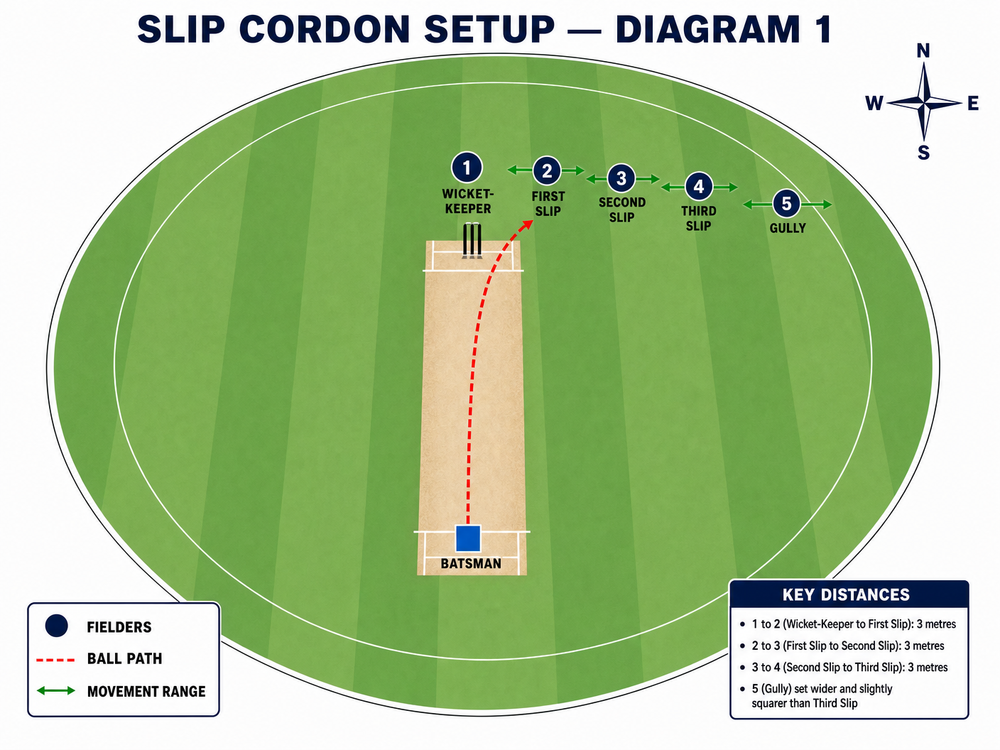
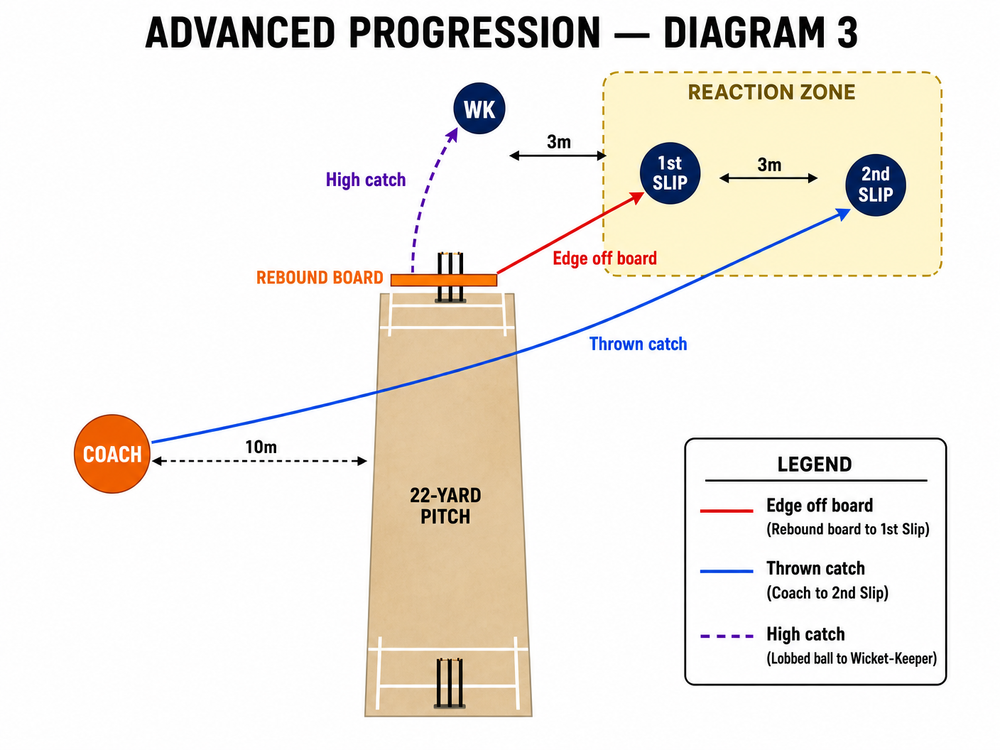
The Rebound Board (Advanced): Replace the bat feed with throws onto a rebound board or slip cradle positioned near the batting crease. This creates unpredictable, sharp deflections that test pure reaction speed and are impossible to anticipate.
Multi-Angle Feeds: Have two coaches feeding from different angles — one from the bowling crease, one from square leg — to force fielders to constantly adjust their focus and positioning. This closely replicates match conditions where edges can come from different bowling angles.
The 'Blind' Start: Fielders start facing away from the Coach and must turn and react only when the Coach shouts "Turn!". This drastically reduces available reaction time and is an excellent drill for elite-level players.
Fatigue Catching: Run the rotation drill continuously for 5 minutes without a break. This simulates the mental and physical fatigue of a long session in the field and tests whether technique holds up under pressure.
7. Age Adaptations
Tailor the drill to suit the age and skill level of your players to ensure it is both safe and developmentally appropriate.
| Age Group | Ball Type | Feed Distance | Focus |
|---|---|---|---|
| Under 10s / Under 12s | Incrediball or Tennis Ball | 5–8 metres | Soft hands, basic posture |
| Under 14s / Under 16s | Leather ball (reduced pace) | 8–12 metres | Rotation, communication |
| Open / Senior | Match-condition leather ball | Full bowling crease | Match intensity, fatigue variations |
For younger groups, prioritise enjoyment and confidence-building. A player who drops a catch should receive immediate positive reinforcement and a technical correction, never criticism. For senior players, hold the standard high and demand perfection in both technique and communication on every single repetition.
