

Cricket
Fast Bowling Run-Up Alignment Corridor Drill
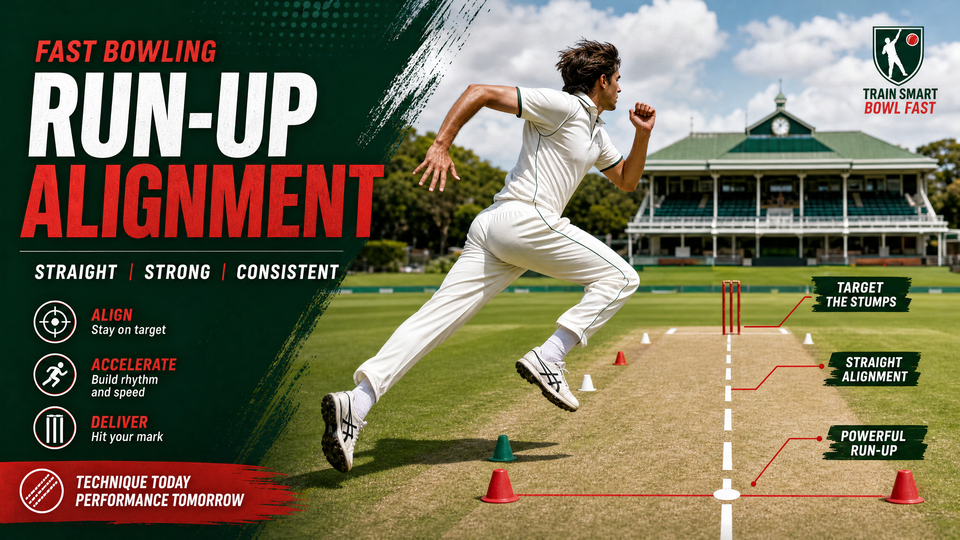
A high-intensity alignment drill designed to help fast bowlers maintain a straight, efficient run-up to maximize momentum and accuracy at the crease.
What you need
12-20 marker cones, Cricket balls, Stumps, Measuring tape
Overview
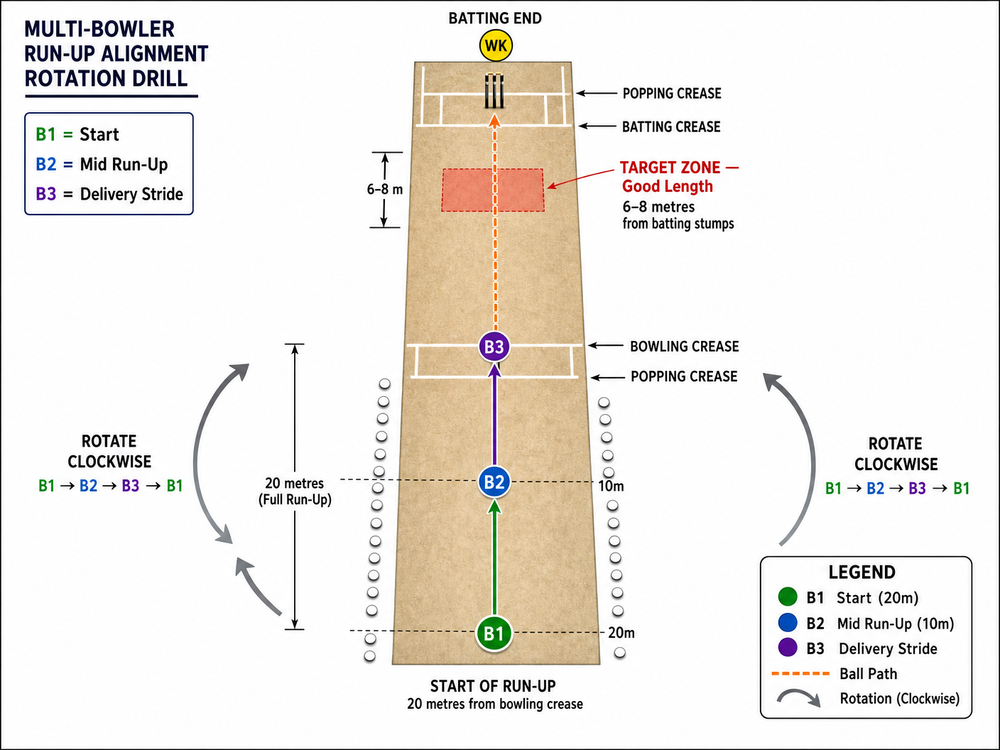
The Fast Bowling Run-Up Alignment Corridor Drill is an essential conditioning and technical exercise for pace bowlers. A straight, rhythmic run-up is the foundation of fast bowling; any lateral deviation bleeds momentum and misaligns the body at the delivery stride. This drill creates a physical and visual "corridor" that forces the bowler to run in straight lines, ensuring all energy is directed squarely at the target. It is highly effective for bowlers who tend to run in on an angle, cross their feet, or drift during their approach.
Setup
Equipment Needed
- 12-20 small marker cones (flat or dome)
- 1 cricket ball per bowler
- Measuring tape (optional, for precise corridor width)
- 1 set of stumps (at the batting end)
Pitch & Field Setup
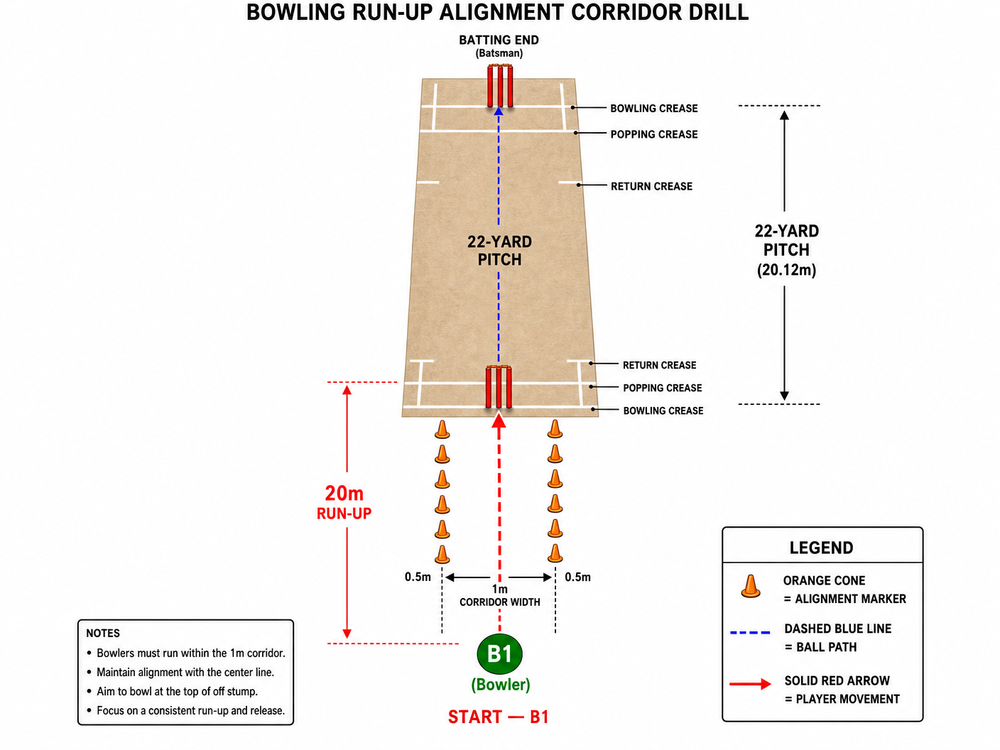
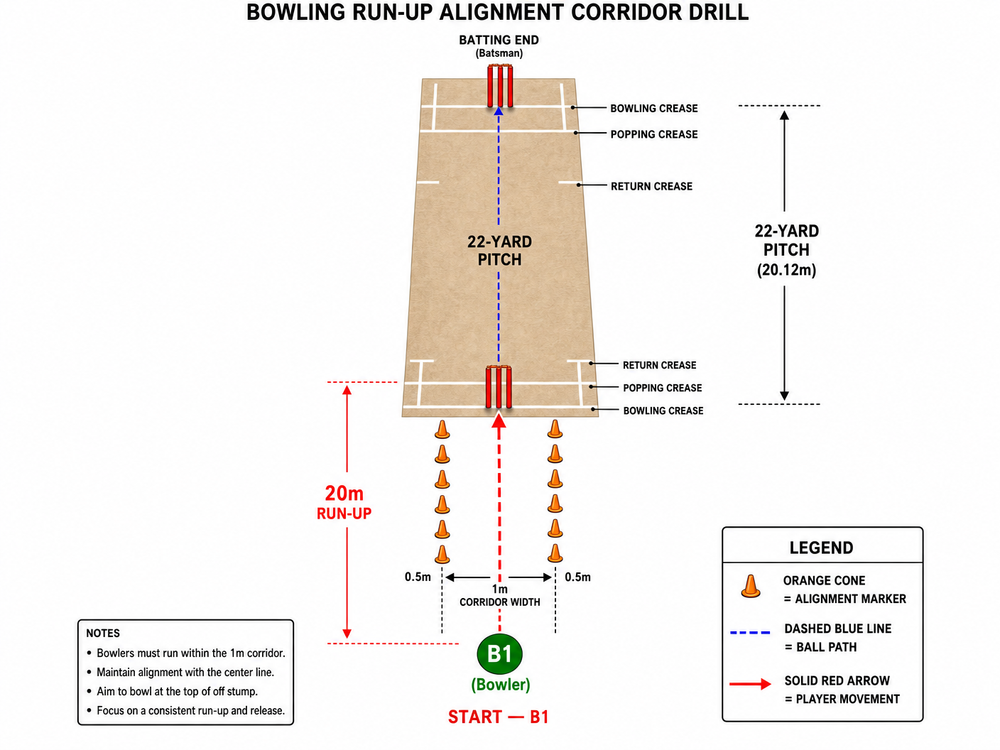
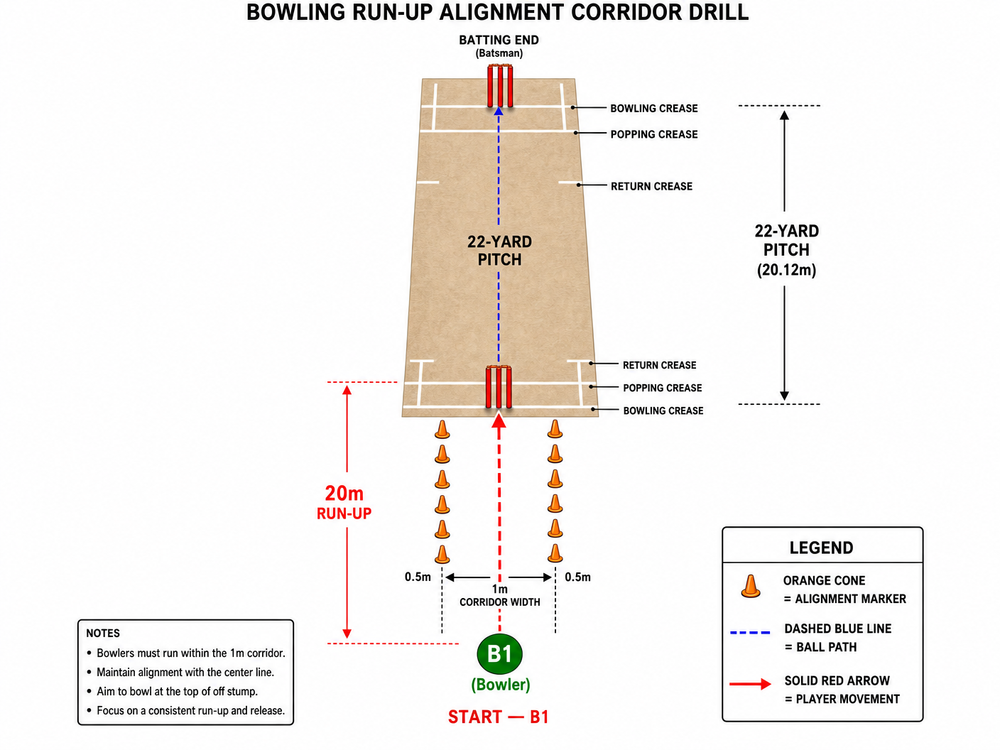
- Start at the bowling crease on a standard 22-yard pitch.
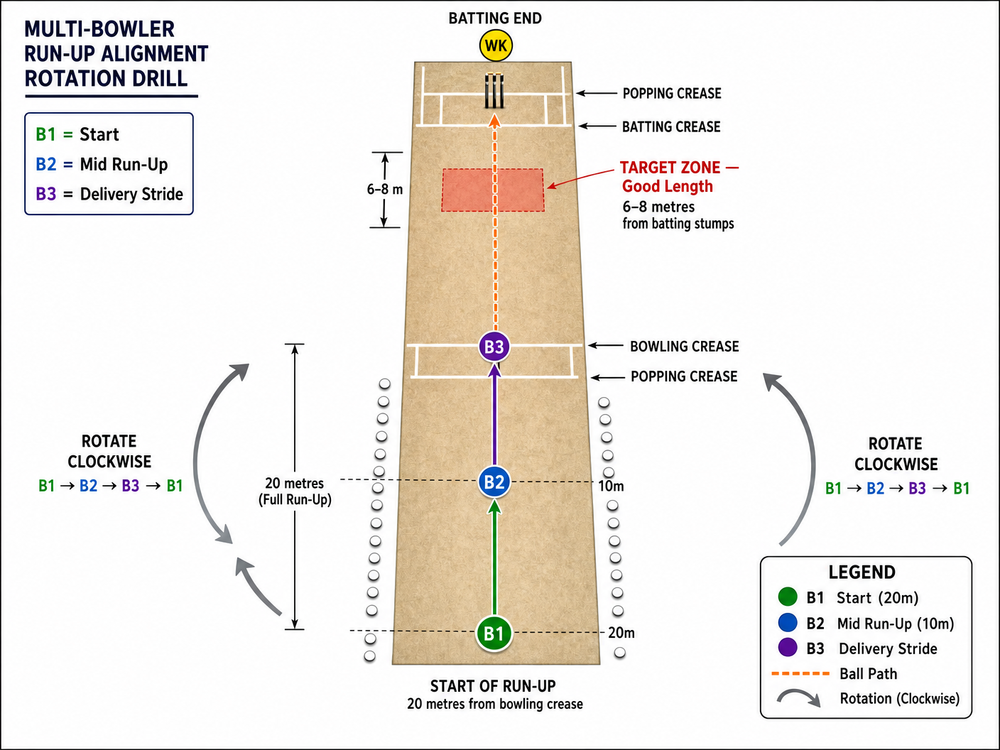
- Measure back to the bowler's exact starting mark (typically 15 to 25 metres, depending on the bowler).
- Place two parallel rows of cones starting from the bowler's mark all the way to the bowling crease.
- The cones should be spaced exactly 1 metre apart laterally, creating a narrow channel. Place a cone every 2-3 metres along the length of the run-up.
- Place the stumps at the batting end. You may also place a target marker on a "good length" (6-8 metres from the batting stumps).
Step-by-Step Instructions
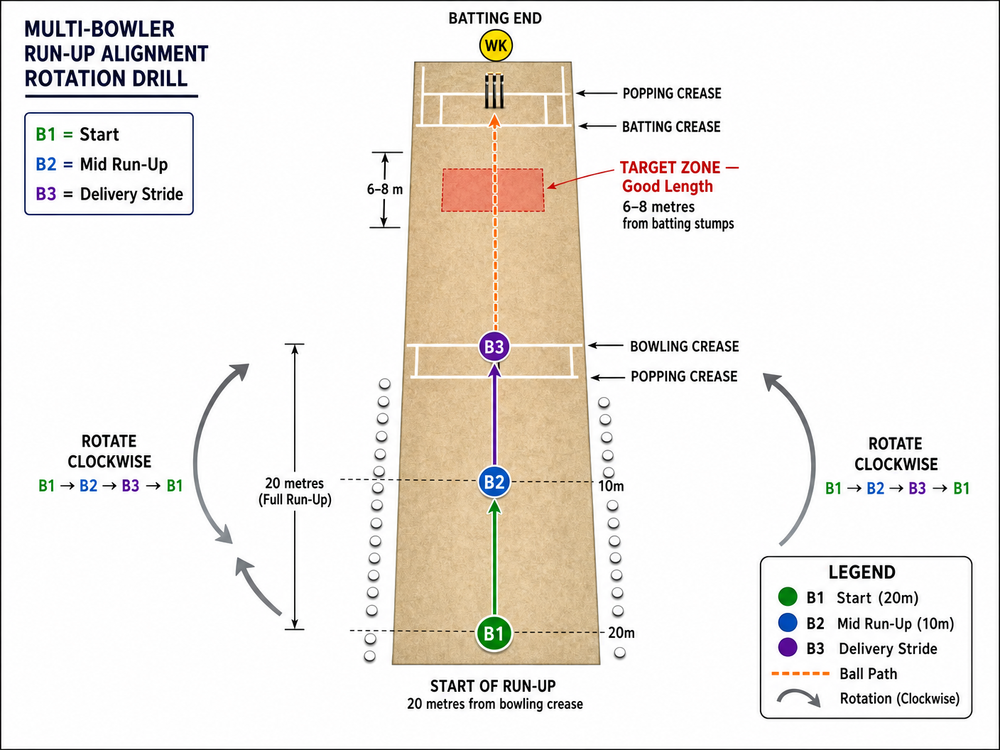
- Starting Position: The bowler (B1) stands at the top of their mark, centered perfectly within the 1-metre cone corridor.
- The Approach: On the coach's call, the bowler begins their run-up. The primary focus must be on keeping their body perfectly centered between the cones.
- Acceleration: As the bowler accelerates through the mid-point of the run-up, they must maintain a straight head position and drive their arms in straight, forward-and-back lines. Any lateral arm swing will cause them to veer towards the cones.
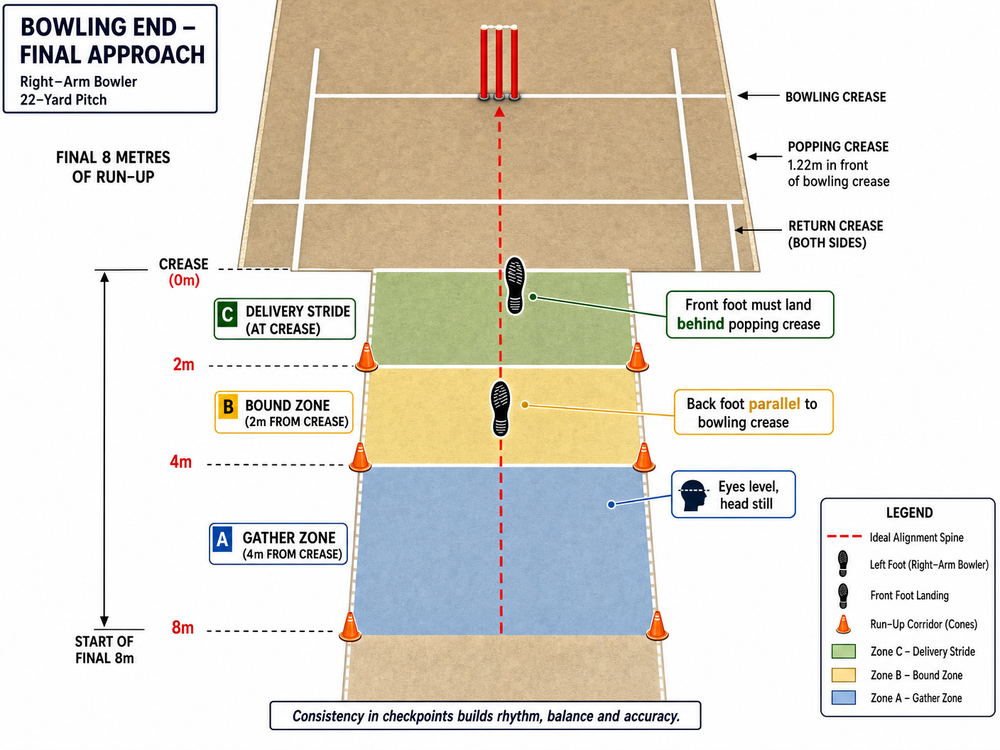
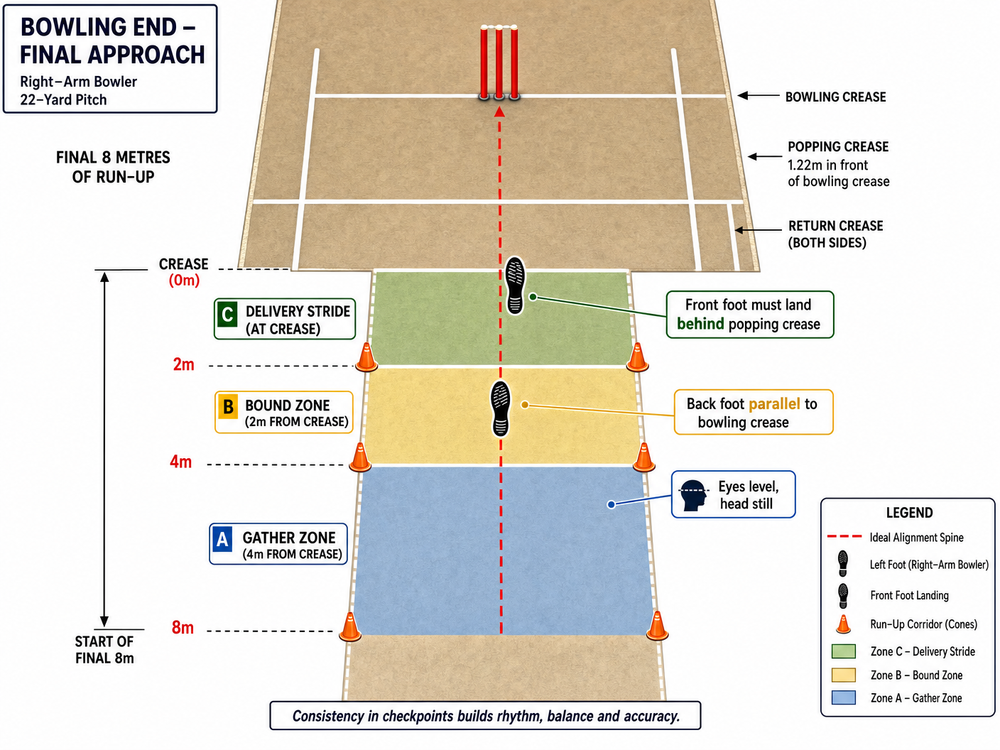
- The Gather and Bound: As the bowler enters the final 4 metres (the Gather Zone), they must prepare for their bound while staying strictly inside the corridor.
- Delivery Stride: The bowler enters the delivery stride at the crease. The front foot must land pointing towards the target, and the back foot should land parallel to the crease (for side-on bowlers) or slightly angled (for semi-open/front-on bowlers), without stepping on or outside the imaginary lines created by the cones.
- Follow-Through: After releasing the ball, the bowler must follow through straight down the pitch, avoiding running onto the protected area (the danger area).
Key Coaching Points
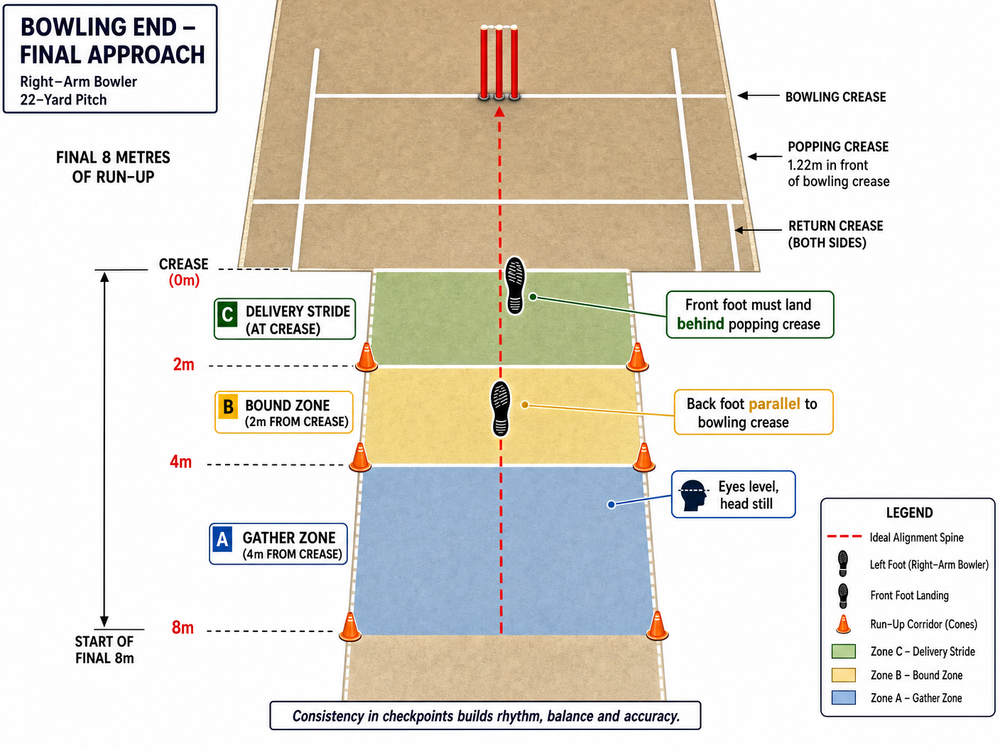
- Head Position: Keep the head dead still and eyes locked on the target (top of off stump or the length target). A wobbling head leads to a weaving run-up.
- Arm Drive: Arms should pump straight forward and back, like a sprinter. Cross-body arm action causes the torso to rotate prematurely, throwing off alignment.
- Foot Plant: Ensure the feet land straight down the center line of the corridor. Watch for bowlers who cross their feet over one another (tightrope running).
- Momentum Transfer: The goal is to build smooth, linear momentum. The run-up should start rhythmically and peak in speed just before the gather phase.
- Crease Position: The alignment in the run-up directly dictates where the bowler's feet land on the crease. A straight run-up leads to a consistent, powerful delivery base.
Common Mistakes
- Running on a curve: Starting wide and curving in towards the stumps, which wastes energy and alters the angle of delivery.
- Looking down at the cones: Bowlers must trust the corridor and keep their eyes on the target. Looking down disrupts posture and balance.
- Over-striding: Taking steps that are too long in an attempt to run faster, which causes a loss of balance and rhythm.
- Decelerating at the crease: Slowing down in the final few strides because they are worried about stepping on the cones or overstepping the popping crease.
Variations & Progressions
- Narrow the Corridor: For advanced bowlers, reduce the width of the cone corridor from 1 metre to 0.75 metres to demand pinpoint alignment accuracy.
- Blindfolded Start: Have the bowler close their eyes for the first 3 strides of the run-up to develop kinesthetic awareness and trust in their natural alignment, opening them once rhythm is established.
- Target Bowling: Combine the alignment drill with a specific target-hitting drill (e.g., hitting a single stump or a coin on a good length) to connect run-up efficiency with delivery accuracy.
Age Adaptations
- Under 10 / Under 12: Use a shorter run-up (10-12 metres) and a wider corridor (1.5 metres). Focus entirely on rhythm and running in a straight line without a ball first.
- Under 14 / Under 16: Introduce the standard 1-metre corridor and full run-up length. Begin linking the straight run-up to hitting specific lengths.
- Open / Senior: Narrow the corridor, add speed-tracking radar to ensure they aren't losing pace to maintain alignment, and incorporate complex target zones.
