

Basketball
The Flex Offense: A Complete Continuity Play Guide for Coaches
Master the Flex Offense, a classic continuity play that uses constant motion, screening, and cutting to create high-percentage scoring opportunities against any man-to-man defense.
What you need
Basketballs, Half-court with regulation markings, Cones (optional, for marking initial positions during practice)
1. Overview
The Flex Offense is one of the most reliable and enduring continuity offenses in basketball. It is designed to create constant movement, utilizing a repetitive pattern of screens and cuts to break down man-to-man defenses. The beauty of the Flex is its equal-opportunity nature; every player rotates through all five positions, forcing the defense to communicate perfectly or surrender an easy basket.
This offense is particularly effective because it requires all five players to be engaged. It relies on the "flex cut" (a cross-screen on the baseline) followed immediately by a down screen, creating a continuous loop of action. When executed with precision, timing, and solid screening fundamentals, the Flex Offense will generate high-percentage layups and open jump shots, regardless of the opponent's defensive pressure.
2. Setup

To run the Flex Offense effectively, you need a standard half-court setup (28m x 15m FIBA dimensions) and five players who are comfortable playing both inside and outside.
Initial Alignment
The Flex Offense begins in a 4-out, 1-in alignment, though it quickly morphs as the continuity begins. The initial setup is crucial for spacing and timing.

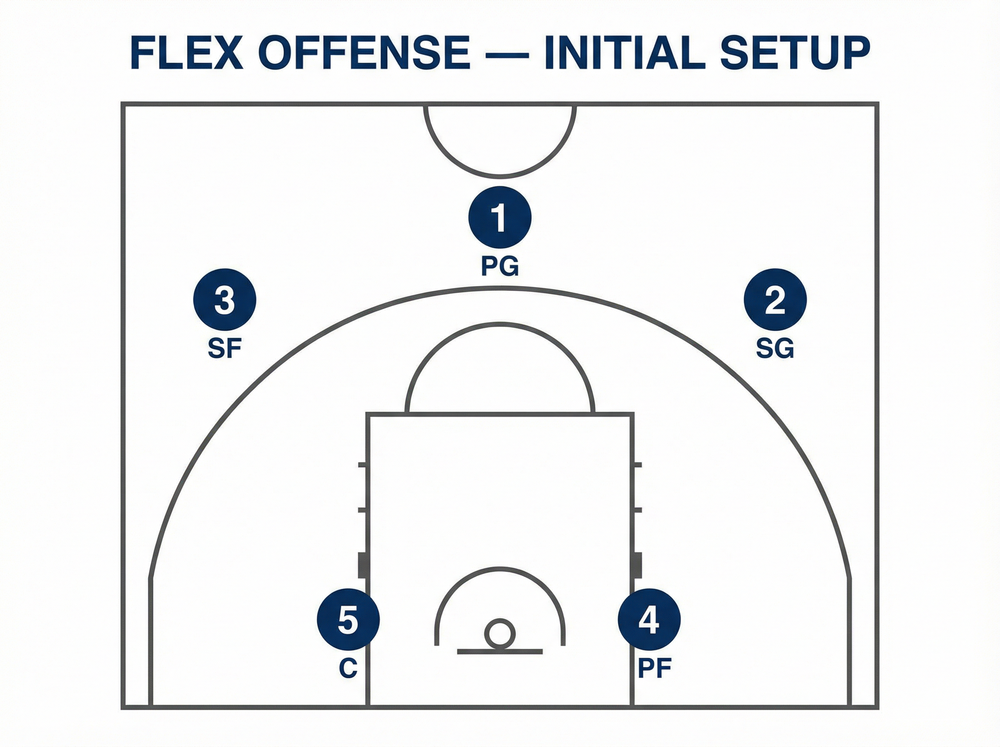
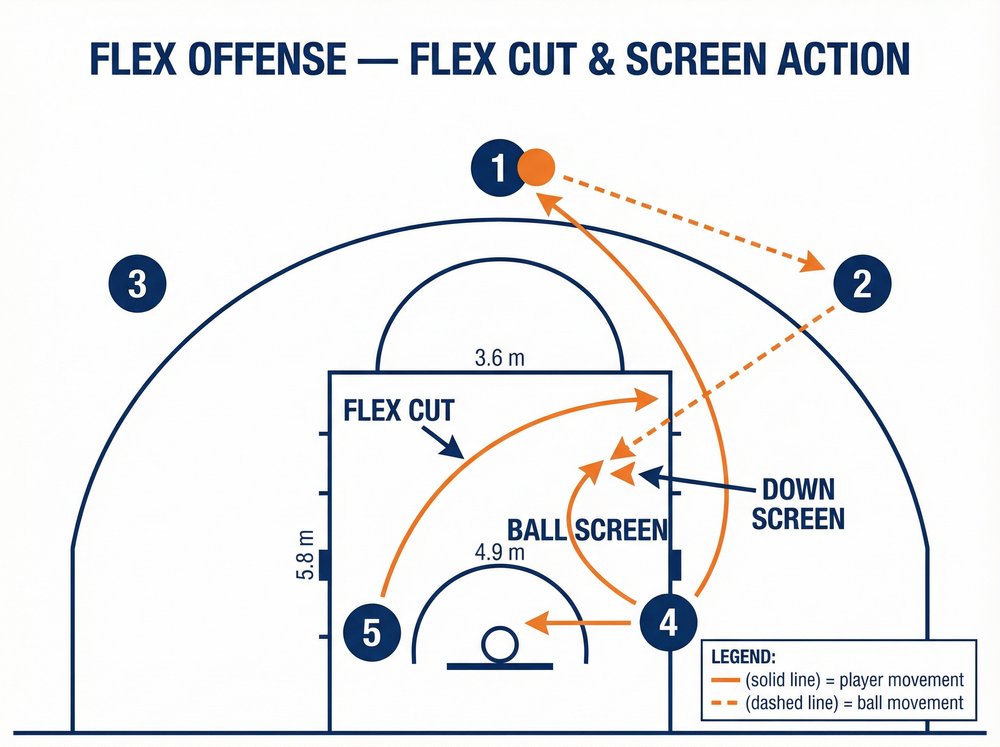
- Player 1 (PG): Starts with the ball at the top of the key, slightly offset to one side (the "ball side").
- Player 2 (SG): Positioned on the wing, extended from the free-throw line, on the same side as the ball.
- Player 3 (SF): Positioned on the opposite wing, mirroring Player 2.
- Player 4 (PF): Positioned on the low post block on the ball side.
- Player 5 (C): Positioned on the low post block on the weak side (opposite the ball).
3. Step-by-Step Instructions

The core of the Flex Offense is a two-screen action: a cross-screen on the baseline (the "flex cut") and a down screen on the ball side. Here is the step-by-step breakdown of the primary action.
The Flex Cut and Screen Action
- The Entry Pass: Player 1 initiates the offense by passing the ball to Player 2 on the wing.
- The Flex Cut: As soon as the pass is made, Player 5 (on the weak side block) uses a cross-screen set by Player 4 (on the strong side block). Player 5 cuts hard across the lane, looking for a quick pass from Player 2 for a layup.
- The Down Screen: Immediately after setting the cross-screen for Player 5, Player 4 turns and receives a down screen from Player 1 (who passed the ball and moved down). Player 4 cuts to the top of the key, looking for a pass from Player 2 for an open jump shot.
- The Rotation: Player 1, after setting the down screen, pops out to the weak side wing to balance the floor.
The Continuity Reset
If neither the flex cut nor the down screen results in an open shot, the offense flows seamlessly into the next cycle on the opposite side of the court.

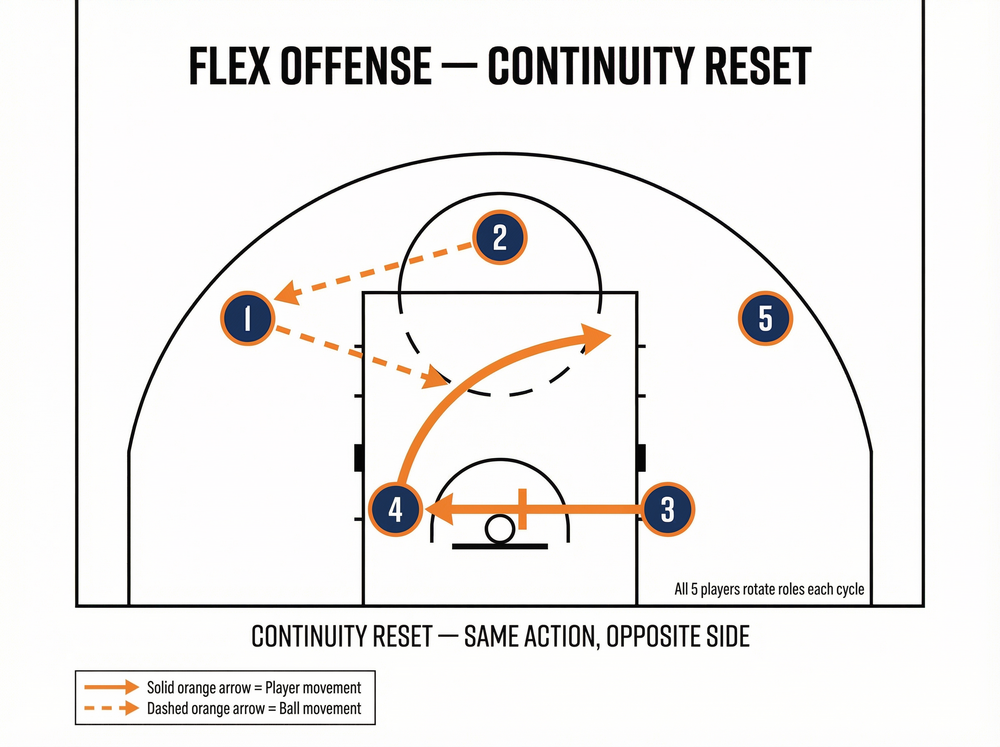
- Ball Reversal: Player 2 passes the ball to Player 4 at the top of the key. Player 4 immediately reverses the ball to Player 1 on the left wing.
- The Next Cycle: The action now mirrors the first cycle. Player 3 (now on the weak side block) uses a cross-screen set by Player 5 (now on the strong side block) for the flex cut.
- The Next Down Screen: Player 5 then receives a down screen from Player 4 (who passed the ball from the top) and cuts to the top of the key.
- Continuous Motion: This pattern repeats indefinitely, with all five players rotating through every position on the floor.
4. Key Coaching Points

To ensure your team executes the Flex Offense effectively, focus on these critical teaching points during practice:
- Screening Angles: The success of the Flex relies entirely on setting solid, legal screens at the correct angles. The cross-screener must force the defender to go over the top, and the down-screener must be stationary before contact.
- Patience and Timing: Players must wait for the screens to be set before making their cuts. Rushing the action will result in offensive fouls or disrupted spacing.
- Reading the Defense: Cutters must read how the defense plays the screen. If the defender cheats under the screen, the cutter should flare out; if the defender trails, the cutter should curl tightly to the basket.
- Passing Precision: Passes must be crisp and delivered on time. The entry pass to the wing and the subsequent pass to the cutter require accuracy and proper velocity.
- Spacing: Maintain proper spacing at all times. If players crowd each other, the defense can easily switch or recover, negating the advantage of the screens.
5. Common Mistakes
Watch for these common errors when installing and running the Flex Offense:
- Slipping Screens Too Early: Screeners often try to roll to the basket before making solid contact on the screen. This allows the defense to easily fight through and disrupt the play.
- Standing and Watching: Players off the ball must remain active and engaged. If the weak side players are stagnant, the defense can sag into the lane and clog the cutting lanes.
- Poor Spacing on the Wing: The wing players must stay wide to create adequate space for the flex cut and the down screen. Pinching in too far compresses the offense.
- Forcing Passes: Players should not force passes into heavily contested areas. If the primary options are covered, maintain possession and flow into the next cycle of the continuity.
6. Variations & Progressions
Once your team has mastered the basic Flex continuity, you can introduce variations to keep the defense guessing and create new scoring opportunities.
- Flex to Pick-and-Roll: Instead of setting a down screen, the player at the top of the key can set a ball screen for the wing player, initiating a quick pick-and-roll action on the side.
- Post Entry Option: If the defense switches heavily on the flex cut, look to feed the ball into the post player who has established deep position after the cross-screen.
- Dribble Entry: If the defense denies the initial wing pass, the point guard can initiate the offense by dribbling toward the wing, pushing the wing player down to the block to start the flex action.
7. Age Adaptations
The Flex Offense can be adapted for various age groups and skill levels:
- Youth (Under 10/12): Focus heavily on the fundamental concepts of passing, cutting, and spacing. Simplify the offense by running only the basic flex cut without the down screen initially.
- Middle School (Under 14/16): Introduce the full continuity with the down screen. Emphasize reading the defense and making the correct decisions off the screens.
- High School/Open: Incorporate advanced variations, such as the pick-and-roll option and post entries. Demand high-level execution, precise timing, and aggressive screening.
