

Basketball
The Flex Offense: A Complete Continuity Play Guide
Master the Flex Offense with this comprehensive guide covering setup, execution, scoring options, and coaching tips for seamless continuity.
What you need
1 Basketball, Half-court (FIBA dimensions: 28m x 15m)
1. Overview
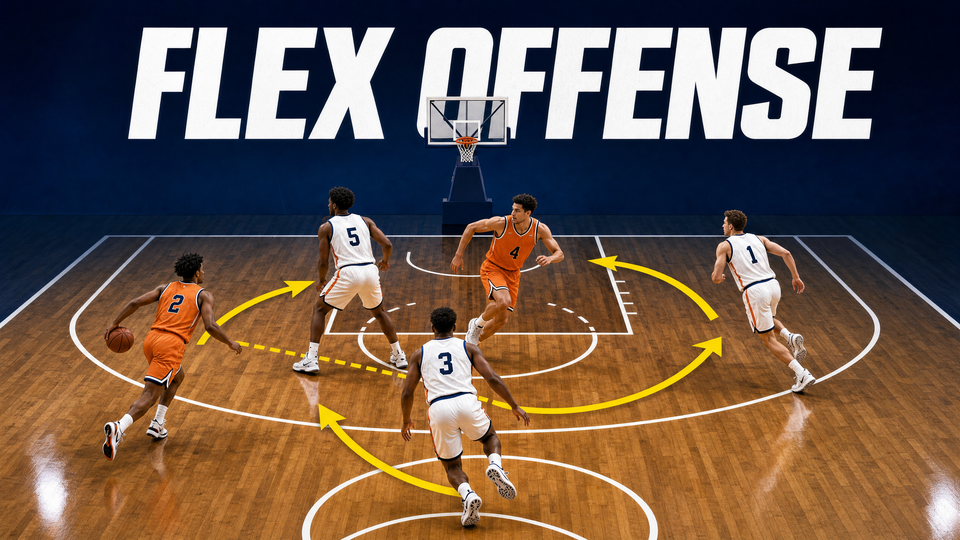
The Flex Offense is one of the most reliable and widely used continuity offenses in basketball. It relies on continuous movement, screening, and passing to break down man-to-man defences. By utilising a pattern of flex cuts (baseline cuts) followed by down screens (or back-screens), it forces the defence to constantly communicate and switch, eventually leading to high-percentage shots near the basket or open jump shots. It is particularly effective for teams lacking a dominant post player, as all five players rotate through all positions on the floor, requiring a balanced skill set from the entire roster.
2. Setup
- Equipment Needed: 1 Basketball, half-court (FIBA dimensions: 28m x 15m), optionally cones or markers for initial teaching.
- Court Setup: Standard half-court setup.
- Player Positions: The offense begins in a 1-4 Low or 4-out, 1-in alignment.
- Point Guard (1): Top of the key with the ball.
- Shooting Guard (2): Right corner.
- Small Forward (3): Left wing.
- Power Forward (4): Left low block.
- Centre (5): Right low block.
3. Step-by-Step Instructions
Action 1: The Initial Flex Cut
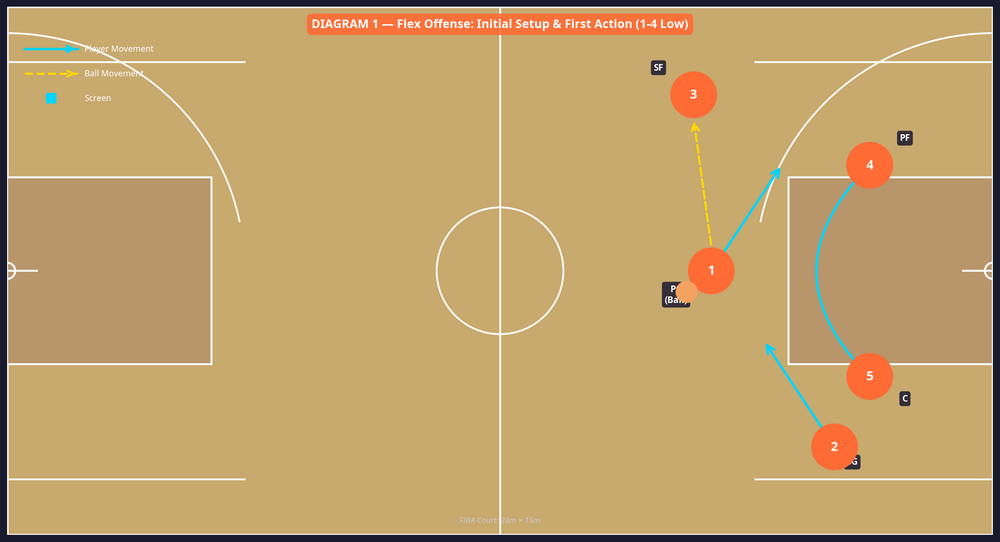
- The Point Guard (1) initiates the offense by passing to the Small Forward (3) on the left wing.
- Immediately upon the pass, the Centre (5) sets a baseline screen on the right block for the Power Forward (4).
- The Power Forward (4) uses the screen to make a flex cut across the baseline, looking for a quick pass from (3) for a lay-up.
- Meanwhile, the Shooting Guard (2) cuts up from the right corner to replace (1) at the right wing, and (1) relocates to the opposite wing to maintain spacing.
Action 2: Back-Screen and Ball Reversal
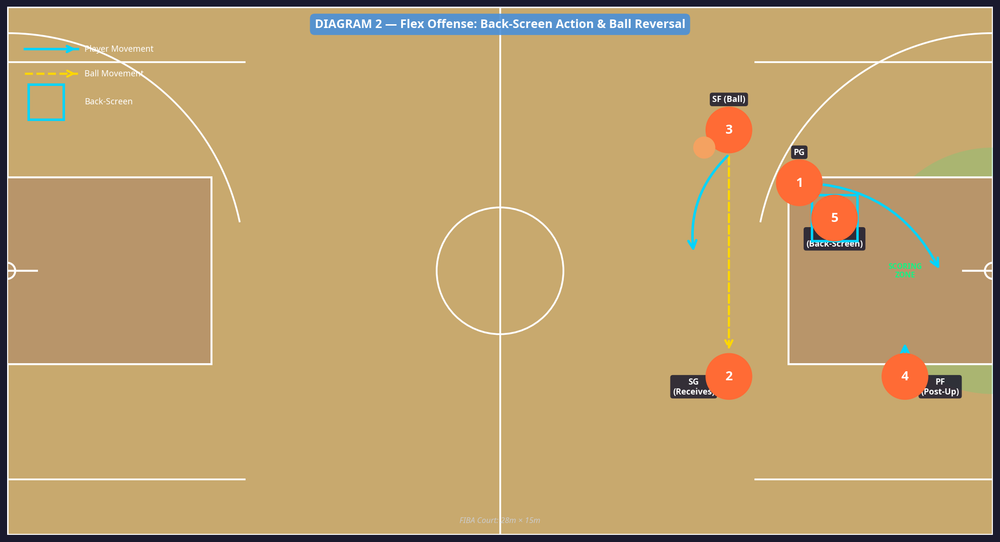
- If the pass to the flex cutter (4) is not open, (4) establishes post position on the right block.
- The Centre (5), who just set the baseline screen, now turns and sets a back-screen (or down screen) for the Point Guard (1) near the elbow.
- The Point Guard (1) uses the back-screen to cut hard towards the basket, looking for a pass from (3).
- If (1) is not open, the ball is reversed. The Small Forward (3) passes to the Shooting Guard (2) who has filled the top/wing position.
Action 3: Continuity and Scoring Options
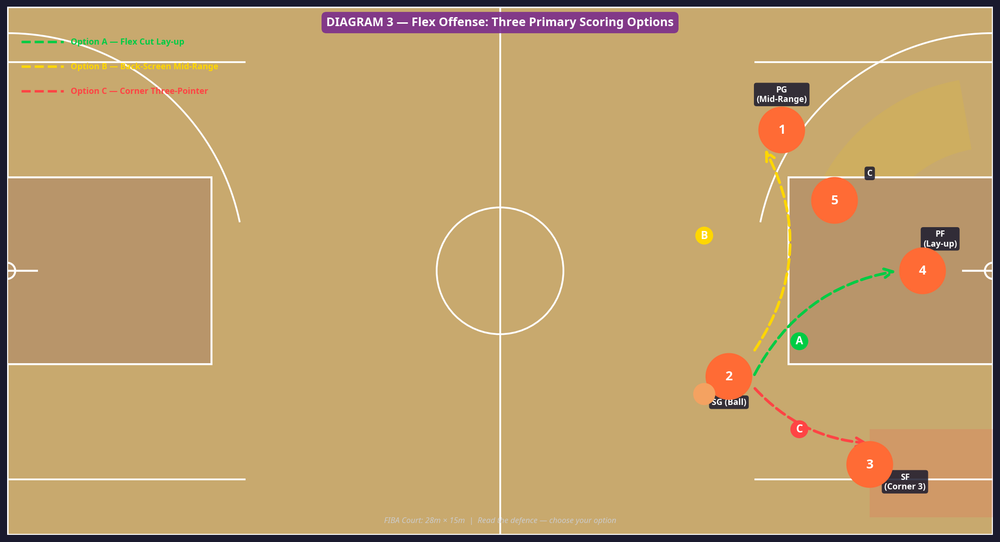
- The offense is now perfectly mirrored. The Shooting Guard (2) has the ball on the right side, and the pattern repeats.
- The player on the left block will set a baseline screen for the player in the left corner to make a flex cut.
- Scoring Options: The primary reads are:
- Option A (Green): Hit the flex cutter for a lay-up as they cross the paint.
- Option B (Yellow): Pass to the player popping off the back-screen for a mid-range jumper.
- Option C (Red): Kick-out to the corner if the defence collapses, creating an open three-point opportunity.
4. Key Coaching Points
- Screening Angles: Screeners must set wide, solid bases and hold their screens. The angle of the baseline screen should force the defender to go over the top, trailing the cutter.
- Patience and Timing: Cutters must wait for the screen to be set before moving. Rushing the cut destroys the timing of the play.
- Setting Up the Cut: Cutters should take their defender one step away from the screen before sharply cutting off the screener's shoulder (rubbing shoulders).
- Read the Defence: Players must be taught to read how the defence plays the screen. If the defence switches, the screener often becomes open on the slip or roll to the basket.
- Spacing: Maintain excellent spacing. If players bunch up, the passing lanes for the flex cut and back-screen will disappear.
5. Common Mistakes
- Slipping Screens Early: Screeners moving before contact is made, resulting in illegal screen fouls or ineffective picks.
- Curving Cuts: Cutters rounding off their cuts instead of making sharp, angular movements, allowing defenders to recover easily.
- Ball Sticking: The ball handler holding the ball too long on the wing. The ball must move quickly to force the defence to shift.
- Ignoring the Screener: Often, the player setting the screen becomes the most open player, especially on the back-screen action. Ball handlers must look at the screener as a viable scoring option.
6. Variations & Progressions
- Flex to Pick and Roll: If the continuity breaks down or the shot clock is winding down, seamlessly transition into a high pick and roll using the ball handler and the nearest post player.
- Dribble Entry: Instead of starting with a pass to the wing, the Point Guard can dribble towards the wing, pushing the wing player down to the block to initiate the flex action from a different alignment.
- False Action Entry: Run a preliminary action, such as a stagger screen away from the ball, simply to shift the defence before flowing directly into the standard flex continuity.
7. Age Adaptations
- Under 10s / Under 12s: Focus purely on the fundamental movements: passing, cutting, and replacing. Introduce the concept of the baseline cut without strict screening rules, emphasising moving to open space.
- Under 14s: Introduce the baseline screen and the concept of "rubbing shoulders" on the cut. Begin teaching the back-screen action as a secondary option.
- Under 16s & Open: Implement the full continuity offense. Focus heavily on reading defensive switches, slipping screens, and maintaining high-speed ball movement.
