

Football
4v4 Small-Sided Game: High-Intensity Transitions
Master the chaotic moments of the game by coaching your players to react instantly when possession changes in this high-intensity 4v4 drill.

What you need
2 small goals, Footballs, Bibs (2 colors), Cones/Markers
1. Overview
Transitions are the most critical moments in modern football. The seconds immediately following a change of possession dictate whether a team can exploit a disorganized opponent or secure their own defensive shape. This 4v4 small-sided game is specifically designed to overload players with transitional moments, forcing them to react instantly, make rapid decisions under fatigue, and execute technical actions at match speed. It is ideal for developing both physical conditioning and tactical awareness in the transition phases.
2. Setup
To ensure the drill runs smoothly and replicates match intensity, the setup must be precise.
Pitch Dimensions: 30m x 20m (Adjust slightly based on age group; 35m x 25m for older/fitter players to increase physical load).
Equipment Needed:
- 2 small goals (or 4 poles/cones if goals are unavailable)
- A large supply of footballs placed with the coach on the touchline
- 8 bibs (4 Red, 4 Blue)
- Flat markers to outline the pitch
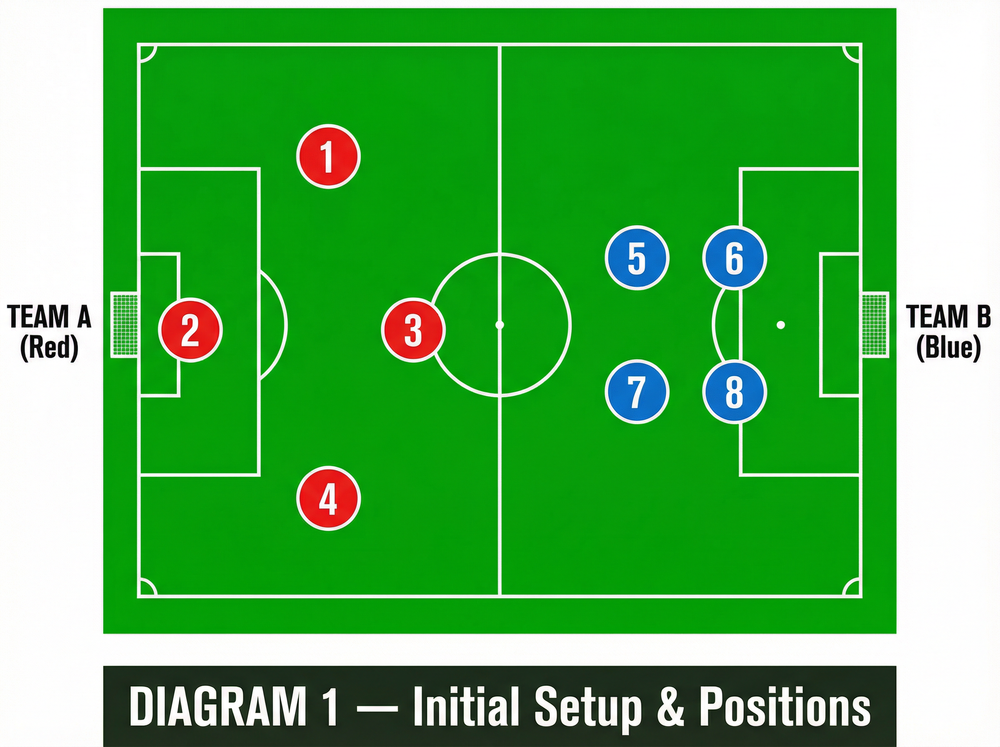
Player Positions:
Divide your 8 players into two balanced teams (Team A and Team B). In a 4v4 setup, a typical shape is a diamond (1 defender, 2 wide players, 1 attacker) or a box (2 defenders, 2 attackers).
3. Step-by-Step Instructions
- Start the Play: The coach stands on the touchline with the supply of footballs. To begin, the coach plays a firm pass into one of the teams to initiate a 4v4 attack.
- Open Play: The team in possession attempts to score in the opponent's goal. Normal football rules apply, but there are no throw-ins or corners. If the ball goes out of bounds, play stops immediately.
- The Transition Trigger: The moment a goal is scored, the ball goes out of play, or the goalkeeper saves and holds the ball, the coach instantly plays a new ball into the team that just lost possession or conceded.
- Immediate Reaction: The team receiving the new ball must attack immediately, capitalizing on the transition. The defending team must instantly counter-press or drop into a compact defensive shape.
- Continuous Play: Play continues in this rapid-fire manner for a set block of time (e.g., 3–4 minutes) before a rest period.

4. Key Coaching Points
- Reaction Speed: The primary focus is the speed of thought and movement the moment the ball changes hands. Players must shift from an attacking mindset to a defensive one (or vice versa) in a fraction of a second.
- First Pass in Transition: When winning the ball, the first pass is crucial. Encourage players to look forward immediately to exploit spaces left by the opponent, but recognize when to secure possession if the forward pass isn't on.
- Compactness in Defence: Upon losing the ball, the closest player must press the ball carrier to delay the attack, while the remaining three players rapidly drop to form a compact defensive unit and protect the goal.
- Exploiting Width and Depth: In attacking transition, players off the ball must sprint to create width and depth, giving the ball carrier multiple passing options and stretching the disorganized defence.
5. Common Mistakes
- Lingering on Mistakes: Players often pause to complain or show frustration after losing the ball or missing a shot. In this drill, that hesitation will result in conceding a goal. Coach them to react to the next action immediately.
- Forcing the Forward Pass: While attacking quickly is the goal, players sometimes force impossible passes into traffic. Teach them that if the counter-attack is blocked, they should secure the ball and build up patiently.
- Defensive Disconnect: If only one player presses and the others don't support, or if players drop off without applying pressure to the ball, the attacking team will easily play through them.
6. Variations & Progressions
- Touch Limit: Introduce a 2-touch or 3-touch limit to increase the speed of play and force quicker decision-making.
- Target Players: Place a target player (or a coach) behind each goal. To score, a team must pass to the target player and receive a lay-off before shooting. This encourages combination play in the final third.
- Directional Change: After a set time, switch the goals the teams are attacking without stopping play, forcing a massive spatial transition.
7. Age Adaptations
- Under 8 – Under 10: Focus heavily on the technical aspects of the transition (first touch, passing accuracy). Increase the pitch size slightly to give them more time on the ball. Reduce the duration of the work blocks to 1–2 minutes.
- Under 12 – Under 14: Introduce the tactical concepts of counter-pressing and exploiting space. Enforce stricter rules on reaction times.
- Under 16 – Open: Run the drill at maximum intensity. Shrink the pitch slightly to increase the pressure and demand elite decision-making and technical execution under fatigue. Extend work blocks to 4–5 minutes to build anaerobic endurance.
