

Football
Mastering the Build-Up from the Back: A Complete Coaching Guide
Learn how to coach a structured, three-phase build-up from the back that breaks the opponent's press, creates wide overloads, and unlocks the final third with confidence.

What you need
footballs (10-15), full-size goal, cones or markers, bibs/training vests, full-size pitch (100-110m x 64-75m)
1. Overview
This set play is designed to teach teams how to confidently and effectively play out from the goalkeeper, breaking the opponent's first line of pressure and progressing the ball into the midfield and attacking thirds. It is a foundational tactic for any team aspiring to a possession-based style of football. The primary goal is to create numerical superiority in the initial phase of the attack, draw the opposition forward to create space in behind, and establish controlled possession in the opponent's half. This approach is best used against teams that press high up the pitch, as it exploits the space they vacate.
2. Setup

Equipment: 1 full-size goal, 10–15 footballs, cones or markers to designate positions.
Pitch Setup: A full-sized pitch (100–110m x 64–75m) is ideal to replicate match conditions. The focus will be on the defensive and middle thirds.
Player Positions (11 players): 1 Goalkeeper (GK #1), 2 Centre-Backs (CB #4, CB #5), 2 Full-Backs (LB #3, RB #2), 3 Midfielders (Holding CM #6, Box-to-Box CM #8, Attacking CM #10), 3 Forwards (ST #9, LW #11, RW #7).
3. Step-by-Step Instructions

This play is broken down into three distinct but fluid phases, from the initial goalkeeper distribution to entering the final third.
Phase 1: Initial Shape & GK Distribution

- Starting Shape: The Goalkeeper (#1) begins with the ball. The Centre-Backs (#4 and #5) split to the edges of the 18-yard box, creating a wide base approximately 35–40m apart. The Full-Backs (#2 and #3) push higher and wider, roughly 10–15 metres ahead of the CBs.
- Midfield Triangle: The holding midfielder (#6) drops into the space between the splitting CBs, offering a central passing option and creating a 3v2 or 3v1 against the opponent's first line of press. The other two midfielders (#8 and #10) position themselves higher, occupying the half-spaces between the opponent's midfield and defensive lines.
- Goalkeeper's Decision: The GK's primary read is the opponent's pressing structure. The first pass is typically to one of the wide Centre-Backs, who should have an open body shape to see the field. This pass must be firm and on the correct foot to facilitate a forward touch.
Phase 2: Midfield Progression & Wide Overloads

- Ball Circulation: Once the CB receives the ball, the immediate goal is to break the first line of pressure. The holding midfielder (#6) acts as a pivot to switch play. The ball-side Full-Back (#2 or #3) provides a safe wide option, while the box-to-box midfielder (#8) looks for pockets of space to receive a vertical pass.
- Creating Overloads: The key to this phase is creating a numerical advantage in wide areas. As the ball moves to the Full-Back, the winger on that side (#7 or #11) pins the opposing Full-Back, and the attacking midfielder (#10) drifts towards the ball to create a 3v2 overload.
- Forward Movement: The Striker (#9) makes intelligent runs to stretch the opposition's backline, either by checking towards the ball to link play or by running in behind to create space for others.
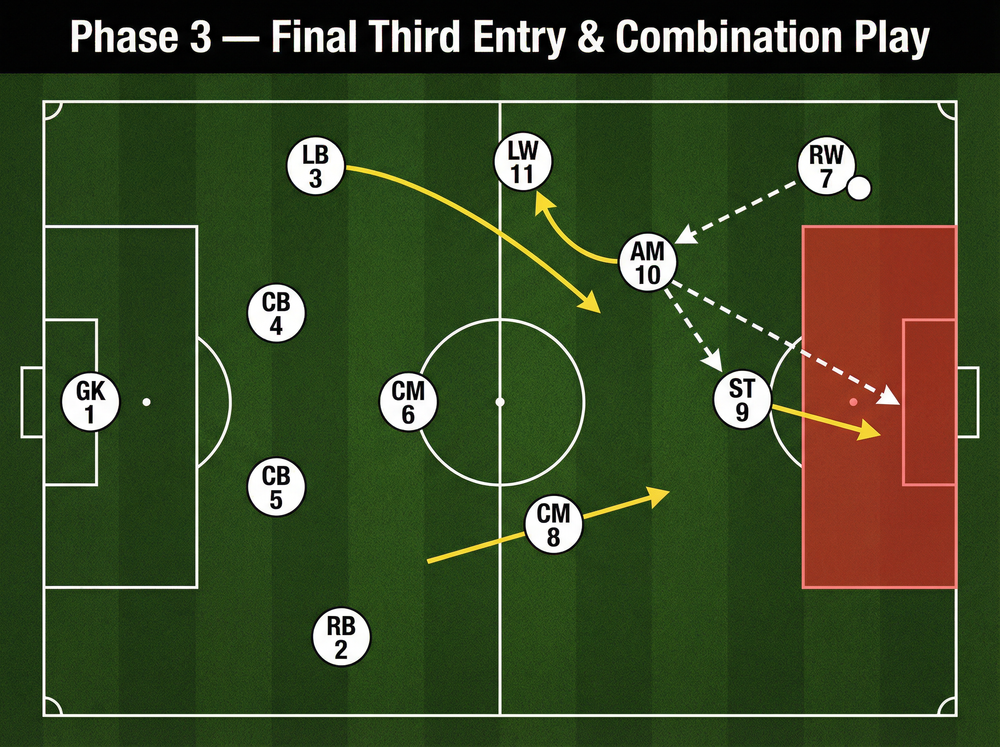
Phase 3: Final Third Entry & Combination Play

- Breaking the Lines: From the wide overload, the aim is to play a decisive pass into the final third. This could be a through ball for the winger, a pass into the feet of the striker, or a combination with the attacking midfielder in the half-space.
- Combination Play: Once in the final third, quick one- and two-touch passing is crucial. The Right Winger (#7) combines with the Attacking Midfielder (#10), who then plays in the Striker (#9) making a run across the face of the goal.
- Supporting Runs: The box-to-box midfielder (#8) should make a late, third-man run into the penalty area, providing another scoring option and attacking any second balls or rebounds.
4. Key Coaching Points

Body Shape: Players must receive the ball with an open body shape, allowing them to see the field and play forward in one touch. Pass Detail: The weight, accuracy, and timing of each pass are critical — passes should be firm and directed to the receiver's front foot. Movement to Create Space: Player movement off the ball is just as important as the pass itself; players must make runs to either receive the ball or to create space for a teammate. Communication: Clear and concise communication is essential — players should be constantly talking, guiding teammates, and demanding the ball. Patience & Composure: Teams must be patient and avoid forcing the ball forward; if a forward option is not available, they should be comfortable recycling possession and switching the point of attack. Scanning: Before receiving the ball, players must scan their surroundings to assess the positions of opponents and teammates, allowing for quicker decision-making.
5. Common Mistakes
Goalkeeper's Poor Distribution: A slow or inaccurate pass from the GK immediately puts the receiving CB under pressure and can lead to a turnover in a dangerous area. Static Movement: Midfielders and forwards remaining static, failing to create passing lanes or space for others. Playing into Pressure: Forcing vertical passes into heavily marked players instead of recycling possession and finding the open man. Closed Body Shape: Receiving the ball facing one's own goal, which slows down play and invites pressure. Lack of Width: Full-Backs and Wingers not staying wide enough, which congests the play and makes it easier for the opposition to defend.
6. Variations & Progressions

Progression 1 — Adding Opposition: Start with passive opposition (shadow play) and gradually increase to full pressure, starting with 2 forwards, then adding midfielders to create an 11v5, 11v7, and eventually a full 11v11. Progression 2 — The 'Up-Back-Through': Coach players to use a more advanced combination where the CB plays a firm pass into the Striker's feet (#9), who lays it back to the attacking midfielder (#10), who then plays a through ball for a winger running in behind. Variation 1 — Holding Midfielder Drops Wide: Instead of the #6 dropping between the CBs, have them drop into a wide area, allowing the Full-Back to push on aggressively, creating a different rotational pattern.
7. Age Adaptations

Under 8/10: Simplify the concept. Focus on the GK playing to a wide defender in a 7v7 or 5v5 game. The goal is simply to encourage playing out from the back rather than kicking it long. Use lots of positive reinforcement. Under 12/14: Introduce the basic 11v11 shape but focus on Phases 1 and 2. Use cones to create 'safe zones' for the CBs to receive the ball in. The objective is to successfully pass the ball into the midfield third. Under 16/Open: Run the full pattern as described, focusing on the speed of play, the quality of movement, and the tactical decisions made under pressure. Introduce the variations and challenge players to read the opposition's press and decide which pattern to use.
