

Football
Mastering the Build-Up from the Back: A Three-Phase Possession Play
Learn how to coach a structured three-phase build-up from the goalkeeper through to wide overloads in the attacking third, giving your team a repeatable, pressure-resistant method of progressing the ball.

What you need
footballs (minimum 6), full-size goals (x2), cones or markers, training bibs (2 sets), full-size pitch (100-110m x 64-75m)
Overview
This set play, "Mastering the Build-Up from the Back," is a fundamental tactical sequence for any team aspiring to a possession-based style of football. The primary objective is to securely progress the ball from the defensive third into the middle and attacking thirds, bypassing the opponent's initial line of pressure. It is most effective when facing teams that employ a high press or when your team has a technical advantage in defense and midfield. By drawing the opposition forward, this play creates space in behind and between their lines, which can then be exploited through calculated passing and movement.
Setup

This drill is designed for a full-size pitch (100-110m x 64-75m) to replicate match conditions accurately. Minimal equipment is required, allowing coaches to focus on player understanding and execution.
- Equipment: A good supply of footballs, a full set of cones or markers (optional, for marking zones), and two full-size goals.
- Pitch Setup: Use the full pitch. For progressions, you can cone off a central channel to emphasize the importance of playing through the pivot.
- Player Positions (11v0 or 11v11):
- Goalkeeper (GK, #1)
- Center-Backs (CB-L #5, CB-R #6)
- Full-Backs (LB #3, RB #2)
- Defensive Midfielder (DM, #4)
- Central Midfielders (CM, #8 & #10)
- Wingers (LW #11, RW #7)
- Striker (ST, #9)
Step-by-Step Instructions

The play is broken down into three distinct but connected phases, moving from initial distribution to final third entry.
Phase 1: Initial Shape & Goalkeeper Distribution
The foundation of the play starts with creating width and the first passing options from a goal kick or open play.

- Goalkeeper (GK) starts with the ball at their feet in the center of the goal.
- Center-Backs (CB-L #5, CB-R #6) split wide to the edges of the 18-yard box. This movement must be quick and decisive to stretch the opposition's first line of defense.
- Defensive Midfielder (DM #4) drops into the space centrally, just outside the penalty arc, presenting a clear, primary passing lane for the GK.
- Full-Backs (LB #3, RB #2) push high and wide, positioning themselves near the halfway line to provide width and an outlet pass if the central option is blocked.
- The GK's first look is to play a firm, ground pass to one of the splitting CBs. The choice of side depends on the opposition's positioning.
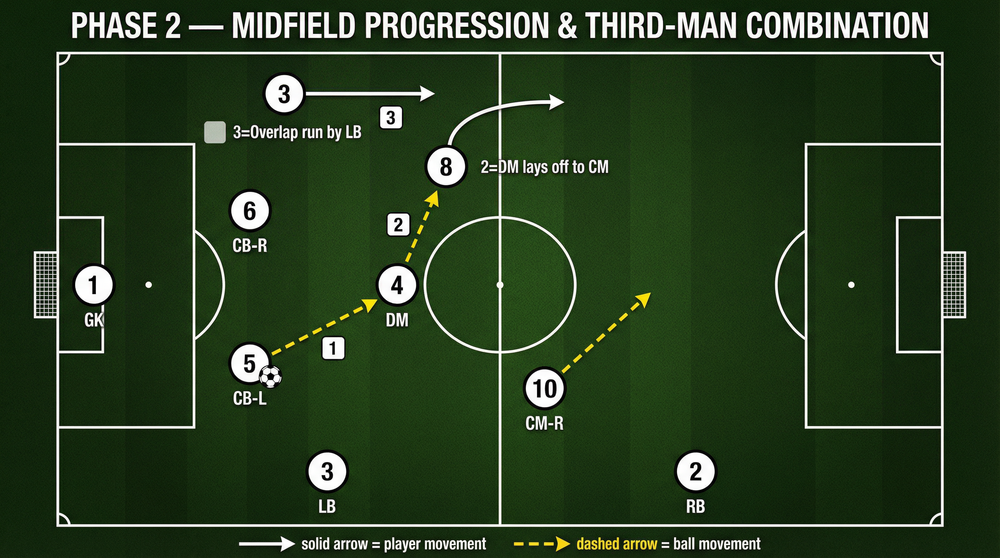
Phase 2: Midfield Progression & Third-Man Combination
Once the ball is with a Center-Back, the goal is to break the next line of pressure by finding the pivot player (DM).

- The CB (#5) receives the ball with an open body shape, allowing them to see the DM, the nearby CM, and the advanced Full-Back.
- The CB plays a sharp pass into the DM (#4), who has found a pocket of space between the opposition's strikers and midfielders.
- The DM (#4) executes a one-touch or two-touch lay-off pass to the nearest Central Midfielder (CM #8). This is a classic "third-man" combination, where the DM acts as a wall to bounce the ball to a forward-facing player.
- As this happens, the CM (#8) makes a pre-emptive movement to support the DM, arriving onto the lay-off pass with momentum.
Phase 3: Wide Overload & Final Third Entry
With the CM now on the ball facing forward, the team looks to exploit the space created out wide.

- The forward-facing CM (#8) drives into the space ahead.
- The Full-Back (LB #3) on that side makes a dynamic overlapping run beyond the Winger, creating a 2v1 overload against the opposition's full-back.
- The Winger (LW #11) can either hold their width to pin the defender or make an inverted run inside to draw them away, clearing the path for the overlapping LB.
- The CM can now either slide a through-ball into the path of the overlapping LB (#3) or play into the feet of the Striker (#9), who makes a run to receive the ball in the box.
- The final action is a cross, cut-back, or shot, involving the ST, opposite Winger, and arriving midfielders.
Key Coaching Points

- Body Shape: Players receiving the ball must have an "open" body shape, allowing them to see the next pass and play forward quickly. The first touch should move the ball into space.
- Pass Weight & Quality: Passes must be firm and accurate, especially into the DM. A slow pass allows the defense to recover and press.
- Timing of Movement: Players must move as the ball travels. The CM must anticipate the lay-off from the DM; the FB must time their overlap to arrive as the CM is ready to pass.
- Scanning & Awareness: Before receiving, players must scan their shoulders to be aware of pressure and the location of teammates. This is critical for the DM and CMs.
- Create Angles: Players without the ball must constantly adjust their position to create clear passing lanes for the player in possession. Avoid standing in straight lines or in the cover shadow of defenders.
Common Mistakes

- CBs Not Splitting Wide Enough: This makes the pass from the GK risky and allows one opposition striker to cover both CBs.
- DM is Flat or Marked: If the DM is not in a good position to receive, the CB will be forced to play a long, hopeful ball. The DM must be active in finding space.
- Slow Ball Speed: A slow, lazy build-up gives the opposition time to get organized and set their press. The ball must move quickly and with purpose.
- Forcing the Central Pass: If the pass to the DM is blocked, the CB must recognize this and use the "out" ball to the high-and-wide Full-Back. Don't force the play through a congested area.
- Poor First Touch: A heavy or backward first touch immediately puts the player under pressure and kills the momentum of the attack.
Variations & Progressions

- Variation (Anti-Press Bypass): If the opposition presses high and man-marks the DM, the GK can play a longer, lofted pass directly to the high Full-Backs, bypassing the midfield pivot entirely.
- Progression 1 (Passive Opposition): Add 2-3 opposition strikers and midfielders who can shadow play but not tackle. This forces players to be more aware of passing lanes and cover shadows.
- Progression 2 (Active Opposition with Incentive): Move to a full 11v11 game, but award the attacking team double points for scoring a goal that originates from the GK and follows the prescribed pattern. This encourages them to use the set play under realistic pressure.
Age Adaptations
- Under 8 - Under 10: Simplify the concept. Focus on Phase 1 only. Play 7v7. Encourage the GK to roll the ball out to wide defenders and teach them to receive with an open body shape. The goal is simply to secure first possession.
- Under 12 - Under 14: Introduce the DM as a pivot player (Phase 2). Work on the combination play between the CB, DM, and CM in small-sided games (e.g., 4v2 rondos) before applying it to the full pitch.
- Under 16 & Open Age: All phases can be coached. Focus on the tactical nuances: recognizing pressing triggers, the speed of combination play, and the quality of the final ball in the attacking third. Introduce variations based on how the opposition defends.
