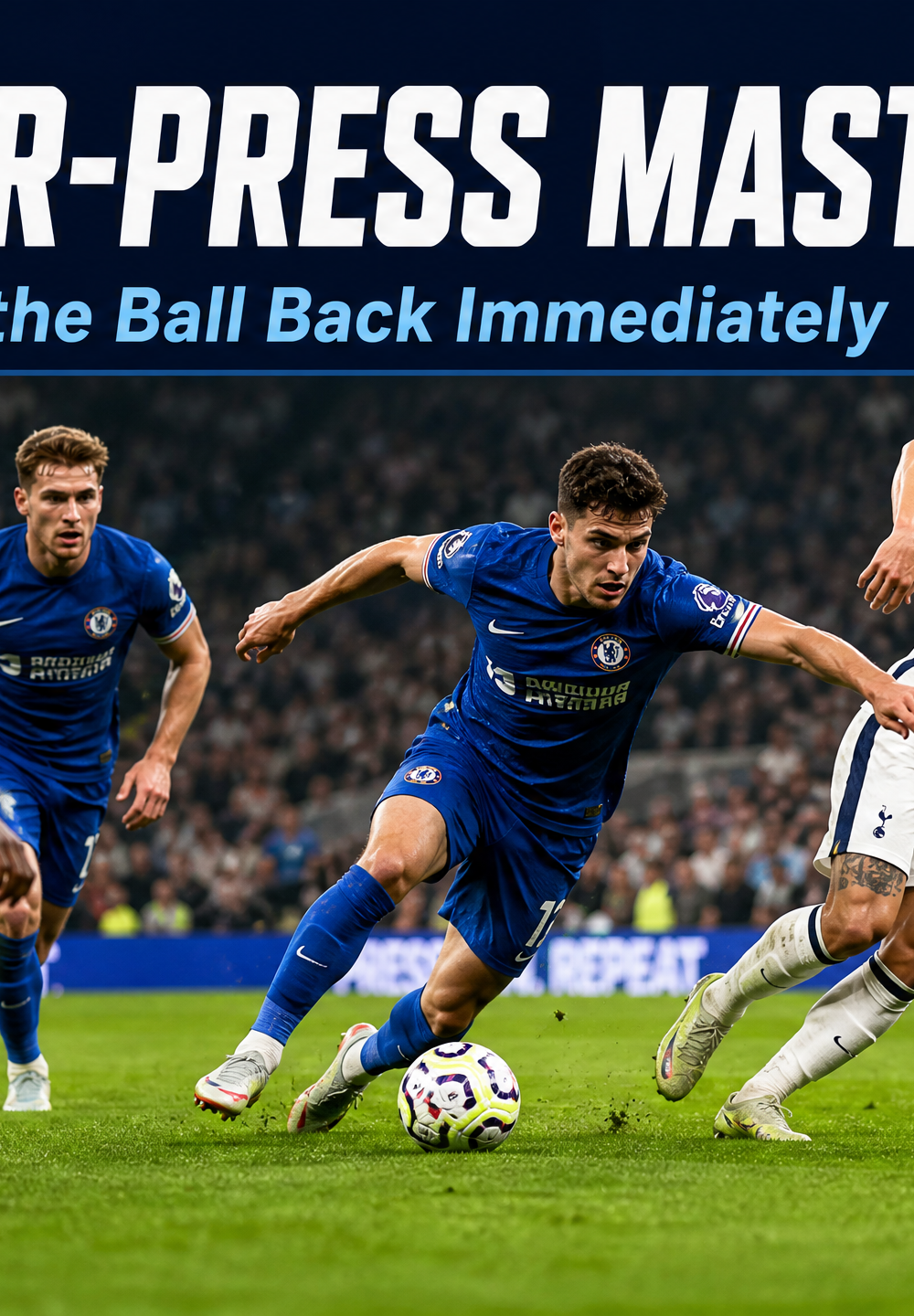
Counter-Press Mastery: Winning the Ball Back Immediately
Equip your team with the tactical framework to instantly suffocate opponents upon losing possession, turning defensive transitions into immediate attacking opportunities.

Equipment Needed
1. Overview
The counter-press (or Gegenpressing) is not merely a defensive action; it is the ultimate playmaker. This set play focuses on the immediate 5-second window following a loss of possession in the middle or attacking third. By aggressively closing down the ball carrier and cutting off passing lanes, your team can force errors while the opponent is still disorganised, instantly launching a high-quality counter-attack. Use this system when your team naturally pushes high up the pitch and seeks to dominate possession.
2. Setup
Pitch Area: Half pitch (approx. 50-55m x 64-75m) focusing on the midfield and attacking zones.
Players: 16-18 players (11 attackers in a 4-3-3 formation, 5-7 defenders simulating a build-up shape).
Equipment: Full-size goal, 12 cones for marking zones, 3 sets of bibs (Attacking team, Defending team, Neutral players if needed), and an ample supply of footballs around the perimeter to maintain high intensity.
3. Step-by-Step Instructions
Step 1: The Trigger (Moment of Loss)
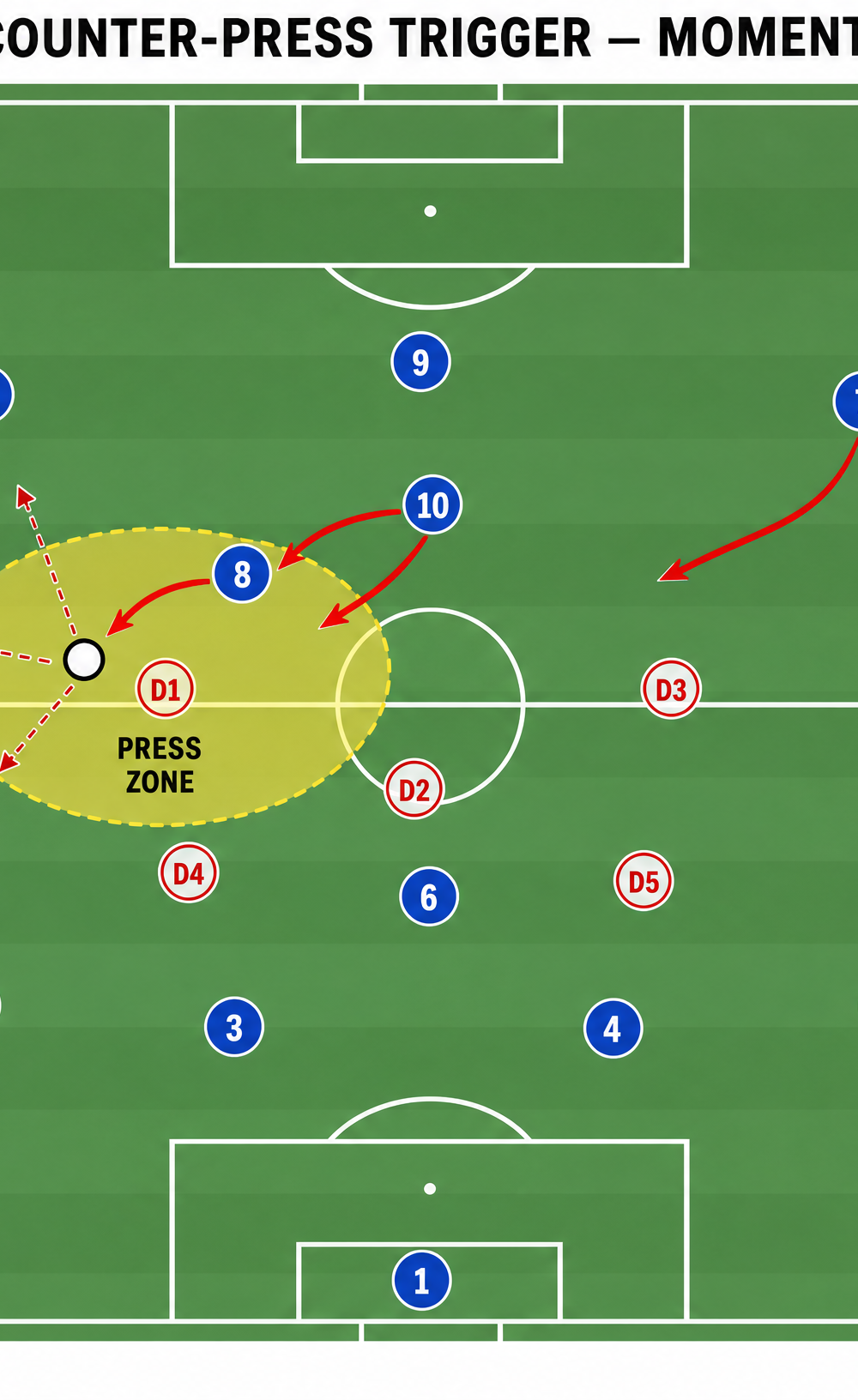
As soon as possession is lost in the attacking half, the nearest 2-3 players must immediately react. The closest player sprints directly at the ball carrier to apply maximum pressure, aiming to tackle or force a rushed decision.
Step 2: Establishing Compactness and Cover Shadows
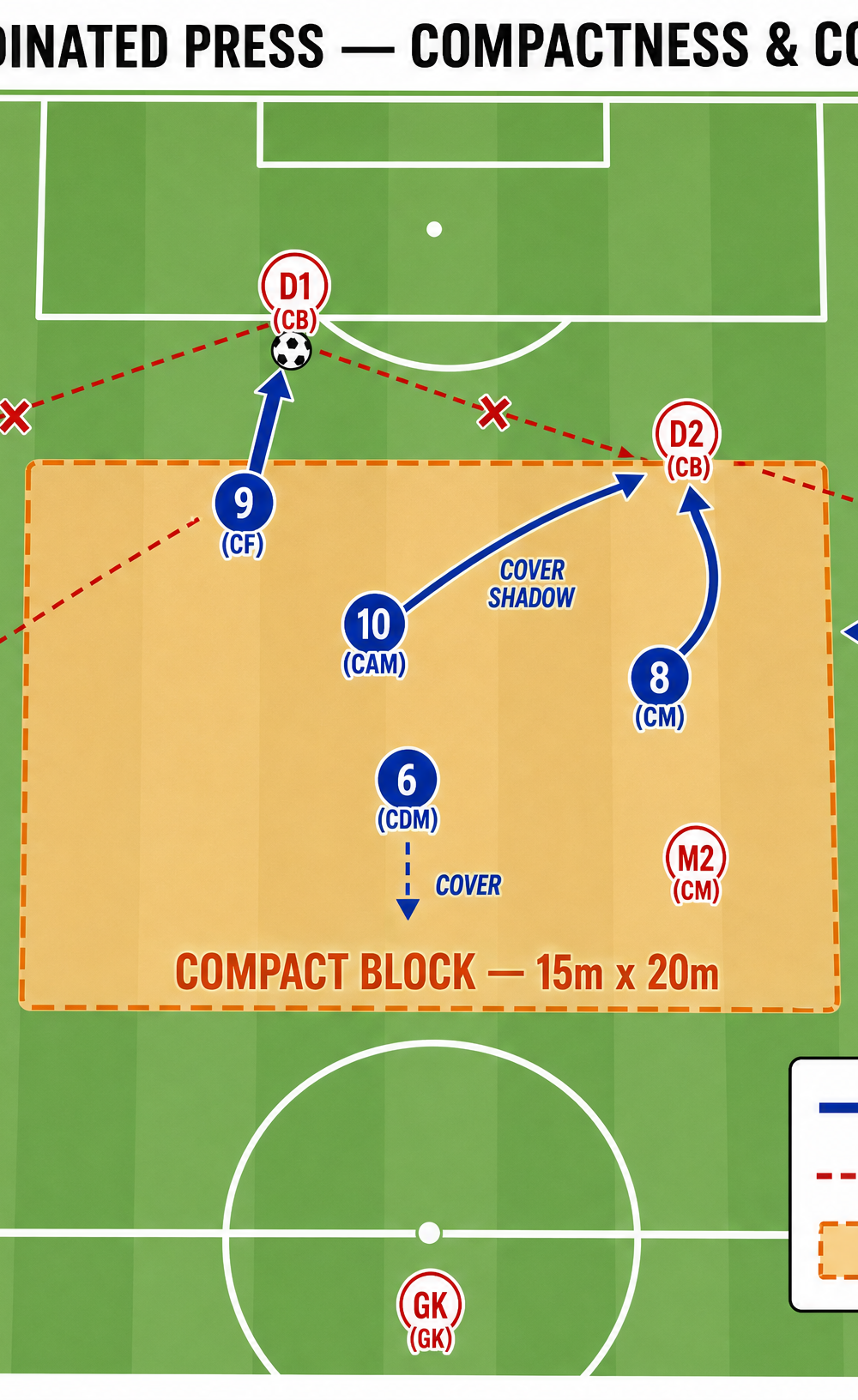
Simultaneously, the surrounding players must sprint to cut off immediate short passing options. The attacking midfielder (10) and opposite winger (7) position themselves in 'cover shadows', blocking passing lanes to the opponent's holding midfielders or full-backs. The team must compress the space into a tight 15m x 20m block around the ball.
Step 3: The Secondary Line (Rest Defence)
The defensive midfielder (6) and the centre-backs must step up to condense the space between the lines, ensuring the opponent cannot easily play a long ball over the press. They are the safety net, ready to intercept forced clearances.
Step 4: The Recovery and Transition
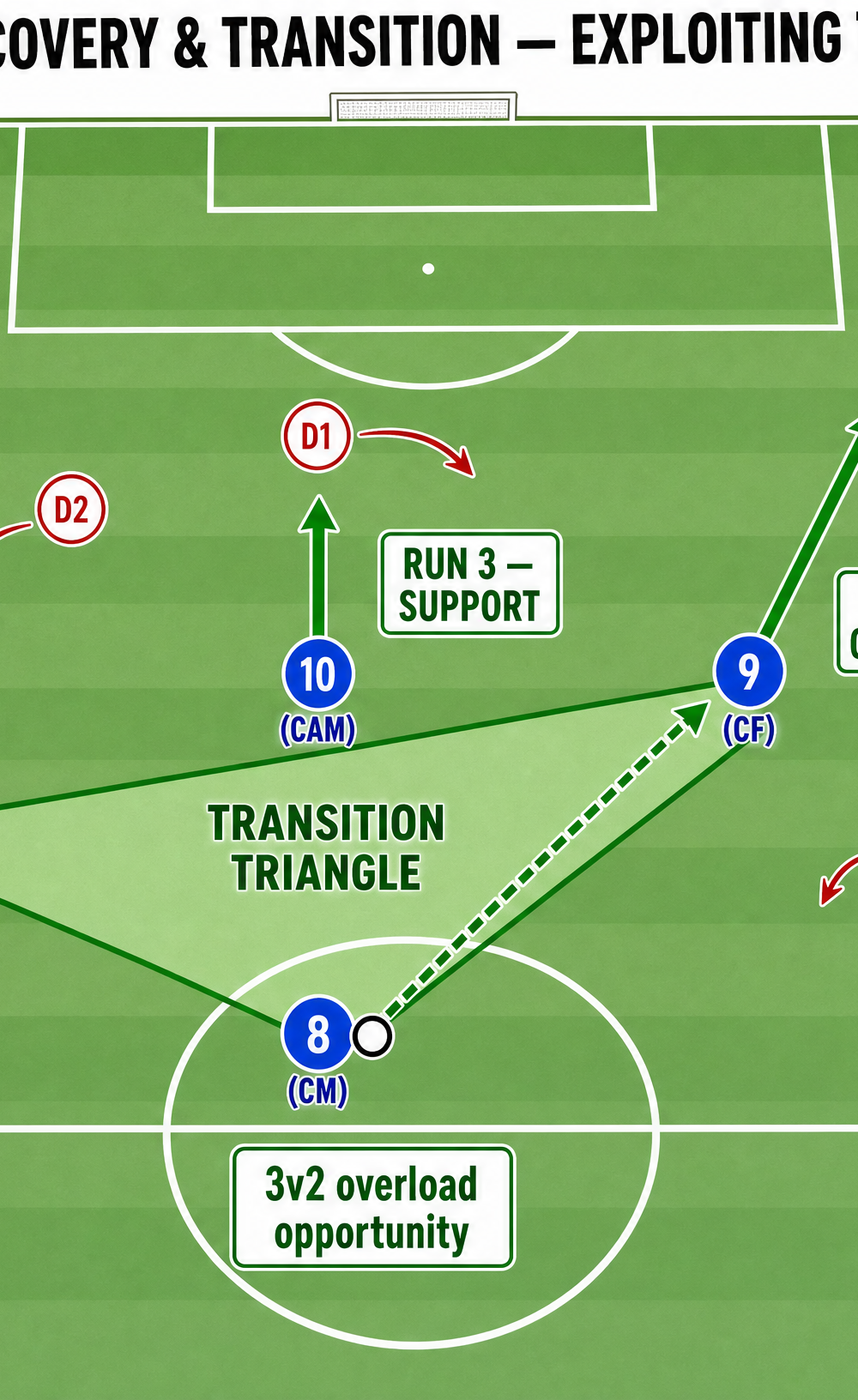
Once the ball is won back, the team must instantly transition from pressing to attacking. The player who recovers the ball (e.g., the 8) looks for an immediate forward pass. The centre-forward (9) and wingers make aggressive, coordinated runs into the channels or central areas to exploit the disorganised opponent, creating a 3v2 or 4v3 overload.
4. Key Coaching Points
- The 5-Second Rule: Emphasise that the highest intensity must be applied immediately. If the ball is not won back within 5 seconds, the team must drop into a compact defensive block.
- Sprint, Don't Jog: The initial reaction to losing the ball must be an all-out sprint. Hesitation allows the opponent time to scan and pick a pass.
- Press the Ball and the Space: The first player presses the ball carrier; the supporting players press the spaces and passing lanes around them (cover shadows).
- Body Shape: When pressing, players should angle their bodies to force the opponent inside towards traffic or towards the touchline, never allowing a free pass through the centre.
- Rest Defence Awareness: The deeper players must constantly adjust their positioning while the team is attacking, ensuring they are ready to step up and intercept if the press is bypassed.
5. Common Mistakes
- One-Man Press: A single player pressing aggressively while teammates jog back, leaving the pressing player easily bypassed and exhausted.
- Over-Committing: Players diving in recklessly and getting beaten by a simple skill, completely breaking the pressing structure.
- Lack of Communication: Players failing to shout "Press!" or coordinate who is taking the ball and who is covering the passing lanes.
- Forgetting the Transition: Winning the ball back but then playing a safe, slow backward pass instead of immediately looking to exploit the opponent's disorganisation.
6. Variations & Progressions
- Progression 1 (Overload): Start the drill with a numerical advantage for the pressing team (e.g., 8v6) to build confidence and understanding of the spatial triggers.
- Progression 2 (Time Limit): Introduce a strict 5-second countdown out loud from the coach upon loss of possession. If the pressing team doesn't win it back, the defending team gets a point for connecting 3 passes.
- Variation (Zone-Specific): Restrict the counter-press to specific zones (e.g., only in the wide areas or only in the central third) to teach players when to press and when to drop.
7. Age Adaptations
- Under 8 - Under 10: Focus purely on the immediate reaction to losing the ball (the "hunt"). Make it a fun, high-energy game of "get it back fast" rather than focusing on complex cover shadows.
- Under 12 - Under 14: Introduce the concept of the first defender pressing the ball and the second defender covering the most dangerous pass. Begin teaching body shape and forcing the opponent one way.
- Under 16 - Open: Implement the full tactical system, including complex cover shadows, rest defence positioning, and immediate, structured attacking transitions upon recovery.