

Football
Dominant Defensive Heading: The Clearing Zone Drill
Master the art of defensive heading with this progressive drill focused on attacking the ball, proper technique, and clearing danger from the penalty area.

What you need
1 full-size goal, 10-15 footballs, 6-8 cones, colored bibs
1. Overview
Defending crosses and high balls into the penalty area is a fundamental requirement for any successful football team. The 'Dominant Defensive Heading' drill is designed to train defenders to attack the ball aggressively, use proper heading technique, and direct their clearances away from the danger zone. This drill is highly effective for improving aerial dominance, timing, and spatial awareness within the 16.5m x 40.32m penalty area.
Use this drill during the defensive phase of your training sessions, particularly when preparing to face opponents known for wide play and frequent crossing. It transitions players from unopposed technical practice to game-realistic, opposed scenarios.
2. Setup

Pitch Area: Penalty area and surrounding defensive third (approx. 40m x 40m).
Equipment: 1 full-size goal, 10-15 footballs, 6-8 cones/markers, colored bibs.
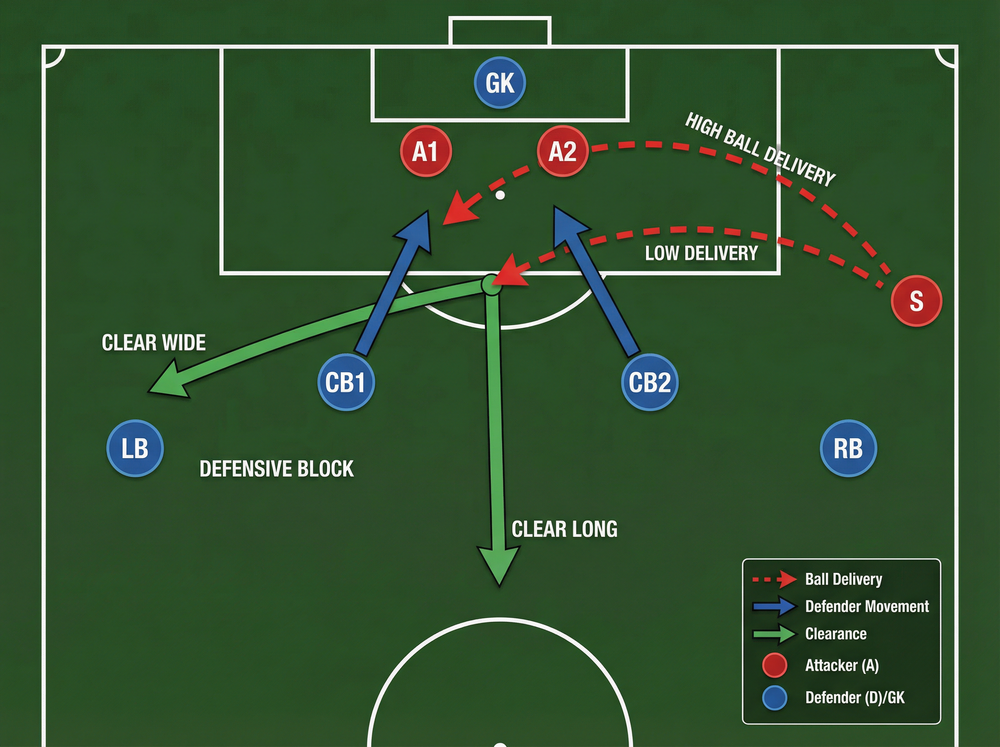
Players: 1 Goalkeeper (GK), 3-4 Defenders (Blue), 2 Attackers (Red), 1-2 Servers (S).
Initial Positioning:
- Position the Goalkeeper in the goal.
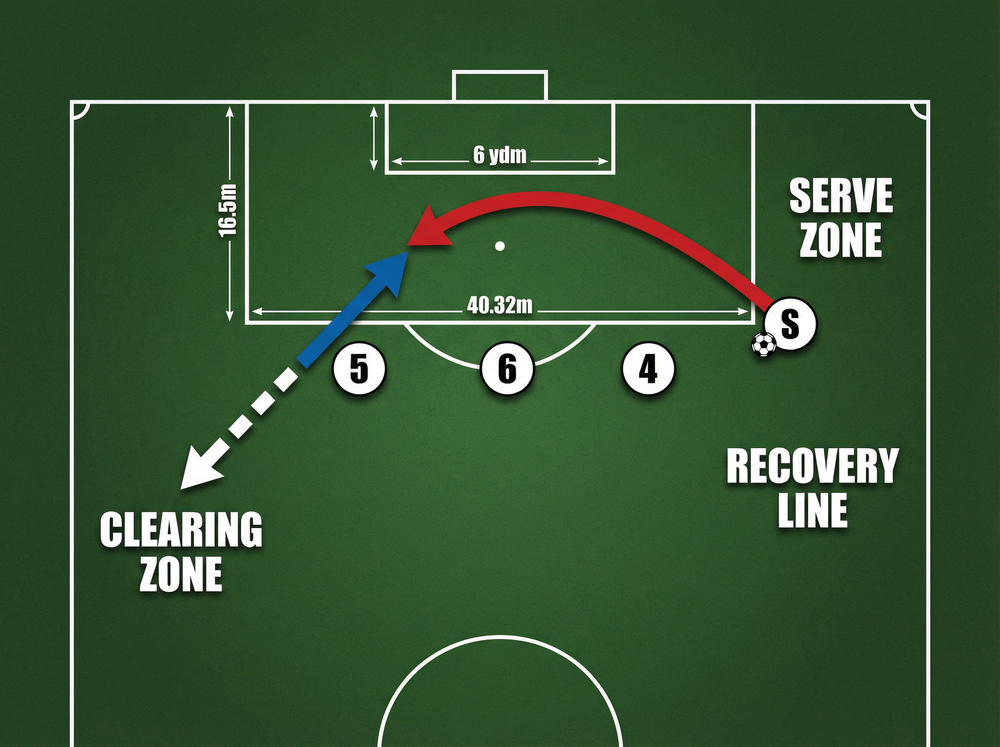
- Place three central defenders (numbered 4, 5, 6) in a horizontal line between the 6-yard box and the penalty spot (approx. 10-12m from goal).
- Position a Server (S) out wide on the flank (Serve Zone) with a supply of footballs.
- Mark a 'Recovery Line' with cones about 25m from goal.
3. Step-by-Step Instructions

- The Serve: The Server (S) delivers a lofted cross from the wide area into the central 'Clearing Zone' between the 6-yard box and the penalty spot.
- The Attack: As the ball is traveling, the designated defender (e.g., number 5) must read the flight, step forward aggressively, and attack the ball at its highest point.
- The Clearance: The defender executes a defensive header. The objective is to head the ball high, far, and wide, away from the central danger area.
- The Reset: Immediately after the header, the defensive line must quickly push up together to the 'Recovery Line' to simulate clearing the box and catching attackers offside.
- Rotation: Rotate the targeted defender and alternate the side of the delivery to ensure all players practice clearing from different angles.
4. Key Coaching Points

- Attack the Ball: Never wait for the ball to drop. Defenders must step forward and meet the ball aggressively in the air.
- Eyes Open, Mouth Closed: Keep eyes fixed on the ball through contact. Keep the mouth closed to prevent injury.
- Use the Forehead: Make contact with the flat, hard surface of the forehead, not the top of the head.
- Neck Muscles and Core: Generate power by arching the back slightly and snapping forward using the core and neck muscles.
- Height and Distance: Defensive headers should prioritize height and distance to give the team time to reorganize. Aim for the wide areas.
5. Common Mistakes
- Closing Eyes on Impact: This leads to poor contact and unpredictable clearances.
- Waiting for the Ball: Allowing the ball to drop gives attackers the advantage. Always step into the header.
- Heading Downward: A defensive header directed downward in the penalty area often lands at the feet of an oncoming attacker. Always aim high and wide.
- Poor Starting Position: Standing flat-footed makes it difficult to generate momentum. Players should be on their toes, ready to move.
6. Variations & Progressions
Once the basic technique is mastered, increase the difficulty and realism:
Progression 1: Add Attackers (Opposed)
Introduce 1 or 2 attacking players (A1, A2) making runs into the box. The defenders must now win the aerial duel under physical pressure.

Progression 2: Variable Delivery
The Server (S) mixes up the delivery: high lofted crosses, driven balls, and near/far post targets. The defensive unit must communicate and decide who attacks the ball and who covers.
Variation: Target Zones
Place mini-goals or target zones in the wide areas outside the penalty box. Award points for successful headers that land in these safe zones.
7. Age Adaptations
- Under 8 - Under 10: Focus strictly on technique with lightweight or sponge balls. Short distances, underhand serves. Emphasize 'eyes open, use the forehead.'
- Under 12 - Under 14: Introduce standard footballs but keep serves manageable. Begin adding light, passive pressure from an attacker.
- Under 16 - Open: Full game realism. Fast, driven crosses, intense physical competition for the ball, and strict demands on the defensive line pushing up quickly after the clearance.
