

Football
Dominant Defensive Heading: The Ultimate Clearing Drill
Master the art of defensive heading with this progressive drill designed to teach timing, power, and the crucial technique of clearing wide and long under pressure.

What you need
10+ footballs, Cones, Full-size goal, Bibs (two colours)
1. Overview
Defensive heading is a non-negotiable skill for any successful backline. A weak or misdirected header in the penalty area often results in a second-ball opportunity for the opposition, leading directly to goal-scoring chances. This progressive drill is designed to teach defenders how to attack the ball at its highest point, generate power using their core and neck muscles, and consistently direct clearances wide and long, away from the central danger zones. Use this drill during the defensive phase of your training session to build aggression, timing, and positional awareness under pressure.
2. Setup
Pitch Area: Penalty Area (18-yard box) and the immediate surrounding space (up to 30 metres from goal).
Players: 4-8 players (ideal for a back four, plus servers and optional attackers).
Equipment: Minimum 10 footballs, cones for starting positions, and a full-size goal.
Player Positions:
- Defenders: Start with your central defenders (CBs) in the middle of the penalty area. Fullbacks (LB/RB) can be added on the edges of the box as the drill progresses.
- Servers: 1-2 servers positioned 15-30 metres away, depending on the phase.
- Attackers (Optional): Introduce strikers (ST) to provide passive or active pressure.
3. Step-by-Step Instructions
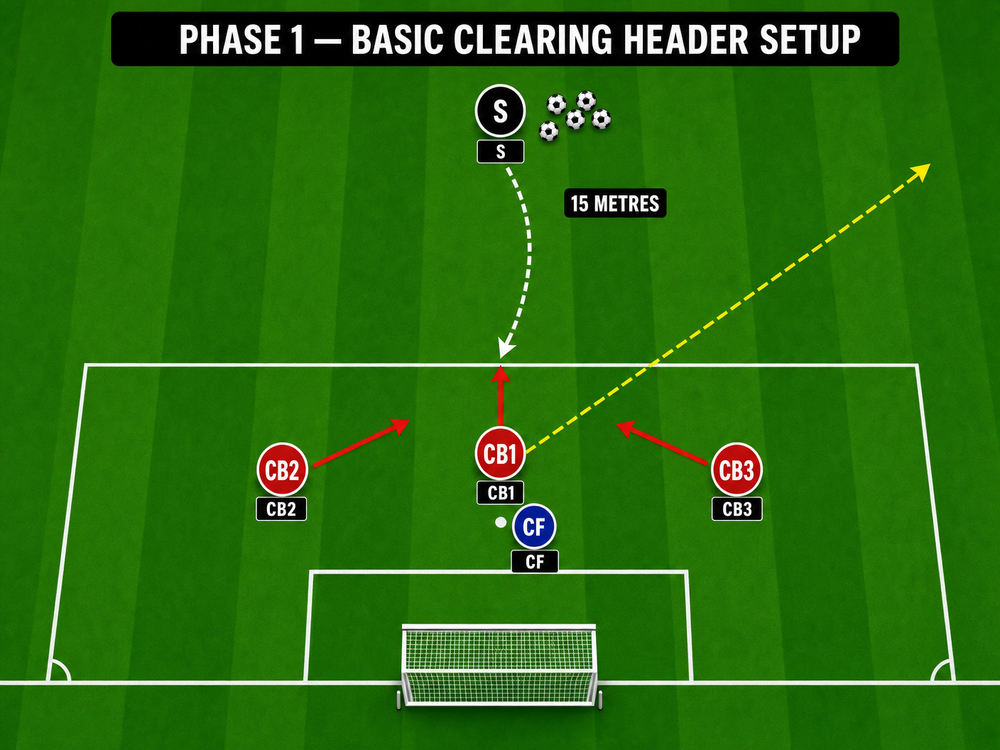
Phase 1: Basic Clearing Header Setup

- Positioning: Place a server (S) 15 metres outside the penalty area with a supply of balls. Position a central defender (CB1) near the penalty spot.
- Delivery: The server throws or lofts a high ball toward the penalty spot.
- Execution: CB1 must attack the ball, jumping off one or two feet, and head the ball back over the server's head or out toward the flanks.
- Rotation: Rotate defenders after 4-5 repetitions to ensure adequate rest and maintain high intensity.
Phase 2: Crossed Ball Clearing Progression
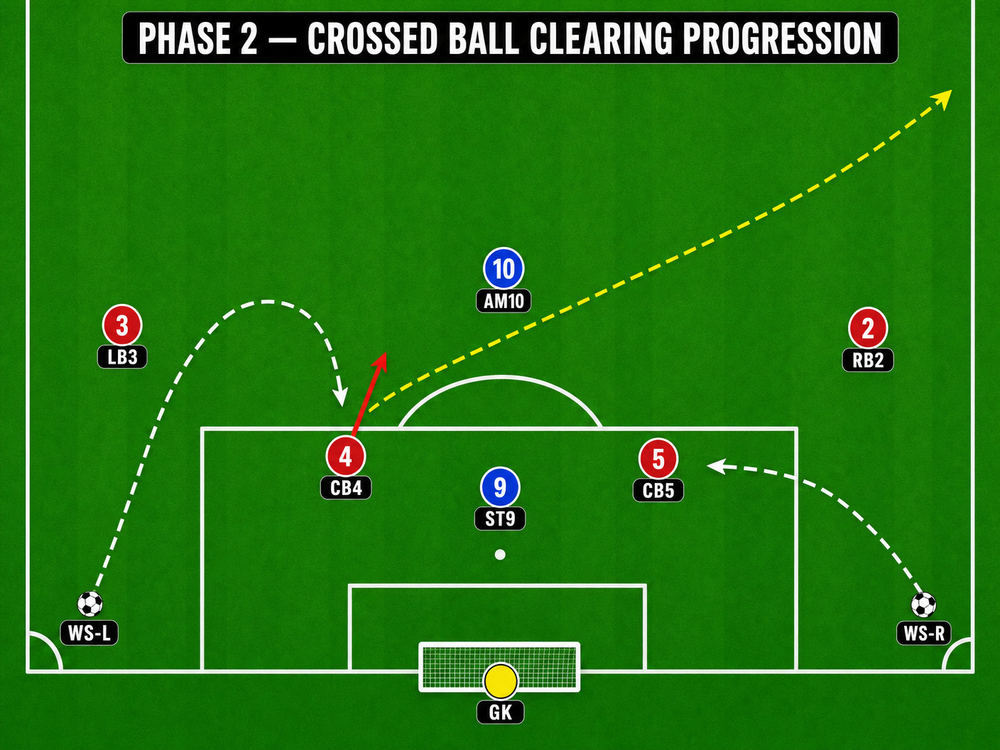
- Positioning: Move servers to the wide areas (WS-L and WS-R) to simulate wingers crossing the ball. Set up a back four inside the penalty area.
- Delivery: Servers alternate delivering crosses into the box (driven, lofted, and inswinging/outswinging).
- Execution: The defensive unit must communicate. The defender attacking the ball shouts "Keeper's" or "Away!" and attacks the cross. The priority is height and distance, aiming for the touchlines.
- Second Ball: Introduce an attacker (ST9 or AM10) at the edge of the box to challenge for any weak clearances.
Phase 3: Competitive Scenario (Game Realistic)
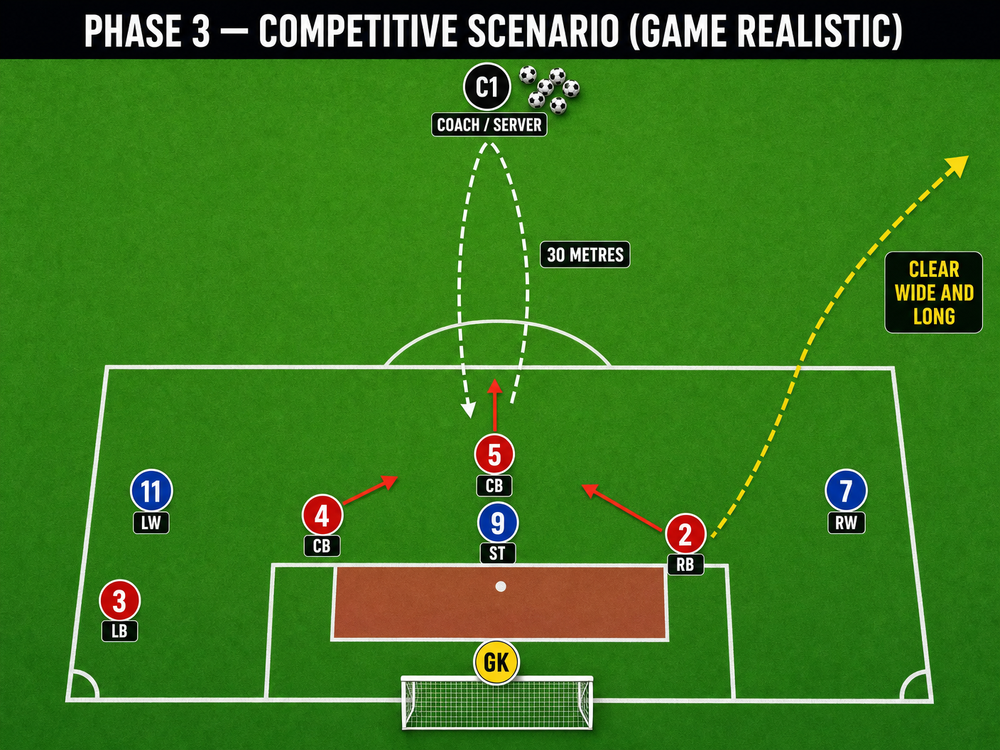
- Positioning: The coach (C1) serves long, high balls from 30 metres out. Position a full defensive line against 2-3 attackers.
- Delivery: The coach delivers varied balls—some straight down the middle, some diagonal.
- Execution: Defenders must read the flight, communicate, and win the aerial duel against active attackers. Covering defenders must drop and narrow to protect the space behind the challenging defender.
- Transition: Upon a successful clearance, the defensive line must quickly push up to the edge of the penalty area to squeeze the space.
4. Key Coaching Points
- Eyes on the Ball: Keep eyes open and fixed on the ball right through the point of contact. Never close your eyes.
- Attack the Ball: Do not wait for the ball to drop. Step forward, jump, and meet the ball at the highest possible point.
- Contact Area: Strike the ball with the forehead (the flat, hard bone above the eyebrows), not the top of the head.
- Power Generation: Power comes from the core and neck. Arch the back slightly before contact and snap forward through the ball.
- Direction (Wide and Long): Always aim to clear the ball high, wide, and long. Never head the ball back into the central "danger zone" at the top of the penalty area.
5. Common Mistakes
- Waiting for the Ball: Defenders who stay flat-footed allow attackers to step in front and win the header.
- Heading Downwards Centrally: Heading the ball down into the middle of the pitch sets up perfect volley opportunities for arriving midfielders.
- Lack of Communication: Two defenders going for the same ball often results in a collision or a weak clearance. Clear, early calls are essential.
- Closing Eyes: Results in mistimed jumps and poor contact, often leading to the ball skimming off the top of the head.
6. Variations & Progressions
- Add Transition to Attack: Place two small target goals near the halfway line. Defenders must try to head their clearances directly into these goals to simulate starting a counter-attack.
- Introduce Goalkeeper Integration: Have the goalkeeper call "Keeper's" to claim crosses, forcing the defenders to quickly get out of the way and clear the box.
- Overload the Attack: Progress to a 4v5 or 4v6 scenario in the box to force defenders to make critical decisions under extreme pressure.
7. Age Adaptations
- Under 8 - Under 10: Focus strictly on technique using soft, lightweight balls (or sponge balls). No jumping; just standing headers to build confidence and eliminate the fear of the ball.
- Under 12 - Under 14: Introduce jumping and attacking the ball, but keep opposition passive. Focus heavily on the "wide and long" concept.
- Under 16 - Open: Full competitive pressure. Demand maximum aggression, height on the jump, and immediate tactical shifting after the clearance.
