

Football
Elite Goalkeeper Shot-Stopping & Rebound Recovery Drill
A high-intensity goalkeeper drill focusing on fundamental shot-stopping, rapid lateral movement, and immediate reaction to secondary rebound opportunities.
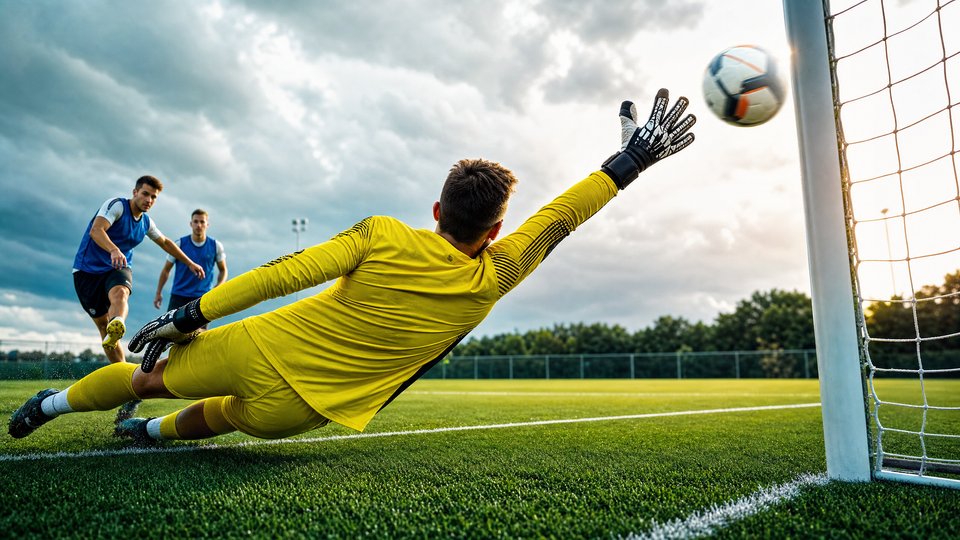
What you need
10-12 footballs, 4 cones, 1 full-size goal, Training bibs
1. Overview
This high-intensity shot-stopping drill is designed to develop a goalkeeper's core reaction speed, lateral agility, and ability to handle secondary phases of play. While standard shooting drills often end after the first save, match situations frequently demand immediate recovery to deal with rebounds. This drill forces the goalkeeper to make an initial save from varying angles and instantly transition into a defensive posture to block or smother a follow-up attempt. It is an essential exercise for bridging the gap between isolated technique training and chaotic match-day scenarios.
2. Setup
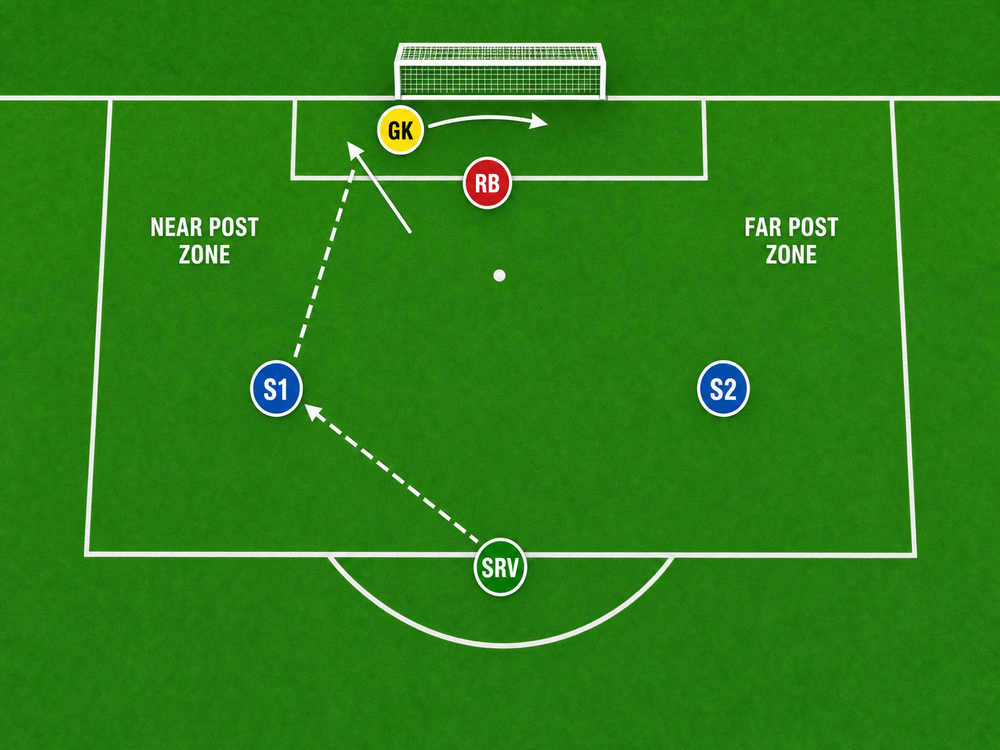
Pitch Area: Penalty area (16.5m x 40.3m) and standard full-size goal.
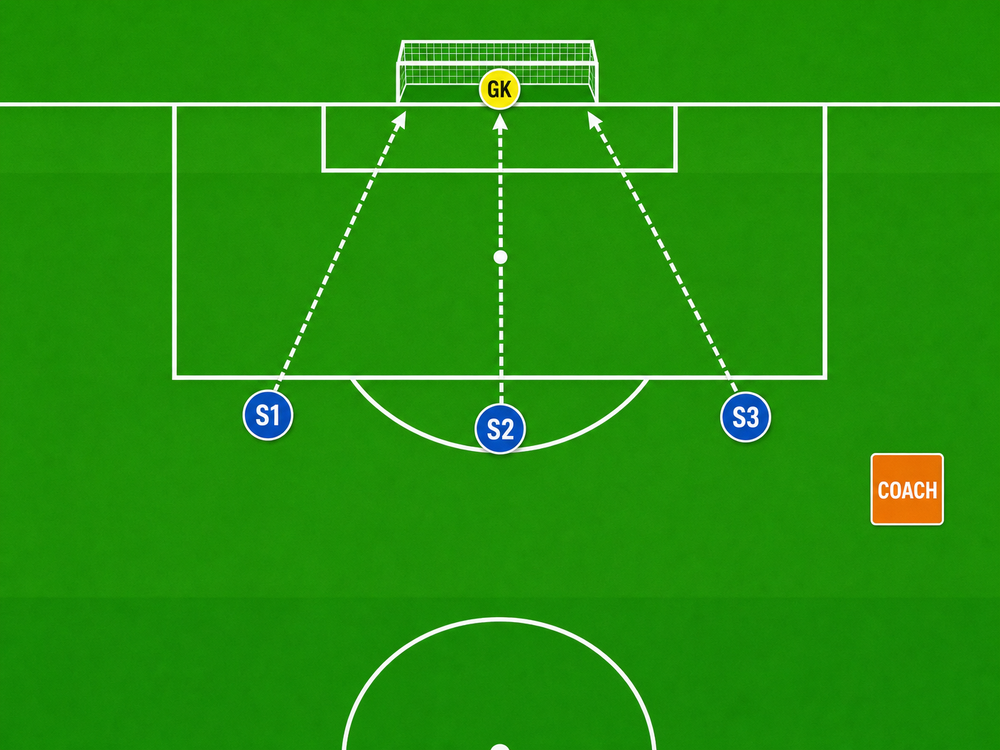
Players: 1 Goalkeeper (GK), 3 Shooters (S1, S2, S3), 1 Server (SRV), 1 Rebounder (RB).
Equipment: 10-12 footballs, 4 cones (to mark shooter/server positions), full-size goal.
Positioning:
- GK: Starts on the goal line, central.
- S1, S2, S3: Positioned in a shallow arc just outside the penalty area (approx. 18-20 yards from goal). S1 on the left, S2 central, S3 on the right.
- SRV: Positioned centrally, slightly behind the shooters (approx. 25 yards out).
- RB: Positioned inside the penalty area, hovering around the penalty spot (12 yards) or edge of the six-yard box, ready to pounce on loose balls.
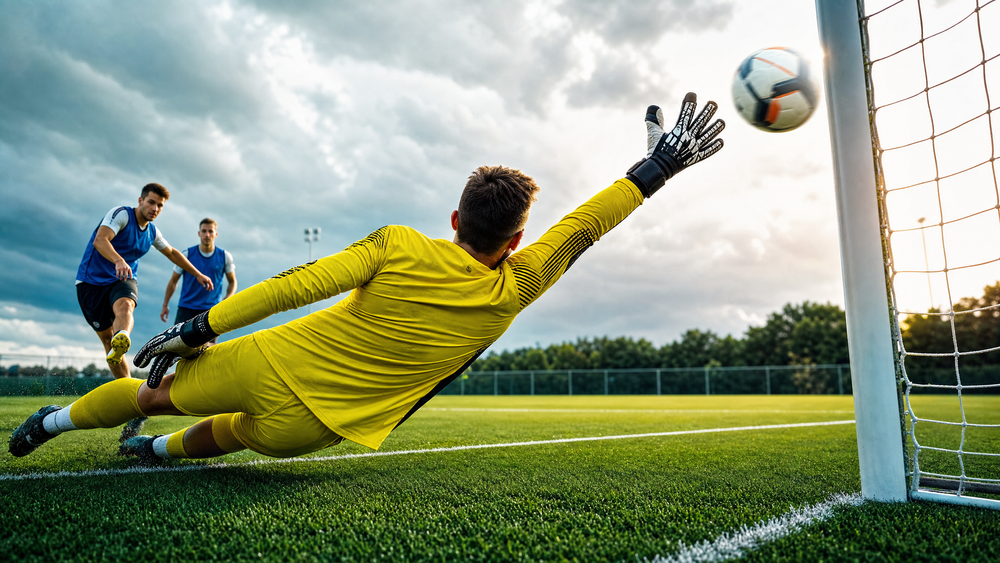
3. Step-by-Step Instructions
- Initial Trigger: The coach blows the whistle or calls "Play!" to initiate the drill.
- First Phase (The Shot): The Server (SRV) plays a firm, varied pass to any of the three Shooters (S1, S2, or S3).
- The Strike: The receiving shooter takes one touch to control (or strikes first time if appropriate) and unleashes a driven shot on target.
- The Save & Recovery: The Goalkeeper (GK) must react, set their feet, and attempt to make a clean save, ideally holding the ball or parrying it safely wide.
- Second Phase (The Rebound): If the ball is parried back into the danger zone (inside the penalty area), the Rebounder (RB) immediately attacks the ball to score.
- The Secondary Save: The GK must rapidly recover their footing, adjust their angle, and attempt to block or smother the rebound shot.
- Reset: Once the ball is dead (goal, save held, or cleared out of bounds), the GK resets to the center line, and the drill restarts with a new ball from the Server.
4. Key Coaching Points
- Set Position: The GK must be perfectly balanced and 'set' (feet shoulder-width apart, weight slightly forward) just before the striker makes contact with the ball.
- Parry Zones: Emphasize the importance of parrying the ball wide and away from the central 'danger zone' if a clean catch is not possible. Pushing the ball out for a corner is preferable to dropping it at the penalty spot.
- Speed of Recovery: The transition from the ground back to a set position must be explosive. Use the momentum of the dive to spring back up.
- Angle Play: As the ball moves from the Server to the Shooter, the GK must quickly adjust their position along the arc to narrow the angle and cover the near post effectively.
- Brave Spreading: On the rebound phase, if the attacker is close, the GK must make themselves as big as possible (spread or block tackle) to eliminate the shooting angle.
5. Common Mistakes
- Guessing: The GK anticipates the shot direction and commits too early, leaving the opposite side exposed.
- Poor Parrying Technique: Batting the ball straight back into the middle of the penalty area instead of pushing it wide with a strong wrist.
- Slow Recovery: Staying on the ground too long after the initial save, allowing the Rebounder an easy tap-in.
- Losing the Angle: Failing to adjust positioning when the ball is passed from the Server to a wide Shooter, leaving the near post vulnerable.
6. Variations & Progressions
- Progression 1 (Added Pressure): Introduce a second Rebounder to increase the chaos and force the GK to make quicker decisions on where to parry the ball.
- Progression 2 (Visual Impairment): Place a passive defender (mannequin or player) directly in front of the GK's line of sight to simulate a crowded penalty area, forcing the GK to react later.
- Variation 1 (Volleys/Half-Volleys): Instead of passes on the ground, the Server throws the ball to the Shooters for volleys or half-volleys, increasing the unpredictability of the shot trajectory.
7. Age Adaptations
- Under 8 - Under 10: Focus purely on the fundamental technique of catching and diving safely. Remove the Rebounder entirely. Keep shots relatively soft and close to the GK.
- Under 12 - Under 14: Introduce the Rebounder but mandate a two-touch rule for the rebound shot to give the GK slightly more time to recover. Focus heavily on parrying technique.
- Under 16 - Open: Full match intensity. One-touch finishes for both the initial shot and the rebound. Emphasize explosive recovery and dominating the penalty area.
