

Football
High Press Play from Front Three: Forcing Wide Turnovers
Master the art of the front-three high press to trap opponents on the touchline, force turnovers, and launch devastating counter-attacks.
What you need
Match balls, Bibs (two colors), Flat markers, Full-size goals
1. Overview
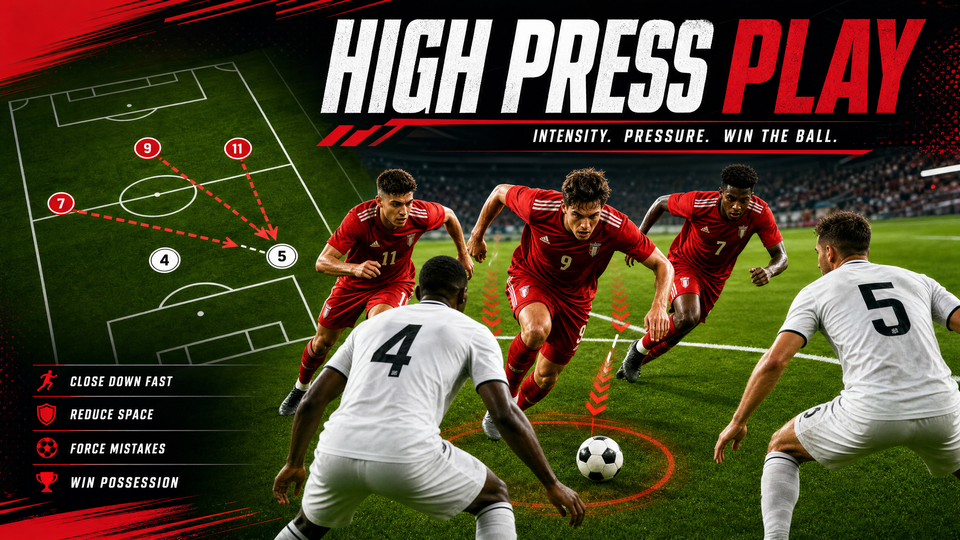
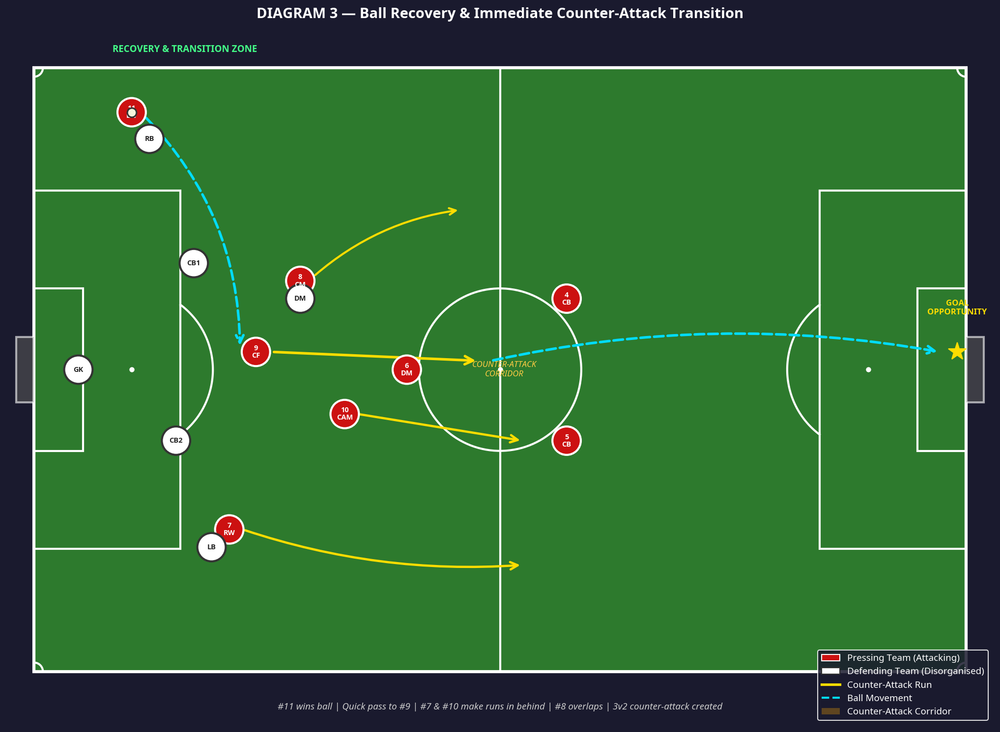
The modern game demands proactive defending, and a well-coordinated high press is one of the most effective ways to disrupt an opponent's build-up play. This set play focuses on using the front three (Striker and two Wingers) to trigger a coordinated press, trap the opposition full-back near the touchline, and win the ball high up the pitch for an immediate counter-attack.
When to use it:
- When the opposition insists on building out from the back (from goal kicks or deep possession).
- When you identify a weak link in the opponent's backline, particularly a full-back who struggles under pressure.
- When your team needs to shift momentum, increase intensity, or chase a goal late in the game.
2. Setup
- Pitch Dimensions: Full pitch (100-110m x 64-75m), focusing on the attacking half.
- Equipment: Standard match balls, bibs (two colors), and flat markers to outline the "Press Trap Zone" (wide channels) if running as a training drill.
- Player Positions (Pressing Team - Red): 4-3-3 formation. Key roles belong to the #9 (Centre-Forward), #11 (Left Winger), #7 (Right Winger), and the #8/#10 (Central Midfielders).
- Player Positions (Defending Team - White): Standard back four (LB, CB1, CB2, RB) plus a holding midfielder (DM) and Goalkeeper.
3. Step-by-Step Instructions
Phase 1: The Initial Trigger
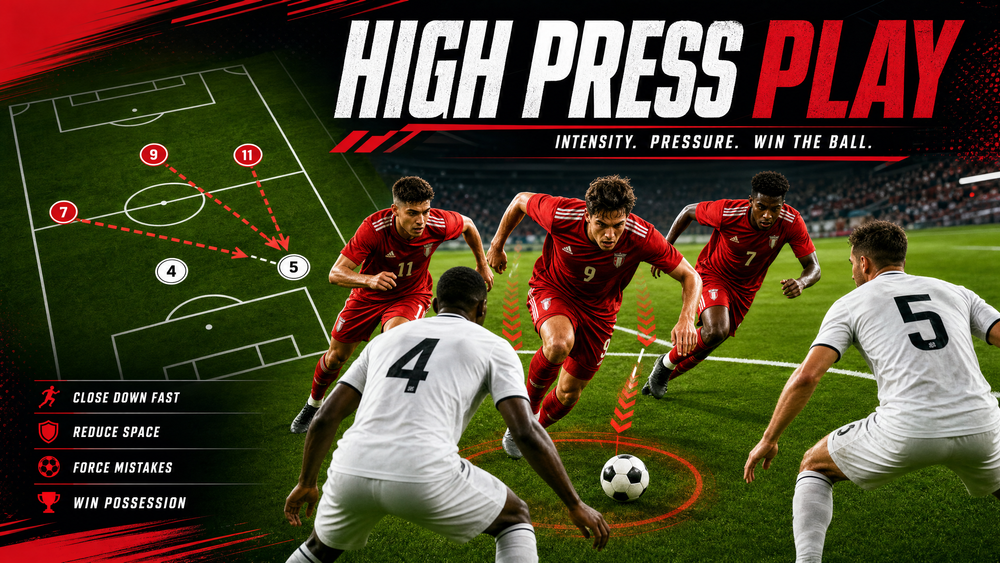
- The Starting Shape: As the opposition Goalkeeper plays the ball to a Center-Back (CB1), the pressing team maintains a compact shape. The front three stay narrow initially, inviting the pass to the CB.
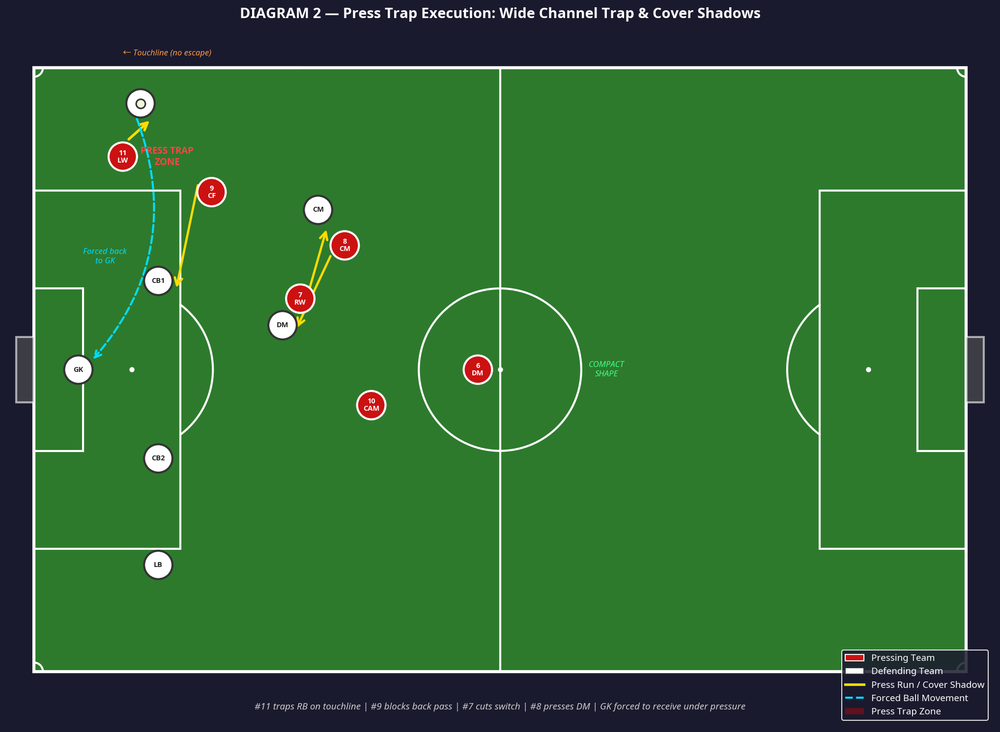
- The Trigger Run: The #9 initiates the press by making an arced run toward CB1. The crucial detail is the angle of the run—the #9 must curve their approach to block the passing lane to the other Center-Back (CB2).
- Cutting Outlets: Simultaneously, the #11 and #7 step slightly higher to deter easy passes to the Full-Backs, while the #8 steps up to get tight on the opposition's Defensive Midfielder (DM), removing the central pivot option.
- Forcing the Play: Under intense pressure from the #9 and with central options blocked, CB1 is forced to play the ball wide to the Right-Back (RB).
Phase 2: Springing the Trap
- Activating the Trap: The moment the ball travels toward the RB, the trap is sprung. The #11 sprints to close down the RB aggressively.
- Using the Touchline: The #11 must approach the RB from an "inside-out" angle, using their body position to force the RB toward the touchline—the best defender on the pitch.
- Locking the Cage:
- The #9 continues their run to cut off the back-pass to CB1.
- The #8 stays locked onto the DM.
- The #7 tucks inside to maintain compactness and deter a long diagonal switch.
- Winning the Ball: The RB is now isolated with no passing options. The #11 engages physically to win the ball, or forces the RB into a rushed clearance or an error.
Phase 3: The Counter-Attack
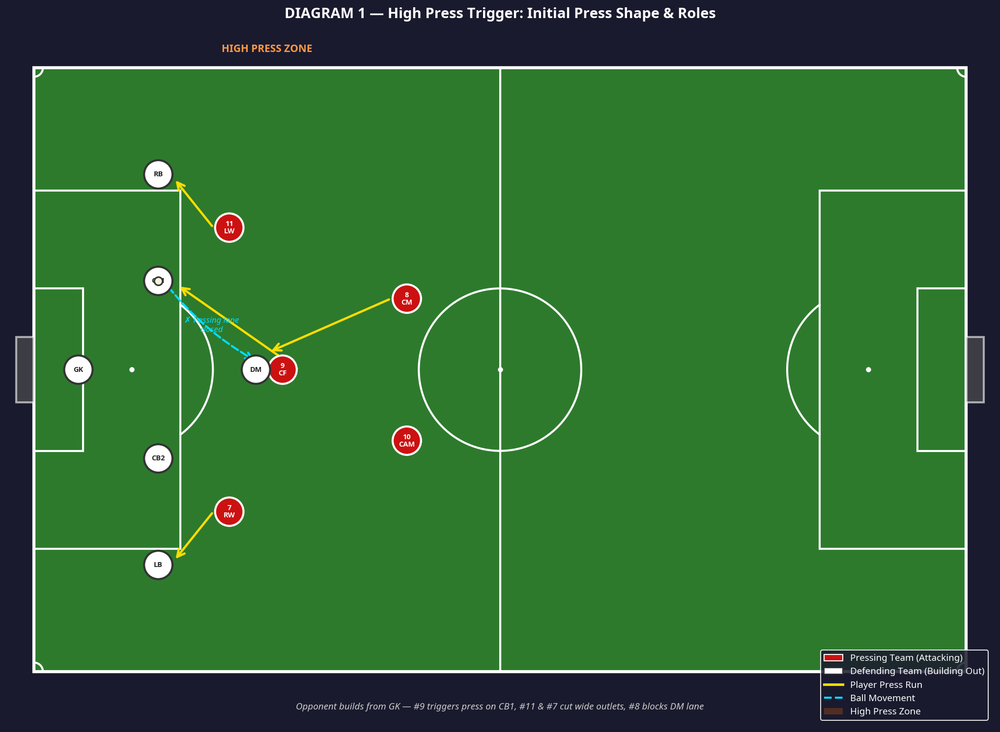
- Immediate Transition: As soon as the #11 wins possession, the team instantly transitions from defense to attack.
- Exploiting Space: The opposition backline will be expansive and disorganized from their build-up attempt. The #9 immediately darts into the central space left vacant by the Center-Backs.
- The Quick Release: The #11 plays a quick, vertical pass into the path of the #9.
- Supporting Runs: The #7 makes a diagonal run toward the back post, while the #10 drives forward from midfield to create a 3v2 overload.
- The Finish: The #9 drives toward goal, utilizing the supporting runs to create a high-quality scoring opportunity.
4. Key Coaching Points
- Curved Runs (Cover Shadows): The #9 must master the arced run. Pressing in a straight line allows the defender to easily pass around them. The run must physically block the passing lane to the other Center-Back.
- Triggers and Timing: The press must be collective. If the #9 goes but the midfield doesn't step up, the press is easily broken. The trigger is the pass from the GK to the CB.
- The Touchline is a Defender: Teach the wingers (#7 and #11) to use the sideline to their advantage. Force the opponent wide where their options are halved (180 degrees instead of 360).
- Aggression with Control: When springing the trap, the winger must close the distance at sprint speed, but slow down for the final two yards to avoid being easily bypassed by a quick touch.
- First Pass Forward: Upon winning the ball, the first thought must be vertical. Do not recycle possession if the opponent is disorganized; punish them immediately.
5. Common Mistakes
- Pressing Alone: One player sprinting while the rest of the team drops deep. This simply wastes energy and opens up massive spaces between the lines.
- Straight-Line Pressing: Approaching the ball carrier without cutting off passing angles, making it easy for the defender to play a simple pass to their partner.
- Leaving the Central Pivot Open: Forgetting to mark the opposition's Defensive Midfielder. If the DM is free, they can easily receive the ball and break the press with one turn.
- Failing to Capitalize: Winning the ball high but playing a safe, backward pass instead of immediately attacking the disorganized defense.
6. Variations & Progressions
- Progression 1 (The Midfield Trap): Instead of trapping the Full-Back, allow the pass into the Defensive Midfielder, but have both your #8 and #10 collapse on them simultaneously from blind spots. This wins the ball centrally, closer to goal.
- Progression 2 (Asymmetric Press): Intentionally leave one specific Center-Back completely unmarked (perhaps their weaker ball-player) to bait the Goalkeeper into passing to them, then trigger an ultra-aggressive press from all angles.
- Variation (Dropping into a Mid-Block): If the high press is bypassed twice in a row, the team must recognize this and automatically drop into a compact 4-1-4-1 mid-block to conserve energy and regroup.
7. Age Adaptations
- Under 10s: Focus purely on the concept of "hunting in packs" and recognizing when the opponent has their head down or takes a bad touch. Don't overcomplicate cover shadows.
- Under 12s - 14s: Introduce the concept of "forcing play one way" and using the touchline as an extra defender. Begin teaching the arced runs for the striker.
- Under 16s+: Implement the full tactical setup, focusing heavily on the speed of the defensive transition and the precision of the immediate counter-attack. Demand high tactical discipline from the midfield to cut off passing lanes.
