

Football
Near-Post Corner Kick: The Driven Flick-On Set Play
Master the near-post corner kick set play — a high-percentage, low-block delivery designed to exploit goalkeeper positioning and create first-contact goal opportunities inside the six-yard box.

What you need
Football (size 5, or age-appropriate), Corner flag, 8–12 training cones, Bibs in two colours, Full-size goal with goalkeeper, Portable height gate (optional, for delivery training)
Overview
The near-post corner kick is one of the most effective and underutilised set plays in modern football. Rather than delivering a looping, high ball into a crowded penalty area — which gives defenders and goalkeepers time to organise — this play exploits the space at the near post with a low, driven delivery that demands a first-contact flick-on or direct finish. When executed correctly, it forces the goalkeeper off their line, disrupts defensive zonal marking, and creates a high-quality chance inside the six-yard box within two seconds of the ball being struck.
This set play is best deployed when your team has earned a corner on either flank and you have identified that the opposing goalkeeper is positioned centrally or towards the far post, leaving the near-post channel exposed. It is equally effective against both man-marking and zonal defensive setups, because the blocking run component neutralises the nearest defender before they can react.
When to use it: Ideal in the final 20 minutes of a match when a goal is needed, against deep defensive blocks that are difficult to break down in open play, or as a surprise variation after establishing a pattern of far-post deliveries earlier in the game.
Setup

Equipment Required
- 1 full-size football (or age-appropriate size)
- Corner flag (standard pitch)
- 8–12 training cones (to mark zones during practice)
- Bibs in two colours to differentiate attacking and defending units
- Portable goal or full-size goal with goalkeeper
Pitch Setup
This set play operates within the standard penalty area (16.5m deep × 40.3m wide) and six-yard box (5.5m deep × 18.3m wide). During training, use cones to mark the following reference zones:
| Zone | Description | Purpose |
|---|---|---|
| Near-Post Target Zone | 1m × 2m at the near post, level with the front of the six-yard box | Primary delivery target |
| Blocking Lane | 3m corridor from the penalty spot to the near post | Route for the blocking run |
| Second-Ball Zone | 5m arc around the penalty spot | Position for the late runner |
| Far-Post Channel | 6m zone at the far post, inside the penalty area | Secondary delivery option |
Player Positions (Starting Setup)
| Player | Position | Starting Location |
|---|---|---|
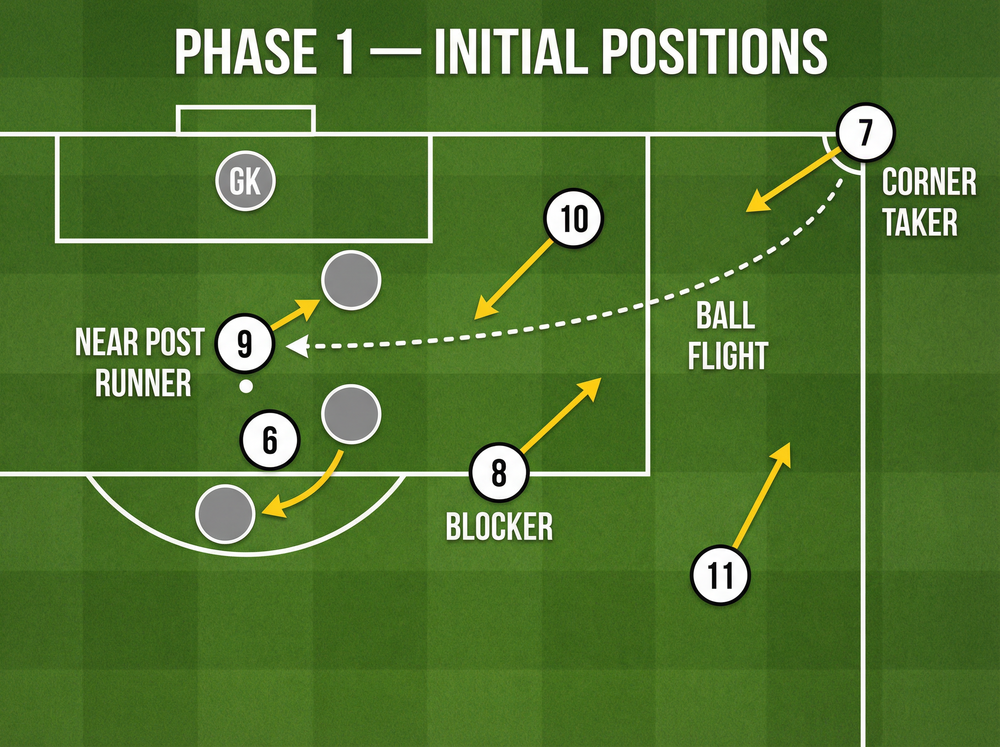
| #7 | Right Winger / Corner Taker | Corner arc (right flank) |
| #9 | Centre Forward / Near-Post Runner | Penalty spot, facing goal |
| #8 | Central Midfielder / Blocker | Edge of the six-yard box, near-post side |
| #10 | Attacking Midfielder / Second Runner | Centre of penalty area |
| #11 | Left Winger / Late Runner | Edge of penalty area, 2m outside |
| #6 | Centre-Back / Penalty Spot Anchor | Penalty spot area, facing play |
| #5 | Centre-Back / Far-Post Presence | Far-post zone |
| #4 | Defensive Midfielder / Counter Cover | Top of penalty area |
| #2 | Right Back / Wide Cover | Edge of penalty area, near touchline |

Diagram 1 — Phase 1: Initial Positions. Players take up starting positions before the corner is taken. Note the corner taker (#7) at the flag, the near-post runner (#9) at the penalty spot, and the blocker (#8) on the edge of the six-yard box.
Step-by-Step Instructions
Step 1 — Signal and Trigger (0–2 seconds before delivery)
The corner taker (#7) uses a pre-agreed visual signal — raising the right arm — to indicate the near-post play is on. All attacking players hold their starting positions until this signal is given. The signal is the trigger for all movement to begin simultaneously.
Step 2 — The Blocking Run (#8, begins at signal)
Player #8 makes a sharp, purposeful run from the edge of the six-yard box across the near-post channel, moving from right to left (when attacking the right-hand corner). This run is not intended to receive the ball — its sole purpose is to occupy and screen the nearest defender, creating a 1–2 metre gap at the near post. The run must be timed to arrive at the near post just before the ball.
Step 3 — The Near-Post Run (#9, begins at signal)
Player #9 makes a curved, accelerating run from the penalty spot toward the near post, using #8's blocking run as a screen. The run curves slightly outward before attacking the near-post target zone at a diagonal angle. This diagonal approach gives #9 the best body position to flick the ball goalward with the near-side foot or head.
Step 4 — The Delivery (#7, 2–3 seconds)
The corner taker drives the ball low and hard — at knee height or below — toward the near-post target zone, approximately 1 metre in front of the near post and 1 metre off the goal line. The ball should arrive with pace, making it difficult for the goalkeeper to intercept. An inswinging delivery (for a right-footed kicker on the right corner) is preferred, as it naturally bends away from the goalkeeper.
Step 5 — The Flick-On or Direct Finish (#9, at delivery)
Player #9 arrives at the near post in stride and either: (a) flicks the ball with the near-side foot across the face of goal toward the far post, or (b) diverts the ball directly on target if the angle allows. The contact should be a firm, redirected touch — not a full swing — to change the ball's direction and beat the goalkeeper.
Step 6 — Second-Ball Runs (#10, #11, #6)
Simultaneously with the delivery, player #10 makes a diagonal run to the far post, #11 makes a late run to the penalty spot, and #6 holds position at the penalty spot as a second-ball anchor. These three players are positioned to capitalise on any deflection, goalkeeper spill, or deliberate flick-on from #9.
Step 7 — Counter-Attack Cover (#4, #2)
Players #4 and #2 hold positions at the top of the penalty area and on the right flank respectively, ready to win the ball and transition quickly if the set play breaks down. No more than seven outfield players should commit into the penalty area.
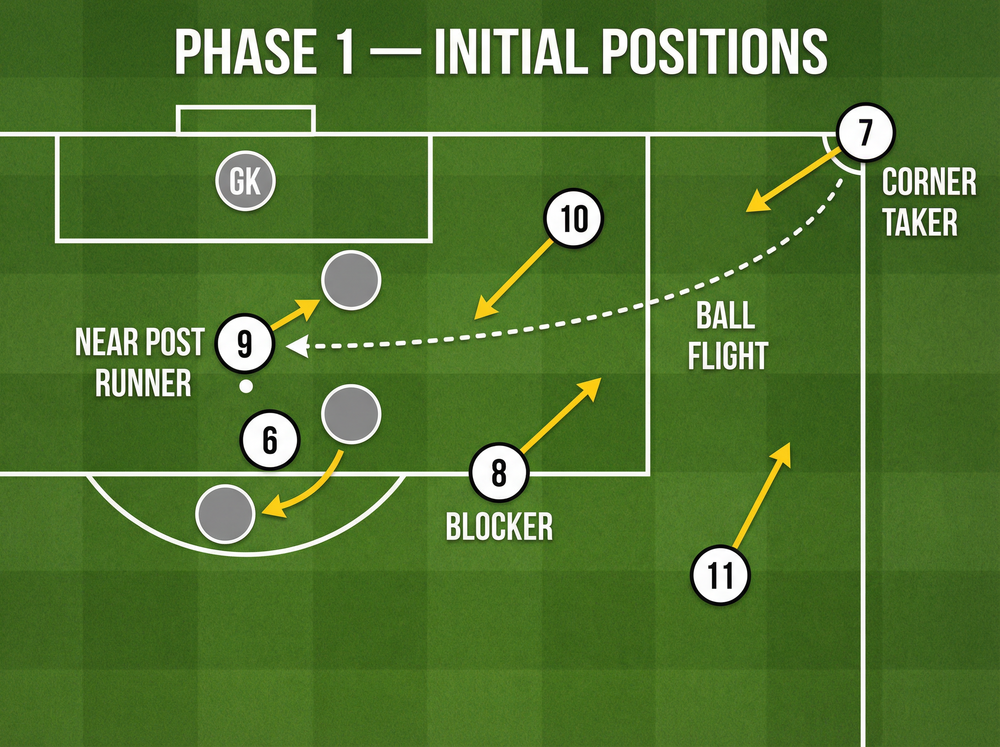
Diagram 2 — Phase 2: Movement & Execution. All movement triggers simultaneously at the corner taker's signal. The blocking run (#8) creates the space for the near-post runner (#9) to attack the driven delivery. Secondary runners (#10, #11) provide far-post and penalty-spot coverage.
Key Coaching Points

1. Delivery Height is Everything
The ball must arrive at knee height or below. A ball delivered above waist height gives the goalkeeper time to claim it and eliminates the near-post threat entirely. During training, place a cone 1 metre in front of the near post at knee height as a target reference for the corner taker.
2. The Blocker Must Commit Fully
Player #8's run is only effective if it is committed and purposeful. A half-hearted jog will not screen the defender. Emphasise to #8 that they are sacrificing their own chance of scoring to create the opportunity for #9 — this is a team role that requires discipline and selflessness.
3. The Near-Post Runner's Approach Angle
Player #9 must approach the near post at a diagonal — not straight on. A straight run means #9 arrives side-on to the goal with no power in the flick. A diagonal approach (from penalty spot, curving outward, then attacking the post) gives #9 a natural body position to redirect the ball across goal with pace.
4. Timing the Run — Not Too Early
The most common timing error is #9 arriving at the near post before the ball. If the runner arrives early, they must check their run, which alerts the defender and eliminates the element of surprise. Drill the trigger-to-run timing repeatedly until #9 arrives at the near post in the same moment as the ball.
5. Second-Ball Runners Must Anticipate, Not React
Players #10, #11, and #6 should be moving before the ball is delivered, not waiting to see what happens. Anticipatory movement means they arrive at their zones with momentum, ready to strike first time. Reactive movement means they arrive late and the chance is gone.
6. Maintain Defensive Shape
Never commit all ten outfield players into the penalty area. Players #4 and #2 must hold their positions regardless of how promising the set play looks. A well-organised opposition can launch a devastating counter-attack from a cleared corner in under five seconds.
Common Mistakes

Mistake 1 — Delivering the Ball Too High
The corner taker floats the ball rather than driving it, giving the goalkeeper time to claim it. Correction: In training, set a height gate using two poles and a crossbar at knee height, 1 metre in front of the near post. The corner taker must hit the ball under the gate on every repetition.
Mistake 2 — The Blocker Arriving Too Late
Player #8 starts their run after the ball is struck rather than at the signal, meaning the blocking run has no effect on the defender. Correction: Drill the signal-to-movement sequence in isolation — signal given, #8 moves immediately, ball struck two seconds later. Use a stopwatch to ensure #8 is in position before the ball arrives.
Mistake 3 — The Near-Post Runner Going Straight
Player #9 runs in a straight line to the near post, arriving side-on with no ability to redirect the ball powerfully. Correction: Place a cone 2 metres outside the penalty area at a 45-degree angle from the near post. #9 must run around the cone before attacking the near post, enforcing the curved approach.
Mistake 4 — Second-Ball Players Watching, Not Moving
Players #10, #11, and #6 stand and watch the near-post action rather than making their runs. Correction: In training, award a point to any second-ball player who arrives in their zone before the ball reaches the near post. This creates a competitive incentive for anticipatory movement.
Mistake 5 — Overcomplicating the Flick-On
Player #9 attempts a full volley or an elaborate finish rather than a simple redirected touch. Correction: Emphasise that the near-post contact should be a firm but controlled redirect — the ball's own pace does the work. Practice the flick-on technique in isolation using a ball-rolling machine or a server before integrating it into the full set play.
Variations & Progressions

Variation 1 — The Dummy Run (Easier)
Instead of #9 making contact with the ball, they run across the near post without touching it, letting the ball continue to #6 who has made a late run to the near-post zone. This variation is simpler to execute because it removes the technical demand of the flick-on, and it can be highly effective against defenders who follow #9's run rather than tracking the ball.
Variation 2 — The Short Corner Trigger (Intermediate)
The corner taker (#7) plays a short pass to #2, who has made a run to receive 5 metres away. #2 plays the ball back to #7, who now has a different angle and can deliver to the near post from a wider position. This variation resets the defensive shape and can catch zonal markers out of position, as they may have shifted to track the short corner movement.
Progression — Live Defensive Opposition (Advanced)
Once the set play is working consistently against a passive defence (defenders holding position), introduce a fully live defensive unit with a goalkeeper. Increase the defensive intensity gradually: first with defenders walking, then jogging, then at full pace. Add the instruction that defenders can counter-attack immediately if they win the ball, which trains the attacking team's defensive transition discipline simultaneously.
Age Adaptations

Under-12 and Below
Simplify the play to three roles only: corner taker, near-post runner, and one second-ball player. Remove the blocking run entirely, as young players find it difficult to understand a run that is not intended to receive the ball. Use a size 4 ball and reduce the delivery requirement to a driven ball at any height — focus on the concept of near-post movement before introducing technical precision.
Under-14 to Under-16
Introduce the blocking run and the second-ball runners, but allow players to self-organise the timing rather than using a formal signal. At this age, the focus should be on understanding why each run is made, not just where to run. Use video review of the set play in training to help players visualise their roles and understand the tactical logic.
Open Age / Senior
Implement the full set play as described, including the counter-attack cover positions and the signal system. Add a secondary variation (e.g., the dummy run or short corner trigger) so the opposition cannot predict which option will be used. Introduce opposition scouting — study how the next opponent defends corners and adapt the blocking run and delivery to exploit their specific defensive shape.
