

Football
Mastering the Counter-Press: A Tactical Guide to Winning the Ball Back
A detailed guide for football coaches on implementing an effective counter-pressing system to dominate transition phases and create immediate scoring opportunities.
What you need
Footballs, Bibs, Cones, Full-size goals
1. Overview
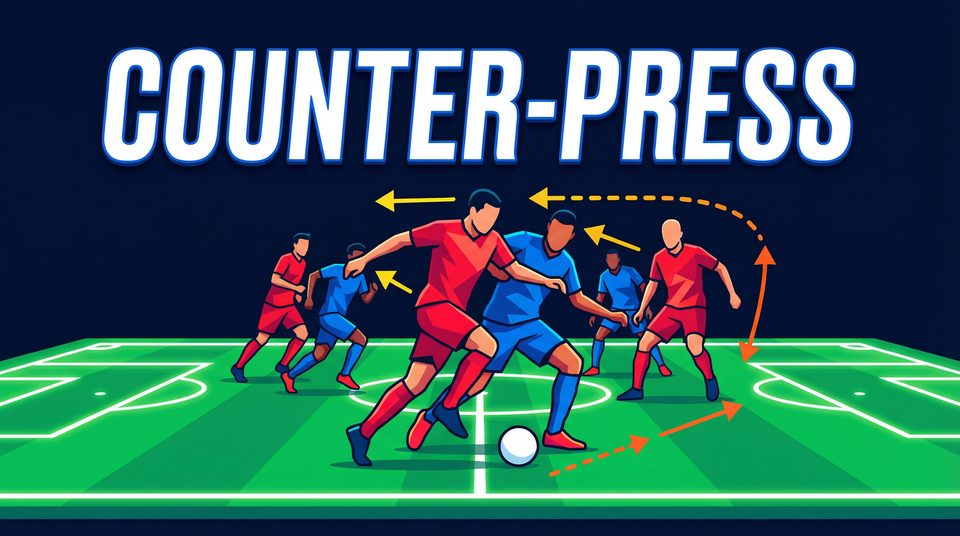
The counter-press, or Gegenpressing, is a tactical principle that has defined modern elite football. It is an organized and immediate response to losing possession, where the primary objective is to win the ball back as high up the pitch as possible — ideally within 5–7 seconds. This approach turns a moment of defensive vulnerability into a potent attacking opportunity, catching the opposition disorganized before they can launch their own attack.
This set play is most effective when your team is in the opponent's half, having just lost the ball during an attacking phase. The proximity of players allows for a rapid, collective press, suffocating the opposition and creating turnovers in dangerous areas. Coaches at all levels can implement this system, but it demands high physical intensity, strong communication, and clear tactical understanding from every player on the pitch.
2. Setup

Equipment Required:
| Item | Quantity | Notes |
|---|---|---|
| Full-sized pitch | 1 | 100–110m x 64–75m |
| Footballs | 6–10 | Supply around the pitch edge |
| Bibs | 1 set | To differentiate teams |
| Cones | 12–16 | Optional: to mark press zones |
| Full-size goals | 2 | Standard match setup |
Player Positions (4-3-3 Formation):
| Number | Position | Role in Counter-Press |
|---|---|---|
| 1 | Goalkeeper | Sweeper-keeper, ready to step out |
| 2 | Right Back | Tucks in, supports midfield press |
| 3 | Left Back | Tucks in, supports midfield press |
| 4 | Centre Back | Holds defensive line, covers behind press |
| 5 | Centre Back | Holds defensive line, covers behind press |
| 6 | Defensive Midfielder | Organizes the press, cuts central lanes |
| 7 | Right Winger | Presses wide, forces play inside |
| 8 | Central Midfielder | Second presser, blocks short passing options |
| 9 | Centre Forward | Leads the press from the front |
| 10 | Attacking Midfielder | First presser in central areas |
| 11 | Left Winger | Presses wide, forces play inside |
3. Step-by-Step Instructions
Initiate Play: The attacking team (red) starts with the ball from the goalkeeper, building an attack as they would in a match scenario. The defending team (blue) applies passive or semi-active resistance.
The Trigger — Possession Loss: The coach signals, or the attacking team naturally loses possession in the middle or final third. This is the critical trigger for the counter-press. Every player must recognize this moment simultaneously.
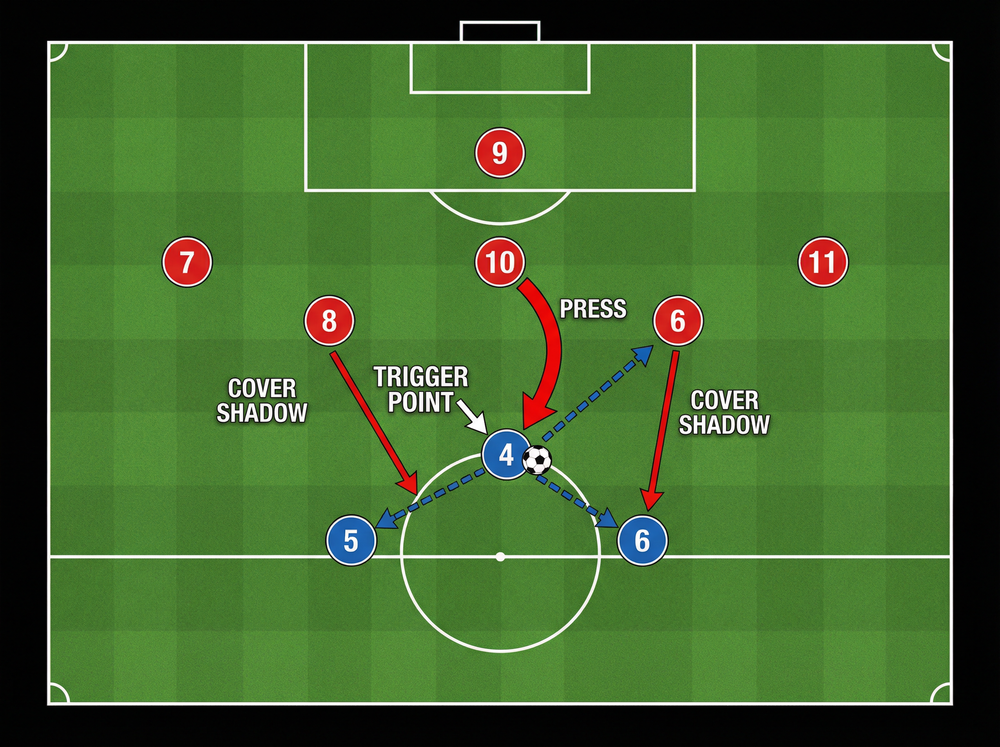
Immediate Pressure — The First Press: As shown in Diagram 1, the player closest to the ball (typically No. 10) immediately sprints to pressure the new ball carrier (blue No. 4). Their aim is not necessarily to win the ball outright, but to force a hurried decision, a poor first touch, or a predictable pass. Approach at speed but under control — do not dive in.

Cutting the Lanes — Cover Shadow: The next closest players (No. 8 and No. 6) do not blindly chase the ball. Instead, they position themselves to block the opponent's most obvious forward passing options. By standing between the ball carrier and the intended receiver, they use their body as a "cover shadow," forcing the opponent sideways or backwards.
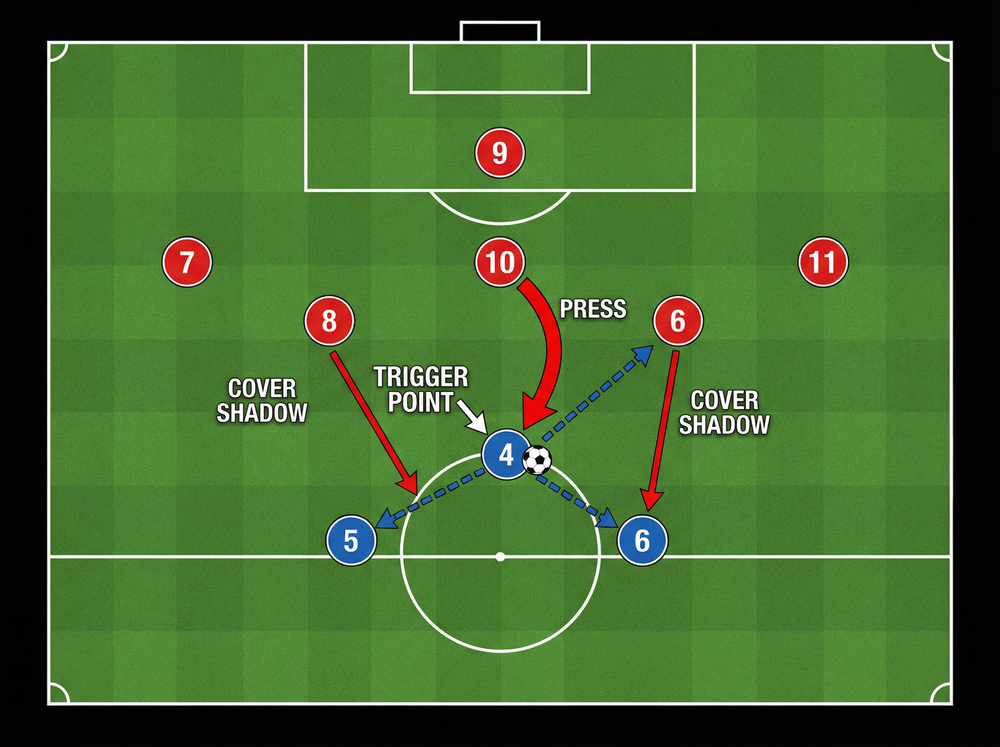
Team Compaction: As illustrated in Diagram 2, the rest of the team squeezes the space collectively. The wide forwards (No. 7 and No. 11) tuck in to reduce the width of the pitch. The defensive line pushes up to the halfway line, shortening the available space to approximately 30–35 metres. This coordinated compaction is what makes the press suffocating rather than merely inconvenient.
- Win the Ball or Reset: The goal is to win the ball back within 5–7 seconds. If successful, the team immediately transitions into attack — the ball should move forward within 2–3 passes. If the opponent plays out of the press successfully, the team must quickly recover into its organized defensive shape, dropping into a compact mid-block.
4. Key Coaching Points

Immediate Reaction and the 5-Second Rule: The psychological shift from attack to defense must be instant. Drill this with a verbal cue (e.g., "PRESS!") and time the team's response. The 5-second rule gives players a clear, measurable target.
Closest Player Applies Pressure — No Exceptions: This is non-negotiable. The nearest player must initiate the press regardless of their position. Any hesitation allows the opponent to lift their head, assess options, and break the press with a single pass.
Cut Passing Lanes, Not Just the Ball: The supporting pressers have the most important job. They must read the game, anticipate the ball carrier's intentions, and make play predictable for the first presser. Encourage them to ask: "Where does he want to pass? How do I stop that?"
Maintain Compact Shape — Press as a Unit: The press is only effective if the team moves as a single, cohesive block. Large gaps between players are exploited by a composed opponent. Reinforce the principle: "If one presses, all press."
Aggressive but Intelligent: The press must be high-energy but disciplined. Players should delay and channel the ball carrier, not lunge recklessly. The objective is to force an error, not necessarily to win the ball in a single tackle.
Transition to Attack is Instant: When the ball is won, the team must immediately switch mentality to attack. Pre-assign counter-attacking runs so players know exactly where to go when possession is regained.
5. Common Mistakes

Pressing in Isolation: The single most common error. One player pressing alone is easily bypassed with a simple lay-off or a turn. If the supporting players do not react simultaneously, the press will fail and the team will be exposed.
Committing Unnecessary Fouls: Pressing with high intensity increases the risk of reckless challenges. Emphasize that the first presser's job is to close space and force a mistake — not to foul. A free-kick in the opponent's half immediately relieves all pressure.
Losing Defensive Shape Behind the Press: Over-committing players to the press can leave the defensive line dangerously exposed. The two centre-backs (No. 4 and No. 5) must hold their position and resist the urge to press forward. There must always be cover behind the press.
Forgetting to Scan Before Pressing: Players who sprint to press without first scanning their environment can be bypassed by a quick one-two combination. Encourage players to take a half-second to assess the situation before committing.
Pressing at the Wrong Time: The counter-press is most effective immediately after losing the ball. If the opposition has had 3–4 seconds to settle, the press is less likely to succeed and may be tactically unsound. Teach players to recognize when to press and when to recover.
6. Variations and Progressions

Add Counter-Attacking Goals: Place two small goals (or cones) on the halfway line, one on each side. If the pressing team wins the ball back, they have 10 seconds to score in one of the small goals. This rewards the press with an immediate attacking opportunity and encourages rapid transition.
Introduce Overload Scenarios: Start the drill with a 6v5 or 7v6 numerical advantage for the team in possession. This makes it significantly harder for the pressing team and forces them to be even more organized, intelligent, and disciplined in their pressing structure.
Zone-Specific Press Triggers: Use cones to divide the pitch into thirds. Only activate the counter-press when the ball is lost in the middle or final third. If the ball is lost in the defensive third, the team must immediately drop into a low block. This teaches players to apply the press contextually.
7. Age Adaptations

Under 10 and Under 12: Introduce the concept through small-sided games (4v4 or 5v5 on a 40m x 30m pitch). Focus exclusively on the immediate reaction of the closest player — use the cue "Hunt the ball!" Use fun, memorable language such as "wolf pack" to encourage collective pressing. Do not overload players with tactical complexity at this stage.
Under 14 and Under 16: Introduce the roles of the second and third pressers. Begin to teach the concept of the cover shadow and cutting passing lanes. Use 7v7 or 9v9 games on a reduced pitch (70m x 50m) to provide more space and tactical complexity. Introduce the 5-second rule as a measurable target.
Open Age and Senior: At this level, the focus shifts to the speed of transition, the organization of the team shape, and the precise tactical triggers that initiate the press. Introduce video analysis — review match footage to identify moments where the counter-press was successful or unsuccessful, and use these as teaching moments in the following training session.
