

Rugby
Forward Pod Play with Inside Offload Option
A dynamic 3-man forward pod sequence designed to break the gainline and release quick ball to the backs via a targeted inside offload.

What you need
1 Rugby ball, 6-8 Cones, Tackle shields (optional for contact practice)
Overview
The 'Forward Pod Play with Inside Offload' is a foundational attacking structure designed to get your team over the gainline and generate quick, front-foot ball. By organizing your forwards into tightly knit 3-man units (pods), you create a heavy, localized attacking threat that forces the defense to commit multiple tacklers. The addition of the inside offload option punishes defenders who over-commit to the primary ball carrier, creating a secondary line break opportunity for trailing support players.
This set play is particularly effective when used in the middle third of the pitch (between the 10m lines) to build momentum before launching a wide backline strike.
Setup
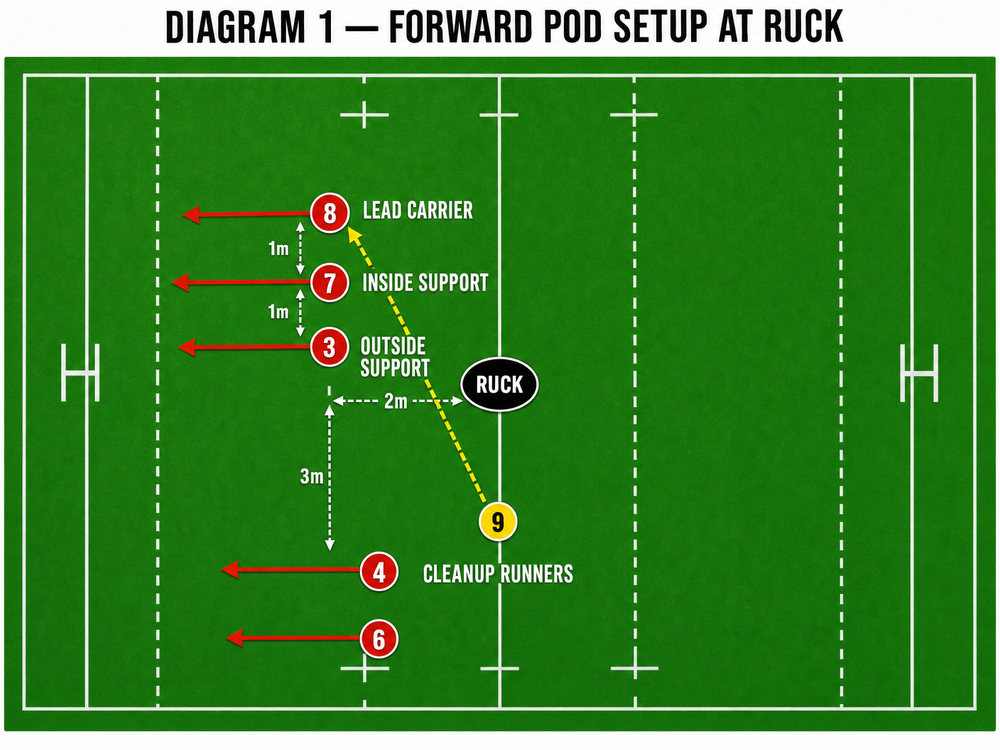
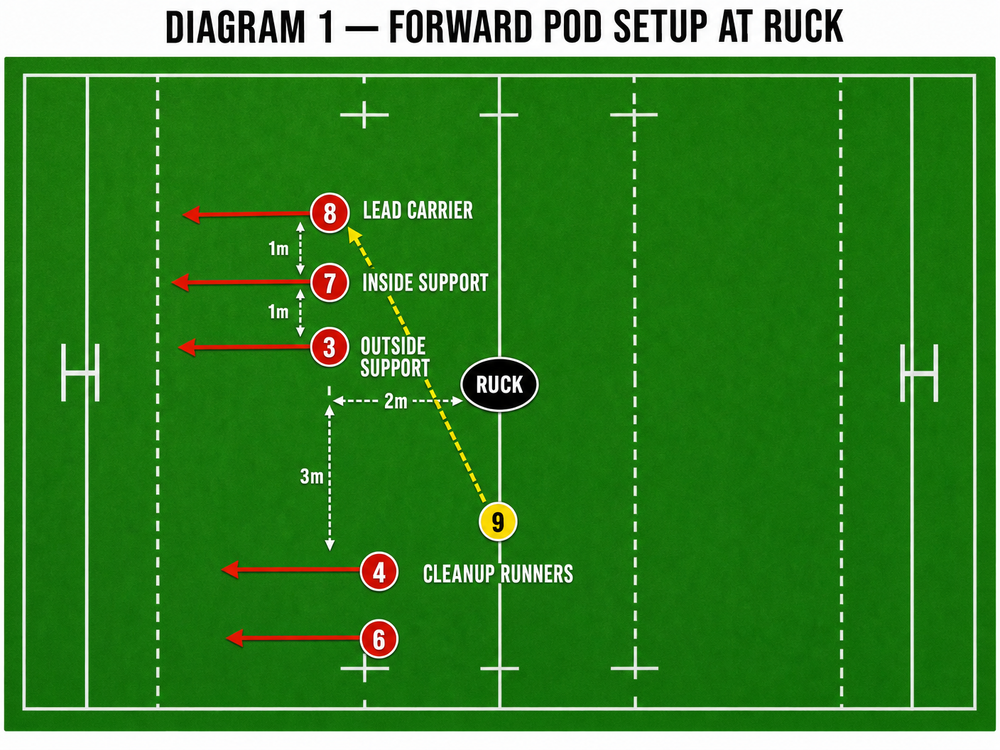
Pitch Area: Middle third of the pitch (between the two 10m lines).
Equipment: 1 Rugby ball, 6-8 cones to mark the ruck and defensive line.
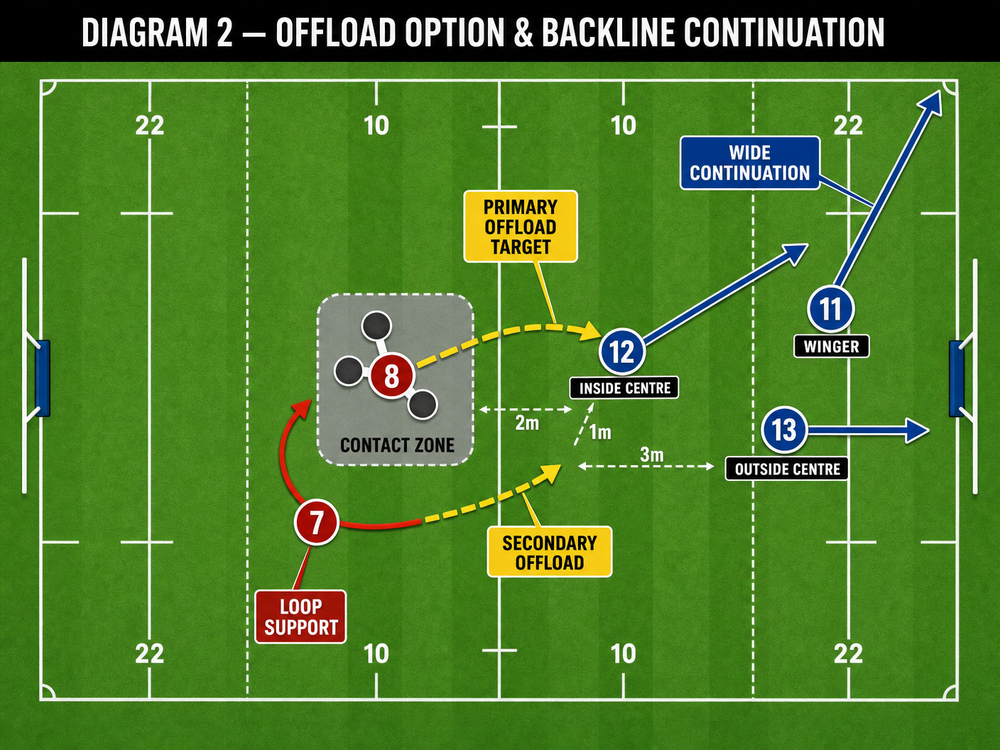
Players Required: Minimum 9 (Scrum-half, 3-man Forward Pod, 2 Cleanup Forwards, Inside Centre, Outside Centre, Winger).
Initial Alignment:
- The Scrum-half (9) starts at the base of the ruck.
- The Forward Pod aligns 2 meters wide of the ruck.
- The Lead Carrier (typically an 8, 1, or 4) stands flat.
- The Inside Support (7) is 1 meter behind and inside the Lead Carrier.
- The Outside Support (3) is 1 meter behind and outside the Lead Carrier.
- Cleanup Runners (4, 6) are positioned 3 meters deeper to secure the next phase if the offload is not on.

Step-by-Step Instructions
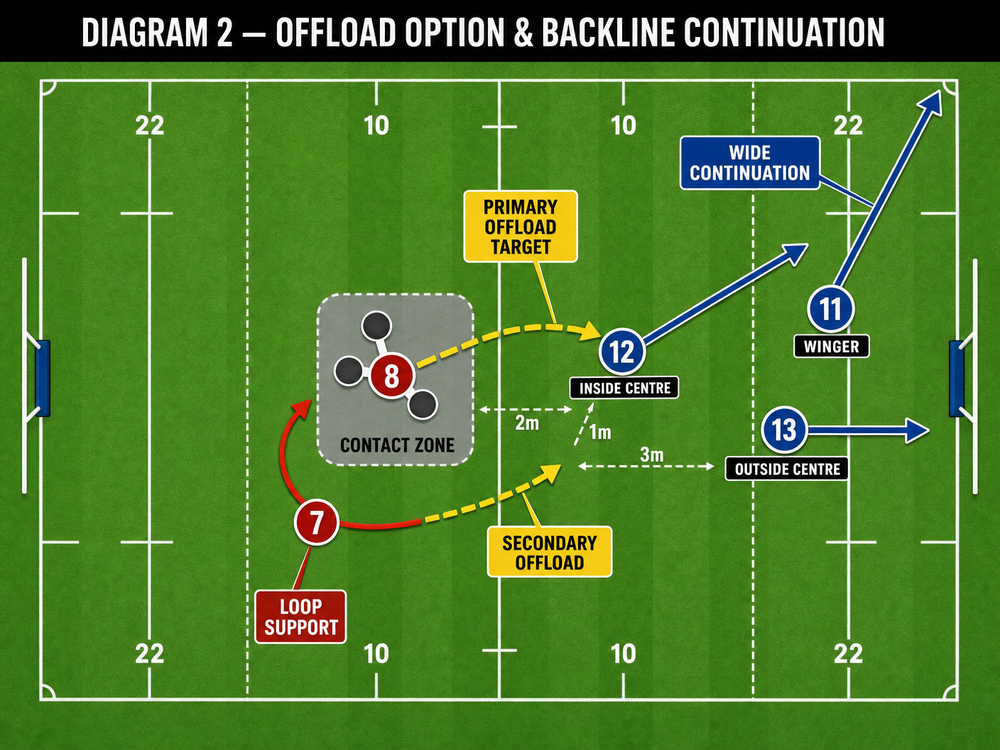
- The Approach: The Scrum-half (9) clears the ball quickly from the base of the ruck to the Lead Carrier (8) who is running a hard, flat line at the defensive seam.
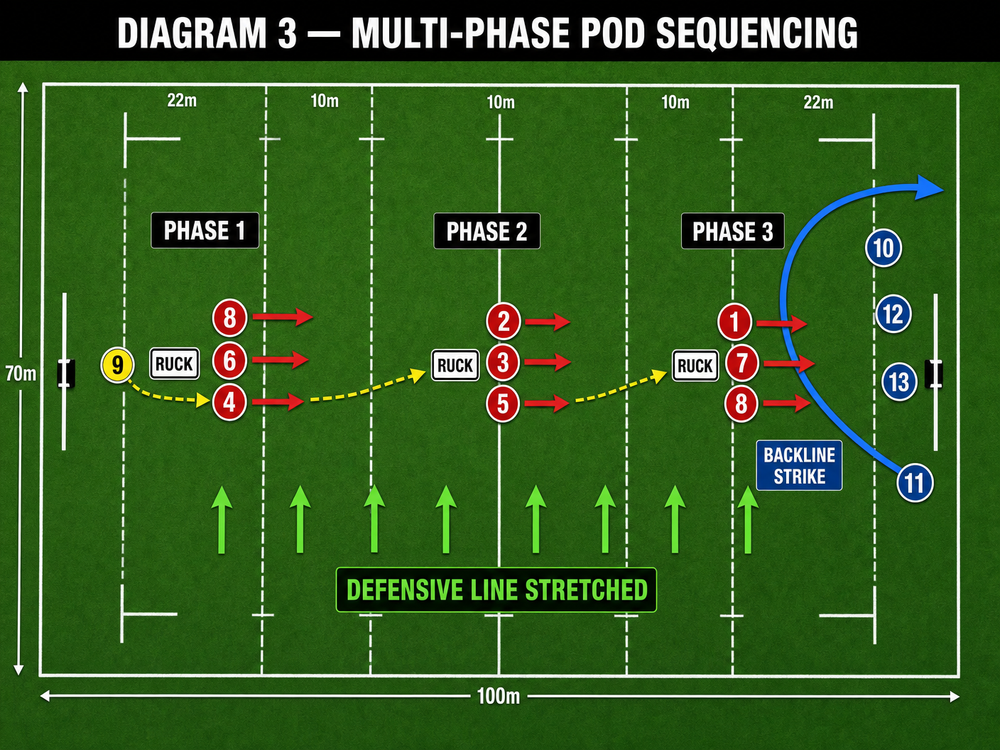
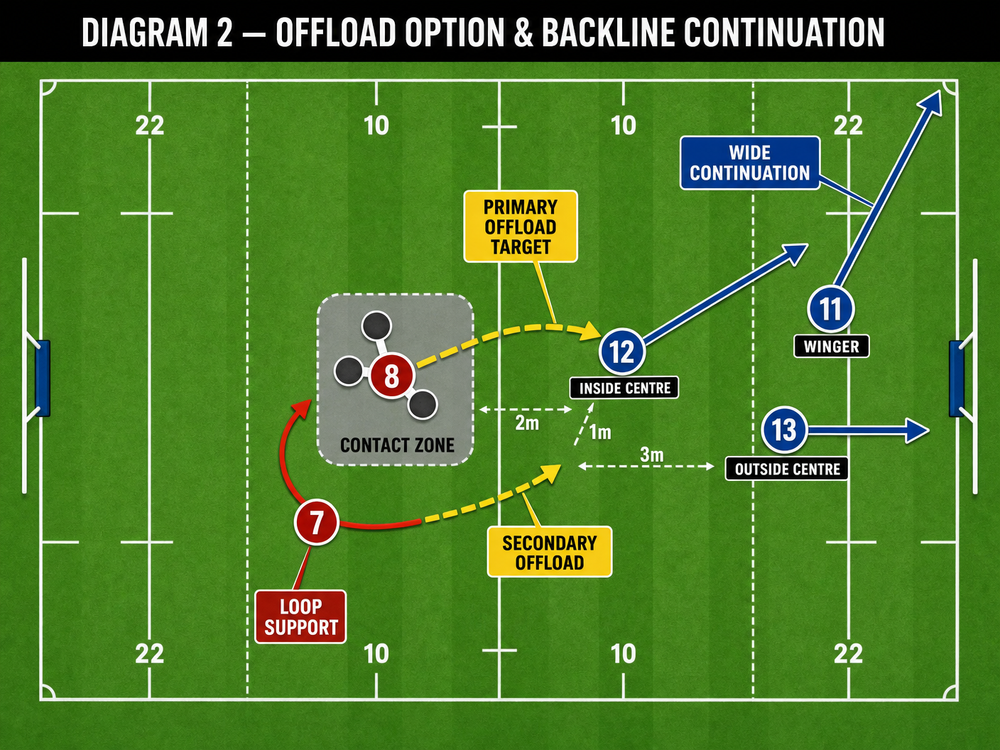
- The Contact: The Lead Carrier aims to step into the space between two defenders, dropping their body height just before contact to win the collision and keep their arms free.
- The Latch (Option A - No Offload): If the defense hits low and wraps the ball, the Inside (7) and Outside (3) support players immediately latch onto the carrier to drive them forward, creating a dominant ruck.
- The Offload (Option B - The Primary Play): If the Lead Carrier manages to keep their arms free through contact, they execute a pop pass or underhand offload to the Inside Centre (12) who is running a sharp, late support line 1 meter behind and 2 meters outside the contact zone.
- The Continuation: The Inside Centre (12) bursts through the defensive line. The Outside Centre (13) and Winger (11) run flat, wide support lines to exploit the broken field.
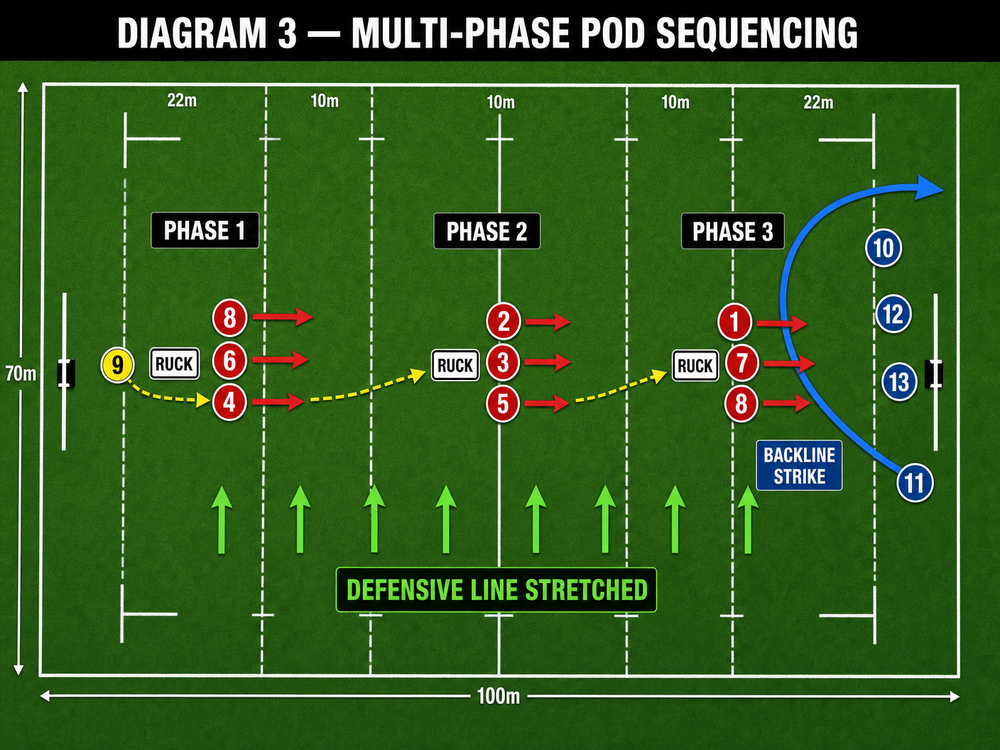
Multi-Phase Sequencing
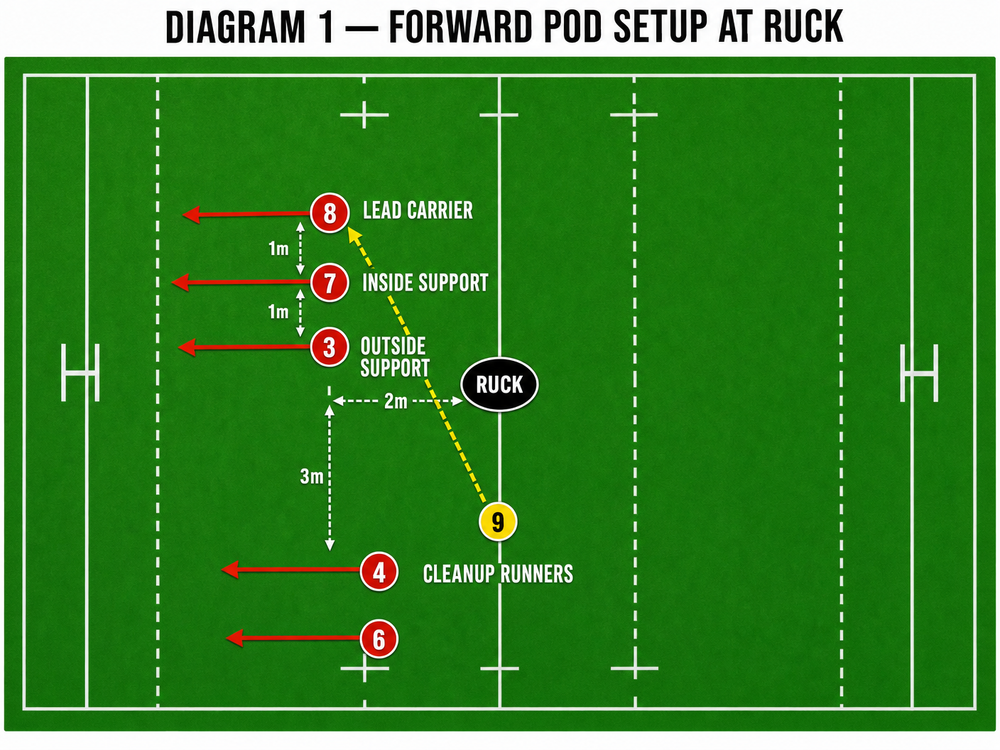
To maximize the effectiveness of this play, it should be run as part of a multi-phase sequence across the pitch.
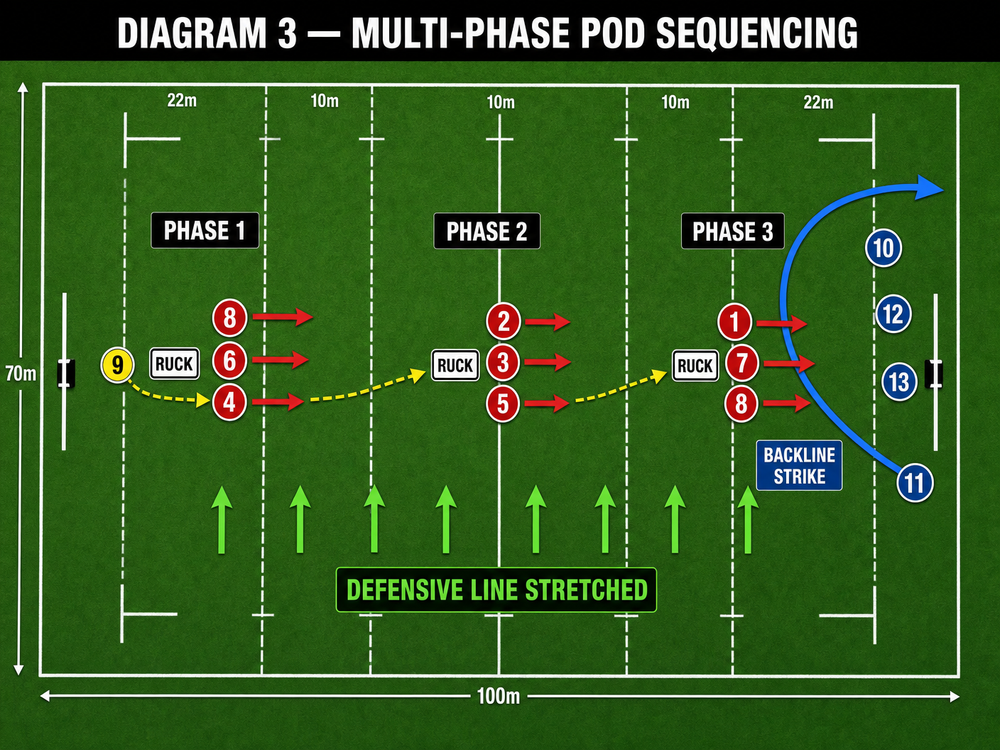
- Phase 1: Hit the middle of the pitch with the first pod to condense the defense.
- Phase 2: Quickly recycle the ball to a second pod driving further wide.
- Phase 3: With the defensive line stretched and scrambling, launch the backline strike off the final pod.
Key Coaching Points
- Depth and Pace: The pod must hit the ball at pace. If they are standing still when they catch it, the defense will dominate the collision. Ensure they start deep enough to accelerate onto the pass.
- Ball Presentation: The Lead Carrier must fight to keep their shoulders square to the opposition try line and the ball away from the initial tackler to allow for the offload.
- Support Lines: Support players (7, 3, 12) must anticipate the offload and run hard lines before the pass is thrown. If they wait to see if the offload is successful, they will be too late.
- Communication: The Scrum-half must dictate the play, calling the pod into position early. The support players must call for the offload loudly to guide the carrier.
Common Mistakes
- Running Too Flat: Forwards align too flat, catch the ball standing still, and are easily driven backward.
- Forcing the Offload: The carrier attempts an offload when wrapped up, resulting in a knock-on or interception. Coach the players to take the tackle and present the ball if the offload isn't clearly on.
- Late Support: The support players hesitate, allowing the defense to isolate the ball carrier and win a turnover.
Variations & Progressions
- Tip Pass: Instead of taking contact, the Lead Carrier tips the ball early to the Outside Support player running a short, hard line.
- Pull-Back: The Lead Carrier shapes to take contact but throws a pull-back pass to a playmaker (10) standing deep behind the pod.
Age Adaptations
- Under 10s / Under 12s: Focus heavily on the ball carrier's body height and presenting the ball safely. Introduce the offload only when players are confident in contact.
- Under 14s / Under 16s: Introduce the latching technique for support players. Practice the timing of the inside support line for the offload.
- Open / Seniors: Focus on multi-phase sequencing, reading the defense to choose between the offload, tip pass, or pull-back options.
