

Rugby
Forward Pod Play with Offload Option: Dominating the Gain Line
Master the forward pod structure to consistently breach the gain line, generate quick ball, and create dynamic offload opportunities in tight channels.

What you need
Rugby Balls, Cones, Tackle Shields, Bibs
1. Overview
The forward pod is a foundational attacking structure in modern Rugby, designed to generate go-forward momentum, commit multiple defenders, and produce quick, clean ball at the breakdown. By organizing forwards into tight groups of three or four, the attacking team forces the defense to condense, opening up space out wide for the backs.
This specific set play focuses on the 'Forward Pod Play with Offload Option.' It elevates the basic pod carry by integrating a hard-running support line specifically designed to receive an offload in contact. When executed correctly, this play not only breaches the gain line but breaks the defensive line entirely, creating line breaks and scrambling the defensive structure. It is highly effective in the middle third of the pitch when the defense is structured and drifting, forcing them to commit to the contact zone.
2. Setup

Proper setup is critical for the timing and spacing of the pod play.
Pitch Setup: Utilize a standard 100m x 70m Rugby pitch. For training, mark out a 30m x 30m grid in the center of the pitch to simulate the midfield battleground. Place a line of cones to represent the gain line.
Player Positions:
| Position | Number | Role in Play |
|---|---|---|
| Scrum Half | 9 | Delivers a fast, flat pass from the ruck base |
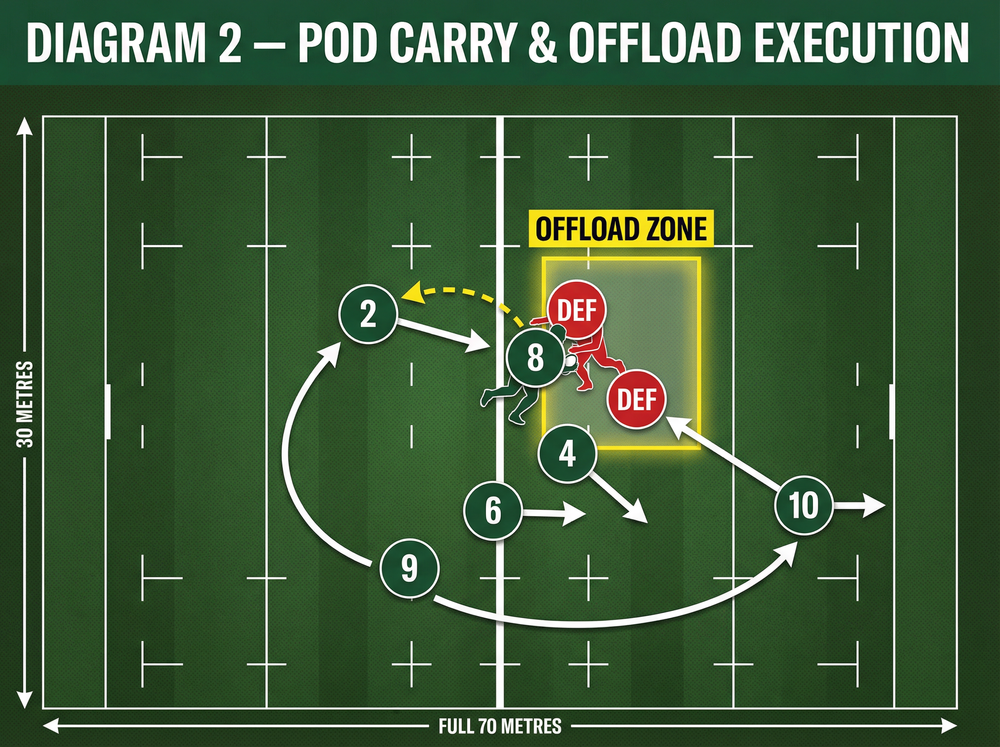
| Number 8 | 8 | Primary ball carrier, attacks inside shoulder of defender |
| Hooker | 2 | Primary offload option, hard inside support line |
| Lock | 4 | Secondary support, occupies outside defender |
| Blindside Flanker | 6 | Depth support, secures breakdown if offload not on |
| Fly Half | 10 | Wide option, 8-10m from pod for second phase |

3. Step-by-Step Instructions

Step 1 — The Alignment and Call
As the previous ruck is formed, the pod (Players 2, 4, 6, and 8) aligns quickly. The 9 scans the defense and calls the play (e.g., "Pod Right, 8 Carry"). The pod players must be set in a staggered, arrowhead formation — 8 at the tip, 2 inside-behind, 4 outside-behind, 6 at depth — before the 9 puts hands on the ball.
Step 2 — The Delivery and the Carry
The 9 delivers a crisp, flat pass to the 8 at a distance of 3-4 metres. The 8 must catch the ball moving forward at pace. The primary objective is to attack the inside shoulder of the targeted defender, forcing a dominant collision and keeping the ball alive in two hands.
Step 3 — The Support Lines
Simultaneously with the 8's run, the support players accelerate hard. The 2 runs a hard, aggressive line directly at the space between the 8 and the inside defender. The 4 runs a slightly wider line to occupy the outside defender. The 6 tracks directly behind the 8 at a depth of 2-3 metres.
Step 4 — The Contact and the Offload
As the 8 enters contact, they must fight to stay on their feet, driving their legs. They carry the ball in two hands, absorbing the initial impact. If the 8 gets their arms free through the tackle, they execute a soft, pop pass (offload) to the 2, who is bursting through the inside gap at full pace. The 2 calls loudly — "Ball! Ball!" — to trigger the offload.
Step 5 — The Breakdown (Alternative)
If the defense executes a dominant tackle and the offload is not on, the 8 must immediately present the ball cleanly on the correct side. The 2 and 4 transition instantly from support runners to clear-out players, aggressively removing threats over the ball. The 6 secures the ball at the back of the ruck, ensuring lightning-fast ball for the 9.
4. Key Coaching Points

Pace onto the Ball: The ball carrier (8) must be accelerating before catching the pass. A static catch allows the defense to set their feet and dominate the collision.
Two-Handed Carry: The ball carrier must hold the ball in two hands going into contact. This keeps the defense guessing, protects the ball from being stripped, and makes the offload physically possible.
Support Runner Depth and Timing: The primary offload option (2) must arrive exactly as the 8's arms come free — approximately 1.5-2 seconds after the initial contact.
Decision Making in Contact: The offload should only be attempted if the hands are free and the support player is calling for it. A forced offload is worse than a clean ruck.
Aggressive Clear-Out: If the offload is not viable, support players must instantly transition from receivers to clearers to ensure quick ball.
5. Common Mistakes

Flat Alignment: The pod aligns too flat, causing a static catch. Correct by placing a cone 3 metres behind the gain line and insisting the carrier catches the ball running through it.
Forcing the Offload: Emphasize that taking the tackle and presenting clean ball is a completely successful outcome. The offload is a bonus, not a requirement.
Support Players Ball-Watching: Drill the running lines in isolation before adding the ball.
Poor Communication: Introduce a mandatory verbal call protocol — "Ball! Ball!" — in every repetition.
Pod Too Wide: The pod should be no wider than 5 metres from the ruck.
6. Variations & Progressions

Progression 1 — Live Defense: Start with tackle shields, progress to a single live defender, then two defenders, then full live defense.
Progression 2 — The Tip Pass Option: The 8 catches and immediately tips to the 4 running the wider line, exploiting aggressive defenders.

Variation — The Pull-Back Pass: If the defense rushes up hard, the 8 throws a pull-back pass to the 10 at depth, bypassing the rush defense entirely.
7. Age Adaptations

| Age Group | Focus | Modification |
|---|---|---|
| Under 10s / Under 12s | Shape and running lines | Touch or non-contact only; emphasize two-handed carry and pod alignment |
| Under 14s | Decision-making | Introduce contact with tackle shields; teach offload vs. present decision |
| Under 16s | Full execution | Live defense; introduce tip pass and pull-back variations |
| Open / Senior | Advanced nuance | Focus on reading defensive line speed and exploiting mismatches within the pod |
