

Rugby
Forward Pod Play with Offload Option: Penetrating the Defensive Line
Equip your forwards with a dynamic pod structure that draws defenders and creates line-break opportunities through well-timed offloads.

What you need
1 Rugby ball, 6-8 Cones, Tackle shields (optional)
Overview
The forward pod play with an offload option is a foundational attacking structure designed to generate momentum, draw multiple defenders, and create line-break opportunities. By organizing forwards into tight, three-man pods (typically operating 5-10 metres off the ruck), coaches can ensure strong ball carrying while simultaneously providing immediate support for both the breakdown and the offload. This set play is particularly effective when the opposition defence is drifting or when you have dynamic ball carriers who can get their arms free in contact.
Setup
Equipment Needed:
- 1 Rugby ball (plus spares)
- 6-8 Cones to mark the ruck area and defensive line
- Tackle shields or hit shields (optional for opposed practice)
Pitch Setup:
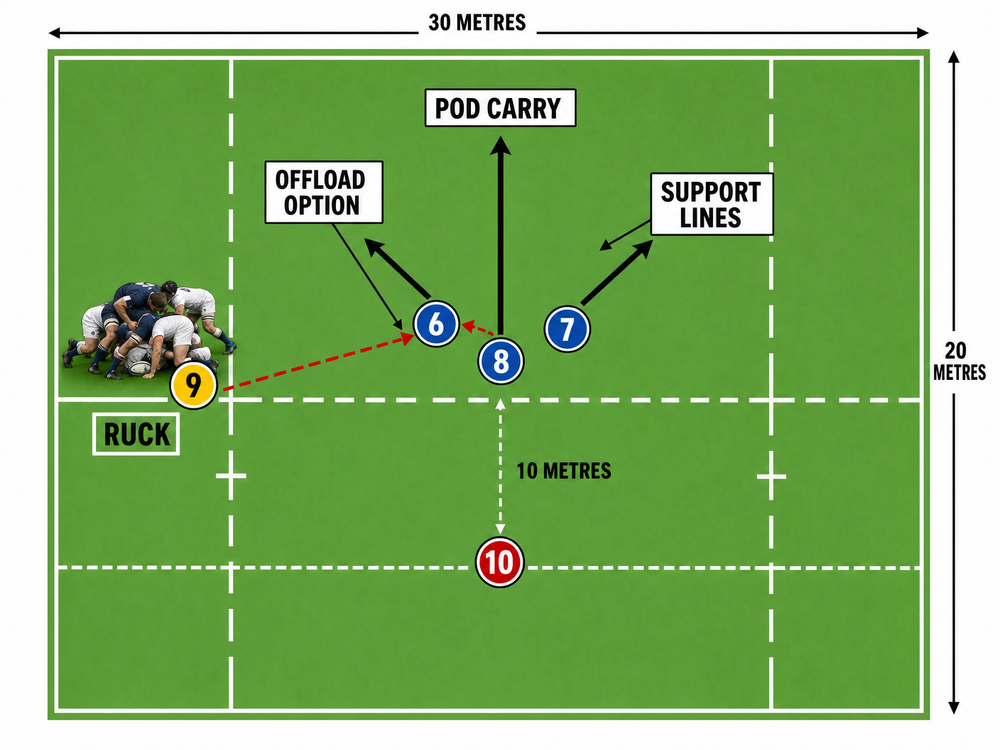
- Set up a grid approximately 30 metres wide by 20 metres deep.
- Place a cone to represent the base of the ruck.
- Mark the defensive offside line 1 metre back from the ruck.
Player Positions:
- Number 9 (Scrum Half): Positioned at the base of the ruck, ready to deliver a fast, accurate pass.
- The Pod (e.g., 8, 6, 7 or 2, 4, 5): Three forwards aligned in an arrowhead or flat formation. The primary ball carrier (the tip) is positioned 5 metres deep and slightly wider than the ruck. The two support players flank the carrier on the left and right shoulders.
- Number 10 (Fly Half): Positioned 10 metres deep behind the pod, communicating options and ready for a pull-back pass if the defence blitzes.
Step-by-Step Instructions

Phase 1: The Initial Strike
- The Call: The Number 9 or the pod leader calls the play, ensuring the three-man pod is set and aligned.
- The Pass: The Number 9 delivers a crisp, flat pass to the primary ball carrier (e.g., Number 8) who is running a hard, straight line towards the defensive seam.
- The Carry: The ball carrier attacks the gap between two defenders, aiming to win the collision and keep their upper body free.
- The Support: The two support players (e.g., 6 and 7) latch onto the carrier's hips just before or upon contact, driving the carrier forward through the tackle.
- The Offload: If the carrier manages to get their arms free through the contact zone, they execute a pop pass or offload to the support player running a hard line on their shoulder.
Phase 2: The Second Pod & Decoy Options
- The Recycle: If the offload is not on, the carrier goes to ground on their terms, placing the ball cleanly. The two support players immediately secure the ruck.
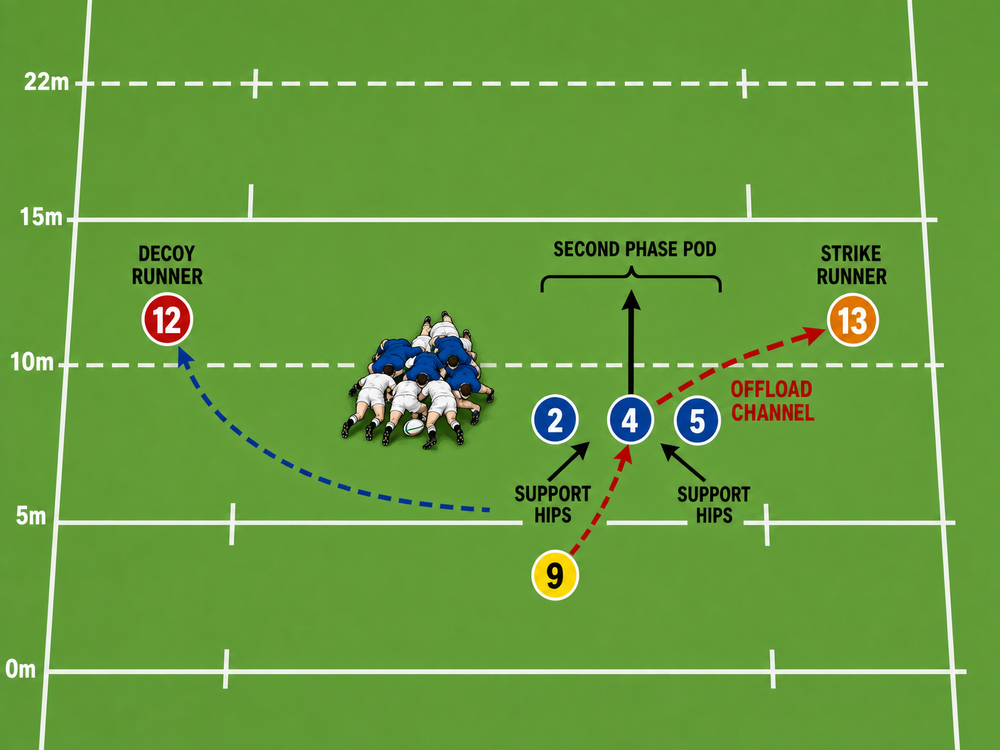
- The Next Pod: The Number 9 arrives at the base and scans. A second three-man pod (e.g., 2, 4, 5) should be set 3-5 metres wider than the previous breakdown.
- The Decoy: A backline player (e.g., Number 12) runs a hard decoy line to fix the inside defenders.
- The Strike: The Number 9 hits the new pod carrier. This carrier has the option to take the contact, offload to a support forward, or tip the ball to a strike runner (e.g., Number 13) hitting the offload channel at pace.
Key Coaching Points
- Depth and Pace: The pod must start deep enough to hit the ball at full pace. Catching the ball while standing still makes the carrier an easy target.
- Body Height in Contact: The ball carrier must drop their body height before contact, driving through the tackle with strong leg drive while fighting to keep the ball available.
- Support Timing: Support players must read the carrier's body language. If the carrier is dominating the collision, anticipate the offload. If the carrier is chopped low, transition immediately into ruck clearance.
- Communication: The support players must be the eyes for the carrier, calling 'Offload! Offload!' if they are in position and the space is open.
- Decision Making: The carrier must not force the offload. If the arms are wrapped or the support is late, taking the tackle and presenting clean ball is the priority.
Common Mistakes
- Flat Alignment: Forwards lining up too flat, resulting in catching the ball static and losing the collision.
- Late Support: Support players reacting after the tackle rather than anticipating the contact, leading to isolated carriers and turnovers.
- Forcing the Pass: Attempting offloads in heavy traffic or when off-balance, resulting in forward passes or knock-ons.
- Poor Latching: Support players failing to bind tightly onto the carrier's hips, reducing the collective driving power of the pod.
Variations & Progressions
- The Pull-Back Option: Instead of carrying, the pod tip catches the ball and immediately throws a pull-back pass to the Number 10 positioned deeper, bypassing the rush defence.
- Tip Passes: The primary carrier receives the ball and instantly tips it to a support player running a slightly wider or tighter line, changing the point of attack before contact.
- Opposed Practice: Introduce live defenders with tackle shields, then progress to full contact to test decision-making under pressure.
Age Adaptations
- Under 8 - Under 10: Focus purely on running straight, catching the ball on the move, and basic support lines. Introduce the concept of the offload using two-handed pop passes before contact.
- Under 12 - Under 14: Introduce the three-man pod structure. Emphasize body height in contact and the decision between offloading and setting a ruck. Use touch or grab variations to build confidence.
- Under 16 - Open: Full implementation of the pod system with complex variations (pull-backs, tip passes). Focus on dynamic latching, aggressive leg drive, and high-speed decision-making in the contact area.
