

Rugby
The Hammer Pod: Forward Drive with Offload Options
Master the 'Hammer Pod' to generate quick front-foot ball, suck in defenders, and unleash your backs or support runners through targeted offloads.
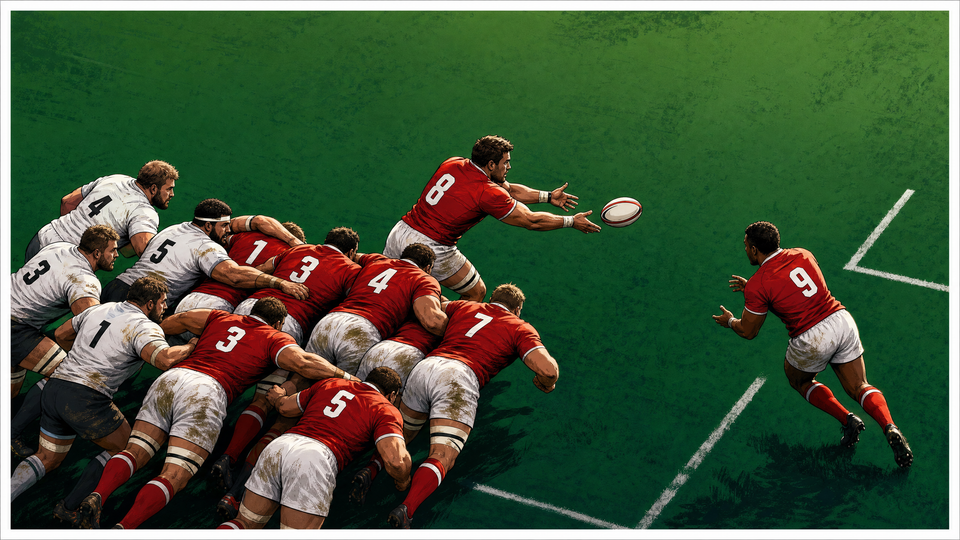
What you need
Rugby balls, Cones for marking pitch areas, Tackle shields (optional for practice)
1. Overview
The 'Hammer Pod' is a direct, aggressive attacking structure designed to punch through the gain line and manipulate the defensive shape. By grouping three forwards tightly together, you force the defense to commit multiple tacklers to halt the momentum. The true power of this play lies not just in the initial carry, but in the secondary options: once the defense condenses to stop the drive, spaces naturally open up on the fringes. This play equips your ball carrier with pre-planned offload options to exploit those newly created gaps, turning a simple crash ball into a dynamic line break.
This set play is particularly effective off slow ruck ball or when the defense has spread wide, anticipating a backline move. It resets the point of attack, generating quick, front-foot ball that puts the attacking team back in control.
2. Setup
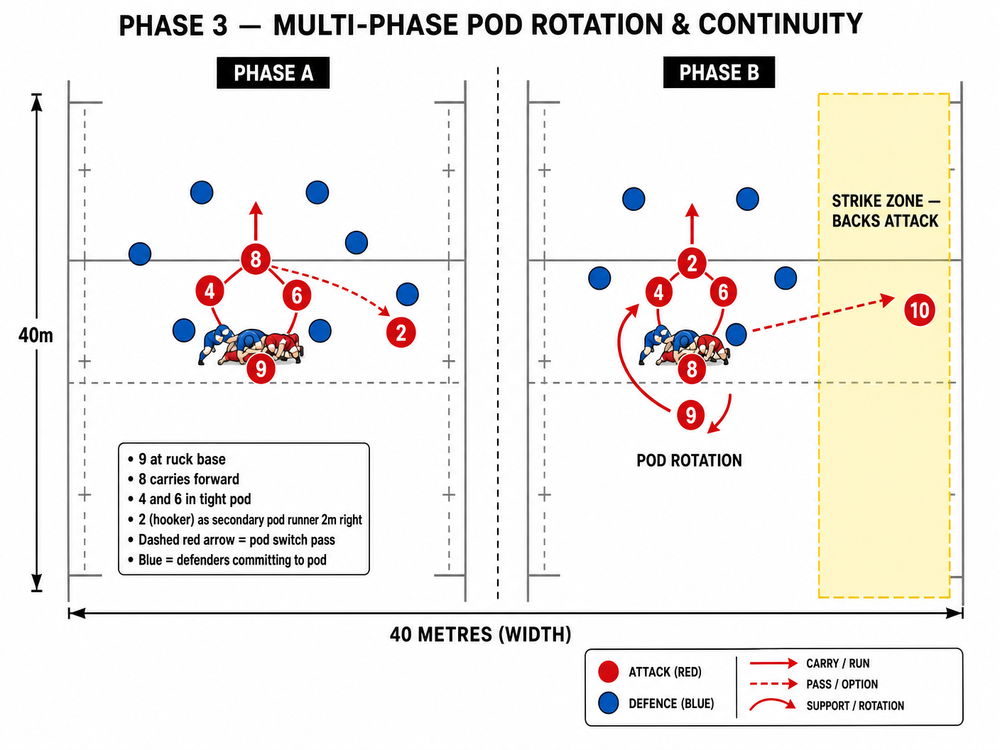
Pitch Setup:
- Full pitch or a 40m x 40m grid for isolated practice.
- Standard rugby markings (5m, 10m, 22m lines).
Player Positions:
- 9 (Scrum-half): Base of the ruck, orchestrating the play.
- 8 (Number 8): The primary ball carrier, positioned directly in front of the ruck.
- 4 & 6 (Locks/Flankers): The 'latchers' or tight support, positioned 1 metre to either side of the 8, forming a tight arrowhead or flat pod.
- 7 (Openside Flanker): Secondary support, positioned 3 metres wide of the pod, ready for a tip-on pass or offload.
- 12 & 13 (Centres): Positioned deeper and wider, ready to exploit the space created if the offload goes out the back.
3. Step-by-Step Instructions
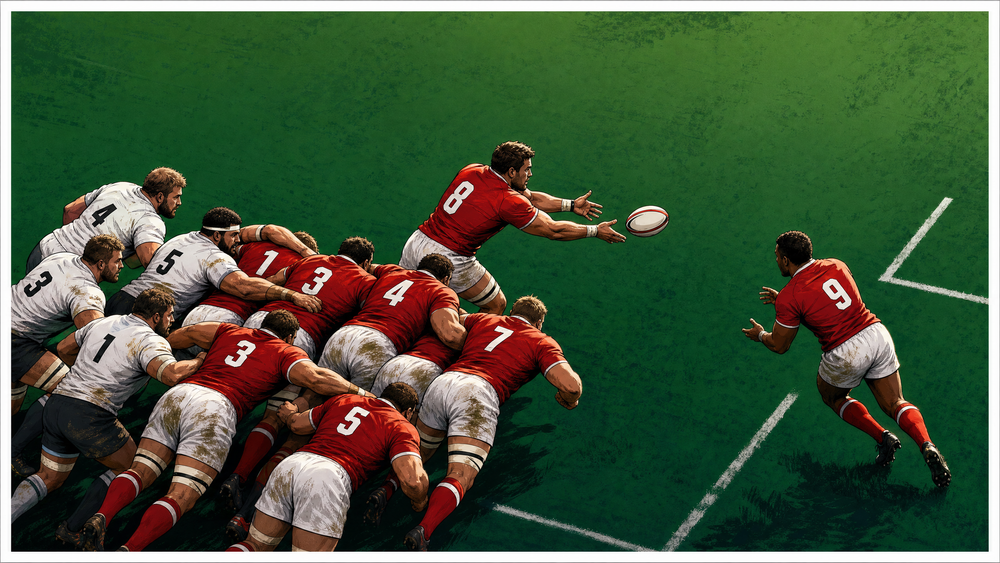
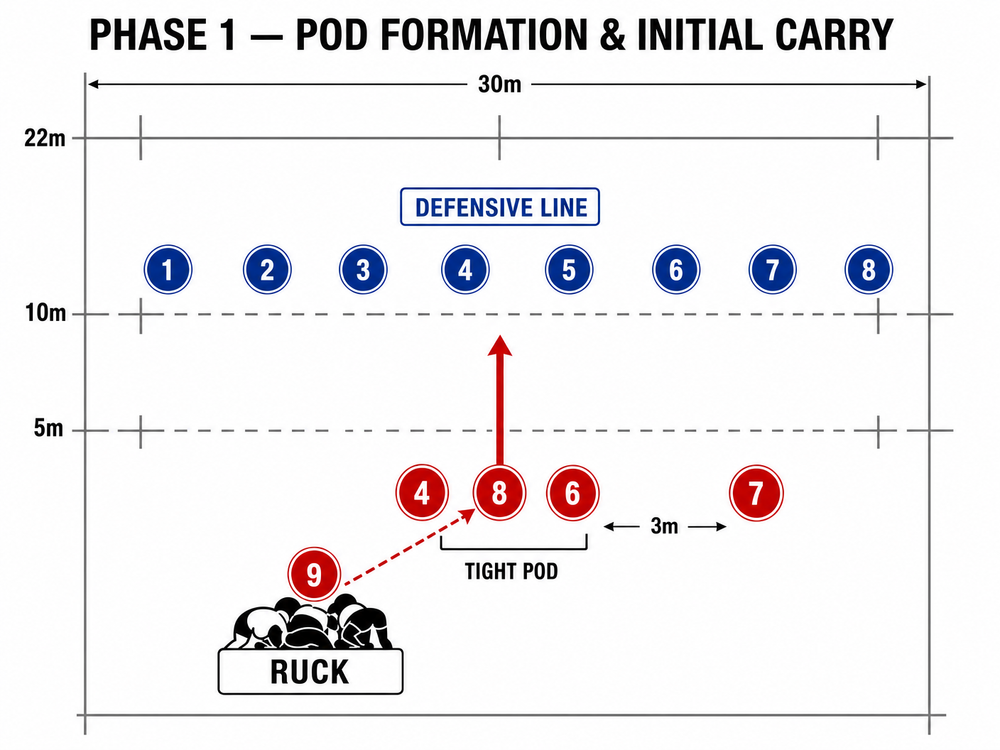
Phase 1: The Initial Drive
- Alignment: The 9 identifies the target area. The 8, 4, and 6 align in a tight pod, no more than 1 metre apart. They must be moving forward before the ball is passed.
- The Delivery: The 9 delivers a crisp, flat pass to the 8. The pass must hit the 8 in stride.
- The Carry: The 8 attacks the seam between two defenders. The focus is on low body height, driving the legs, and fighting to stay on their feet post-contact.
- The Latch: Immediately upon contact, 4 and 6 latch onto the 8, driving them forward to ensure gain line success and secure the ball if a ruck forms.
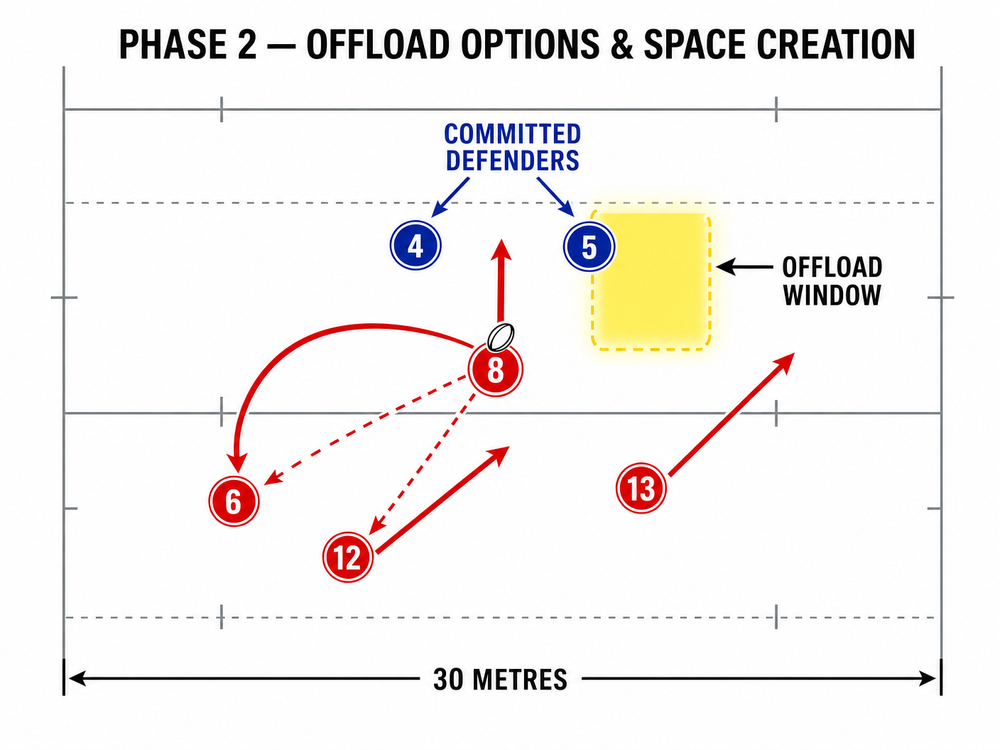
Phase 2: The Offload Window
5. Drawing Defenders: As the pod drives forward, watch the defensive line. The goal is to draw at least two, preferably three, defenders into the tackle area.
6. The Offload Option 1 (Short): If the defense over-commits to the 8, the 7, running a sharp support line on the outside shoulder, becomes the prime target for a short pop pass or offload in the tackle.
7. The Offload Option 2 (Wide): If the fringe defense gets sucked in, the 8 looks for the 12 or 13 running an angled line out the back. This requires a longer, more skilled offload, often a one-handed flick or a pass out the back door.
Phase 3: Continuity
8. Recycle or Break: If the offload connects, the support runner (7, 12, or 13) accelerates through the gap. If the offload is not on, the 8 goes to ground, 4 and 6 secure the ruck, and the 9 is immediately there to distribute the fast ball to the waiting backs (Phase B in the diagram).
4. Key Coaching Points
- Pacing and Timing: The pod must not be static. They need to hit the ball at pace. If they are standing still when they catch the ball, the play fails.
- Body Height: The ball carrier (8) must dip before contact, targeting the space between defenders, not running upright into their chests.
- Ball Presentation: If the offload isn't available, the 8 must fight to ground on their terms, snapping the ball back violently for a lightning-fast ruck.
- Support Lines: Support runners (7, 12, 13) must run convincing lines. They need to demand the ball and expect it, not just act as decoys.
- Decision Making: The 8 must read the defense in a split second. Don't force an offload that isn't there. A strong carry and quick ruck is better than a forced turnover.
5. Common Mistakes
- Too Flat: The pod aligns too flat, receiving the ball standing still, making them easy targets for the defense.
- Isolation: The 8 breaks the line but the support (4 and 6) are too slow to react, resulting in a turnover or holding-on penalty.
- Forced Offloads: The ball carrier tries to offload when wrapped up or when no support is available, leading to forward passes or knock-ons.
- Telegraphing the Play: The pod sets up too early and stares down the 9, allowing the defense to drift and cover the intended attack zone.
6. Variations & Progressions
- The Tip-On: Instead of the 8 carrying, they immediately tip the ball on to the 7 on their outside shoulder before contact, shifting the point of attack rapidly.
- The Pull-Back: The 8 shapes to carry but pulls the ball back to a deeper 10 or 12, bypassing the pod entirely to attack the wider channels.
- Two-Pod System: Run two pods in succession (as shown in Phase 3 diagram). Pod A carries, generating quick ball for Pod B to attack the disorganized defense on the next phase.
7. Age Adaptations
- Under 10s/12s: Focus heavily on the shape of the pod and running straight. Introduce the concept of the 'latch' safely. Keep offloads simple (two hands, pop passes).
- Under 14s/16s: Emphasize the decision-making of the ball carrier (carry vs. offload). Introduce more complex support lines (e.g., the 12 running the out-the-back line).
- Open/Senior: Focus on the speed of the execution, aggressive latching, and exploiting the specific defensive mismatches created by the pod.
