

Football
High-Intensity 4v4 Small-Sided Game: Attacking Shape & Defensive Transitions
A dynamic 4v4 small-sided game designed to improve attacking combinations, rapid defensive recovery, and transitional awareness in a match-realistic environment.
What you need
Bibs (2 colours), Footballs (10+), Cones/Markers, 2 Mini-goals
Overview
This 4v4 Small-Sided Game (SSG) is a staple for developing both attacking fluidity and aggressive defensive transitions. By playing in a tight 30x20 metre grid, players are forced to make rapid decisions under pressure, mimicking the chaotic nature of match-day transitions. The primary focus here is twofold: establishing a strong attacking shape (the diamond) to stretch the opposition, and immediately reacting to the loss of possession with a coordinated counter-press or defensive recovery sprint. This drill is excellent for conditioning and tactical awareness.
Setup
- Pitch Size: 30m x 20m grid (adjust slightly based on age/ability).
- Goals: Two small goals (or mini-goals) placed at opposite ends of the grid.
- Players: 8 players total, divided into two teams of 4 (e.g., Red vs. Blue).
- Equipment: Bibs (2 colours), plenty of footballs placed around the perimeter for quick restarts, flat markers or cones to define the grid boundaries.
Step-by-Step Instructions
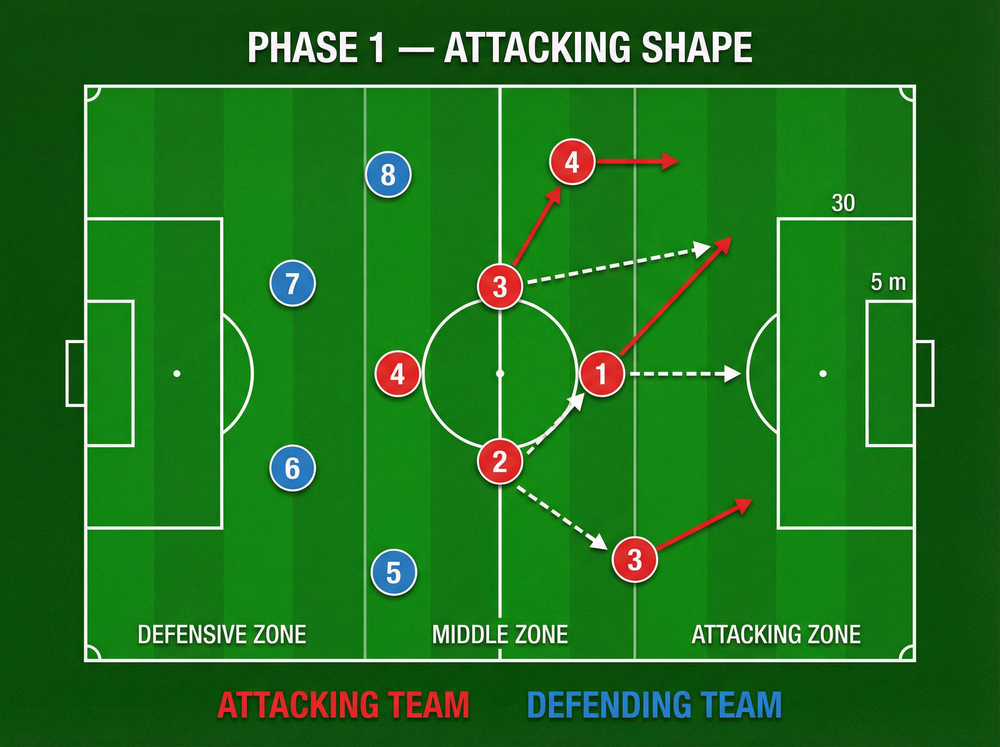
- Initial Shape: Both teams set up in a 1-2-1 diamond shape. The coach serves the ball into the Red team to begin the attacking phase.
- Attacking Phase: The Red team aims to maintain possession and score in the opponent's goal. They must utilise the width and depth provided by the diamond shape to stretch the Blue team's defensive block.
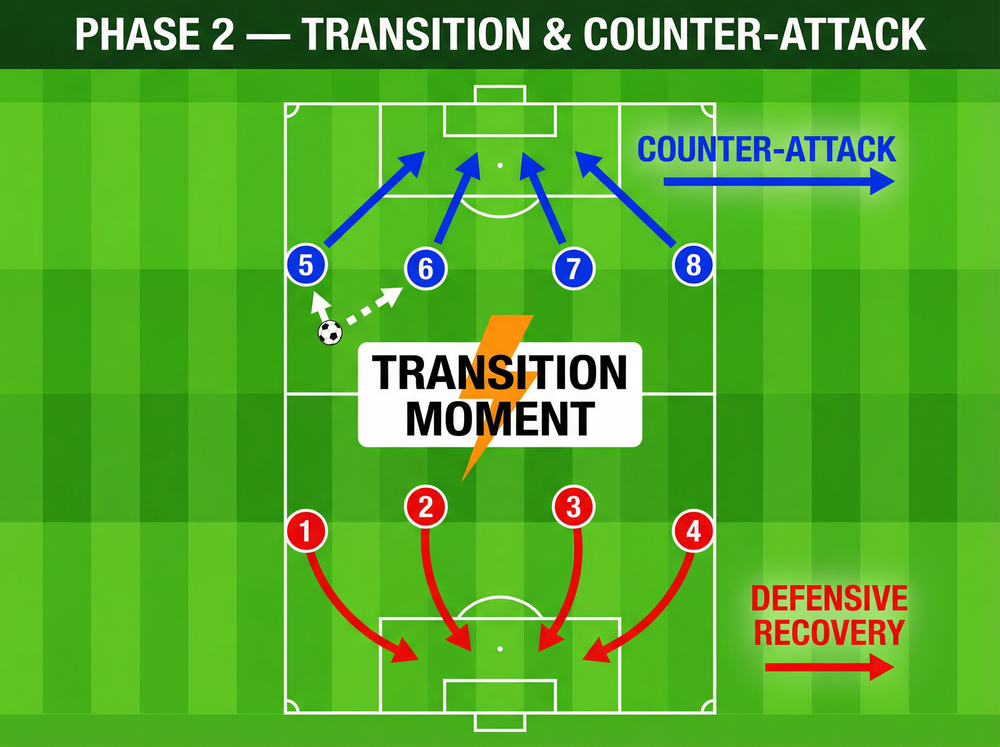
- Transition Moment: If the Blue team wins possession (or if the Red team scores/shoots wide), the transition phase begins immediately. There are no stops in play.
- Counter-Attack: Upon winning the ball, the Blue team must immediately look to exploit the space left by the Red team's attacking shape. They should aim to play forward quickly and score within 3-4 passes.
- Defensive Recovery: The instant the Red team loses the ball, they must aggressively counter-press to win it back within 3 seconds. If the initial press fails, they must drop rapidly to protect their goal and re-establish a defensive block.
- Restarts: If the ball goes out of bounds, the coach immediately feeds a new ball to the team that should have possession to keep the intensity high and simulate rapid transitions.
Key Coaching Points
- Attacking Width & Depth: Ensure the team in possession maintains a wide and deep diamond shape to create passing lanes and stretch the defense.
- Speed of Transition (Attack to Defense): The reaction to losing the ball must be instantaneous. Players closest to the ball must press aggressively, while others cut off passing lanes or recover to defend the goal.
- Speed of Transition (Defense to Attack): Upon winning the ball, the first thought should be to play forward. Exploit the disorganized opponent before they can recover.
- Communication: Constant, clear communication is vital, especially during transitions. Players must instruct each other on who is pressing and who is covering.
- Intensity: This drill must be played at match speed. High intensity is crucial for the conditioning and tactical benefits to translate to game day.
Common Mistakes
- Slow Reaction to Loss of Possession: Players dropping their heads or jogging back instead of immediately counter-pressing or sprinting to recover.
- Playing Too Narrow in Attack: Failing to utilize the full width of the grid, making it easy for the defending team to stay compact and win the ball.
- Forcing the Forward Pass: In transition, if the forward option is blocked, players must learn to retain possession rather than forcing a low-percentage pass that leads to another turnover.
- Lack of Communication: Silent transitions often lead to two players pressing the same man or leaving the most dangerous attacker unmarked.
Variations & Progressions
- Touch Limit: Introduce a 2-touch or 3-touch limit to increase the speed of play and force quicker decision-making.
- Time Limit to Score: Give the team that wins the ball a strict time limit (e.g., 6 seconds) to score on the counter-attack, emphasizing rapid forward play.
- Add a Neutral Player (Joker): Play 4v4+1, where the neutral player always plays for the team in possession. This creates a 5v4 overload, making it easier to maintain possession and forcing the defending team to work harder.
Age Adaptations
- Under-8 to Under-10: Focus primarily on the basic attacking shape (spreading out) and the simple reaction of trying to win the ball back quickly. Increase the pitch size slightly to give them more time on the ball.
- Under-12 to Under-14: Introduce the specific concepts of counter-pressing vs. dropping off. Demand quicker transitions and enforce touch limits to speed up play.
- Under-16 to Open Age: Play at maximum intensity. Focus on the tactical nuances of cutting off specific passing lanes during the press and exploiting specific spaces during the counter-attack. Decrease the pitch size to increase pressure.
